




 Face Verification
 Address Verification
 Document Verification
 Age Verification
 VideoIdent
 Fast ID
 Docless Verification
 Consent Verification
 NFC Verification
 Business Verification
 Due Diligence
 Investor Verification
 E-Signature

 QES
QES
 AML Screening
 Transaction Monitoring
 Adverse Media
 Business AML Screening
 PEP & RCA
 Sanctions
 Watchlist
 Behavioural Biometrics
 Device Fingerprinting
 Biometric Face Authentication
 MFA
MFA
 Fraud Hub
 Onboarding
 Ongoing Monitoring
 KYC
KYC
 KYB
KYB
 KYI
KYI
 Age Assurance
 Identity Verification
 Workforce IAM
 Candidate Verification
 Compliance
 Fraud prevention
 Trust & safety
 Global expansion
 Product Managers
 Compliance Officers
 Fraud Analysts
 Developers
 Deepfake Detection
 Bonus Abuse / Promotion Abuse
 Account Takeover
 Synthetic Identity Fraud
 Document Fraud
 Impersonation Fraud
 Multi-Accounting
 Fraud Networks
 Chargeback Fraud
 Money Mule Activity
 Party Fraud
 Regulatory & Compliance Risks
 Fintech
 Crypto
 iGaming
 Forex
Forex
 Social Network
 Marketplace
 Banking
 Gig Economy
 Payments
 Ride Hailing
 Adult Content
 Blind Spot Audit
 Deepfake Detector
 Liveness Spoofs
 Document Originality
 Document Deepfake
 Global Trust Platform
 Journey Builder
 Case Management
 Shufti AI
 Fraud Analytics
 Vendor Comparison
 Brand Personalisation
 AI Compliance Co-Pilot
 OCR
OCR
 Secure Capture
 Deployment Options
 Identity Methods
 API Documentation
 Mobile SDKs
 Service Status
 Help Center
 Contact Us
 Technical Support
 Supported Documents
 Supported Countries
 Content library
 Blogs
Blogs
 News
News
 Reports
 Insights
 Knowledgebase
 ROI calculator
 About
About
 Career
 Press Release
 Certifications
 Partnership
 Awards
 Events & Webinar
 Interactive Demo
 Podcast Studio
 Spotlight Studio
- Australia
- Austria
- Bangladesh
- Brazil
- Bulgaria
- Canada
- China
- Cyprus
- Egypt
- Estonia
- Eswatini
- Ethiopia
- France
- Germany
- Greece
- Haiti
- Hong Kong
- India
- Iraq
- Ireland
- Indonesia
- Italy
- Japan
- Jordan
- Kazakhstan
- Kenya
- Kosovo
- Kuwait
- Latvia
- Luxembourg
- Malaysia
- Malta
- Mauritius
- Mexico
- Micronesia
- Moldova
- Montenegro
- Morocco
- Mozambique
- Myanmar
- Namibia
- Nauru
- Nepal
- Nigeria
- Nicaragua
- Niue
- Norway
- Netherlands
- New Zealand
- Oman
- Pakistan
- Palau
- Palestine
- Panama
- Papua New Guinea
- Paraguay
- Peru
- Puerto Rico
- Philippines
- Portugal
- Portugal
- Qatar
- Republic of Congo
- Romania
- Russia
- Rwanda
- Samoa
- San Marino
- Senegal
- Serbia
- Seychelles
- Sierra Leone
- Singapore
- Slovakia
- Slovenia
- Somalia
- South Africa
- South Korea
- South Sudan
- Sri Lanka
- St Kitts and Nevis
- St Maarten
- St Lucia
- Sweden
- Switzerland `
- Syria
- Taiwan
- Tajikistan
- Tanzania
- Thailand
- Timor Leste
- Togo
- Tonga
- Trinidad and Tobago
- Turkey
- Turks and Caicos
- Turkmenistan
- Tunisia
- Tuvalu
- Uganda
- Ukraine
- UK
- Uruguay
- USA
- Uzbekistan
- Vatican City
- Vietnam
- Venezuela
- Vanuatu
France
Identity Verification & KYC For France
Built for organisations subject to France’s LCB-FT obligations under the Code monétaire et financier, including customer and beneficial owner identification/verification and 5-year record retention. One platform for KYC + KYB + AML screening, aligned to French supervisors and reporting workflows.
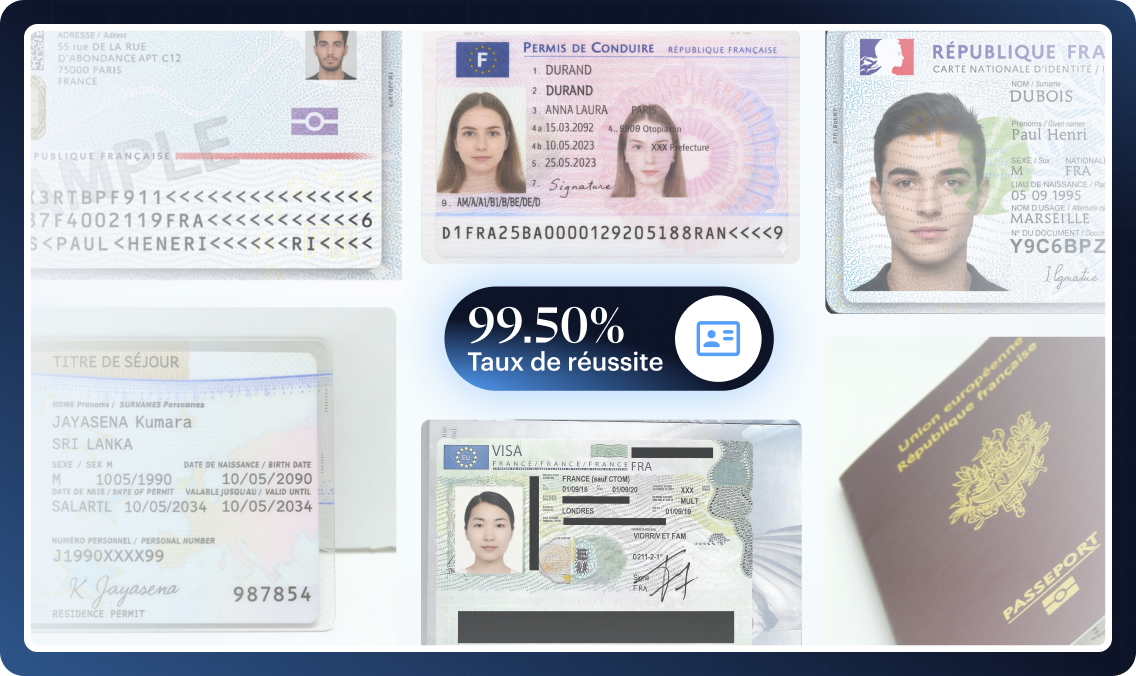
Operational performance for France KYC
Our Numbers Speak Volumes
99.50%
Pass rates
> 5 sec
Verification
Time
95%
EIDV
Verification
Evidence-Ready Checks Across People & Businesses
Individual Documents We Verify
Shufti verifies 19 individual documents in France.
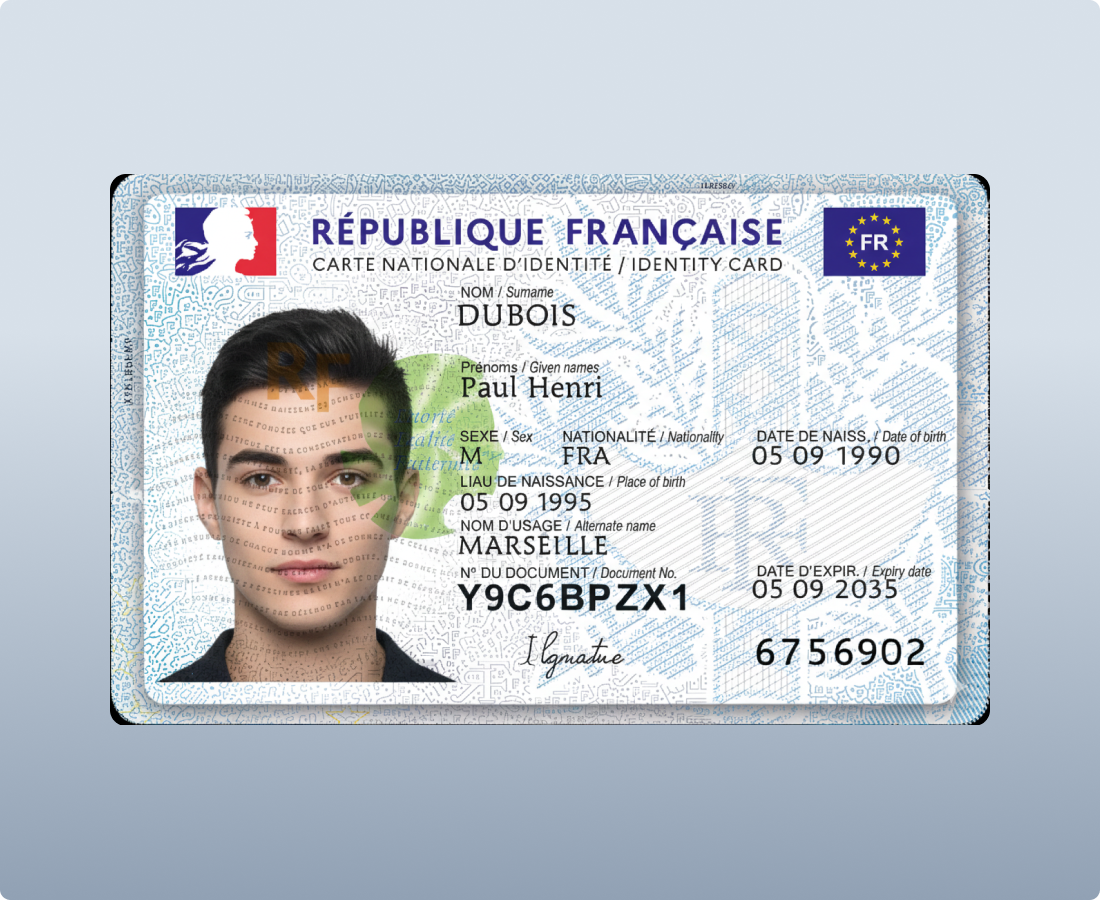
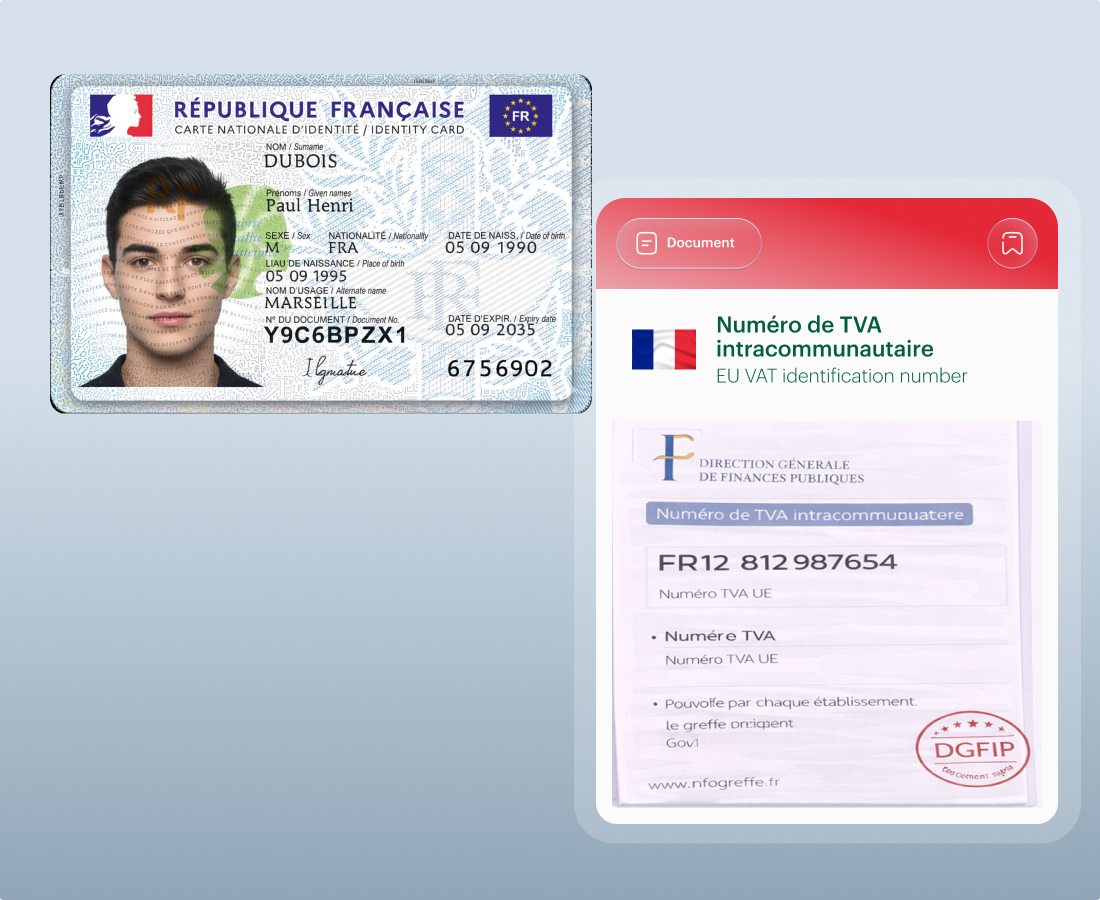
View All Supported DocumentsCarte nationale d’identité (CNI / CNIe, new format)
Primary identity document for French residents; the new ID-1 “bank card” format has been rolling out since 15 March 2021, with systematic issuance for new applications since 2 August 2021.
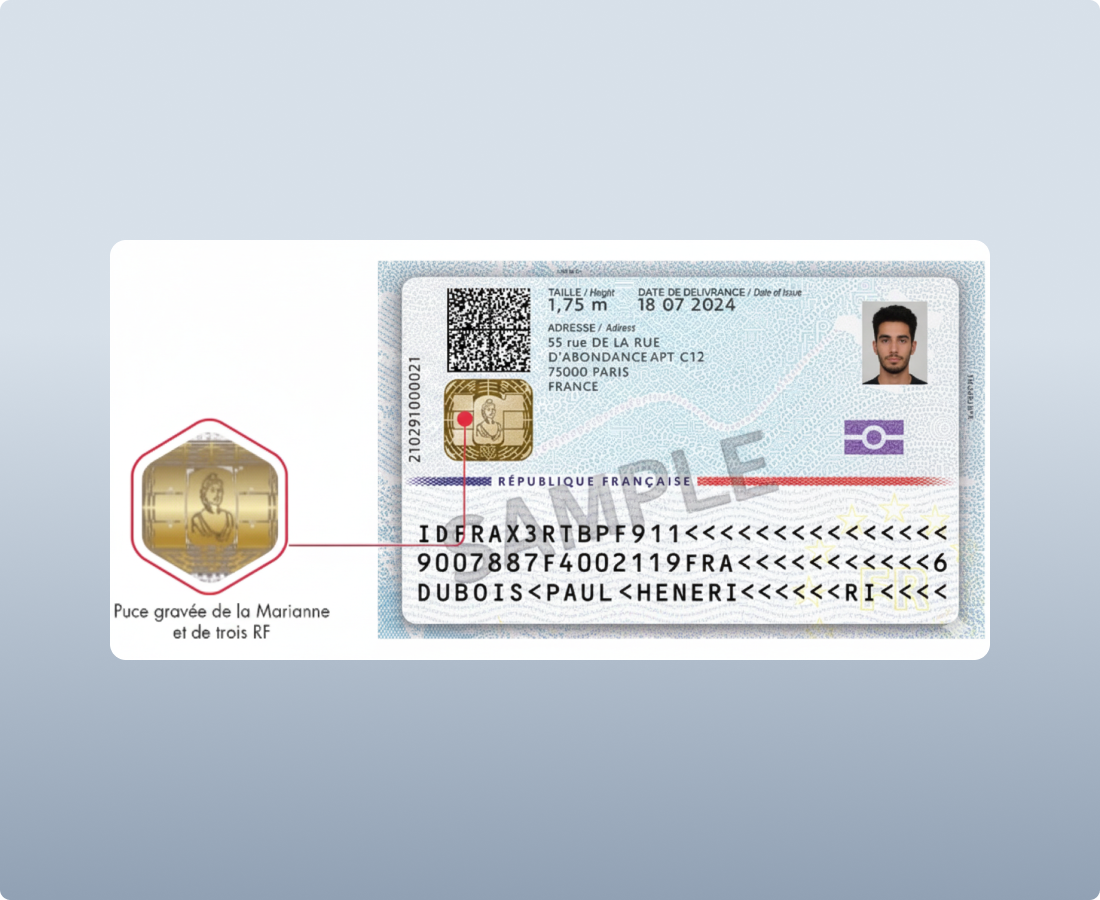
CNIe chip consistency checks
Where the CNIe chip is used, coherence between printed data and chip data is a documented control to reduce documentary fraud and identity theft.
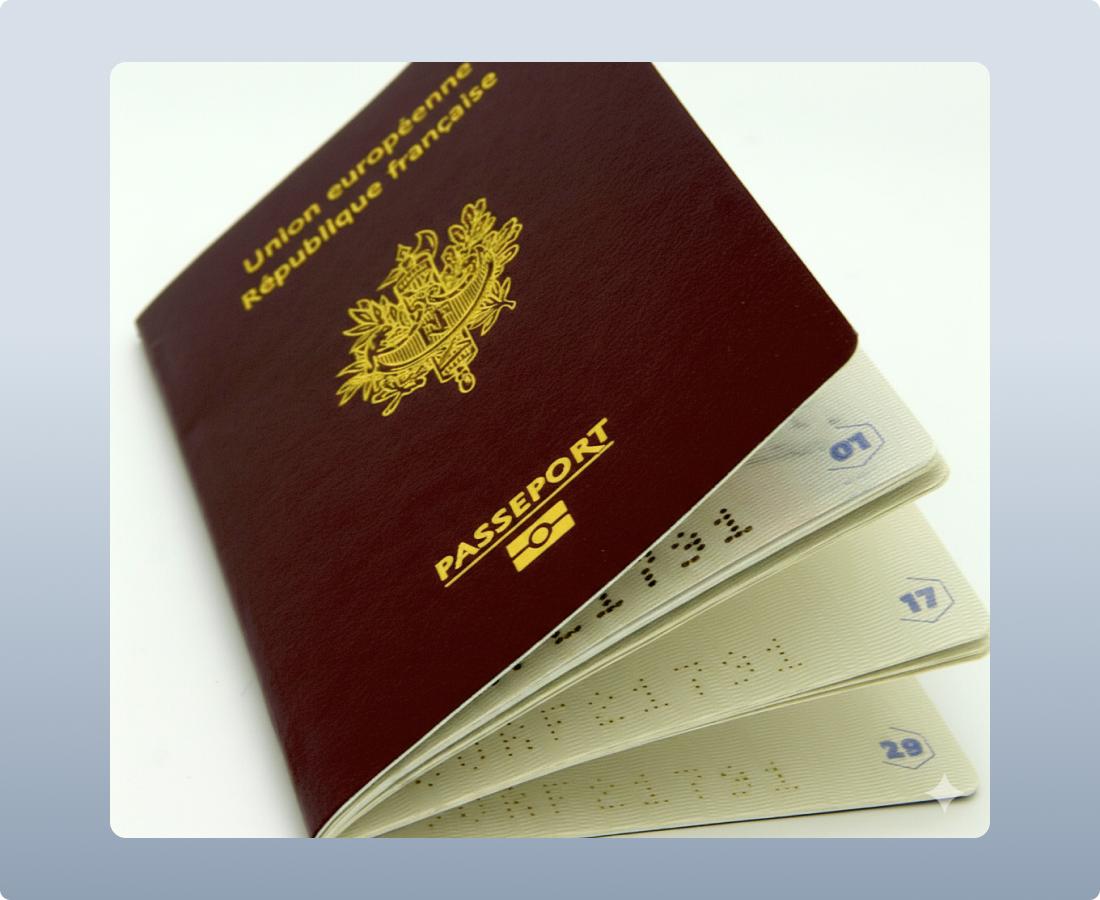
Passeport biométrique (French biometric passport)
Accepted travel/identity document with biometric issuance controls (e.g., fingerprints checked on delivery for 12+).
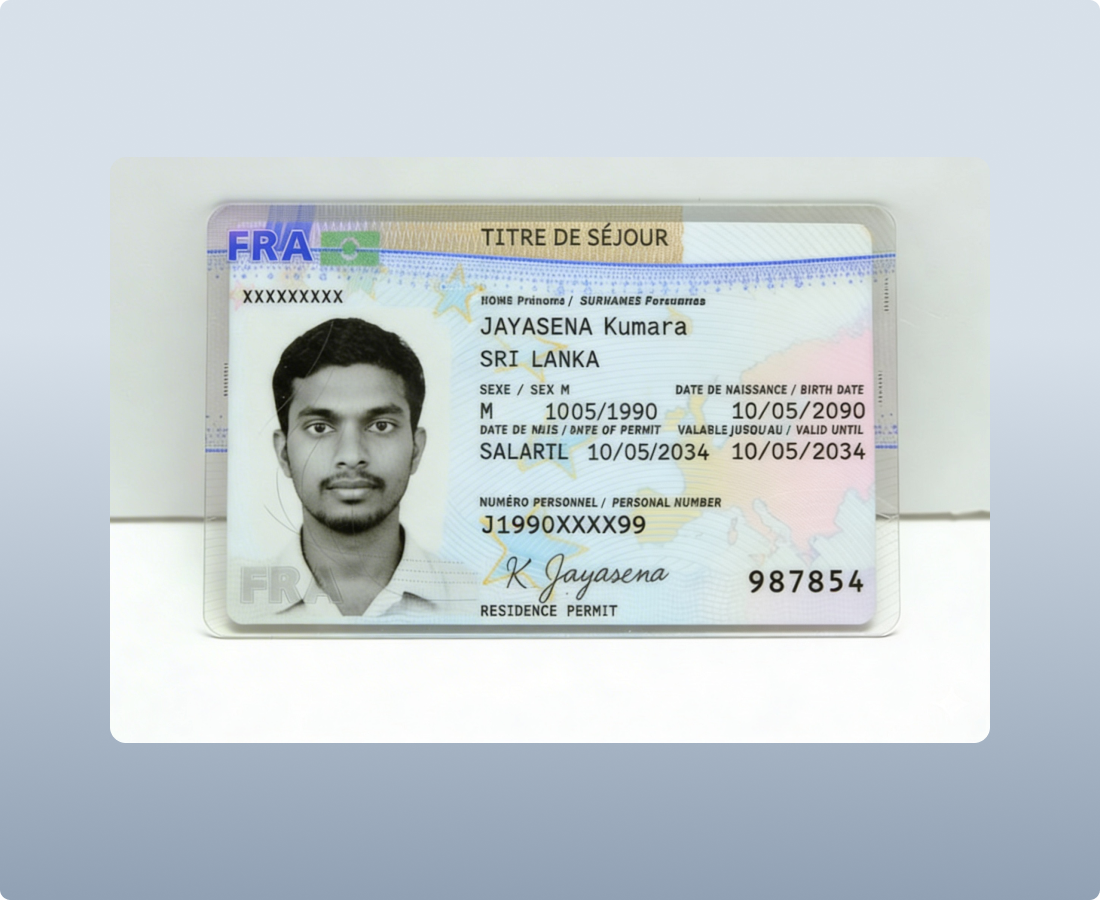
Titre de séjour (cartes de séjour / carte de résident)
Residence documents used to evidence lawful stay for non-EU nationals (multiple categories exist, depending on status).
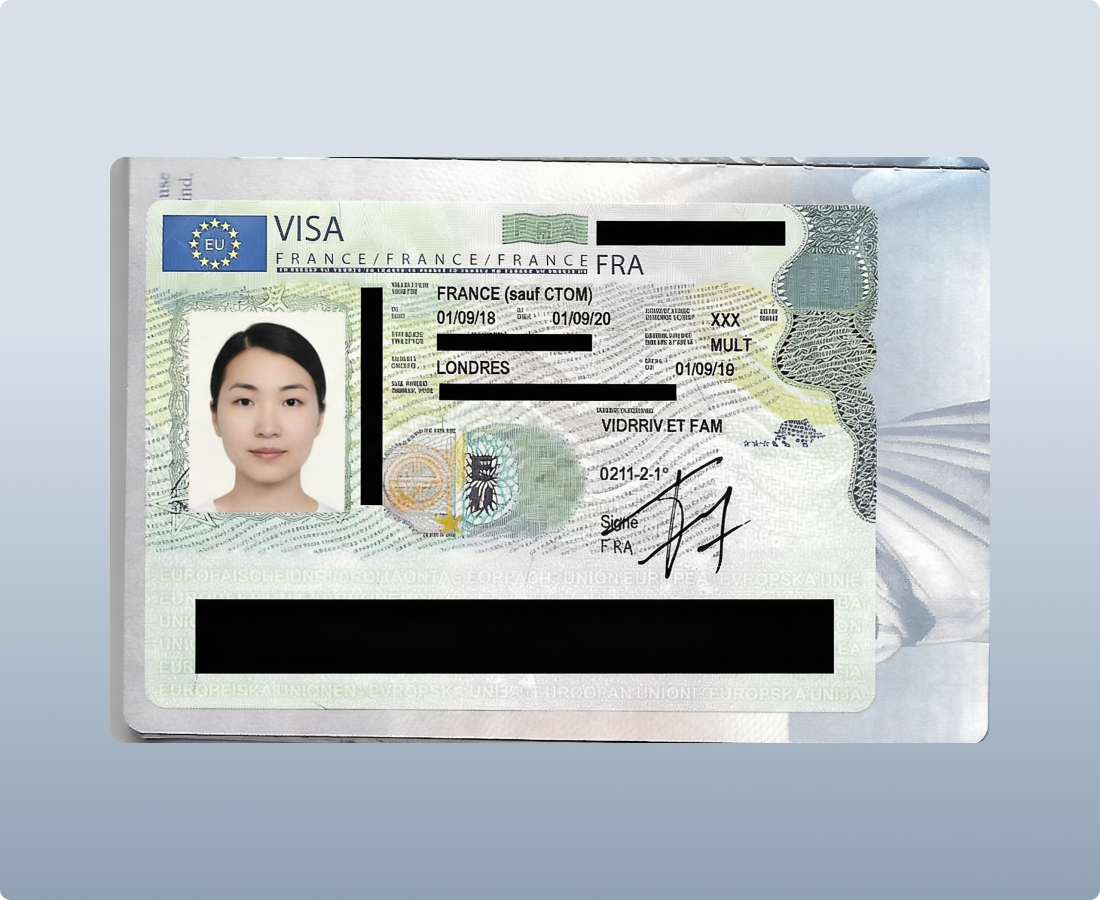
Visa long séjour valant titre de séjour (VLS-TS)
Relevant for onboarding non-EU customers at the start of residency journeys, before longer-duration cards.
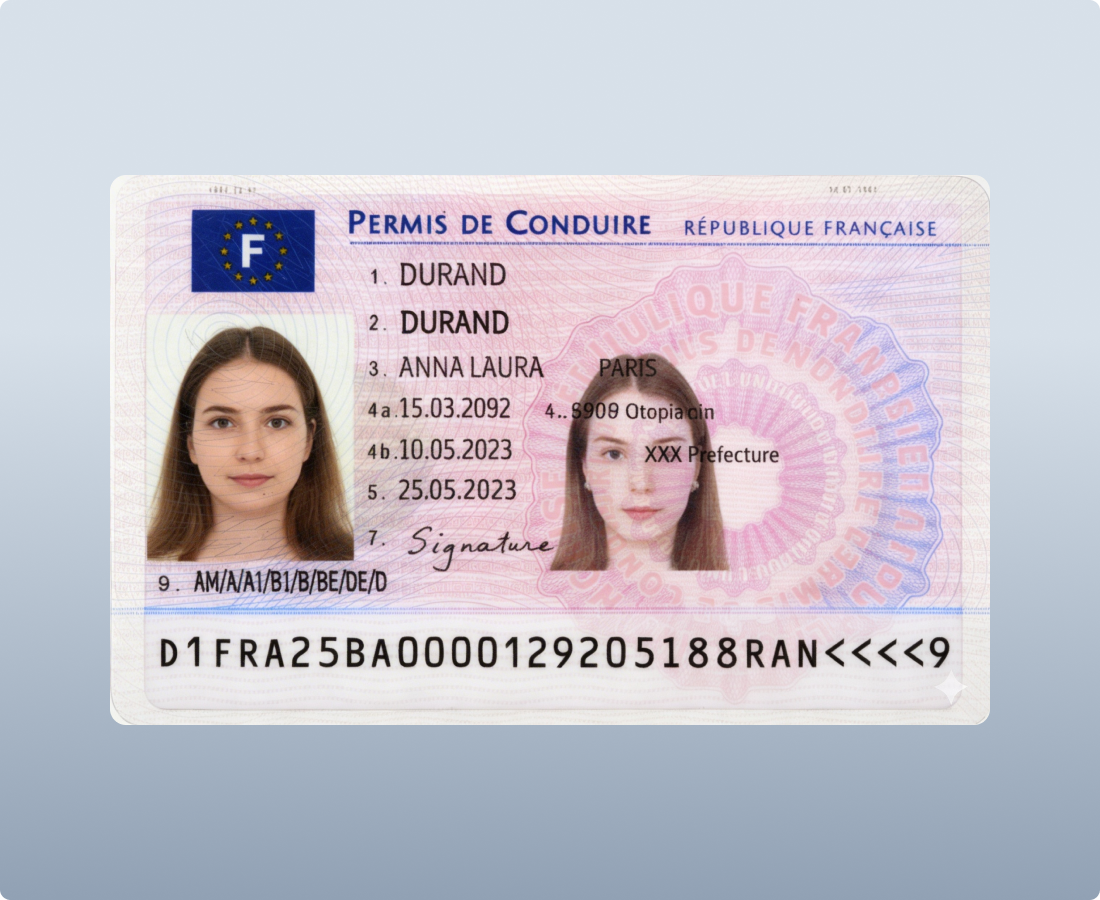
Permis de conduire (French driving licence)
Can be used as supporting identity evidence, but does not carry the same status as passport/CNI for identity + nationality and is not universally accepted as sole ID.
France Identité (digital identity, where available)
France Identité is linked to the new CNIe and requires the user to be an adult with a CNIe (bank-card format); it relies on a compatible smartphone (NFC requirements apply).

Business Entity Identity
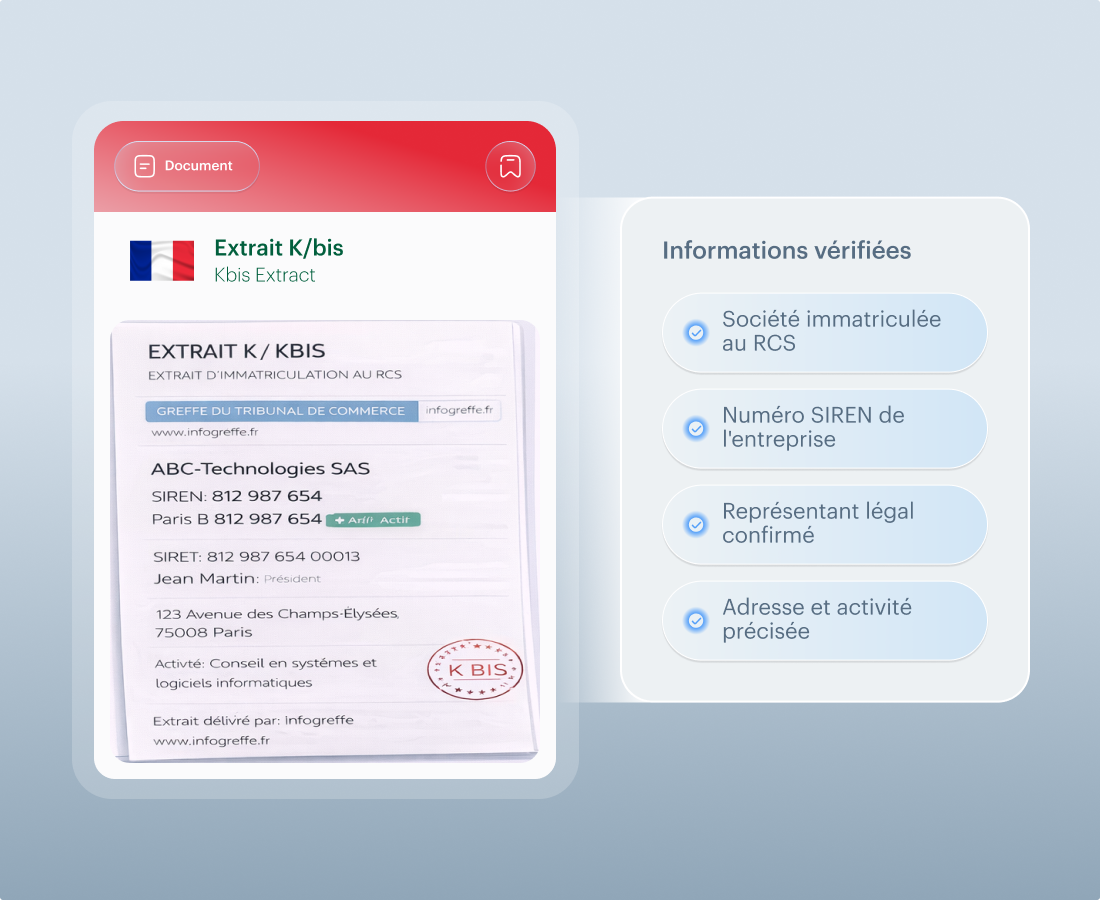
Extrait K / Kbis (RCS registration proof)
Used to evidence legal existence and core company facts for commercial companies registered at the RCS.
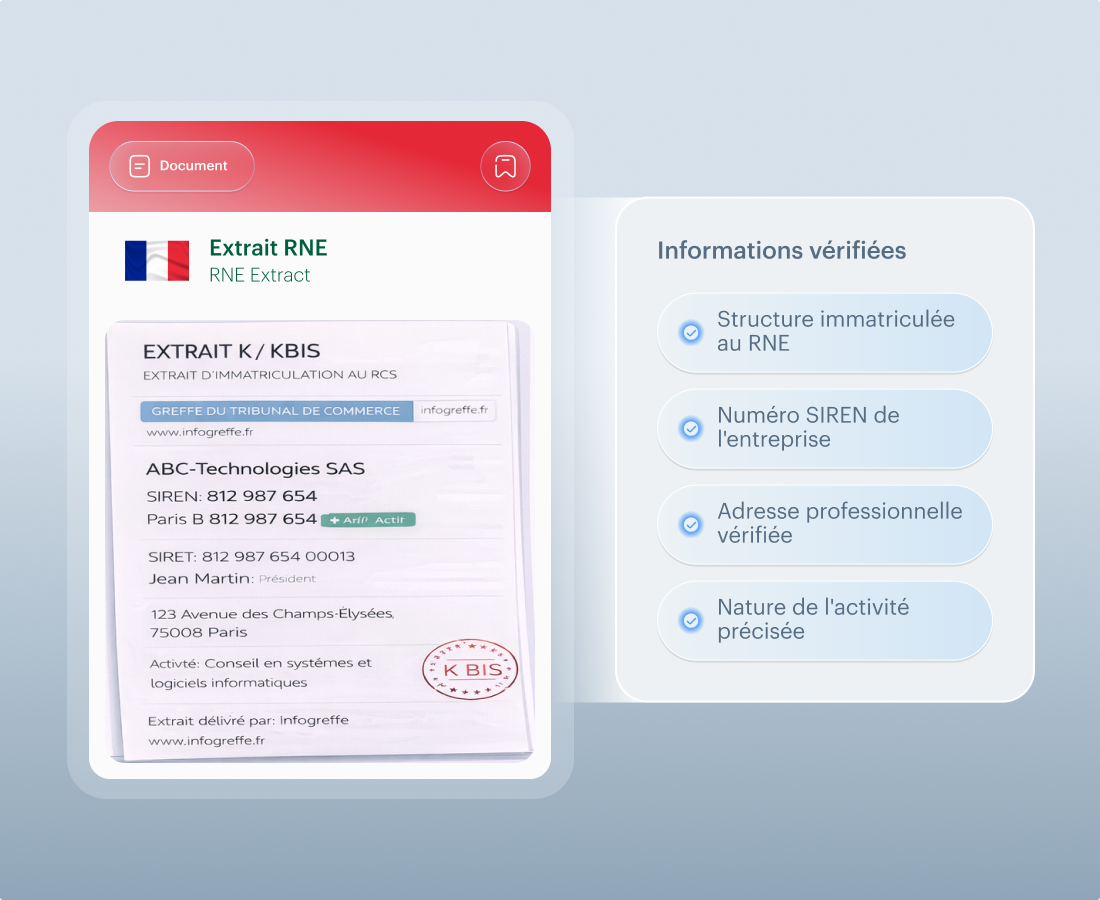
Extrait RNE (Registre national des entreprises)
Used when the entity is not in the RCS (e.g., many artisans/liberal prof essions) and a RNE extract is the practical registration proof.
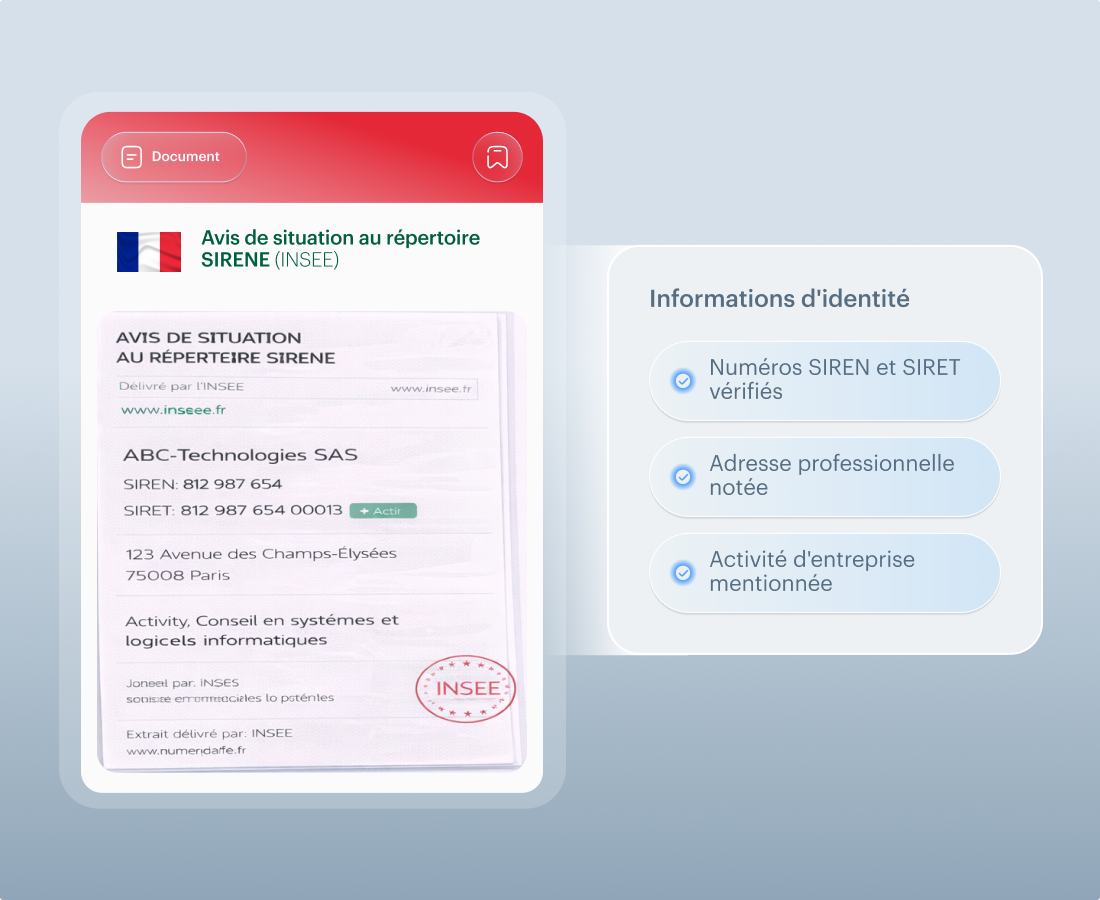
Avis de situation au répertoire Sirene (INSEE)
A widely used “identity sheet” for a legal entity/establishment (SIREN/SIRET context), even though it carries no legal value as stated by INSEE.
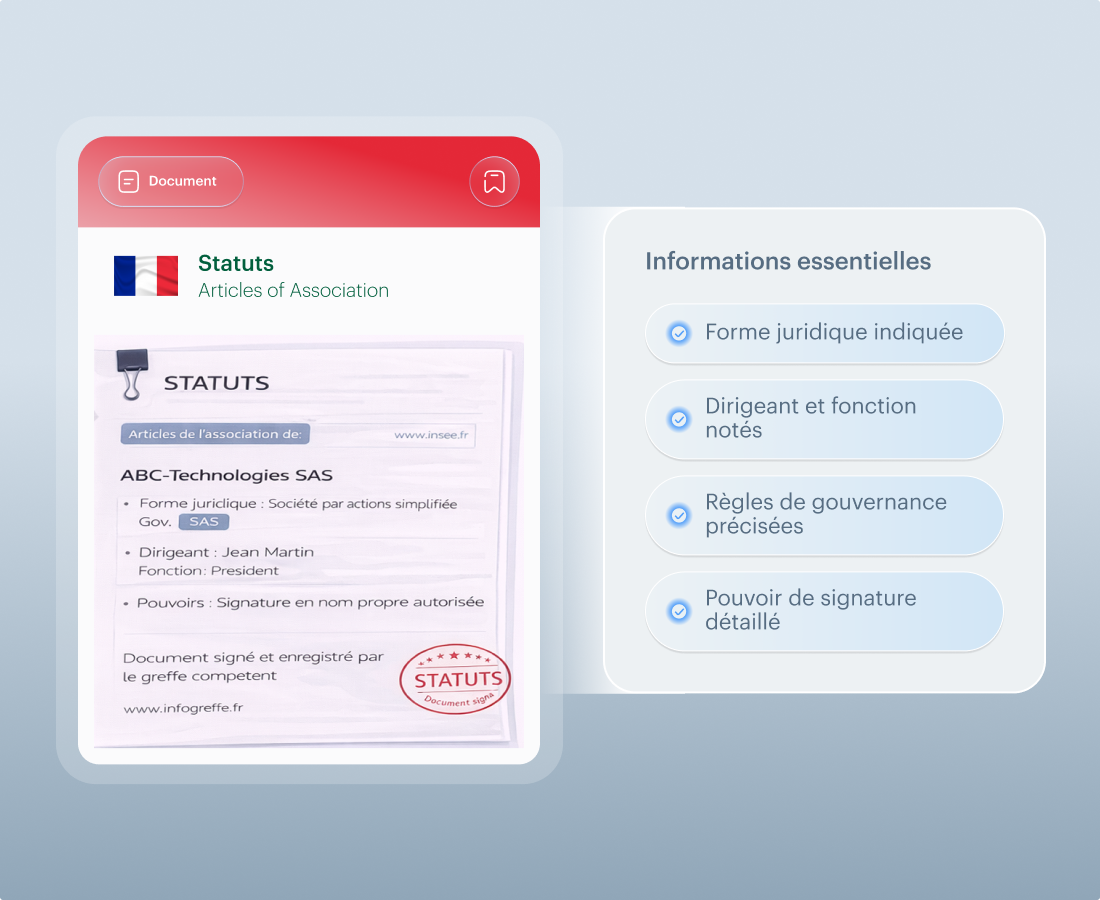
Statuts (articles of association)
Used to evidence legal form, governance rules, and signatory powers (typically paired with registry extracts).
Business Tax Identity
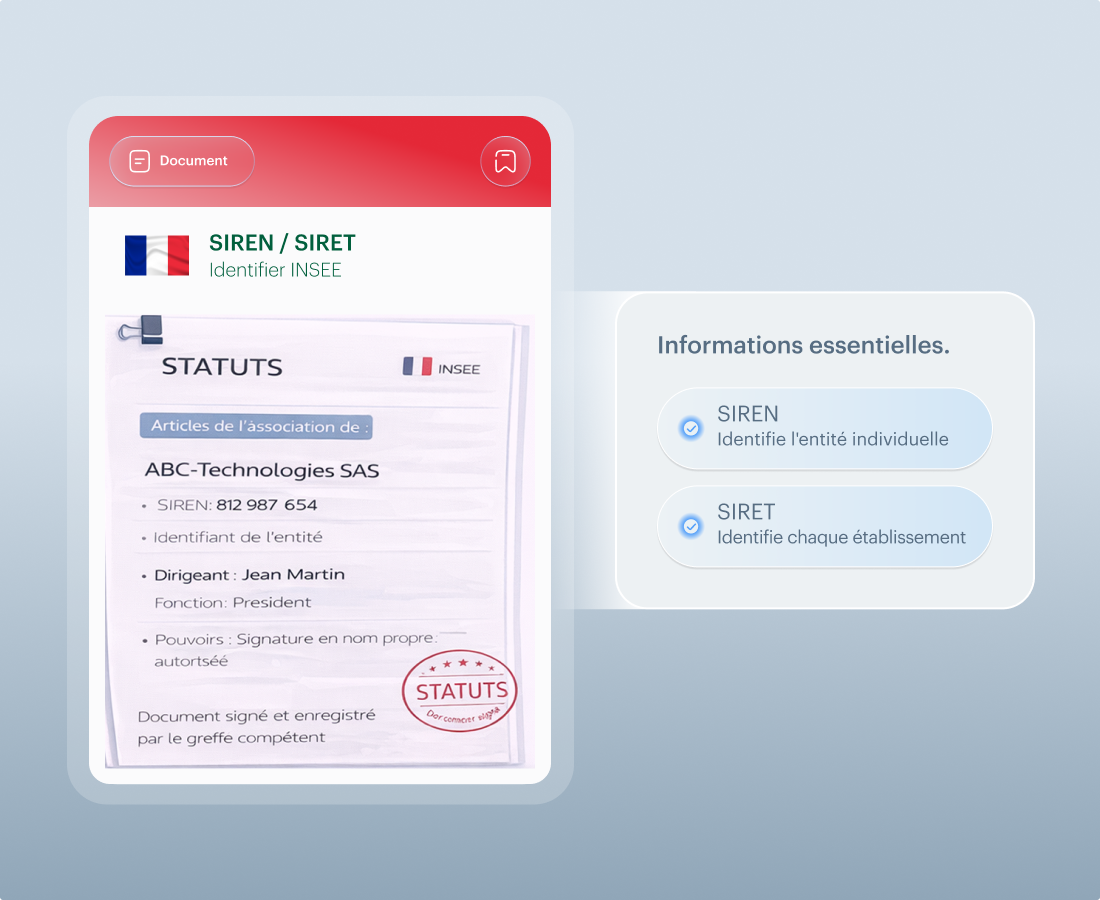
SIREN / SIRET
Identifiers assigned by INSEE (SIREN for the entity; SIRET for each establishment).
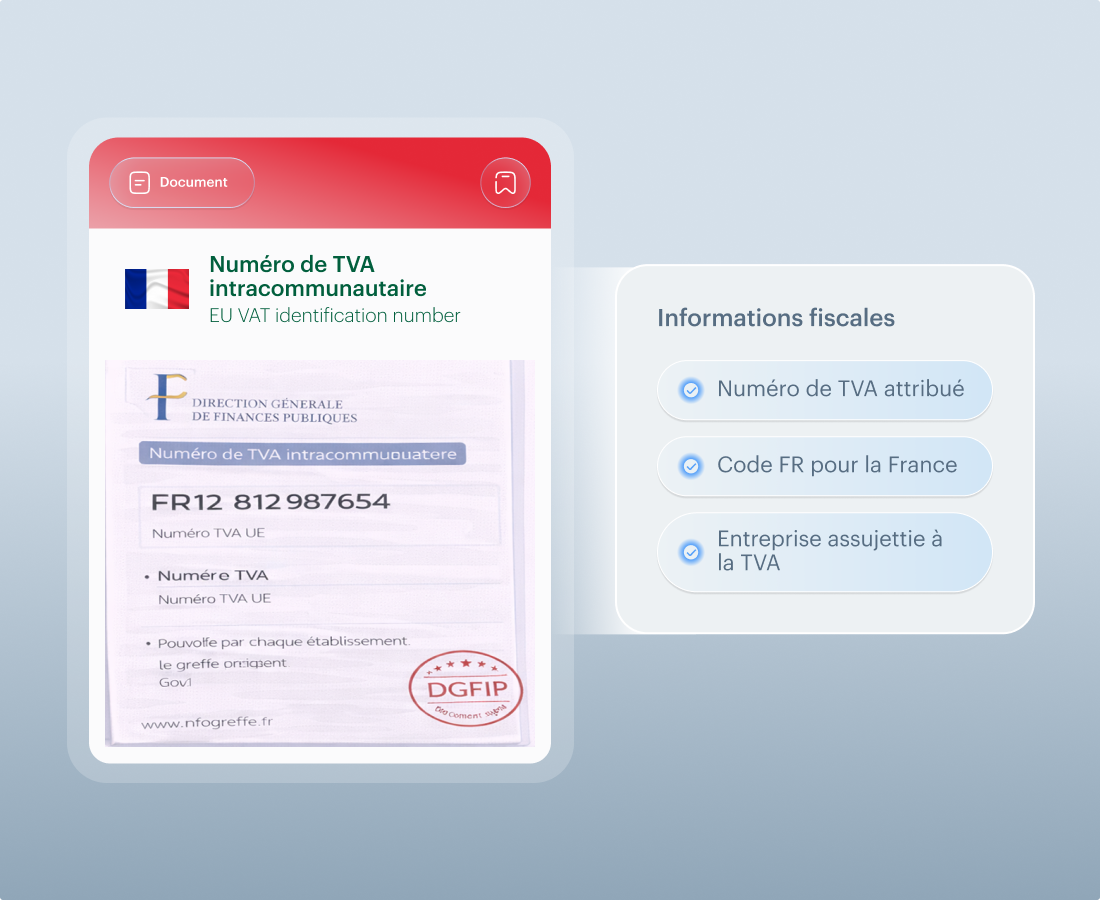
Numéro de TVA intracommunautaire
Tax identifier issued by the French tax administration for VAT-subject businesses.
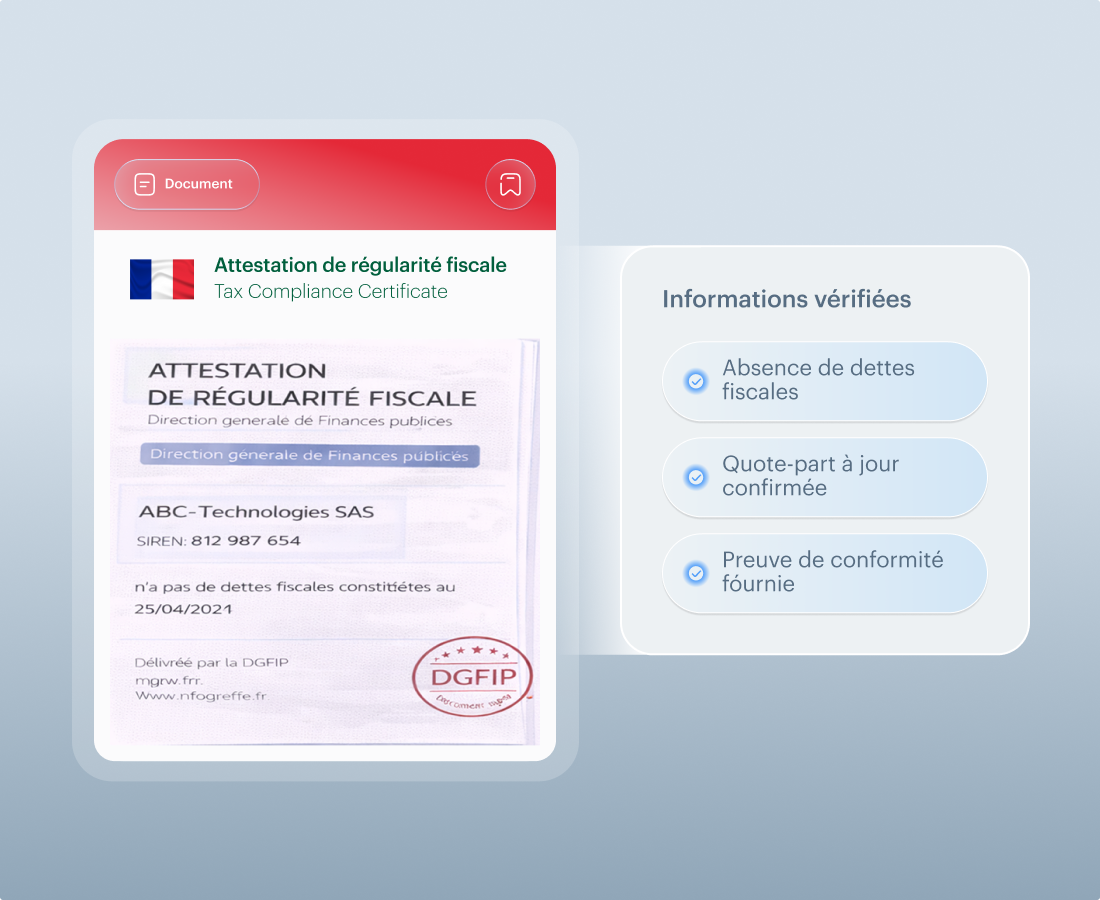
Attestation de régularité fiscale
Evidence the business is up to date with key tax obligations (commonly requested in B2B due diligence contexts).
Languages We Cover
Document text handling
France is a French-first environment (French is the constitutional language of the Republic). Shufti supports French-Latin script extraction that tolerates accents and apostrophes.
Name matching controls
Controls account for diacritics and usage-name patterns. In France, a nom d’usage (e.g., spouse’s name) can be used and shown on identity papers—so matching needs to handle both birth name and usage name paths.
Evidence consistency
Cross-step consistency is enforced across ID document, proof-of-address (where used), and KYB controller evidence—so you can defend “same person / same controller” decisions under LCB-FT programmes.
GOVERNANCE & CONTROLS
Audit-Ready Decisions, Lower Operational Drag
Fewer Avoidable Re-Submissions
Pre-2021 and post-2021 CNI document capture reduces manual review friction and repeat submission requests during customer onboarding for French nationals.
Cleaner Audit Trails
Structured case files with evidence logs retrievable for ACPR and AMF examinations, regulatory audits, compliance inspections and supervisor requests.
Better Name Matching Outcomes
Handles French diacritics, hyphenated surnames and nobiliary particles to reduce false negatives in sanctions and PEP screening workflows and decisions.
One Workflow, One Back Office
KYC, KYB, AML screening and case management consolidated in a single system with a unified evidence repository retrievable on demand to all French regulators and inspectors.

National ID-First Flow Design
CNI and passport-first capture flows aligned with how French nationals verify identity in domestic KYC compliance processes and regulatory frameworks.
France IDV/KYC Challenges

Justificatif de domicile friction
Proof-of-address is often required and must be recent; name/address mismatches trigger retries and manual review.

Nom d’usage mismatches
Birth name vs usage name (spouse name) creates screening/record inconsistencies unless matching logic handles both.

UBO access & evidence gaps
Since 31 July 2024, RBE access is restricted—KYB teams need controlled evidence capture and escalation paths.

STR auditability pressure
TRACFIN expects electronic reporting via ERMES; decisions must be reconstructable and retained for 5 years.
Shufti’s IDV Solution for the France
KYC Solutions

Face Verification
Built for France’s remote onboarding reality, where identity fraud and impersonation are explicitly targeted by national ID modernisation. Shufti pairs liveness + face match to evidence “same person” decisions.
.
Age Verification
Selfie-based age estimation for low-friction checks, with a document verification step when you must evidence age (e.g., regulated or policy-gated journeys). Uses French primary IDs (CNIe/passport) where required.
.
Address Verification
Shufti verifies any address-bearing document aligned to France’s “justificatif de domicile” reality (recent proof often required). Common examples include utility bills (EDF, Engie), telecom bills (Orange, SFR, Bouygues Telecom, Free), and bank statements (BNP Paribas, Société Générale, Crédit Agricole).
.
Document Verification
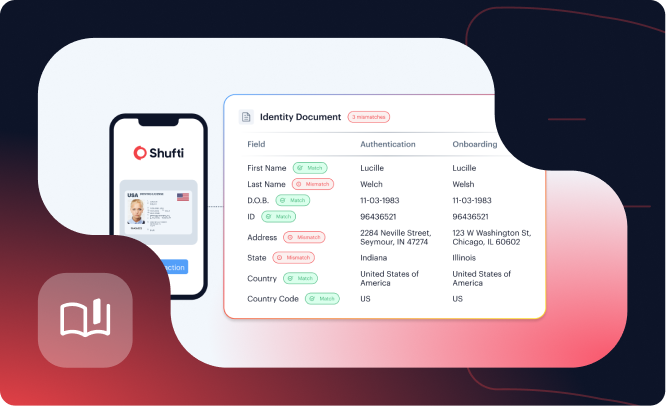
Verification for French CNI/CNIe (including chip-consistency controls where used), biometric passports, and titres de séjour—built for French formats and data fields.
.KYB Solutions

Business Verification
Automated KYB using France’s core evidence set: Kbis/K or RNE extract, INSEE identifiers (SIREN/SIRET), and tax identifiers (VAT ID where relevant).
.
Enhanced Due Diligence (EDD)
Structured EDD for complex ownership, cross-border structures, and controller risk—supporting the risk-based approach that underpins LCB-FT programmes (and the resulting data capture).
.AML Screening

Business AML Screening
Screen businesses and controllers against EU financial sanctions data and France’s national asset-freeze register, with decision reasoning captured for audit.
.
Transaction Screening
Ongoing monitoring calibrated to French LCB-FT expectations, with operational escalation pathways that support TRACFIN reporting readiness.
.Built to Fit France's Compliance Landscape

ACPR
Supervises banks and insurers, including LCB-FT and CDD requirements. Shufti supports structured identity verification and audit-ready decision logs.

AMF
Regulates market participants and the PSAN regime for digital asset providers. Shufti supports KYB/UBO capture, screening, and risk-based decision documentation.

TRACFIN
France’s FIU receiving suspicious activity reports under LCB-FT rules. Shufti maintains structured decision trails to support STR submissions.

Direction générale du Trésor
Oversees national financial sanctions and asset-freeze measures. Shufti supports sanctions screening and match documentation.

CNIL
Supervises data protection and GDPR enforcement. Shufti enables privacy-by-design, lawful processing, and EU hosting support.

France Titres / ANTS – Ministère de l’Intérieur
Manages secure identity titles and France Identité. Shufti supports verification of French ID documents.
Deployment Choice
Available via French/EU cloud regions (AWS eu-west-3, Azure France Central, GCP europe-west9) or on-premise to meet enterprise governance requirements.
Regulatory Alignment
Aligned to French Monetary and Financial Code (Article L561-12 recordkeeping requirements) and GDPR Article 32 encryption mandates strictly enforced by CNIL.
Retention Controls
Configurable retention and purge settings aligned to the French Monetary and Financial Code five-year minimum recordkeeping obligation for customer identification.
Encryption Posture
Strong encryption (AES-256 or equivalent) applied to personal and financial data in transit (TLS 1.2+) and at rest in line with ANSSI guidance standards.
Data and Privacy Controls in France
France AML Sources That Strengthen Decision
TRACFIN

ACPR

AMF

Direction générale du Trésor

Registre national des gels des avoirs
Ministère de l’Économie
Ministry of Justice

Council of State
Ministry of Foreign Affairs

EU Consolidated Sanctions List

UN Security Council Consolidated List

FATF
TRACFIN
ACPR
AMF
Direction générale du Trésor
Registre national des gels des avoirs
Ministère de l’Économie
Ministry of Justice
Council of State
Ministry of Foreign Affairs
EU Consolidated Sanctions List
UN Security Council Consolidated List
FATF
TRACFIN
ACPR
AMF
Direction générale du Trésor
Registre national des gels des avoirs
Ministère de l’Économie
Ministry of Justice
Council of State
Ministry of Foreign Affairs
EU Consolidated Sanctions List
UN Security Council Consolidated List
FATF
Frequently Asked Questions
What is the primary ID for onboarding in France?
The CNI/CNIe is the standard primary ID for French residents. The new CNIe format has been rolling out since March 2021 and is now the default for new issuance.
Can we rely on a French passport instead of the CNIe?
Yes. France issues biometric passports with issuance controls, and passports are commonly used where a travel document is preferred or required.
What should we use for non-EU nationals in France?
Residence documentation (titres de séjour) is the normal evidence route for lawful stay, with multiple categories depending on status.
How do we handle “nom d’usage” and spouse-name variants?
France allows a nom d’usage (including spouse name) that can appear on identity documents. Matching should support both birth-name and usage-name paths to reduce false mismatches.
What are the core KYB documents for a French company?
Typically: Kbis/K (RCS entities) or an RNE extract, plus SIREN/SIRET identifiers. For VAT-subject businesses, VAT ID is also relevant.
Is UBO data straightforward to retrieve in France?
UBO information exists via the RBE framework, but since 31 July 2024 access is no longer public and requires authorised/legitimate-interest access via INPI. Plan for escalations and controlled evidence capture.
How are suspicious reports submitted in France?
TRACFIN expects professionals to use ERMES for suspicious reports, with prior registration on the platform.
How long do we need to retain KYC/LCB-FT evidence?
As a baseline, the CMF requires 5-year retention from account closure or end of the business relationship (subject to stricter rules where applicable).
What typically drives onboarding drop-off in France?
Proof-of-address requests (recent justificatif de domicile) and name-format differences (accents/usage name) are common friction points in digital flows.
Build a France-ready KYC, KYB & AML programme with Shufti
INDEPENDENTLY AUDITED. GLOBALLY CERTIFIED.
Certified to Global Standards






PROVEN WORKFLOWS
Use Cases for Regulated Growth in France
Accelerate Growth, Eliminate Friction
Onboard users in seconds, not days. Deploy tiered address verification flows that maximise completion rates for genuine users while filtering out synthetic fraud.

Onboard Global Traders in Real-Time
Verify investors across 250+ countries & territories. Ensure compliance with international financial regulations while preventing identity theft and high-risk chargebacks.



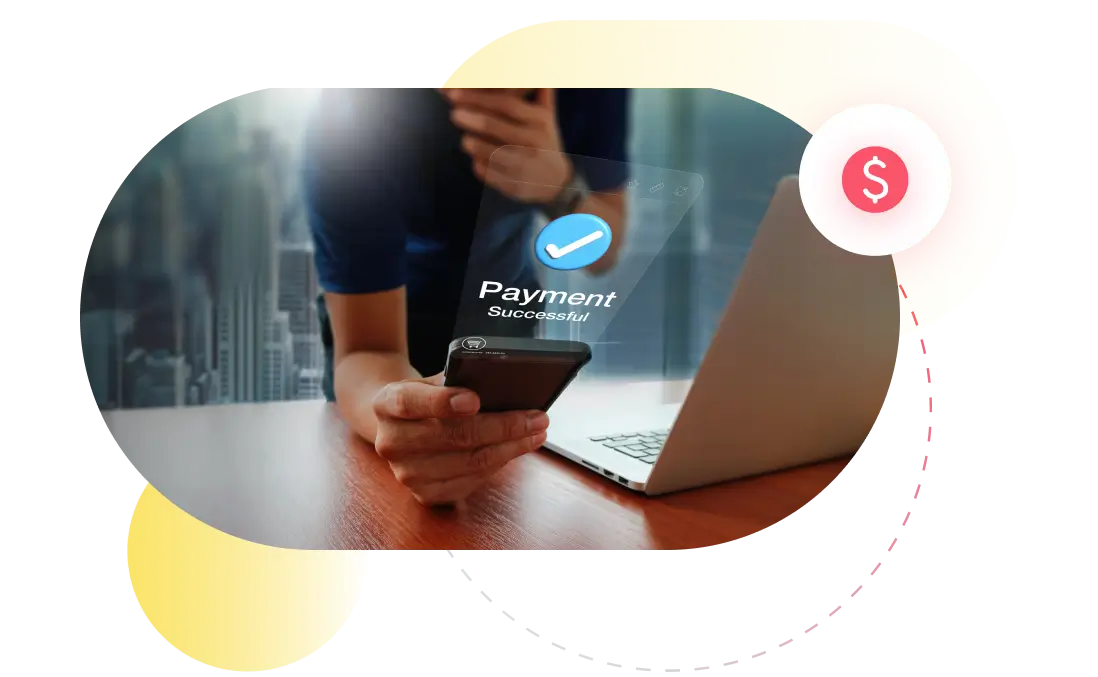
Secure Trust at Every Transaction
Automate KYC and AML workflows to reduce manual onboarding costs. Strengthen residency checks while delivering the frictionless digital experience modern customers expect.


Power a Fair & Secure Player Experience
Reduce bonus abuse and multi-accounting rings at the door. Enforce location rules and trigger step-up checks without disrupting the player journey.



Build a Trusted, Verified Workforce
Screen freelancers and drivers at scale. Verify residency and reduce onboarding friction while maintaining trust between users.



Scale Your Exchange with Confidence
Balance anonymity with compliance. Instantly verify user jurisdiction to meet Travel Rule obligations and help stop abuse without slowing down legitimate trading volume.




Reduce fraud without blocking growth
Shufti supports marketplace integrity by verifying seller and buyer identities, enabling age-gated journeys where needed, and preserving evidence to support investigations, disputes and risk-led enforcement actions.




Accelerate Growth, Eliminate Friction
Onboard users in seconds, not days. Deploy tiered address verification flows that maximise completion rates for genuine users while filtering out synthetic fraud.
Onboard Global Traders in Real-Time
Verify investors across 250+ countries & territories. Ensure compliance with international financial regulations while preventing identity theft and high-risk chargebacks.
Secure Trust at Every Transaction
Automate KYC and AML workflows to reduce manual onboarding costs. Strengthen residency checks while delivering the frictionless digital experience modern customers expect.
Power a Fair & Secure Player Experience
Reduce bonus abuse and multi-accounting rings at the door. Enforce location rules and trigger step-up checks without disrupting the player journey.
Build a Trusted, Verified Workforce
Screen freelancers and drivers at scale. Verify residency and reduce onboarding friction while maintaining trust between users.
Scale Your Exchange with Confidence
Balance anonymity with compliance. Instantly verify user jurisdiction to meet Travel Rule obligations and help stop abuse without slowing down legitimate trading volume.
Reduce fraud without blocking growth
Shufti supports marketplace integrity by verifying seller and buyer identities, enabling age-gated journeys where needed, and preserving evidence to support investigations, disputes and risk-led enforcement actions.
Accelerate Growth, Eliminate Friction
Onboard users in seconds, not days. Deploy tiered address verification flows that maximise completion rates for genuine users while filtering out synthetic fraud.
Onboard Global Traders in Real-Time
Verify investors across 250+ countries & territories. Ensure compliance with international financial regulations while preventing identity theft and high-risk chargebacks.
Secure Trust at Every Transaction
Automate KYC and AML workflows to reduce manual onboarding costs. Strengthen residency checks while delivering the frictionless digital experience modern customers expect.
Power a Fair & Secure Player Experience
Reduce bonus abuse and multi-accounting rings at the door. Enforce location rules and trigger step-up checks without disrupting the player journey.
Build a Trusted, Verified Workforce
Screen freelancers and drivers at scale. Verify residency and reduce onboarding friction while maintaining trust between users.
Scale Your Exchange with Confidence
Balance anonymity with compliance. Instantly verify user jurisdiction to meet Travel Rule obligations and help stop abuse without slowing down legitimate trading volume.
Reduce fraud without blocking growth
Shufti supports marketplace integrity by verifying seller and buyer identities, enabling age-gated journeys where needed, and preserving evidence to support investigations, disputes and risk-led enforcement actions.
Let’s Tailor your journey
Just a few quick questions to guide your Shufti experience.

Shufti
Market Positioning and Commercial Assessment

Industry stands at 1.7rating

Best ID Verification Innovator

TOP 10 KYC Solution Provider
Best Client Onboarding Solution

Samer Al Tamimi@CEO of Safwa Bank
We take our client's privacy very seriously and always look for new innovative solutions to ensure a safe banking experience. Working with Shufti feels like a breath of fresh air, as their 100% in-house tech keeps our customer's data free from vulnerabilities and fully safe and protected.




PROVEN PLAYBOOKS
Explore Practical KYC & AML Resources
16 August, 2025
5 minutes read
How Much of What You’ve Verified Is Actually Real?
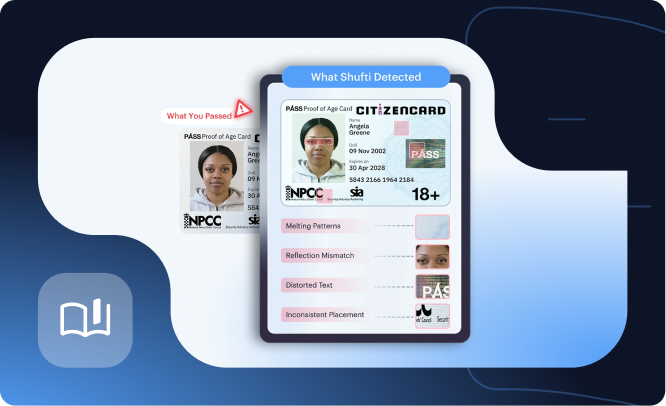
Shufti’s Deepfake Blindspot Audit now runs fully inside your AWS environment, auditing historic KYC for manipulation signals without moving sensitive data off-prem.
whitepapers