AMLR Solutions
 AMLR Consultation
 Onboarding
 Ongoing Monitoring
 FRAML
FRAML KYC
KYC KYB
KYB KYI
KYI Age Assurance
 Workforce IAM
 Candidate Verification
 Account Takeover
 Bonus/ Promotion Abuse
 Chargeback Fraud
 Deepfake
 Document Fraud
 Fraud Networks
 Impersonation Fraud
 Money Mule Activity
 Multi-Accounting
 Party Fraud
 Regulatory & Compliance Risks
 Synthetic Identity Fraud
 Adult Content
 Banking
 Crypto
 Fintech
 Forex
Forex Compliance
 Fraud prevention
 Trust & safety
 Global expansion
 Compliance Officers
 Developers
 Fraud Analysts
 Product Managers
 Advanced Journey Builder (AJB)
 Global Trust Platform
 Customer Profiles
 Vendor Comparison
 IDV Case Management
 AML Case Management
 Regulatory Reporting
 Travel Rule Protocols
 Agentic Rule Builder
 AI Compliance Co-Pilot
 Fraud Analytics
 Fraud Hub
 OCR
OCR Shufti AI
 Bank Account Verification
 Biometric Duplication
 Database Checks
 Document Intelligence
 Government ID
 Mobile Driver's License
 NFC
NFC Selfie Liveness
 Brand Personalisation
 Deployment Options
 Identity Methods
 IDV Modes
 Multi-tenancy
 On-Premise IDV
 Secure Capture











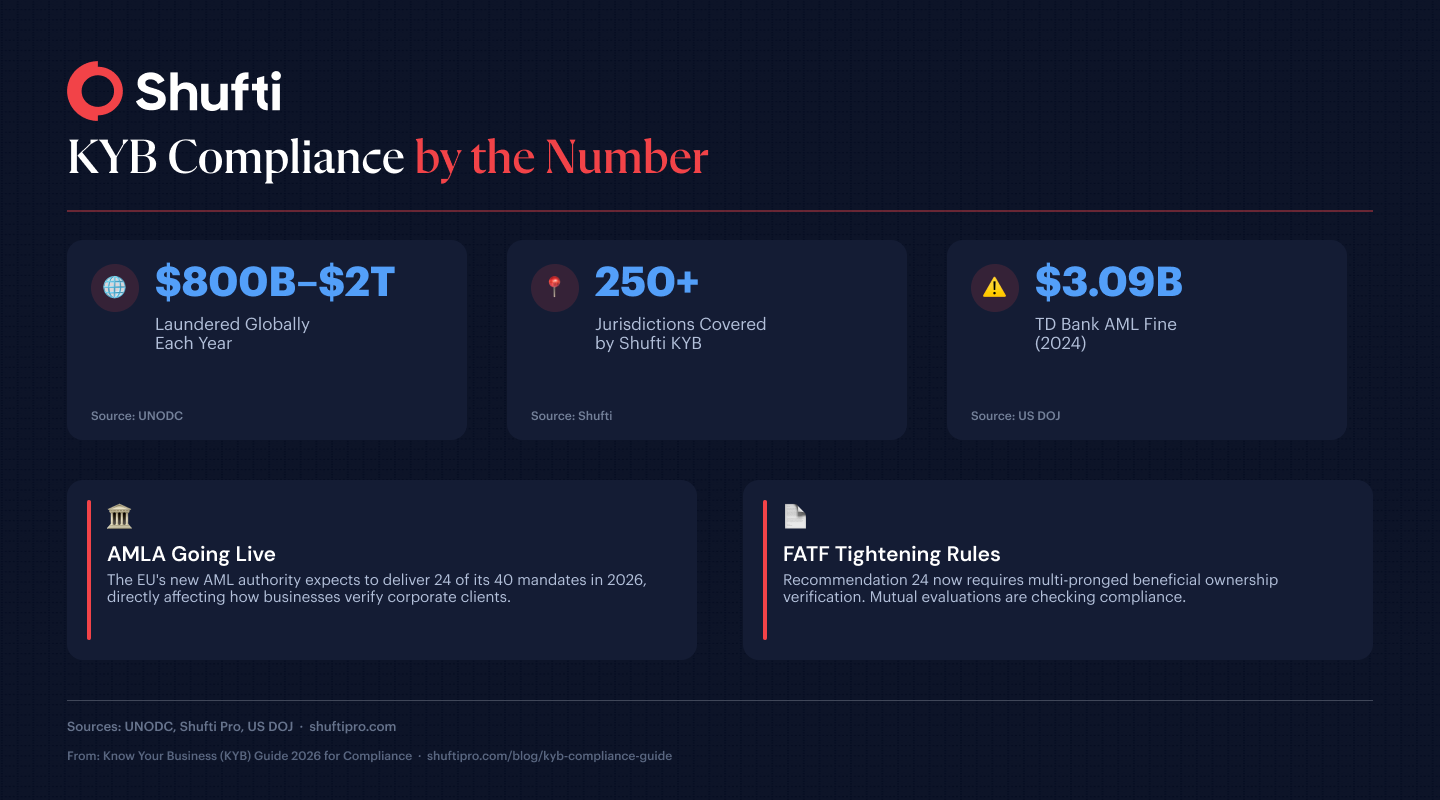
Between $800 billion and $2 trillion moves through the global financial system as laundered money every year, according to the UNODC. A significant share of that flows through shell companies and opaque corporate structures that could have been caught with proper business verification checks. If you’re onboarding business clients (whether you’re a bank, a fintech, a payment processor, or a B2B marketplace) and you’re not running thorough KYB checks, your compliance programme has a gap that regulators are increasingly unwilling to ignore.
Know Your Business (KYB) is the due diligence process regulated entities use to verify the identity, ownership structure, and legitimacy of a business before entering into a commercial relationship. Where KYC focuses on verifying individual customers, KYB focuses on verifying the entity itself: its registration status, its directors, its Ultimate Beneficial Owners (UBOs), and its exposure to money laundering or terrorism financing risks.
This guide covers what Know Your Business compliance actually involves in 2026, the regulatory changes making it more urgent, and the step-by-step verification process.
Why KYB Compliance Matters More in 2026
Three regulatory forces are converging this year that make KYB compliance harder to defer.
First, the EU Anti-Money Laundering Authority (AMLA) began operations in July 2025 and is now finalising technical standards for customer due diligence, risk classification, and governance. According to KPMG’s AMLA analysis, AMLA expects to deliver 24 of its 40 mandates in 2026, with priority given to standards that directly affect how obligated entities verify business clients. From July 2027, the new EU AML rulebook becomes directly applicable across all member states.
Second, the FATF tightened Recommendation 24 in 2022 and has been pushing countries toward multi-pronged beneficial ownership verification mechanisms ever since. Mutual evaluations are actively checking whether countries have adequate, accurate, and up-to-date UBO registries.
Third, the US Corporate Transparency Act has narrowed its scope after FinCEN’s March 2025 interim rule exempted domestic US companies from beneficial ownership reporting, but foreign companies doing business in the US still face filing obligations. The regulatory direction is clear: more transparency, not less.
Meanwhile, enforcement actions keep climbing. In 2024, TD Bank agreed to pay $3.09 billion to US authorities for systemic AML program failures. The UAE now imposes fines up to AED 5 million (~USD 1.36 million) on firms that fail to maintain proper UBO records. Nigeria’s regulators have revoked fintech licences for onboarding corporate clients without meeting KYB standards.
Across the board, regulators expect you to know who owns the businesses you work with. The penalties for getting it wrong are growing faster than most compliance budgets.
What are different Steps in KYB Process?
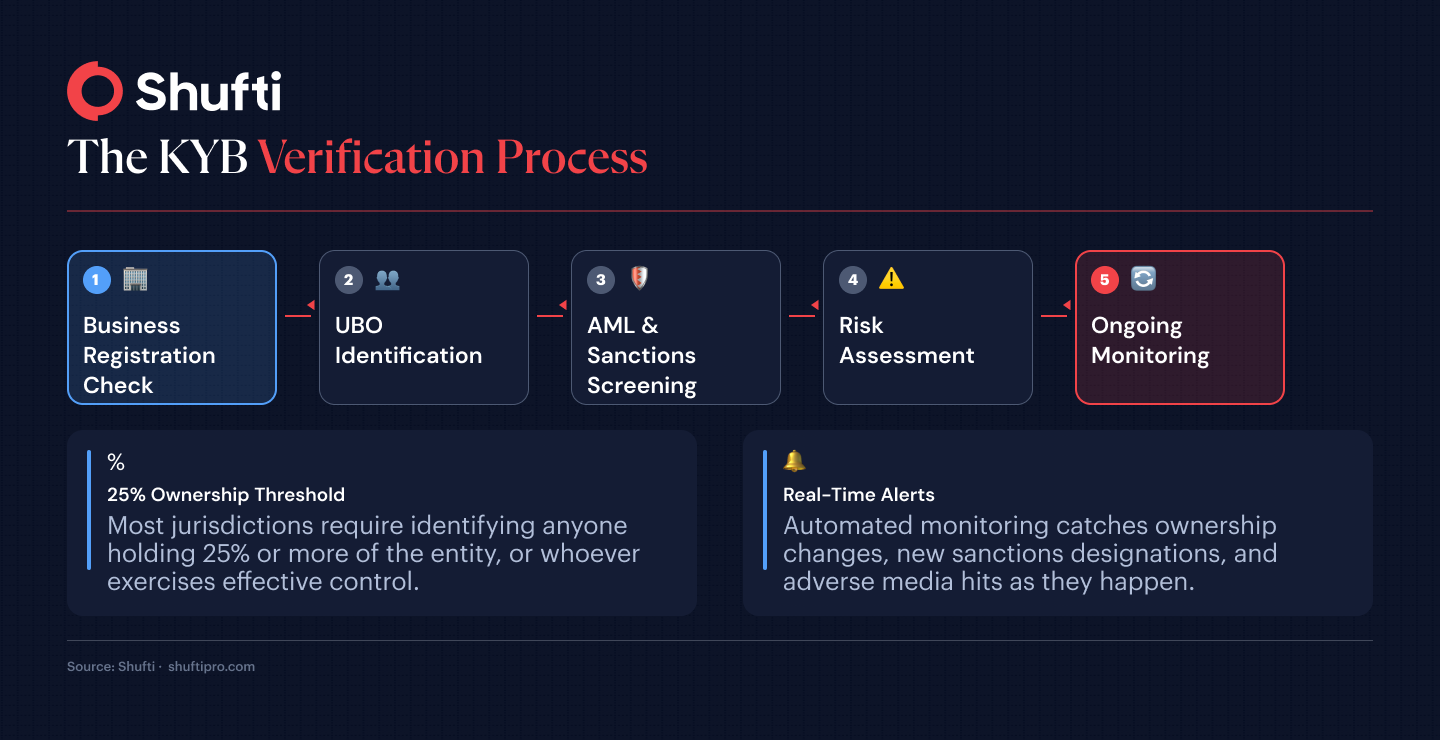
A complete KYB check typically involves five stages. The depth of each varies depending on your risk appetite and the jurisdiction, but the sequence is consistent across most regulatory regimes.
1. Business Registration Verification
Confirm that the business is legally registered and in good standing. This means pulling data from official commercial registries: company name, registration number, date of incorporation, registered address, and legal status.
2. UBO Identification and Verification
Map the ownership structure to identify everyone who holds 25% or more of the entity (or whoever exercises effective control, depending on jurisdiction). Each UBO must be verified as an individual. This is the stage where shell companies get flagged. If you can’t identify the UBO, you shouldn’t onboard the client.
3. AML and Sanctions Screening
Screen the business entity, its directors, and its UBOs against global sanctions lists, PEP databases, and adverse media sources. This is not a one-time check. Ongoing monitoring is now the regulatory expectation. FATF’s guidance on beneficial ownership makes clear that static onboarding-only checks are no longer sufficient.
4. Risk Assessment and Classification
Assign a risk score based on the business type, industry, jurisdiction, ownership complexity, and screening results. High-risk entities (those in sanctioned jurisdictions, complex multi-layered structures, or PEP-connected) require Enhanced Due Diligence (EDD).
5. Ongoing Monitoring
KYB onboarding process is not a one time activity. Changes in ownership, new sanctions designations, adverse media hits, or shifts in business activity all require re-verification. Automated monitoring with real-time alerts is what separates compliant programmes from audit failures.
What are Challenges in KYB for Financial Institutions?
Key challenges in Know Your Business (KYB) for financial institutions include:
- Data Quality and Access: Obtaining accurate, up-to-date information about businesses, especially in regions with limited access to reliable data sources, is a significant issue. Many businesses may not have public records or structured data available.
- Complexity of Ownership Structures: Businesses with intricate ownership or control structures (e.g., shell companies, offshore entities) make it difficult to trace the true beneficial owners, increasing the risk of money laundering or fraud.
- Compliance with Global Regulations: Financial institutions must comply with a complex web of international and local regulations, which can differ significantly across jurisdictions. This requires constant monitoring of regulatory changes and adapting internal processes accordingly.
- Manual Verification: Many KYB processes still rely on manual verification, which is time-consuming, error-prone, and often unable to scale with increased volumes of data or global businesses.
- False Positives/Negatives: Ensuring accurate risk assessments without flagging too many businesses incorrectly (false positives) or missing high-risk entities (false negatives) remains a challenge, as it can affect customer experience and lead to financial or legal repercussions.
- Cost and Resource Allocation: The KYB process can be resource-intensive. Smaller institutions or startups may struggle with the cost of maintaining compliance programs, technology infrastructure, and trained staff, putting them at a competitive disadvantage.
How to Build a KYB Programme That Passes Audit
If you’re standing up or upgrading your KYB programme, here’s what auditors and regulators will look for:
Document your policies: Written KYB policies that specify risk thresholds, escalation procedures, and review cycles. If it’s not written down, it didn’t happen.
Automate registry checks: Manual verification against 250+ jurisdictions is not scalable. Solutions like Shufti’s KYB verification connect directly to official corporate registries across 240+ countries, pulling real-time data on over 300 million companies from 300+ data sources through a single API.
Screen continuously, not just at onboarding: Pair your KYB process with AML screening that monitors for sanctions list updates, new PEP designations, and adverse media on an ongoing basis. Shufti’s screening draws from 100,000+ data sources updated every 15 minutes.
Keep an audit trail: Every check, every decision, every flag should be logged and retrievable. Regulators expect digital audit trails, not PDF printouts of manual reviews.
Apply a risk-based approach: Not every business client needs Enhanced Due Diligence. Calibrate the depth of your checks to the actual risk, but document why you made that call.
What Happens When Businesses Get KYB Wrong
The consequences extend well past the fine itself. TD Bank’s $3.09 billion penalty also triggered enhanced regulatory supervision, public consent orders, and a leadership overhaul. In the UAE and Nigeria, regulators have revoked licences entirely. Correspondent banks quietly sever relationships with institutions flagged for compliance weaknesses, cutting off access to payment networks. And reputational damage, for companies whose product depends on trust, tends to outlast the financial hit. More context on how KYB business verification protects companies is covered in our earlier analysis.
Conclusion
KYB compliance in 2026 is not just about checking a regulatory box. With AMLA finalising enforcement standards, FATF tightening beneficial ownership rules, and jurisdictions from the UAE to Nigeria imposing real penalties for failures, the cost of weak KYB business verification keeps climbing.
The fundamentals haven’t changed: verify the business, identify the owners, screen against watchlists, assess the risk, and keep monitoring. What has changed is that regulators now have the authority, the tools, and the political will to enforce these expectations.
If your KYB process still involves manual registry lookups and spreadsheets, 2026 is the year to fix that. Request a demo today with Shufti’s team to see how can you automate your business verification workflow.
Frequently Asked Questions
What is KYB compliance and why does it matter?
KYB compliance is the regulatory requirement for financial institutions to verify the identity, ownership, and legitimacy of business clients before onboarding them. It matters because it prevents shell companies, money laundering, and terrorism financing, and because regulators impose heavy fines on firms that skip it.
What documents are required for KYB verification?
Common documents include certificates of incorporation, articles of association, shareholder registers, UBO declarations, proof of registered address, and government-issued IDs for each beneficial owner. Requirements vary by jurisdiction and risk level.
What are the latest KYB regulations in 2026?
The EU's AMLA is finalising due diligence technical standards, FATF's tightened Recommendation 24 is driving stricter UBO verification globally, and the US Corporate Transparency Act continues to evolve. The EU's single AML rulebook becomes directly applicable from July 2027.
How long does a KYB check take?
Manual KYB can take days to weeks depending on entity complexity and jurisdiction. Automated solutions like Shufti process registry checks, UBO mapping, and AML screening in minutes through a single API.
Is KYB mandatory for all financial institutions?
Yes, for regulated financial institutions, payment service providers, crypto exchanges, and most entities covered by AML legislation. Scope varies by jurisdiction, but the global trend is toward broader coverage, not narrower.