KYC for Online Gambling: UKGC, MGA, and Global Compliance Requirements
- 01 UKGC KYC regulations: what online operators must meet
- 02 MGA KYC requirements: risk-based compliance for global operators
- 03 How do global gambling KYC requirements compare?
- 04 The cost of non-compliance: fines, audits, and license risk
- 05 How to improve the online casino KYC process?
- 06 How Shufti helps online casinos manage KYC and AML compliance?
Over $160 million in regulatory penalties hit online gambling operators in the first half of 2025 alone, spanning 40-plus enforcement actions across eight countries. As of April 2026, that pressure is not easing. Regulators are issuing fines while audits are still open and suspending licences where verification gaps persist.
Know your customer (KYC) sits at the centre of most of these actions. When an operator fails KYC, it fails the checks designed to catch underage players, problem gamblers, and money launderers before they cause harm. The rules vary by jurisdiction, but the underlying obligation is the same. Verify who your players are, screen them against risk registers, and monitor them over time.
This article covers what the UK Gambling Commission (UKGC), the Malta Gaming Authority (MGA), and global frameworks actually require in 2026 and what it takes to meet those requirements without adding unnecessary friction to player onboarding.
UKGC KYC regulations: what online operators must meet
The UK Gambling Commission is the most prescriptive gambling regulator on identity verification. Its requirements sit in the Licence Conditions and Codes of Practice (LCCP) and leave little room for discretion. Operators who treat these rules as flexible tend to find out otherwise during an enforcement review, by which point the record has already been built against them.
Identity verification before the first deposit
Under LCCP Condition 17.1.1, UKGC-licensed operators must verify a player’s identity and confirm that they are 18 or older before that player makes a deposit, places a bet, or accesses any gambling product. The 72-hour grace period that existed in earlier iterations of the LCCP is gone. Verification is now required at account creation, full stop.
Accepted documents include passports, national identity cards, and driving licences. Document verification combined with biometric face matching against the document photo is the standard approach for most digital onboarding flows. It confirms both identity and age verification in a single session and generates a defensible audit trail that UKGC-approved KYC providers must be able to produce on request.
AML obligations and emerging risk guidance
UKGC KYC regulations extend beyond identity confirmation. Operators must conduct anti-money laundering (AML) checks, apply customer due diligence (CDD) at onboarding, and deploy enhanced due diligence (EDD) for customers who meet defined risk thresholds, including high-value depositors, customers with unusual transaction patterns, and those flagged through ongoing monitoring.
In April 2025, the UKGC published updated guidance on emerging money laundering and terrorist financing risks, addressing typologies that include cryptocurrency deposits and synthetic identity fraud. AML and KYC compliance gaming workflows must surface these signals, not just run a document against a watchlist. For a detailed view of how these risks play out across gaming products, gaming industry fraud patterns, and KYC controls show the practical stakes for operators.
MGA KYC requirements: risk-based compliance for global operators
The Malta Gaming Authority (MGA) issues licences recognised across dozens of markets, which makes its AML and KYC framework a practical default for operators building compliance for a global player base. Unlike the UKGC’s prescriptive rulebook, the MGA applies a risk-based approach that gives operators more design flexibility, but it also demands more internal judgment about what that risk picture actually looks like.
What MGA licensees must verify?
MGA licensees must verify a player’s identity at registration. The required evidence includes a government-issued photo ID, proof of address, and date of birth confirmation. For MGA licensing KYC requirements, the timing obligation is clear. Verification happens at the point of registration, before any financial transaction takes place.
For higher-risk players, including those making large deposits, flagged through transaction monitoring, or originating from high-risk jurisdictions, the MGA requires additional documentation and enhanced scrutiny.
MGA KYC verification requirements also extend to source-of-wealth checks at defined thresholds. Digital identity verification gambling platforms need to support this full range of document types and check depths in a single workflow.
AML framework and MLRO obligations
Every MGA licensee must appoint a Money Laundering Reporting Officer (MLRO), who carries personal accountability for the operator’s AML controls. The MLRO is responsible for filing suspicious transaction reports with the Financial Intelligence Analysis Unit (FIAU) and for maintaining an AML/CFT policy that reflects the operator’s current risk exposure.
The FIAU expects operators to demonstrate their risk logic, not just their outcome decisions. Audit trails that record what was checked, when it was checked, and what the result was are not optional documentation. They are evidence that a compliance framework is functioning. For operators building these systems from scratch, KYC requirements for casino operators provide a practical orientation to what the full compliance build involves.
How do global gambling KYC requirements compare?
The FATF classifies casinos as designated non-financial businesses and professions (DNBFPs), which means AML obligations apply at the same standard as financial institutions. CDD at onboarding, EDD for high-risk players, and ongoing monitoring with suspicious activity reporting are all mandated.
The FATF’s analysis of casino vulnerabilities makes clear that gaps in player verification are one of the most consistently exploited entry points for money laundering in the sector.
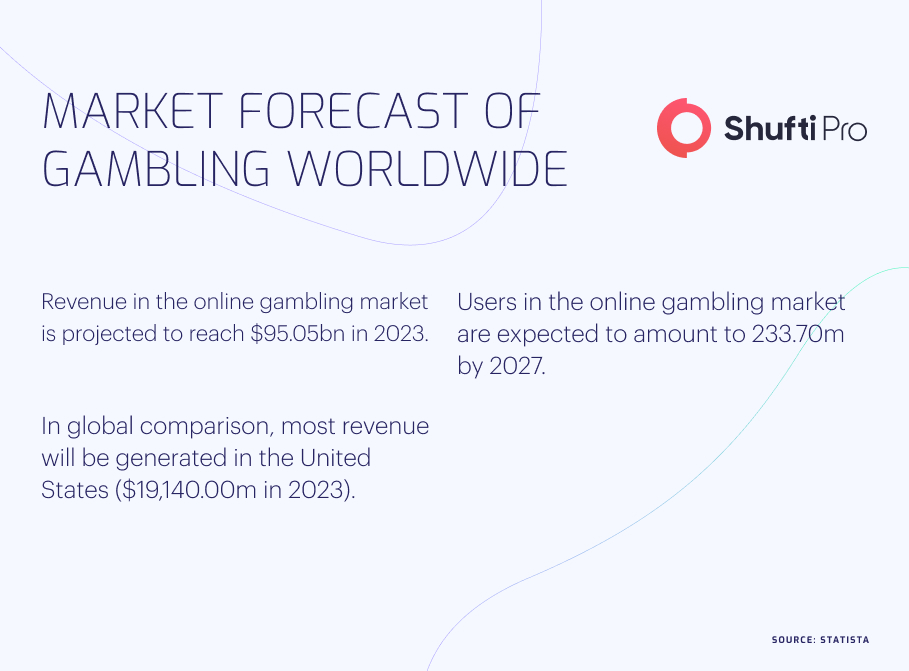
Global gambling compliance rules diverge sharply beyond that FATF baseline. The global online gambling market is projected to grow from $87.99 billion in 2025 to $227.36 billion by 2033, a CAGR of 12.6%, which means the compliance surface is expanding as fast as the market itself.
Australia’s AUSTRAC applies transaction reporting obligations on casinos. US tribal and commercial gaming operators face a patchwork of state-level and FinCEN requirements. Each new regulated market an operator enters adds a layer of KYC onboarding solutions for casinos to manage. Gambling compliance services across global markets require document coverage that extends well beyond the UK and Malta.
The table below captures the three main compliance reference points most operators encounter.

The cost of non-compliance: fines, audits, and license risk
The KYC checklist for online gambling operators is not a theoretical exercise. The UKGC’s enforcement record from 2024 and 2025 makes the financial exposure concrete.
Gamesys Operations received a £6 million fine for social responsibility and AML failings, which also triggered a mandatory third-party compliance audit. In November 2025, Videoslots Limited received a £650,000 fine for AML and social responsibility failures across three websites. These are part of a broader pattern. iGaming Today’s 2025 compliance cost analysis documented over $160 million in penalties across eight countries in H1 2025 alone, spanning more than 40 enforcement actions.
What the fines have in common is not the size of the operator but the nature of the gap. Customer verification was either incomplete, delayed, or not backed by documentation that could withstand scrutiny.
A compliance system that generates auditable records per player, flags risks in real time, and can produce those records on regulator request is a fundamentally different position from one that only acts when a player raises a concern. The cost of a mandatory external audit, in time and in operational disruption, often exceeds the fine itself.

How to improve the online casino KYC process?
The online casino KYC process works best when identity checks, age confirmation, AML screening, and ongoing monitoring run in parallel rather than sequentially. Sequential workflows, where each check waits for the previous one to complete, create the player-dropout problems that compliance teams often attribute to friction when the real cause is architectural.
KYC automation tools for the gambling industry resolve this by running document verification, biometric matching, and watchlist screening concurrently. For most players, a full verification completes in under 15 seconds. Returning players benefit from a reusable identity layer, which means the document capture only happens once.
KYC API integration for betting platforms matters here for a different reason. A single API endpoint that handles document verification, biometric face matching, AML screening, and ongoing monitoring means the operator manages one vendor relationship, one data contract, and one audit trail.
Best KYC software for online casinos consolidates these capabilities so the compliance team spends its time on edge cases rather than reconciling outputs from disconnected systems. Gambling compliance services across global markets also require document support that extends well beyond the UK and Malta, covering the identity documents issued in every market the operator enters.
For operators with age-gating requirements specific to betting products, age verification for betting sites covers the regulatory and operational details.
How Shufti helps online casinos manage KYC and AML compliance?
Most gambling operators reach a point where the fragmented-vendor problem becomes a compliance problem. One provider handles document checks, another handles watchlist screening, and neither system knows what the other found.
When a regulator requests the full record on a player flagged for suspicious activity, that record exists across multiple platforms, in multiple formats, with no unified view.
Shufti’s Know Your Customer solution handles document verification, biometric face matching, and age confirmation through a single API.
The AML screening layer runs on the same platform, drawing on 3,500-plus global watchlists across 215-plus sanction regimes, with data updated every 15 minutes. Coverage extends to 230-plus countries and territories, supporting the document types issued in each.
For operators seeking UKGC or MGA licences, or expanding into new regulated markets, the platform is configurable to jurisdiction-specific risk rules without rebuilding the integration. The same API that handles UK onboarding can be reconfigured for MGA compliance or for a market opening under a new licensing framework. Operators who want to see the full gaming-specific capability set, including compliance workflows built to UKGC and KJM standards, can find it in Shufti’s gaming industry solution.
Book a demo to see how Shufti’s platform fits your compliance build.
Frequently Asked Questions
What are the KYC requirements for online gambling operators?
Online gambling operators must verify each player's identity and confirm their age before allowing a deposit or access to gambling products. Required documents typically include a government-issued photo ID and proof of address. Operators must also screen players against AML watchlists at onboarding and maintain ongoing monitoring for unusual activity. Specific requirements vary by regulator. The UKGC mandates verification before the first deposit, while the MGA applies a risk-based framework with similar intent but more operator discretion.
How does the UKGC enforce KYC compliance?
The UKGC enforces compliance through licence conditions that operators must meet to hold a UK gambling licence. When the Commission identifies KYC or AML failures, it can issue financial penalties, require third-party compliance audits, or suspend and revoke licences. Recent enforcement actions have resulted in fines ranging from hundreds of thousands to millions of pounds for operators that failed to verify players adequately or maintain proper AML records.
What role does the MGA play in gambling KYC?
The MGA sets the KYC and AML standards that its licensees must meet. Operators must verify player identity at registration, appoint an MLRO, and file suspicious transaction reports with the FIAU. The MGA uses a risk-based approach, meaning operators have design flexibility, but they must document their risk methodology and demonstrate that their controls address the risks their specific player base presents.
How can online casinos improve KYC onboarding efficiency?
In well-built onboarding flows, document verification, biometric face matching, and AML screening run in parallel rather than sequentially, which removes most registration friction. KYC automation tools that complete a full verification in under 15 seconds reduce drop-off at the registration stage. A single API integration that handles all verification steps also removes the overhead of managing multiple vendor relationships and reconciling separate audit trails.
What should compliance teams look for in gambling KYC software?
Compliance teams should look for a platform covering document verification, biometric matching, AML screening, and ongoing monitoring in one integration. Coverage matters. Operators expanding internationally need a provider that supports identity documents from 200-plus countries. Audit trail quality is also a practical factor. When a regulator requests the record on a specific player, producing a complete, time-stamped log from one system is far easier than reconstructing it from multiple platforms.
What is the difference between UKGC and MGA KYC rules?
The UKGC applies a prescriptive, rule-based approach. Verification is mandatory before the first deposit, the 72-hour grace period no longer exists, and EDD thresholds are specifically defined. The MGA takes a risk-based approach that gives operators more design flexibility but requires them to document and justify their risk methodology. Both frameworks require identity verification at onboarding, AML screening, and ongoing monitoring. The difference lies in how much prescriptive detail the regulator provides versus how much it expects the operator to determine from their own risk assessment.
How do global gambling KYC requirements compare?
The FATF's DNBFP designation means AML obligations apply globally at financial institution standards. Most national gambling regulators with active licensing frameworks follow FATF guidance as a baseline. The UKGC and MGA sit within that global framework but add jurisdiction-specific requirements on top. Operators expanding across markets face layered compliance, where each new licence adds verification and reporting obligations beyond the FATF baseline, covering local document types, reporting channels, and risk thresholds.
Which documents are required for online gambling KYC?
The standard set includes a government-issued photo ID (passport, national identity card, or driving licence) for identity and age confirmation, and a proof-of-address document (utility bill or bank statement, typically issued within three months). For higher-risk players or those triggering EDD thresholds, operators may also need to collect source-of-funds or source-of-wealth documentation. The specific document types accepted vary by jurisdiction and by the operator's own risk policy.
How does KYC help prevent fraud in online casinos?
KYC prevents fraud by confirming a player is who they claim to be before they deposit or play. Document verification and biometric face matching catch identity fraud at onboarding. AML screening flags players against sanctions lists, PEP registers, and adverse media sources, catching financial crime risk that identity verification alone would miss. Ongoing monitoring detects behavioural changes after onboarding, such as unusual deposit patterns or rapid account changes that may indicate account takeover or money laundering.
What are the penalties for non-compliance with gambling KYC regulations?
Penalties vary by regulator but can include financial fines, mandatory third-party compliance audits, licence suspension, and full licence revocation. The UKGC fined Gamesys Operations £6 million and required an external audit. Videoslots Limited received a £650,000 fine in November 2025. Globally, over $160 million in penalties hit gambling operators in H1 2025 across more than 40 enforcement actions. For operators, the financial cost of a fine is often smaller than the reputational and operational cost of a mandatory audit or licence suspension.
Explore Now