AMLR Solutions
  AMLR Consultation
 EUDI Wallet
 Onboarding
 Ongoing Monitoring
 FRAML
FRAML KYC
KYC KYB
KYB KYI
KYI Age Assurance
 Workforce IAM
 Candidate Verification
 Account Takeover
 Bonus/ Promotion Abuse
 Chargeback Fraud
 Deepfake
 Document Fraud
 Fraud Networks
 Impersonation Fraud
 Money Mule Activity
 Multi-Accounting
 Party Fraud
 Regulatory & Compliance Risks
 Synthetic Identity Fraud
 Adult Content
 Banking
 Crypto
 Fintech
 Forex
Forex Compliance
 Fraud prevention
 Trust & safety
 Global expansion
 Compliance Officers
 Developers
 Fraud Analysts
 Product Managers
 Journey Builder
  Global Trust Platform
 Customer Profiles
 Vendor Comparison
 IDV Case Management
 AML Case Management
 Regulatory Reporting
 Agentic Rule Builder
  AI Compliance Co-Pilot
  Fraud Analytics
 Fraud Hub
  OCR
OCR Shufti AI
 Bank Account Verification
  Biometric Duplication
 Database Checks
 Document Intelligence
 Government ID
 Mobile Driver's License
 NFC
NFC Selfie Liveness
 Brand Personalisation
 Deployment Options
 Identity Methods
 IDV Modes
 Multi-tenancy
 On-Premise IDV
 Secure Capture
 Shufti MCP





















TL;DR
- Manual document verification puts a human reviewer at the centre of every decision useful in low-volume or edge-case scenarios, but inherently slow (hours to business days per review) and inconsistent at scale.
- Automated online verification uses AI and OCR to extract data, check security features against 10,000+ trained document templates, and return a result in under 15 seconds consistently and without shift-coverage constraints.
- Speed and accuracy is where the gap is widest: manual review degrades with queue depth and reviewer fatigue; automated systems maintain the same accuracy at 1 verification or 1 million.
- For high-volume businesses the data runs in one direction: automated verification reduces operational costs, eliminates bottlenecks at onboarding, and maintains an auditable, timestamped trail.
- The practical best practice is AI-first with a human-in-the-loop exception path; the model handles the majority of decisions, and reviewers focus only on flagged or ambiguous cases.
“An email comes to us and everything is done manually. The checks are done manually.” That line came out of a compliance discovery call with a financial services firm last quarter. The frustration behind it is familiar. Manual document verification was built for a world where fraud was slower, onboarding volumes were lower, and audit requirements were less demanding than they are now.
Document verification is the process of confirming that an identity document is genuine, unaltered, and belongs to the person presenting it. Manual verification relies on human reviewers to make that call. Automated online document verification uses AI and machine learning to do the same in seconds.
For most businesses processing documents at any real volume, the data on this comparison runs in one direction. This guide covers each dimension with specifics.
What each approach actually involves
Manual document verification puts a human reviewer at the centre of every decision. A customer submits a passport, driver’s licence, or national ID. The reviewer checks the document against known templates, looks for signs of tampering, extracts data, and makes a judgement call. In low-volume settings, trained reviewers catch things that automated systems occasionally miss on edge cases. That advantage is real. It also comes with a cost structure and throughput ceiling that matter enormously at scale.
Automated online document verification replaces most of that workflow with AI. The system captures the document image, runs optical character recognition (OCR) to extract data fields, checks security features against a trained model covering 10,000+ document templates, and flags anomalies. Where needed, results feed into a liveness or biometric check. The full cycle takes under 15 seconds. The core difference is that one approach puts the judgement in the reviewer, and the other puts it in the model, with a human available for defined exception cases.
How does automated document verification compare on speed and accuracy?
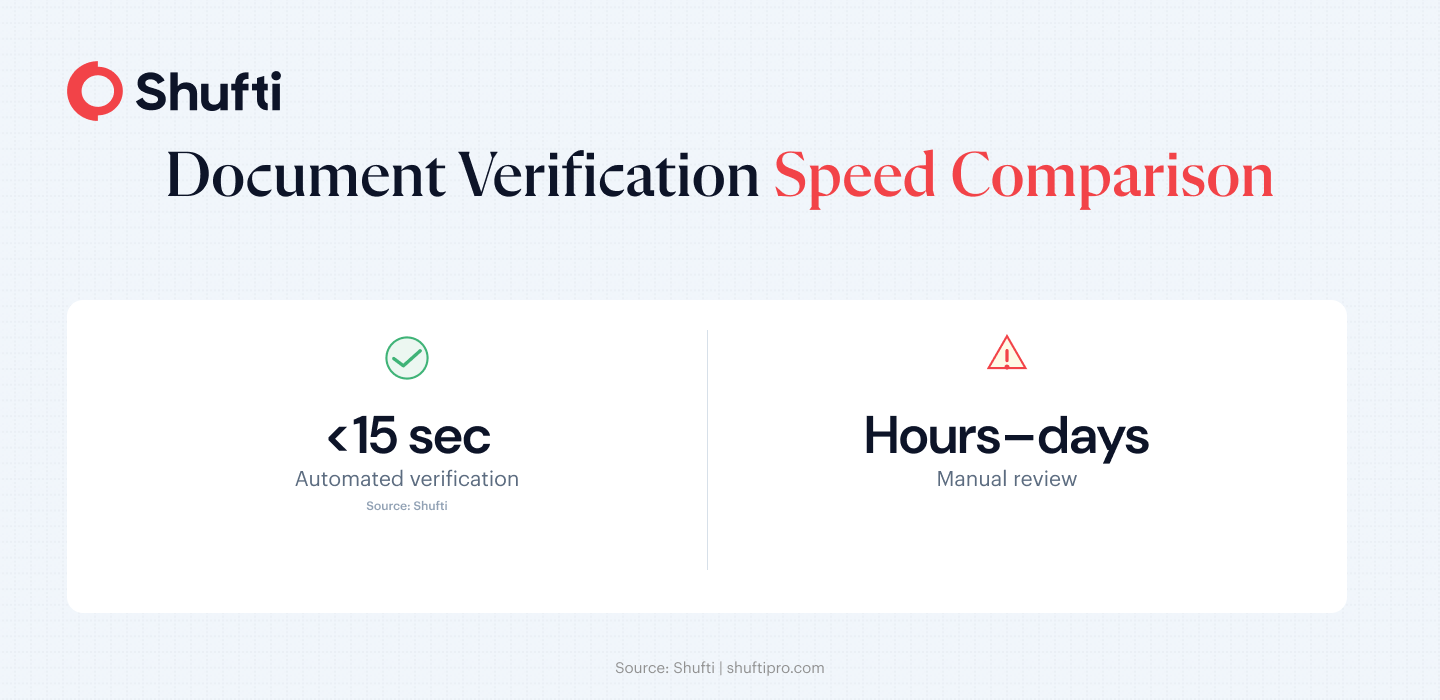
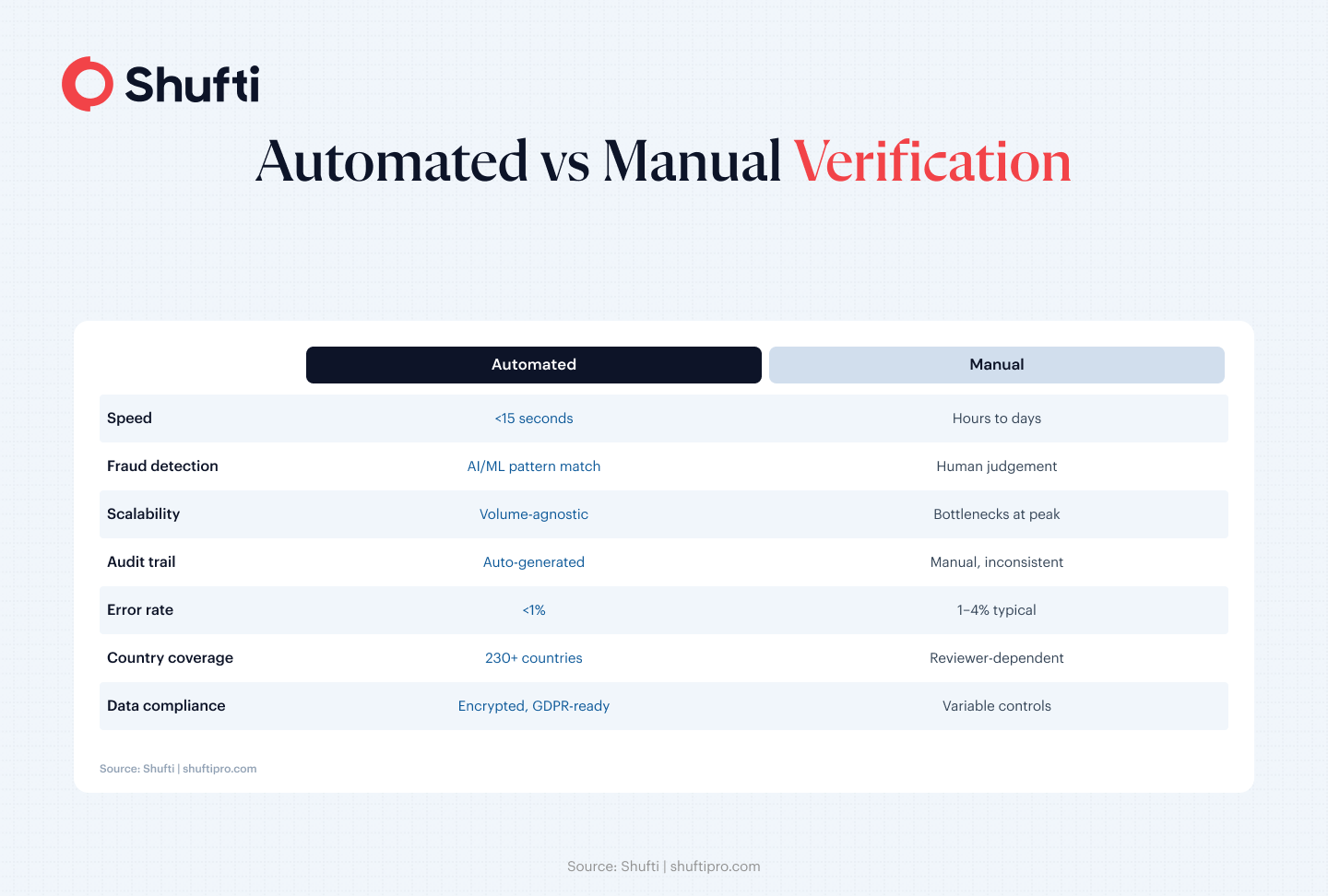
Speed and accuracy are where the measurable gap between the two approaches is widest, and where manual review loses ground regardless of how well the team is trained. Manual review typically takes anywhere from a few hours to several business days, depending on team size, shift coverage, and queue depth. At peak onboarding periods, that timeline creates a conversion bottleneck. A user completing a sign-up at 10 PM expects a decision before they close the tab.
Automated verification returns a result in under 15 seconds regardless of queue volume or time of day. That matters not just for throughput, but for conversion rates. Wait times between document submission and a verification decision translate directly into onboarding drop-off, and real-time document verification keeps users inside the flow.
On accuracy, the assumption that trained human eyes catch more fraud than an algorithm does not hold at volume. AI-powered systems detect tampered documents, font inconsistencies, metadata manipulation, hologram anomalies, and MRZ data mismatches at a speed no human review team can match under pressure. Deloitte projects According to Deloitte, that losses from generative AI-powered fraud will reach $40 billion by 2027, up from $12.3 billion in 2023. That trajectory demands detection capability that scales with the threat. Human reviewers working high-volume shifts generate an error rate that grows with workload, not shrinks.
Manual review does hold a genuine edge in one narrow area. Genuinely ambiguous or degraded documents are where human context reading can outperform a model’s confidence threshold. A trained reviewer might correctly clear a legitimate but badly worn passport that an automated system flags with low confidence. That edge is real but specific, and it does not justify routing all standard verifications through a human queue.
What does manual document verification cost at scale?
The direct cost of manual verification is staff time. Hiring, training, and retaining a qualified review team represents a fixed overhead that scales linearly with volume. As onboarding volume grows, headcount grows with it, and there is no way to absorb a volume spike without additional staff or extended queue times.
Automated verification scales horizontally without additional headcount. A spike in onboarding volume, a new market launch, or a seasonal sign-up peak does not change the unit processing time or require hiring decisions. That scalability difference changes the total cost comparison at any volume above a modest threshold.
The hidden costs compound the picture. Manual processes generate more errors, and errors in verification carry compliance consequences. An incorrectly cleared document that later proves fraudulent exposes the business to regulatory liability. The rework and investigation costs of a single failure typically exceed what a more capable verification process would have cost in the first place.
Automated document verification also generates audit trails automatically, a timestamped, structured record of every check, every result, and every data field extracted. Manual processes depend on reviewers to document their own decisions, which introduces gaps that auditors flag during examinations.
When does manual document verification still make sense?
Manual review is not obsolete. It plays a specific role in a well-designed verification workflow, just not the primary one. Understanding where human review adds value is what separates a well-architected stack from one that either over-automates or under-automates.
Genuine edge cases exist. Documents in poor physical condition, identity records from jurisdictions with unusual formats, or submissions that fall below an automated system’s confidence threshold are genuinely better handled by a trained reviewer than by a model that has not been trained on that document type. Routing low-confidence results to a human reviewer rather than auto-declining them is the right architecture.
Manual review also serves as the exception layer in Enhanced Due Diligence (EDD) cases. High-risk individuals and politically exposed persons require human judgement alongside document checks to satisfy EDD obligations. The document authentication layer runs automated; the risk assessment layer brings in a reviewer.
The document verification process in a modern onboarding flow typically routes fewer than five percent of submissions to human review. For the other 95 percent, automated verification is faster, more consistent, and more accurate.
Data privacy controls also differ between the approaches. Automated systems built to General Data Protection Regulation (GDPR), Service Organization Control 2 (SOC 2), and ISO 27001:2013 standards process document data within defined retention windows and encrypted pipelines. Businesses can also choose between cloud, on-premises, or hybrid deployment depending on their data residency requirements. Manual handling of identity documents, by contrast, introduces access control and storage risks that structured automated systems eliminate by design.
How Shufti helps compliance teams verify documents at scale
Most document verification problems that compliance teams describe come down to two things. Either the manual process is the bottleneck limiting how fast the business can onboard, or the automated solution in place does not cover the documents their customers actually carry.
Shufti’s document verification service covers 10,000+ document types from 240+ countries and territories, including documents with non-Latin scripts across nearly 100 OCR languages. Verifications process in under 15 seconds via a single API, with a 99.3% true detection rate for confirmed fraud attempts. Deployments run on cloud, on-premises, or hybrid infrastructure, so businesses in regulated markets with data residency requirements can verify documents without routing sensitive data outside their jurisdiction.
The exception-handling layer is configurable. Businesses can set confidence thresholds that route low-confidence results to a human reviewer, keeping the review team focused on cases that genuinely need their attention rather than every routine submission. For teams running identity document verification at scale, the audit trail is automatic: every verification generates a timestamped, structured record that satisfies AML and KYC compliance requirements without additional documentation work.
Manual document verification is slow, inconsistent at scale, and leaves compliance teams maintaining audit trails by hand. Shufti’s document verification replaces that with AI-powered checks that run in under 15 seconds, cover documents from 240+ countries, and generate compliance-ready records automatically. Request a demo to see how the verification flow handles your specific document types and volumes.
Frequently Asked Questions
Is Automated Document Verification more accurate than manual?
For data extraction and fraud pattern detection, yes. Automated systems maintain consistent accuracy regardless of volume or time of day, while human reviewers average a 1 to 4 percent error rate that grows under high-volume conditions.
Can automated document verification replace human reviewers entirely?
Not entirely. Automated verification handles the large majority of submissions accurately and at speed, but genuinely ambiguous documents and EDD cases benefit from human review as a defined exception layer.
What types of documents are better suited to manual verification?
Heavily degraded originals, documents from jurisdictions with non-standard formats, and submissions that fall below an automated system’s confidence threshold are where human reviewers add genuine value.
Does automated verification increase or decrease fraud risk?
It decreases it. AI-powered systems detect tampered documents, metadata manipulation, and synthetic identity fraud faster and more consistently than human reviewers, particularly as fraud tooling advances.
Is manual document verification still compliant in 2026?
Regulatory frameworks permit manual verification, but compliance requirements around audit trail quality, data handling, and the consistency of due diligence findings grow harder to satisfy with manual processes at scale.