AMLR Solutions
  AMLR Consultation
 EUDI Wallet
 Onboarding
 Ongoing Monitoring
 FRAML
FRAML KYC
KYC KYB
KYB KYI
KYI Age Assurance
 Workforce IAM
 Candidate Verification
 Account Takeover
 Bonus/ Promotion Abuse
 Chargeback Fraud
 Deepfake
 Document Fraud
 Fraud Networks
 Impersonation Fraud
 Money Mule Activity
 Multi-Accounting
 Party Fraud
 Regulatory & Compliance Risks
 Synthetic Identity Fraud
 Adult Content
 Banking
 Crypto
 Fintech
 Forex
Forex Compliance
 Fraud prevention
 Trust & safety
 Global expansion
 Compliance Officers
 Developers
 Fraud Analysts
 Product Managers
 Journey Builder
  Global Trust Platform
 Customer Profiles
 Vendor Comparison
 IDV Case Management
 AML Case Management
 Regulatory Reporting
 Agentic Rule Builder
  AI Compliance Co-Pilot
  Fraud Analytics
 Fraud Hub
  OCR
OCR Shufti AI
 Bank Account Verification
  Biometric Duplication
 Database Checks
 Document Intelligence
 Government ID
 Mobile Driver's License
 NFC
NFC Selfie Liveness
 Brand Personalisation
 Deployment Options
 Identity Methods
 IDV Modes
 Multi-tenancy
 On-Premise IDV
 Secure Capture
 Shufti MCP




















Compliance teams already know they can’t cut corners without inviting fines. The harder question is how to keep spending under control when the problem is that most of the process of KYC still runs on manual reviews, paper documents, and onboarding workflows that take days instead of minutes.
Why KYC Compliance Costs Keep Rising?
KYC compliance cost covers far more than software. The real expense is people, time, and the penalties when something goes wrong.
A single KYC review for a commercial client costs upward of $2,500, as per Corporate Compliance Insights research. For individual retail customers, manual checks still run between $13 and $130 per case depending on the risk level. Enhanced due diligence pushes that higher, with some firms spending 6 to 8 hours per high-risk client.
So the math adds up together and is pretty much direct: either spend on compliance, or spend more on fines.
Where Does the Money Actually Go?
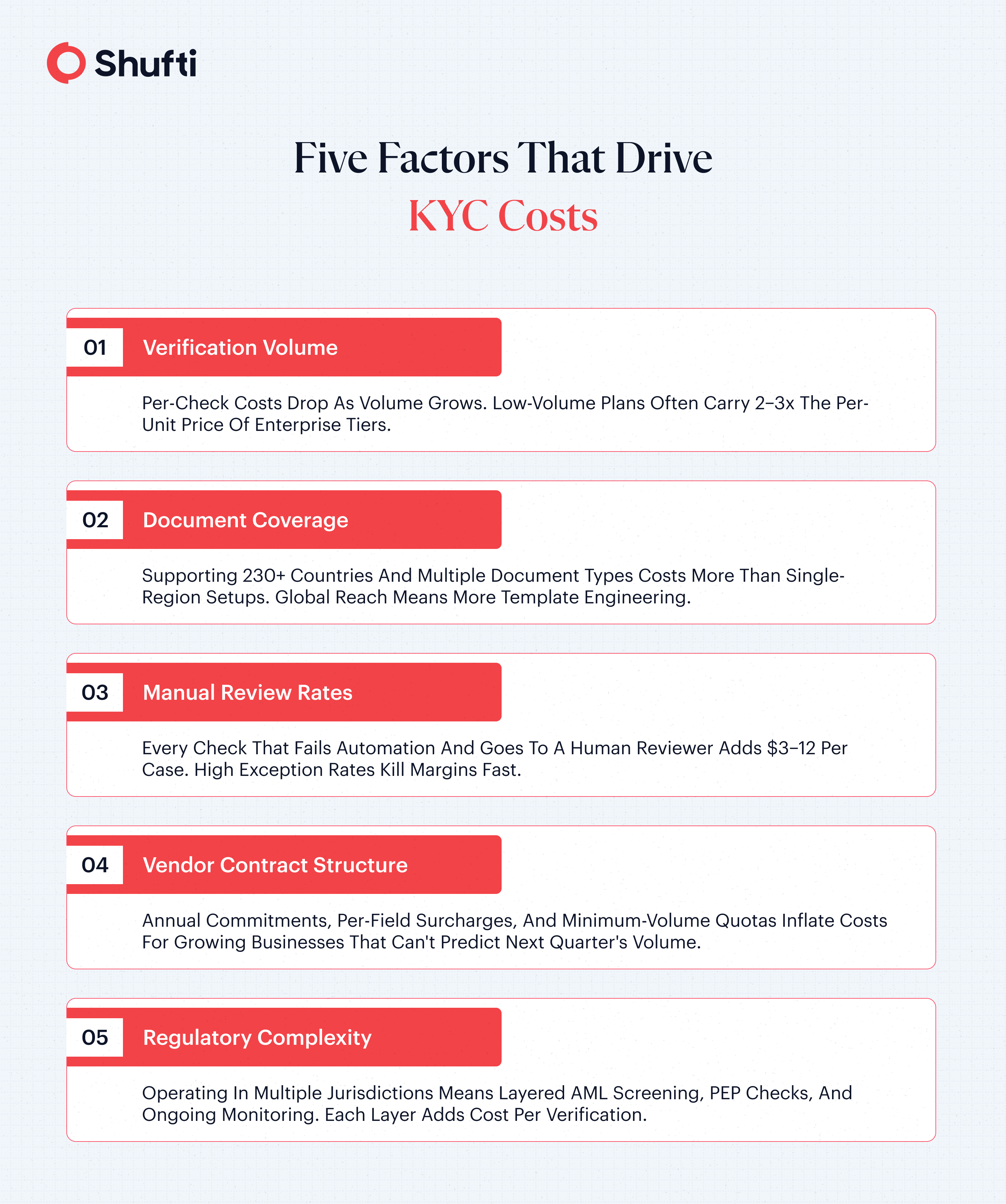
For banks, most of the KYC compliance cost remains a result of manual processes. Compliance analysts verify documents by hand, cross-reference watchlists, chase missing information from clients, and run periodic reviews on accounts that were onboarded years ago.
Fintechs find themselves facing the same problem, although it is a different version of it. They are able to move quickly but very often start with either manual or semi-automated KYC workflows. The growth of fintechs reaches the scale of thousands to hundreds of thousands, as a result cost per verification stays flat while volumes multiply. That creates a breaking point where hiring more compliance analysts becomes unsustainable.
How Digital KYC Solutions Reduce These Costs?
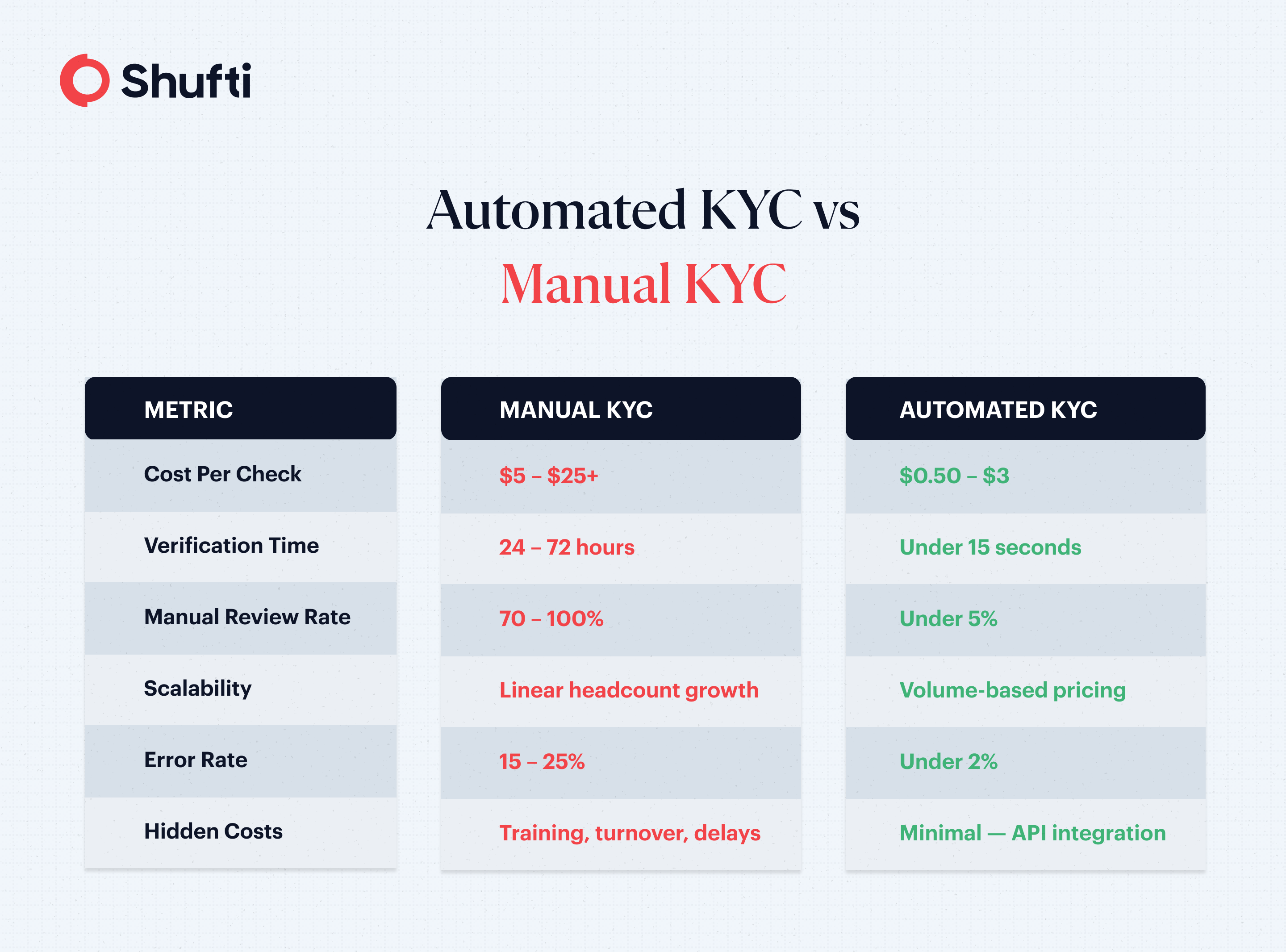
Moving from manual to digital KYC changes the cost structure entirely, not just the speed.
Harvard Business Review research shows that banks are able to reduce their KYC costs by up to 70% through automation. Tasks that take an analyst 4 hours per client, checking documents, matching faces, screening watchlists, can be handled in under 30 seconds through automated identity verification.
Modern, digital KYC solutions also significantly reduce mistakes. Data input that is done manually is one of the biggest sources of false positives in AML screening. Every false positive that triggers a review costs time and money. Automation eliminates most of those.
For fintechs that are specifically API-based KYC pricing models, payment per verification is required instead of maintaining a fixed compliance headcount. At scale, this dramatically lowers the KYC cost per verification as compared to in-house manual processes.
The cost of the platform is covered by that gap within the first quarter, with money left over.
Red Flags in KYC Pricing Models
Not all affordable KYC software is actually affordable once you read the fine print. Watch for minimum monthly commitments that don’t match your volume. Some vendors charge $149 to $500 per month before you run a single check. Others bundle services you don’t need and charge accordingly.
KYC API pricing should be transparent. Per-check pricing with no setup fees, no minimums, as well as relatively clear documentation on what’s included, document verification, face matching, AML screening) versus what costs extra. If the vendor can’t give you a straight answer on pricing, that’s a signal.
How Shufti Helps Lower KYC Compliance Costs?
Shufti handles identity verification, document checks, face matching, and AML screening through a single API. One integration replaces three or four separate vendors, which cuts both build time and the in progress maintenance costs.
Verification takes under 15 seconds for standard checks. That’s compared to the 4-hour manual review cycle most firms are stuck with. Shufti as a platform is well-equipped to cover 240+ countries in 150+ languages, so there’s no need to add regional vendors as you expand.
Shufti Pricing can be pay-as-you-go with no setup fees and no monthly minimums, however there are multiple plans suitable for every company as per their need. For fintechs processing high volumes, this keeps the cost per verification predictable and low. For banks which require the data to be on their own servers, Shufti also offers on-premises deployment alongside its cloud and other available hybrid options.
Want to see the actual cost difference for your verification volume? Request a free demo and get a pricing comparison against your current setup.
Frequently Asked Questions
How much does KYC compliance cost for a bank?
The average annual spend on KYC and AML operations reached, according to an article by International Journal of Information Technology and Management Informations System was 53.3 billion USD in 2023 with a compound annual growth rate of 12.4% through 2027.
How much does KYC compliance cost for fintechs?
It varies by stage and volume. Early-stage fintechs spend an estimated $50,000 to $200,000 annually on compliance operations. At scale, costs grow quickly unless automated KYC tools are in place.
What is the cost of manual KYC vs automated KYC?
Manual KYC typically costs $13 to $130 per check depending on complexity. Automated digital KYC solutions bring down this price significantly.
What is KYC software ROI?
A firm running 10,000 monthly verifications can save $120,000 or more per month by switching from manual to automated KYC. Most platforms pay for themselves within the first quarter.
Why is KYC compliance so expensive for banks?
The biggest cost driver is manual processes. Periodic reviews, document collection, watchlist screening, and false positive investigation all require analyst time.
How can I reduce KYC compliance costs?
Automate the highest-volume, lowest-risk checks first. Use API-based KYC tools that scale with your volume. Consolidate vendors into a single platform to cut integration and maintenance costs.
What is the cost of a KYC compliance failure?
Global AML fines totalled $3.8 billion in 2025. Individual penalties can run from hundreds of thousands to over a billion dollars, plus the reputational damage and client loss that follow.