


 Face Verification
 Address Verification
 Document Verification
 Age Verification
 VideoIdent
 Fast ID
 eIDV
eIDV
 Consent Verification
 NFC Verification
 Business Verification
 Due Diligence
 Investor Verification
 E-Signature

 QES
QES
 AML Screening
 Transaction Monitoring
 Adverse Media
 Business AML Screening
 PEP & RCA
 Sanctions
 Watchlist
 Behavioural Biometrics
 Device Fingerprinting
 1:1 Authentication
 MFA
MFA
 Fraud Hub
 Onboarding
 Ongoing Monitoring
 KYC
KYC
 KYB
KYB
 KYI
KYI
 Age Assurance
 Identity Verification
 Workforce IAM
 Candidate Verification
 Compliance
 Fraud prevention
 Trust & safety
 Global expansion
 Product Managers
 Compliance Officers
 Fraud Analysts
 Developers
 Deepfake
 Bonus Abuse / Promotion Abuse
 Account Takeover
 Synthetic Identity Fraud
 Document Fraud
 Impersonation Fraud
 Multi-Accounting
 Fraud Networks
 Chargeback Fraud
 Money Mule Activity
 Party Fraud
 Regulatory & Compliance Risks
 Fintech
 Crypto
 iGaming
 Forex
Forex
 Social Network
 Marketplace
 Banking
 Gig Economy
 Blind Spot Audit
 Deepfake Detector
 Liveness Spoofs
 Document Originality
 Document Deepfake
 Global Trust Platform
 Journey Builder
 Case Management
 Shufti AI
 Fraud Analytics
 Vendor Comparison
 Brand Personalisation
 IDV Modes
 AI Compliance Co-Pilot
 OCR
OCR
 Secure Capture
 Deployment Options
 Identity Methods
 API Documentation
 Mobile SDKs
 Service Status
 Help Center
 Contact Us
 Technical Support
 Supported Documents

 Content library
 Blogs
Blogs
 News
News
 Reports
 Insights
 Knowledgebase
 ROI calculator
 About
About
 Career
 Press Release
 Certifications
 Partnership
 Awards
 Events & Webinar
 Interactive Demo
 Podcast Studio
 Spotlight Studio
KYC Challenges in 2026 and the Road Ahead

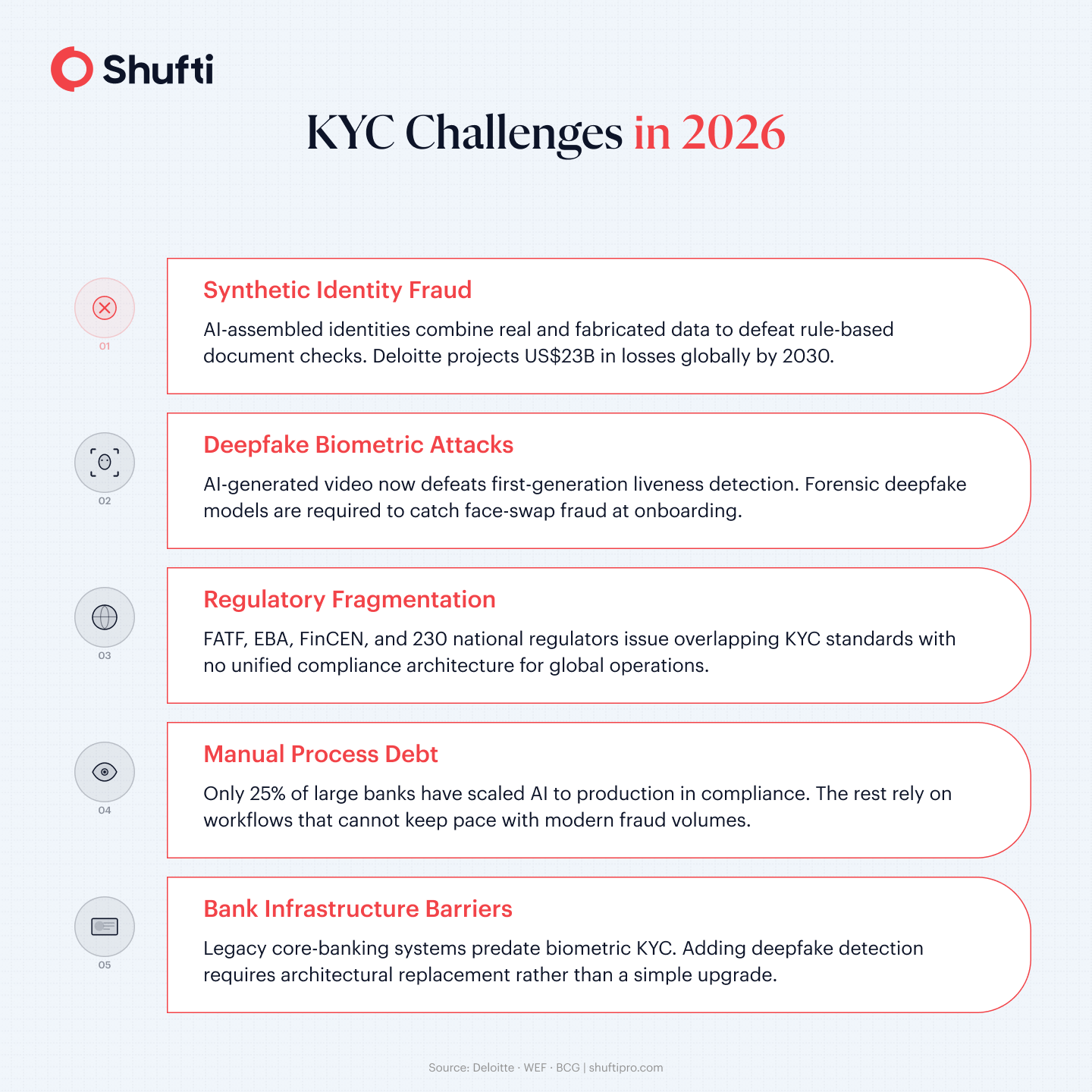
The Deloitte Center for Financial Services projects that synthetic identity fraud losses will hit at least US$23 billion by 2030. The most important part of that number is where those losses originate. Synthetic identities do not slip past overworked analysts. They slip past the checks. KYC systems built around document capture and rule-based screening were designed for a fraud environment that no longer matches what compliance teams encounter today. Regulatory fragmentation has expanded across 230 jurisdictions.
Deepfakes have become accessible enough that a fraudster can construct a convincing biometric attack in minutes. Manual onboarding queues are buckling under the weight of checks that AI-generated threats render insufficient. This article breaks down the five biggest KYC challenges in 2026, examines why existing verification systems struggle to address them, and maps the practical path forward.
KYC challenges are the operational, regulatory, and technical obstacles organizations face when verifying customer identities at scale while meeting compliance requirements. In 2026, those obstacles have grown substantially more complex. The fraud techniques targeting onboarding systems are AI-generated, the regulations governing those systems are fragmented across jurisdictions, and the workflows managing them were often built before either problem existed at this scale.
What are the biggest KYC challenges in 2026?
KYC failures in 2026 trace back to a consistent structural gap. Detection systems built for yesterday’s fraud are now facing today’s attacks. Whether the failure mode is a liveness check designed for static image fraud, a screening workflow with no continuous monitoring layer, or a regulatory framework assembled from conflicting national standards, the underlying pattern is the same. The five challenges below are where that structural gap is widest.
Synthetic identity fraud
Synthetic identity fraud now accounts for the majority of new account fraud cases, according to the Deloitte Center for Financial Services. Unlike traditional identity theft, which relies on a single stolen record, synthetic fraud combines real and fabricated data fragments (a real national ID number, a constructed name, a manufactured credit history) to build an identity that passes standard document checks without a single stolen file. Rule-based verification systems that check document authenticity alone cannot detect this type of fraud because the identity is internally consistent. Catching it requires behavioral cross-referencing and biometric matching across multiple data points, which most legacy onboarding stacks were not built to perform.
Deepfake and AI-generated biometric attacks
The World Economic Forum’s 2026 cybercrime report identifies deepfakes as a growing systemic threat to digital identity verification, targeting liveness checks designed for static image fraud. AI-generated video and audio can now replicate genuine facial movement with enough fidelity to defeat first-generation liveness detection systems. A fraudster does not need to steal a face to launch this attack.
The technique uses publicly available images assembled into a convincing synthetic video, then presented through an automated biometric check. Liveness systems that measure head movement or blink detection as their primary signal are insufficient against this attack vector. Only forensic AI models trained specifically on deepfake artifacts can reliably distinguish a constructed identity from a real one at scale.
Regulatory fragmentation across jurisdictions
The Financial Action Task Force (FATF), the European Banking Authority (EBA), and national regulators across 230 countries each issue KYC requirements that overlap without being consistent. A business operating in the EU, the UK, and Singapore simultaneously faces three distinct compliance standards, with incompatible enhanced due diligence triggers, different beneficial-ownership thresholds, and conflicting data-retention rules.
The EU Anti-Money Laundering Package introduces a new EU AMLA supervisory layer on top of existing national frameworks, requiring firms to reconcile their procedures with binding standards that interact unpredictably with what they already operate. For businesses managing KYC compliance across multiple jurisdictions, regulatory fragmentation is not a temporary complexity. It is the permanent operating environment.
Manual process debt and KYC automation challenges
Manual KYC workflows create compounding operational risks that the scale of modern fraud makes worse. When analysts spend hours per file on document review, re-verification, and data reconciliation, the onboarding queue backs up, high-risk sessions go unreviewed, and the compliance function becomes a bottleneck on revenue rather than an enabler of it.
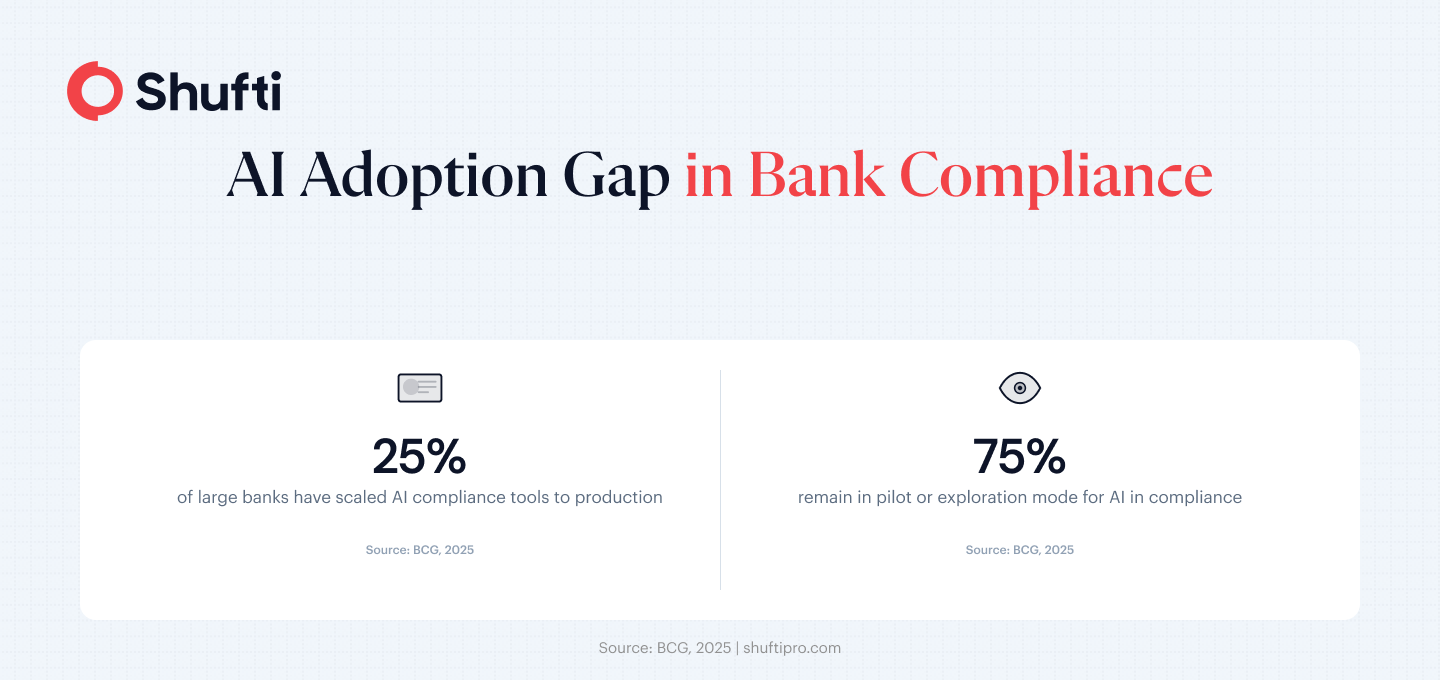
According to BCG’s 2025 analysis of bank compliance transformation, only 25% of large and regional banks have successfully scaled AI or GenAI tools to production within their compliance function. The remaining 75% are still in pilot or exploration mode. The cost of that gap shows up in analyst hours, onboarding drop-off rates, and the compliance blind spots created when manual workflows cannot keep pace with onboarding volumes.
KYC challenges for banks specifically
Banks operate under a distinct set of constraints that amplify KYC challenges at every layer. High onboarding volumes, the specificity of FFIEC and Basel III customer due diligence requirements, and legacy core-banking infrastructure all contribute to a situation where integrating modern KYC compliance software into an existing bank stack is an architectural undertaking rather than a straightforward procurement decision.
Many banks still route document verification through semi-manual review queues designed before biometric liveness verification was a standard check. When a bank’s verification layer predates current biometric technology, adding deepfake detection means replacing that layer rather than extending it. That distinction carries timeline and budget implications most KYC transformation assessments underestimate.
How is AI transforming KYC automation in 2026?
Artificial intelligence addresses KYC automation challenges not as a single tool but as a category of capabilities, each solving a different layer of the onboarding problem. AI KYC solutions tackle document fraud at the forensic level, deepfake attacks at the biometric layer, and manual process debt through workflow automation.
McKinsey’s 2025 research on agentic AI in banking describes systems that automate KYC checks, customer refresh cycles, transaction monitoring, and sanctions investigations from alert to case closure. Understanding what each AI layer actually does is the starting point for a practical modernization roadmap.
AI KYC tools for document and identity fraud detection
AI-powered document verification moves beyond checking whether an identity document is authentic and begins analyzing whether the person presenting it matches the document’s biometric data, whether the document has been digitally altered, and whether the identity’s behavioral history is consistent with a real customer profile.
Machine learning models trained on fraud patterns, including altered MRZ zones, font inconsistencies, and metadata mismatches, can flag manipulated documents that pass visual inspection. Combining document analysis with database cross-referencing allows a KYC automation platform to detect synthetic identities by their inconsistency footprint rather than their document quality alone, which is the only reliable detection path when the document itself is technically valid.
Biometric liveness and deepfake detection
Effective liveness detection in 2026 requires models trained specifically on AI-generated artifacts rather than only on traditional liveness cues. A forensic deepfake detection system analyzes textural inconsistencies, compression artifacts, and physiological signals that deepfake generation models introduce in predictable ways. Advanced KYC systems layer liveness verification with deepfake forensics so that a passed liveness test and a passed deepfake test are two separate gates rather than a single combined score. The distinction matters in practice. A deepfake that passes liveness does so by replicating liveness signals, but it remains detectable at the forensic layer when the model was trained for that specific artifact class.
Continuous monitoring and fraud prevention trends
Static onboarding KYC, where a customer is verified once at account opening, is no longer sufficient given how fraud patterns evolve after account creation. Continuous KYC reassesses risk signals throughout the customer lifecycle, covering transaction behavior changes, new device registrations, geographic anomalies, and real-time sanctions-list updates.
The shift toward event-driven re-verification is one of the defining fraud prevention trends in 2026. A customer’s KYC status updates automatically when a risk trigger fires rather than on a fixed annual review schedule. This approach reduces manual refresh cycles while keeping risk exposure current. Businesses seeking guidance on AML compliance and ongoing monitoring are increasingly treating perpetual KYC as the baseline standard rather than an enhanced-due-diligence option.
How Shufti helps compliance teams navigate KYC challenges
Synthetic identity fraud, deepfake attacks, and regulatory fragmentation each require a different technical response. Most compliance teams discover this only after a single-point verification solution fails at a second challenge it was never designed to address. Businesses evaluating KYC solutions in 2026 face a practical question about pipeline ownership. Which verification infrastructure can detect threats at each layer without requiring a separate vendor integration per attack vector.
Shufti’s identity verification platform handles document verification, biometric liveness, and forensic deepfake detection through a single API, processing full KYC checks in under 15 seconds across 230 countries with support for 10,000 document types and nearly 100 OCR languages.
For teams managing ongoing compliance, Shufti’s fraud prevention solutions include continuous AML screening against 100,000 data sources updated every 15 minutes, so onboarding KYC and ongoing monitoring run from the same pipeline rather than separate vendor stacks. When a sanctions-list update, PEP designation, or adverse media hit triggers a risk signal, re-verification happens automatically rather than waiting for the next scheduled review cycle. That is what closing the advanced KYC systems gap looks like in practice. The goal is a different architecture that treats verification as a continuous signal rather than a one-time event, not a faster version of the existing manual workflow.
Legacy KYC processes designed for static document review are now the weak point in onboarding, exposed by synthetic identities that pass document checks and deepfakes that defeat liveness systems built for an older generation of fraud.
Shufti’s AI-powered know your customer platform combines document verification, biometric liveness, and forensic deepfake detection in a single API so compliance teams stop threats at each layer without managing separate vendor relationships. Request a demo to run your onboarding scenarios through Shufti’s verification pipeline and see how it handles synthetic identity, deepfake, and cross-border compliance challenges in your environment.
Frequently Asked Questions
What are the biggest KYC challenges in 2026?
The five biggest KYC challenges in 2026 are synthetic identity fraud, deepfake biometric attacks, regulatory fragmentation across jurisdictions, manual process debt from legacy systems, and bank-specific infrastructure barriers that make integrating modern verification tools an architectural project rather than a procurement decision.
How is AI used to overcome KYC challenges?
AI addresses KYC challenges through document fraud detection, forensic deepfake analysis, biometric liveness verification, and continuous risk monitoring. As of 2025, McKinsey's research on agentic AI shows these systems can automate end-to-end KYC from initial onboarding through ongoing re-verification and monitoring.
What is synthetic identity fraud and how does it challenge KYC?
Synthetic identity fraud combines real and fabricated data to create fictitious identities that pass standard document checks. Per Deloitte's analysis, it accounts for the majority of new account fraud because rule-based KYC cannot detect an identity that is internally consistent but structurally fabricated.
What are KYC challenges specific to banks?
Banks face FFIEC-specific due diligence requirements, high onboarding volumes, and legacy core-banking infrastructure built before biometric KYC existed. Integrating modern KYC verification tools into a bank's existing stack typically requires architectural changes rather than simple integrations, extending implementation timelines and budgets considerably.
How does regulatory fragmentation challenge global KYC?
The Financial Action Task Force (FATF), EBA, FinCEN, and national regulators each set overlapping but inconsistent KYC standards. A business operating across the EU, UK, and APAC must reconcile conflicting enhanced due diligence triggers, beneficial-ownership thresholds, and data-retention rules with no single unified compliance framework covering all three.