AMLR Solutions
 AMLR Consultation
 Onboarding
 Ongoing Monitoring
 FRAML
FRAML KYC
KYC KYB
KYB KYI
KYI Age Assurance
 Workforce IAM
 Candidate Verification
 Account Takeover
 Bonus/ Promotion Abuse
 Chargeback Fraud
 Deepfake
 Document Fraud
 Fraud Networks
 Impersonation Fraud
 Money Mule Activity
 Multi-Accounting
 Party Fraud
 Regulatory & Compliance Risks
 Synthetic Identity Fraud
 Adult Content
 Banking
 Crypto
 Fintech
 Forex
Forex Compliance
 Fraud prevention
 Trust & safety
 Global expansion
 Compliance Officers
 Developers
 Fraud Analysts
 Product Managers
 Advanced Journey Builder (AJB)
 Global Trust Platform
 Customer Profiles
 Vendor Comparison
 IDV Case Management
 AML Case Management
 Regulatory Reporting
 Travel Rule Protocols
 Agentic Rule Builder
 AI Compliance Co-Pilot
 Fraud Analytics
 Fraud Hub
 OCR
OCR Shufti AI
 Bank Account Verification
 Biometric Duplication
 Database Checks
 Document Intelligence
 Government ID
 Mobile Driver's License
 NFC
NFC Selfie Liveness
 Brand Personalisation
 Deployment Options
 Identity Methods
 IDV Modes
 Multi-tenancy
 On-Premise IDV
 Secure Capture
















“Manual verification is a bottleneck. Even when the team works fast, the tooling kills the conversion rate.” That observation came from compliance leads at three separate fintechs last quarter, each describing the same problem in nearly identical language.
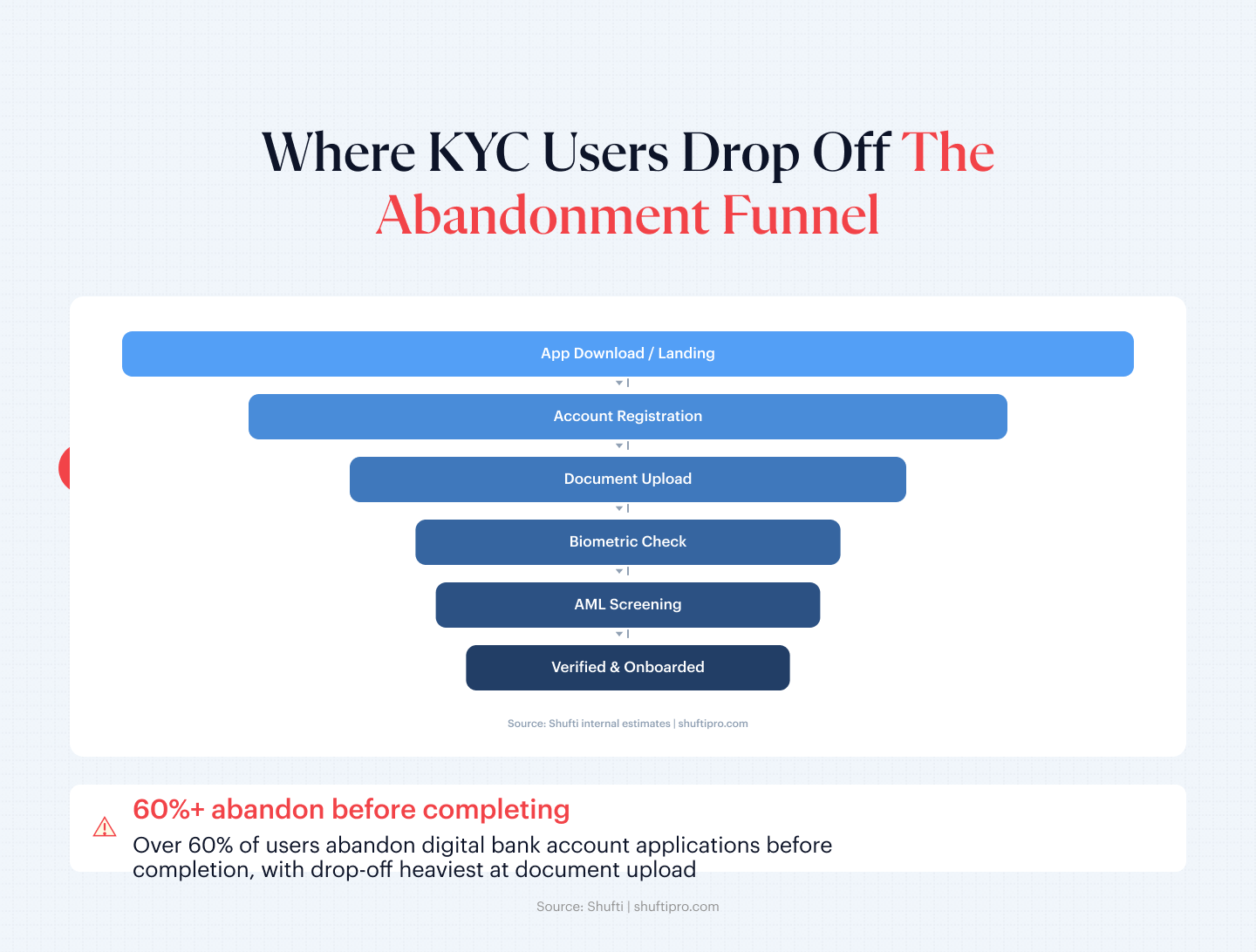
It is well established that a significant share of users abandon digital onboarding before completing the KYC steps, and that drop-off is rarely random; it clusters precisely where the process demands the most from the user. KYC drop-off is not an inevitable compliance cost. The design of your onboarding flow determines how many verified customers come out the other side.
Why do users drop off during KYC onboarding?
KYC onboarding UX failures split into two categories. The first is flow design problems that create active friction at the document upload, biometric, or review stage. The second is expectation gaps, where users arrive unprepared for the documentation or time the session requires. Both cause abandonment, and both are fixable without weakening the underlying verification controls.
The friction points that stall users
In KYC flows, unclear upload instructions, strict file-format requirements, and rejection messages without retry guidance stack on top of each other. Users who hit one friction point without a clear path forward rarely return to complete the session in the same day, let alone the same hour.
Which industries see the highest KYC drop-off
Financial services carries the sharpest KYC abandonment rate, given the depth of identity checks required for bank accounts, lending products, and crypto trading. Gaming operators face a distinct pattern. Mandatory age verification and identity checks required before a first deposit create a gap between app install and active play that drives many users away before they ever engage.
Fintech platforms serving cross-border customers face an additional layer of friction. Certain passport types register lower OCR accuracy, forcing retries that push the session past most users’ patience threshold and turn an onboarding flow into a support ticket.
7 UX fixes to reduce KYC drop-off
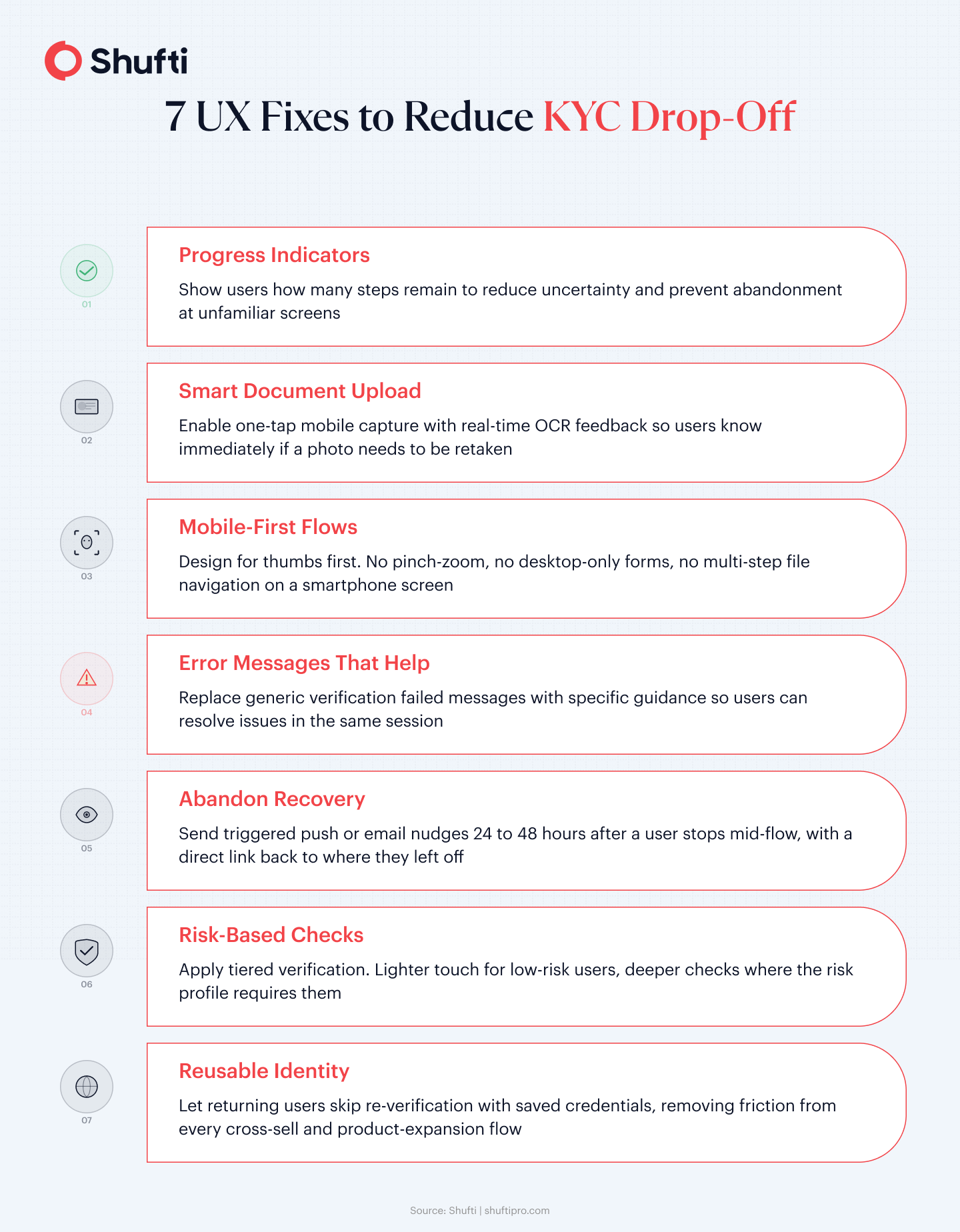
Seven design changes address most KYC onboarding abandonment without touching the underlying verification logic. Each one targets a specific friction point in the funnel, from the first screen a user sees to the notification they receive if they leave mid-flow. Three or four of these fixes, applied together, produce measurable KYC conversion rate improvement, and none require a relaxed compliance standard.
1. Add progress indicators
Progress indicators reduce KYC drop-off by removing one of its most common causes. When users cannot see how many steps remain, they quit at the first unfamiliar screen rather than pushing through.
A status bar with distinct phases for document upload, biometric check, and identity review gives users enough context to continue. Compliance teams can add progress indicators without changing any verification step in the underlying flow, which makes this the lowest-effort fix on this list.
2. Enable smart document capture
Smart document capture lets users photograph their ID in a single tap instead of navigating a file upload dialog. Real-time OCR feedback tells users when an image is too blurry or cut off, rather than surfacing a rejection message minutes later with no guidance.
This change alone cuts abandonment at the document upload step, which UX research on banking onboarding consistently identifies as the single highest drop-off point in the entire KYC funnel.
3. Design for mobile screens first
Mobile-first KYC design treats phone-based document capture and biometric selfies as the primary interaction model, not the exception. Desktop-ported flows that require pinch-zoom gestures, small-target form fields, or multi-step file navigation create digital onboarding friction immediately on smartphones.
Most KYC sessions start on mobile, which means the majority of drop-off is a mobile problem. Flows built around camera-direct capture, large tap targets, and single-screen steps complete at meaningfully higher rates.
4. Replace generic error messages with specific guidance
Generic error messages drive KYC abandonment at the retry stage. A message reading “Verification failed. Please try again.” gives the user no path forward. Specific guidance, such as “Your document appears expired. Please upload a valid passport or national ID,” lets the user resolve the issue in the same session. KYC verification UX fixes at the error-message layer require no changes to the verification logic itself, only to the copy surfaced when a check fails.
5. Build an abandon-recovery workflow
An abandon-recovery workflow sends a re-engagement notification when a user stops mid-KYC. A push notification or email sent 24 to 48 hours after session abandonment, with a direct link to the exact step where the user stopped, recovers a measurable share of dropped users without support-team involvement.
This is the most commonly skipped item on a KYC onboarding checklist. Product teams treat it as optional until they see the volume of unrecovered sessions sitting in their funnel data each week.
6. Apply tiered verification based on risk level
Risk-based verification applies lighter checks to lower-risk users and deeper checks where the risk profile warrants them. A user depositing below a reporting threshold in a low-risk geography needs a different onboarding path than a high-value account seeking institutional access.
This risk-based KYC approach reduces verification time and drop-off for the majority of users who represent lower compliance exposure, without lowering the bar for those who represent higher risk.
7. Enable reusable identity for returning users
Reusable identity verification lets users who have already completed KYC skip re-verification when returning or adding new products. A user who verified to open a savings account should not need to re-submit documents for a follow-on product from the same provider. KYC automation tools that support reusable credential storage at the API layer make this possible.
A well-designed KYC API integration returns a stored verification token on subsequent sessions, cutting drop-off on every cross-sell and product-expansion flow. Research on AI-powered KYC automation shows that reusable credentials are now deployable at scale through standard identity verification APIs.
How can compliance teams balance UX and regulatory requirements?
KYC compliance solutions and strong UX are not at odds by default. The Financial Action Task Force (FATF) Guidance on Digital Identity, published in 2020 and updated through 2024, explicitly recognises digital onboarding methods that meet equivalent risk-based assurance levels to in-person checks. Friction reduction in onboarding is fully consistent with the FATF risk-based approach, provided the controls behind the flow remain intact.
KYC UX best practices and compliance documentation belong in the same planning cycle. Compliance teams that audit existing flows against current FATF guidance often find friction with no regulatory basis. A document type added to a 2015 workflow to satisfy a policy that no longer applies is friction, not a control. The documentation needed to remove it is a rationale that the step no longer meets current guidance requirements. The verification standard itself does not change.
KYC funnel optimization becomes a shared objective when product and compliance teams review the same abandonment data. A verified-user completion rate as a shared KPI aligns both teams around reducing KYC abandonment across all user segments, without relaxing the controls that matter most.
Where Shufti fits in the onboarding flow
For teams applying the fixes above, the implementation layer is where design choices become live customer experiences. Shufti’s identity verification platform completes full KYC in under 15 seconds via a single API call. That speed addresses the abandonment that design changes alone cannot fix. A user who waits three minutes for a verification result will abandon regardless of how clear the progress indicator is.
The no-code Journey Builder lets compliance and product teams configure verification workflows directly, without engineering involvement. Tiered checks, mobile-first capture flows, and abandon-recovery triggers are all adjustable in the builder without writing a line of code. Teams evaluating the best KYC software for user onboarding should look for a platform that handles all seven UX requirements through a single integration.
Shufti processes over 280 million identity checks annually across 240+ countries and territories, making the platform practical for both high-volume fintech onboarding and regulated financial services.
High KYC drop-off is a funnel design problem, and most of the fixes above require design changes rather than compliance trade-offs. Shufti’s KYC platform delivers sub-15-second identity checks and configurable onboarding workflows through a single API, giving teams the infrastructure to ship all seven UX fixes without rebuilding their stack. Request a demo to walk through a live onboarding flow on your own data and see where the drop-off points resolve.
Frequently Asked Questions
Why do users drop off during KYC onboarding?
KYC drop-off occurs when verification flows create more friction than users expect. Common causes include unclear document upload steps, slow processing, repeated retry loops after failed biometric checks, and no indication of how many steps remain. Poor mobile UX is the most frequent root cause in financial services.
What UX fixes can reduce KYC abandonment?
The highest-impact fixes are progress indicators to reduce uncertainty, smart document capture to cut upload failures, and mobile-first screen design. Abandon-recovery notifications recapture users who leave mid-flow. Specific error messages that guide users through retries also reduce KYC abandonment at the retry stage.
How does automation improve KYC conversion rates?
KYC automation tools reduce the manual review steps that extend onboarding sessions past users' patience thresholds. Automated OCR, real-time biometric checks, and instant screening complete the full Know Your Customer process in seconds, well before most users would consider abandoning the flow.
What role does mobile optimization play in KYC UX?
Most KYC sessions start on mobile. Desktop-ported flows create friction through poor camera integration, small tap targets, and multi-step file uploads. Mobile-first design with camera-direct document capture, single-screen steps, and thumb-friendly layouts cuts digital onboarding friction for the majority of users.
How can compliance teams balance UX and regulatory requirements?
FATF's Guidance on Digital Identity recognises digital onboarding methods that meet risk-based assurance standards. Compliance teams auditing their flows against current FATF guidance often find friction with no regulatory basis. That finding means UX improvements and KYC compliance solutions can align without lowering verification standards.