AMLR Solutions
  AMLR Consultation
 EUDI Wallet
 Onboarding
 Ongoing Monitoring
 FRAML
FRAML KYC
KYC KYB
KYB KYI
KYI Age Assurance
 Workforce IAM
 Candidate Verification
 Account Takeover
 Bonus/ Promotion Abuse
 Chargeback Fraud
 Deepfake
 Document Fraud
 Fraud Networks
 Impersonation Fraud
 Money Mule Activity
 Multi-Accounting
 Party Fraud
 Regulatory & Compliance Risks
 Synthetic Identity Fraud
 Adult Content
 Banking
 Crypto
 Fintech
 Forex
Forex Compliance
 Fraud prevention
 Trust & safety
 Global expansion
 Compliance Officers
 Developers
 Fraud Analysts
 Product Managers
 Journey Builder
  Global Trust Platform
 Customer Profiles
 Vendor Comparison
 IDV Case Management
 AML Case Management
 Regulatory Reporting
 Agentic Rule Builder
  AI Compliance Co-Pilot
  Fraud Analytics
 Fraud Hub
  OCR
OCR Shufti AI
 Bank Account Verification
  Biometric Duplication
 Database Checks
 Document Intelligence
 Government ID
 Mobile Driver's License
 NFC
NFC Selfie Liveness
 Brand Personalisation
 Deployment Options
 Identity Methods
 IDV Modes
 Multi-tenancy
 On-Premise IDV
 Secure Capture
 Shufti MCP













TL:DR
- Synthetic identity fraud blends breached personal data, AI-generated documents, and a deepfake selfie.
- Malta hosts 300+ MGA-licensed operators, a concentrated target for coordinated bonus-abuse rings.
- A single ring runs 30 to 200 composite accounts in parallel.
- The fraud reads as a steady promo-budget drain, not one clear alert.
- The MGA and the FIAU audit the same registration event, so identity data quality drives STR quality.
- Shufti binds document, liveness, and face-match into one decision in under 15 seconds.
“We pass the audits, but the bonus spend keeps drifting.”
That sentence came out of three separate calls with compliance leads at Malta Gaming Authority (MGA) licensees in Q1 2026, and it describes the exact fingerprint of synthetic identity fraud. The attack rarely triggers a dramatic alert. It shows up instead as a steady erosion of promotional budget and a creeping manual review queue, visible only when someone plots four months of welcome-bonus data on the same chart.
Malta’s iGaming market has become a concentrated target for this pattern. This article maps how the fraud plays out on a Malta registration window, what the MGA and the Financial Intelligence Analysis Unit (FIAU) expect when it does, and where a combined face-and-document verification flow closes the gap that three separate tools tend to leave open.
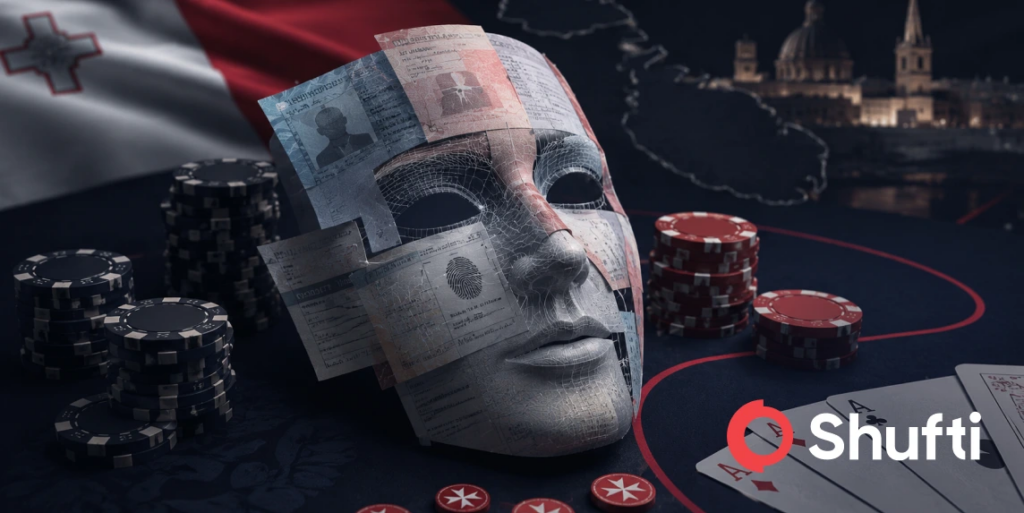
Synthetic identity fraud is the creation of a fictitious person by stitching together real breached data (a valid name, a stolen national ID number, a reused address) with AI-generated or hybrid document images and a deepfake-assisted selfie. The identity does not map to a real human, but it passes enough checks to register, deposit, and claim a welcome bonus. A coordinated ring runs dozens of these in parallel.
Why does Malta’s iGaming market draw synthetic identity fraud rings?
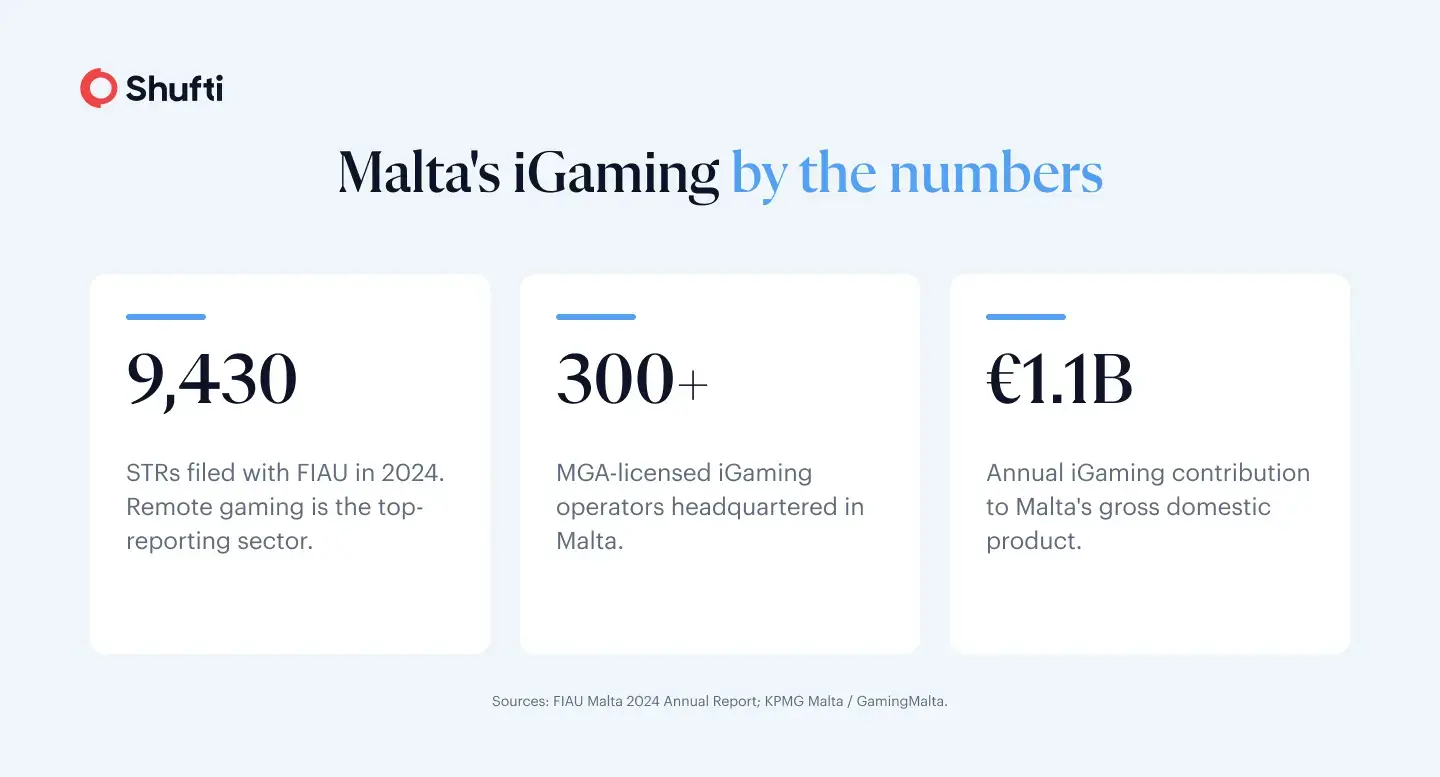
Malta carries a disproportionate share of Europe’s online gaming traffic relative to its population, and that density is the first condition fraud rings look for. More than 300 MGA-licensed operators are headquartered on the island, and the sector contributes over €1.1 billion a year to Malta’s gross domestic product, according to KPMG Malta’s iGaming practice.
The second condition is a global player base. MGA licensees accept registrations from more than a hundred countries, which gives a fraudster access to document formats from dozens of jurisdictions at a single registration page.
Three structural factors pile on.
First, welcome-bonus spend per player is high because operator competition is fierce and customer acquisition cost is a board-level metric.
Second, MGA-licensed platforms must verify every player to the same regulatory standard regardless of where the player sits geographically, which creates a wide surface area for impersonation.
Third, the FIAU received 9,430 suspicious transaction reports in 2024 (an increase of 3% year-on-year), and remote gaming remains the top-reporting sector in the country. Fraud rings know an attack here gets written up quickly, but they also know the volume keeps scrutiny diffuse.
How does synthetic identity fraud play out on a Malta registration window?
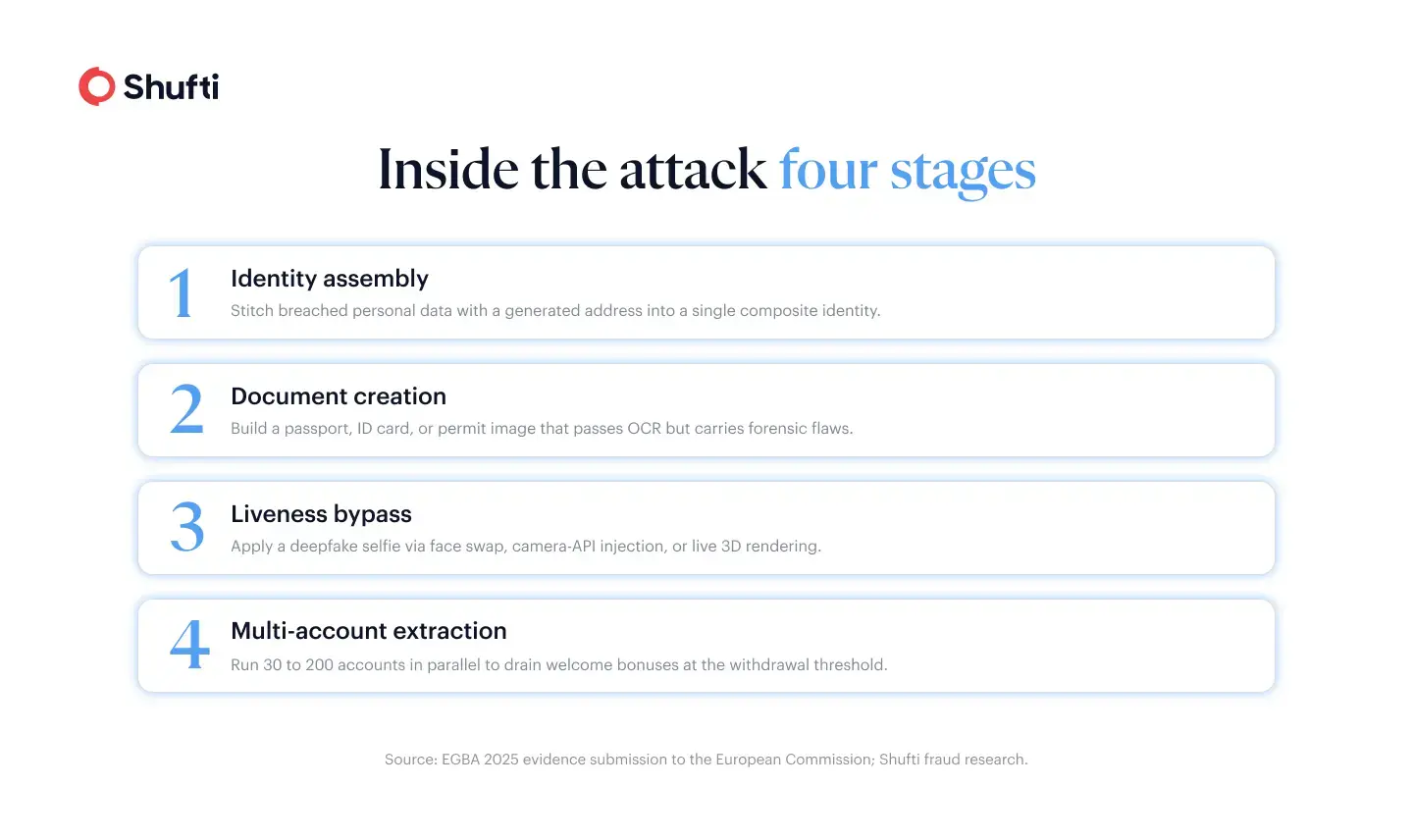
The registration window on a licensed Maltese platform is where the attack succeeds or fails. Understanding the four stages matters because the defence has to be placed at the right stage. A fraud ring does not run a single attack. It runs a pipeline.
Identity assembly
The ring starts with leaked personal data sold in bulk on closed channels. A European breach gives a name, a date of birth, and sometimes a national ID number. Address data comes from a separate breach or from a generative model trained to output plausible Maltese, Italian, or Spanish addresses. The finished identity is never a real person and never a fully fabricated one. It is a composite with just enough real data to pass a database cross-check.
Document creation
The ring produces or buys a template-quality image of a passport, residence permit, or national ID card, then populates the MRZ zone with values consistent with the assembled identity. Template quality has improved sharply in the last eighteen months because the models used to generate them are the same models players legitimately use for photo editing. Anything that fails basic OCR is dropped before submission. Whatever passes OCR but carries forensic inconsistencies gets submitted anyway, because most operators do not run forensic checks by default.
Liveness bypass
A deepfake selfie is attached to the identity through one of three methods, typically a frame-by-frame face swap against a cooperating human, a video injection at the mobile camera API, or a 3D-rendered face driven in real time from a live studio. The European Gaming and Betting Association’s 2025 evidence submission to the European Commission explicitly calls out deepfake-enabled synthetic identity creation as a method currently used to exploit promotional bonuses and enable multi-accounting on licensed European platforms.
Multi-account bonus extraction
The first account deposits the minimum needed to claim the welcome bonus, then plays it to the withdrawal threshold through a sequence of low-variance bets. A single ring runs thirty to two hundred accounts in parallel, each on a different composite identity. Behaviour at the individual account level looks unremarkable, and the pattern only surfaces when someone correlates play across the full cohort
Stop synthetic identities before the first deposit
Shufti binds document authentication, liveness, and face match into one decision in under 15 seconds.
What MGA rules and the FIAU actually expect at onboarding?
Malta’s regulatory architecture is specific, and it treats identity verification as a primary compliance control rather than a tick-box. Two authorities matter here. The MGA sets gaming licence conditions, while the FIAU handles anti-money laundering and suspicious-activity reporting. Both sets of obligations land in the same registration window.
The MGA Player Protection Directive requires licensees to establish strong controls and procedures covering every stage of the player relationship, starting with identity verification at registration. Under that directive, verification must be completed before any wager is placed where relevant conditions apply, which turns the verification window into a hard commercial and compliance pinch point. If the flow is slow, legitimate players abandon. When it is loose, synthetic identities get in.
On the AML side, Malta’s Prevention of Money Laundering and Funding of Terrorism Regulations (PMLFTR) require subject persons (which includes every MGA licensee) to carry out customer due diligence (CDD) at onboarding and to file Suspicious Transaction Reports (STRs) when player behaviour or source-of-funds indicators warrant it.
Across 2024, the FIAU conducted 187 supervisory interventions and took over 70 compliance actions through remediation or administrative measures, with remote gaming among the most scrutinised sectors. Practically, onboarding controls get audited backwards from STR quality. When STRs rest on shaky identity data, they read as operational failure rather than diligence.
Where does Shufti smooth the player-onboarding flow?
The gap most operators live with is architectural. A document-verification vendor, a separate liveness vendor, and a separate AML screening stack leave handoff seams that synthetic identity rings target specifically. Shufti’s approach is to bind the three checks together in a single decision event and return one defensible verdict.
In practical terms, that means a player presents a document, the document is authenticated against 10,000+ templates, the selfie is captured with active or passive liveness, and the face is matched back to the document photo in the same transaction.
The face verification layer covers 56+ anti-spoofing attack vectors, including AI-generated deepfake injection, 3D mask attacks, and video replay, and was named a top performer in the United States Department of Homeland Security’s 2025 Remote Identity Validation Rally (DHS RIVR 2025) across diverse demographic groups. Combined document and biometric verification is completed in under fifteen seconds at a 99.5% pass rate for legitimate players, which keeps the MGA’s pre-wager timing obligation intact without degrading conversion.
One SDK, one audit trail, one decision. That is the architectural point. The FIAU’s expectations and the MGA’s requirements both land on the same event record, which shortens the paper trail every thematic review eventually asks for.
Synthetic identity fraud doesn’t announce itself on a Maltese iGaming platform. It arrives as a steady drain on promotional budget, a creeping manual review queue, and a pattern that only becomes visible when it lands in the FIAU’s next annual report or the MGA’s next thematic review.
Shufti’s face verification binds live liveness to a document photo in under fifteen seconds, covering 56+ anti-spoofing attack vectors, including AI-generated deepfake injection, and sits inside the same API that also handles document, NFC, AML, and KYB for a single audit trail that regulators can read.
Frequently Asked Questions
What is synthetic identity fraud in an iGaming context?
Synthetic identity fraud in iGaming is the creation of a fictitious player by combining stolen personal data with AI-generated or hybrid documents and a deepfake selfie. The identity never maps to a real person, but it passes enough onboarding checks to register an account, deposit, and extract a welcome bonus. Rings runs dozens of these accounts in parallel on a single platform.
How do fraud rings actually abuse welcome bonuses on MGA-licensed platforms?
A ring registers anywhere between thirty and two hundred composite identities on a platform, deposits the minimum amount required to claim each welcome bonus, and plays the bonus through to the withdrawal threshold using low-variance wagers. Each account looks legitimate on its own. The abuse surfaces only when behaviour is correlated across accounts or when identity data is cross-checked for reuse patterns.
What does the MGA require for player verification under the Player Protection Directive?
Under the Player Protection Directive, MGA licensees must establish identity-verification controls at registration and, where applicable, complete verification before a wager is placed. Those obligations are anchored in Malta's broader Remote Gaming Regulations and reinforced by the PMLFTR's CDD requirements, meaning operators are held to both a gaming-licence standard and an AML standard on the same registration event.
How does liveness detection catch a deepfake selfie during KYC?
Strong liveness detection combines active signals (small prompted movements), passive signals (3D depth analysis, texture, and lighting forensics), and injection-attack detection at the camera API layer. A face-swap deepfake typically fails on at least one of the three because it cannot replicate genuine 3D depth, real-world lighting response, and device-native capture signals at the same time. Single-signal liveness catches far fewer attacks than a layered stack.
Why has Malta's iGaming market become a target for coordinated bonus-abuse rings?
Malta concentrates more than 300 MGA-licensed operators in one jurisdiction, accepts a globally diverse player base, and runs a competitive welcome-bonus market. That combination offers fraud rings' scale, document-format variety, and a high payout per successful composite identity. The FIAU's reporting data confirms remote gaming as the leading suspicious-transaction-reporting sector in the country, which makes the problem visible but also diffuse.