AMLR Solutions
  AMLR Consultation
 EUDI Wallet
 Onboarding
 Ongoing Monitoring
 FRAML
FRAML KYC
KYC KYB
KYB KYI
KYI Age Assurance
 Workforce IAM
 Candidate Verification
 Account Takeover
 Bonus/ Promotion Abuse
 Chargeback Fraud
 Deepfake
 Document Fraud
 Fraud Networks
 Impersonation Fraud
 Money Mule Activity
 Multi-Accounting
 Party Fraud
 Regulatory & Compliance Risks
 Synthetic Identity Fraud
 Adult Content
 Banking
 Crypto
 Fintech
 Forex
Forex Compliance
 Fraud prevention
 Trust & safety
 Global expansion
 Compliance Officers
 Developers
 Fraud Analysts
 Product Managers
 Journey Builder
  Global Trust Platform
 Customer Profiles
 Vendor Comparison
 IDV Case Management
 AML Case Management
 Regulatory Reporting
 Agentic Rule Builder
  AI Compliance Co-Pilot
  Fraud Analytics
 Fraud Hub
  OCR
OCR Shufti AI
 Bank Account Verification
  Biometric Duplication
 Database Checks
 Document Intelligence
 Government ID
 Mobile Driver's License
 NFC
NFC Selfie Liveness
 Brand Personalisation
 Deployment Options
 Identity Methods
 IDV Modes
 Multi-tenancy
 On-Premise IDV
 Secure Capture
 Shufti MCP


















The Gun Control Act (GCA) has governed minimum-age requirements for firearm purchases in the United States since 1968. What the Act’s framers did not anticipate was a world in which buyers browse, select, and pay for firearms online, often days before setting foot inside a licensed dealer. That gap between online checkout and physical transfer is exactly where modern age verification must operate. For federal firearms licensees (FFLs) running e-commerce channels, getting this right is not a matter of best practice; it is a legal baseline, and some states are now writing specific penalties for falling short.
Age verification for firearms refers to the process of confirming that a prospective buyer meets the statutory minimum age before completing an online purchase or initiating a licensed transfer. For FFL dealers with e-commerce channels, this check sits upstream of the physical point of sale, applied at checkout before any shipping or transfer instruction is issued.
As online sales channels grow and states begin codifying what “reasonable” pre-sale verification looks like, compliance teams face a two-layer obligation: satisfy federal minimums and track an evolving patchwork of state requirements. This article maps both layers, explains how the online-to-FFL transfer model creates a distinct verification point, and sets out what document-level age checks at checkout must accomplish.
What does federal law require for firearm age verification?
The Gun Control Act, 18 USC 922, places minimum-age obligations squarely on FFLs. The Bureau of Alcohol, Tobacco, Firearms and Explosives (ATF) publishes guidance that distinguishes between two buyer-age thresholds depending on the type of firearm or ammunition involved. Both thresholds apply at the point of FFL sale, including online sales that result in an FFL transfer.
The 18 and 21 split
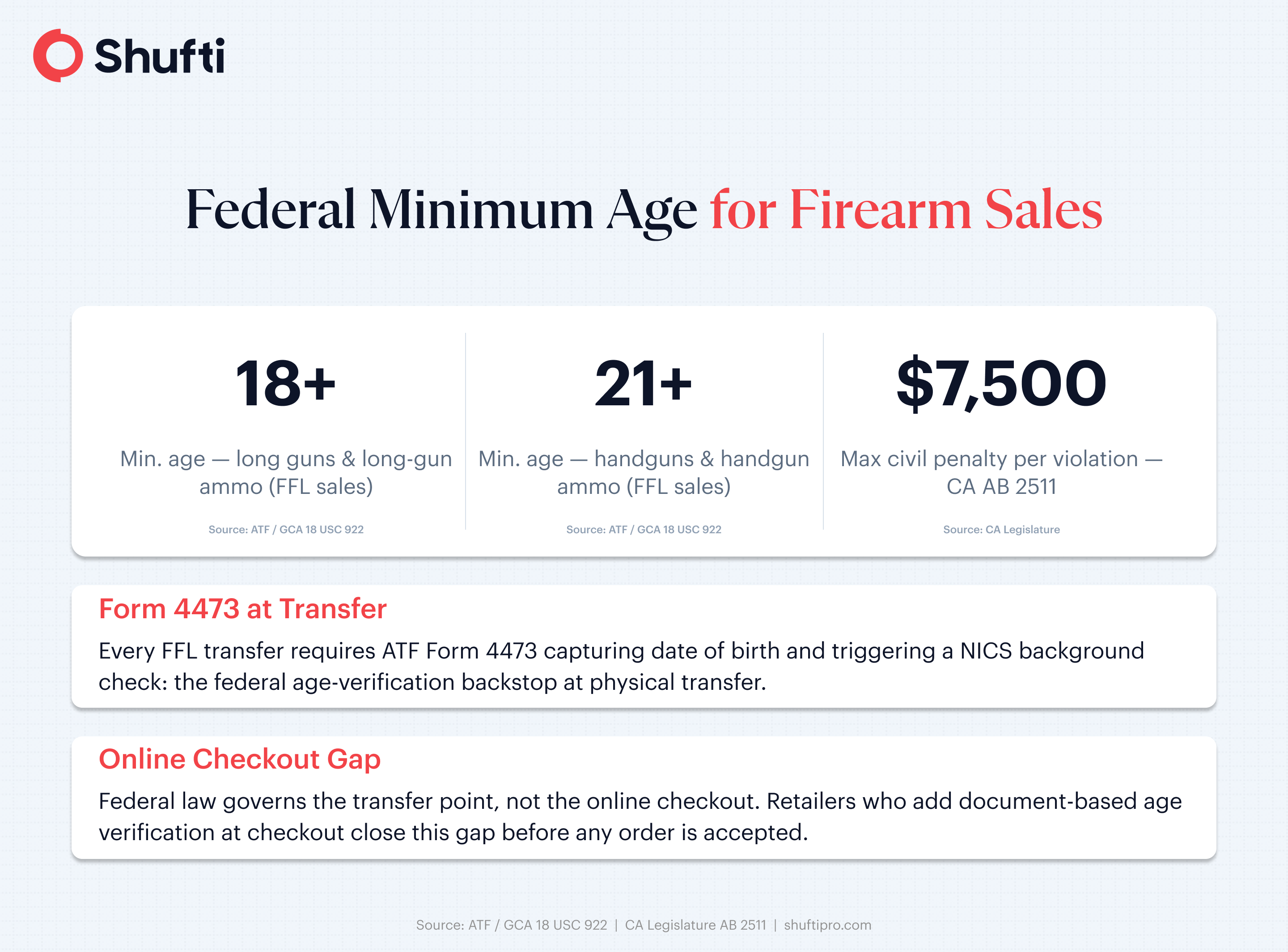
Under the GCA, FFLs may not transfer long guns (rifles and shotguns) or long-gun ammunition to any person under 18. The threshold rises to 21 for handguns and handgun ammunition. These rules apply to every FFL transaction, whether the sale originates in a physical store or through an e-commerce platform where the buyer selects a firearm and designates a receiving FFL.
A RAND Corporation analysis has identified minimum-age requirements among the most thoroughly studied firearm-policy interventions for reducing youth injuries and fatalities, which helps explain why regulators treat FFL compliance with these thresholds as non-negotiable. Supporting data from the Office of Juvenile Justice and Delinquency Prevention (OJJDP) shows that youth aged 13 to 20 account for approximately 22.8% of US weapons-offense arrests while representing roughly 10.4% of the population, a disparity that makes age-gating at the point of sale a public safety priority, not just a compliance checkbox.
FFL obligations under Form 4473
Every FFL transfer requires completion of ATF Form 4473, which captures the buyer’s date of birth and triggers a National Instant Criminal Background Check System (NICS) check. For online sales, the buyer completes Form 4473 at the receiving FFL, not the originating retailer. This means the formal age-check mechanism under federal law occurs at transfer, not at the point of online purchase.
The ATF FFL Quick Reference and Best Practices Guide recommends that licensees review a photo ID before completing any transfer. For online retailers, this reinforces the need for a complementary age-verification layer at checkout, applied before the order is accepted and processed.
How does the online-to-FFL transfer model change age verification?
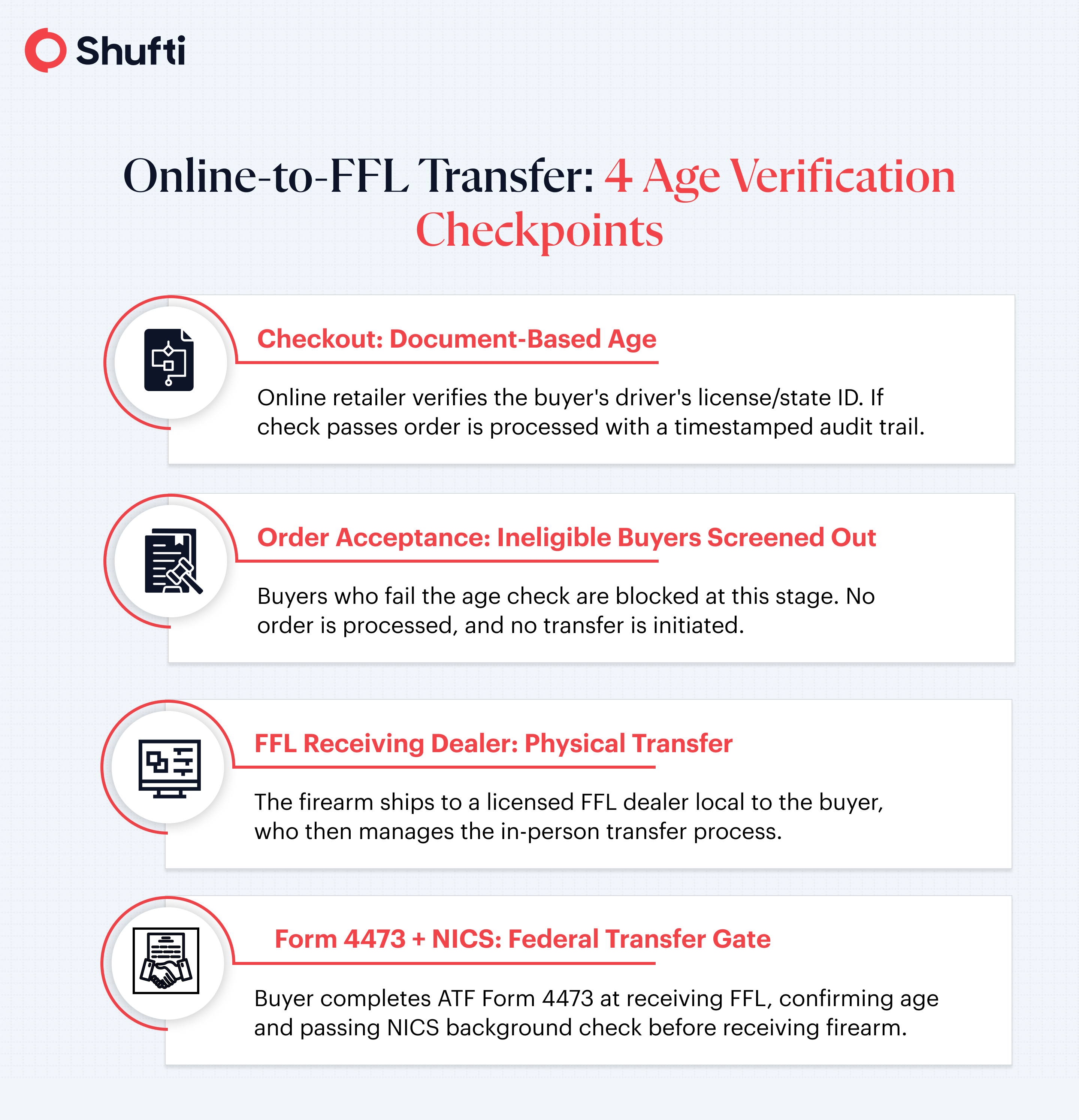
Purchasing a firearm online in the United States does not mean receiving it at the buyer’s door. Federal law requires that the firearm be shipped to a licensed FFL dealer local to the buyer, who then completes the Form 4473 transfer. This two-step model creates a distinct verification architecture, one where the originating online retailer and the receiving FFL each hold a separate piece of the compliance picture.
Where pre-sale verification fits
The originating online retailer’s responsibility under federal law is not identical to the receiving FFL’s responsibility. The receiving FFL handles the online firearms age check at the point of transfer, completing Form 4473 and running a NICS check before the firearm changes hands. The originating retailer, however, controls the checkout flow. Without a pre-sale age check, an underage buyer could place an order, pay, and remain undetected until the receiving FFL refuses the transfer.
Adding a document-based age check at checkout allows the retailer to catch ineligible buyers before any order is processed. For compliance teams, it also creates an audit trail showing that the retailer took affirmative steps to screen buyers at the point of purchase, a record that carries weight in any subsequent regulatory inquiry.
Ammunition sales and the verification gap
Ammunition purchased online does not require FFL transfer; it can ship directly to the buyer’s address. This creates a meaningful verification gap. Under the GCA, handgun ammunition sold by an FFL to a person under 21 is prohibited. For online-only retailers that sell ammunition but not firearms, there is no receiving FFL to act as a backstop. The entire age-check obligation falls on the seller at checkout.
States are beginning to address this gap directly. California’s online age-verification rules, discussed in the next section, apply explicitly to ammunition sales as well as firearms.
State-level requirements and the California AB 2511 standard
Federal law sets a floor, not a ceiling. Individual states have authority to impose stricter requirements on firearms and ammunition retailers, including rules about how age is verified during online sales. California has moved furthest in this direction, creating a legal framework that other states are watching closely and that online retailers with national customer bases cannot afford to overlook.
What California AB 2511 requires
California Assembly Bill 2511, enacted as part of the 2017-2018 California Parent’s Accountability and Child Protection Act, requires businesses selling age-restricted products online to take “reasonable steps” to verify purchaser age, with civil penalties of up to $7,500 per violation for any age-restricted product sold in California, including firearms and ammunition.
AB 2511 does not define a single approved verification method, which gives retailers flexibility but also creates compliance uncertainty. Retailers that rely on a simple date-of-birth entry field at checkout almost certainly fall short of “reasonable steps.” The statute’s intent points toward methods that actually confirm the purchaser is who they claim to be.
Understanding “reasonable steps” in practice
Regulators and legal practitioners interpret “reasonable steps” to require more than self-declaration. At a minimum, the approach should tie the claimed age to an identity document that can be authenticated: a driver’s license, a state-issued photo ID, or comparable government-issued identification. The verification should produce a timestamped record showing that a check was completed for a specific transaction. Without that record, a retailer cannot demonstrate compliance if a violation is later alleged.
For retailers selling into multiple states, designing to California’s “reasonable steps” standard establishes a defensible baseline. States that have not yet enacted specific online age verification rules for firearms are unlikely to view a documented, document-based check unfavourably.
How Shufti helps online firearms retailers verify buyer age
Retailers selling firearms or ammunition online need a checkout-stage verification layer that goes beyond self-declaration of date of birth. Document-based verification, where the buyer submits a driver’s licence or state-issued ID, provides a government-authenticated identity anchor for the age claim. When paired with a passive liveness check, it confirms that the person submitting the document is physically present during the verification, rather than uploading a scan of someone else’s ID.
Shufti’s age verification and document verification capabilities are built to integrate directly into e-commerce checkout flows via the age verification API. The verification returns a pass or fail result in real time, along with a timestamped record of the check: the kind of audit trail that AB 2511 and similar state frameworks expect retailers to maintain. With support for more than 10,000 document types across 240+ countries, the solution handles the full range of government-issued IDs a US-based retailer is likely to encounter, including military identification for buyers claiming a legal exemption under state law. For e-commerce platforms handling regulated goods, the integration is designed so that raw ID images are not retained on the retailer’s servers after verification completes, a privacy-by-design consideration that matters to buyers and compliance teams alike.
|
Online firearms compliance is a moving target: federal minimums, state-specific rules, and the particular demands of the online-to-FFL transfer model all create distinct verification points that a simple date-of-birth checkbox cannot address. Shufti’s document verification and age verification products are built to meet that challenge, integrating at checkout with a verified audit trail that holds up under regulatory scrutiny. Book a demo to see how the solution fits your platform’s verification workflow. |
Frequently Asked Questions
What age do you have to be to buy a firearm online?
Under the Gun Control Act, the minimum age is 18 for long guns and long-gun ammunition, and 21 for handguns and handgun ammunition, when purchased through a licensed FFL dealer. State law may impose stricter requirements above the federal floor.
Do online firearms retailers need age verification?
Federal law requires age verification at the point of FFL transfer through Form 4473, but online retailers who sell ammunition direct-to-consumer carry their own verification obligation at checkout, with no receiving FFL to act as a backstop. States including California have enacted laws that extend this obligation explicitly to the online purchase stage.
What is California AB 2511 for firearms age verification?
California AB 2511, enacted as part of the 2017-2018 Parent’s Accountability and Child Protection Act, requires businesses that sell age-restricted products online, including firearms and ammunition, to take “reasonable steps” to verify purchaser age, with civil penalties of up to $7,500 per violation.
What documents are required for online firearms purchase?
At the FFL transfer point, a government-issued photo ID is required to complete Form 4473. Online retailers adopting pre-sale age verification typically accept a driver’s licence or state-issued ID, verified against the document’s security features.
Does age verification apply to ammunition sales?
Yes, the Gun Control Act prohibits FFLs from selling handgun ammunition to anyone under 21, and for online-only ammunition retailers with no receiving FFL to serve as a backstop, the full age-check obligation rests with the seller at checkout.