




 Face Verification
 Address Verification
 Document Verification
 Age Verification
 VideoIdent
 Fast ID
 Docless Verification
 Consent Verification
 NFC Verification
 Business Verification
 Due Diligence
 Investor Verification
 E-Signature

 QES
QES
 AML Screening
 Transaction Monitoring
 Adverse Media
 Business AML Screening
 PEP & RCA
 Sanctions
 Watchlist
 Behavioural Biometrics
 Device Fingerprinting
 Biometric Face Authentication
 MFA
MFA
 Fraud Hub
 Onboarding
 Ongoing Monitoring
 KYC
KYC
 KYB
KYB
 KYI
KYI
 Age Assurance
 Identity Verification
 Workforce IAM
 Candidate Verification
 Compliance
 Fraud prevention
 Trust & safety
 Global expansion
 Product Managers
 Compliance Officers
 Fraud Analysts
 Developers
 Deepfake Detection
 Bonus Abuse / Promotion Abuse
 Account Takeover
 Synthetic Identity Fraud
 Document Fraud
 Impersonation Fraud
 Multi-Accounting
 Fraud Networks
 Chargeback Fraud
 Money Mule Activity
 Party Fraud
 Regulatory & Compliance Risks
 Fintech
 Crypto
 iGaming
 Forex
Forex
 Social Network
 Marketplace
 Banking
 Gig Economy
 Payments
 Ride Hailing
 Adult Content
 Blind Spot Audit
 Deepfake Detector
 Liveness Spoofs
 Document Originality
 Document Deepfake
 Global Trust Platform
 Journey Builder
 Case Management
 Shufti AI
 Fraud Analytics
 Vendor Comparison
 Brand Personalisation
 AI Compliance Co-Pilot
 OCR
OCR
 Secure Capture
 Deployment Options
 Identity Methods
 API Documentation
 Mobile SDKs
 Service Status
 Help Center
 Contact Us
 Technical Support
 Supported Documents
 Supported Countries
 Content library
 Blogs
Blogs
 News
News
 Reports
 Insights
 Knowledgebase
 ROI calculator
 About
About
 Career
 Press Release
 Certifications
 Partnership
 Awards
 Events & Webinar
 Interactive Demo
 Podcast Studio
 Spotlight Studio
KYC vs AML vs KYB: Key Differences Explained

Global compliance penalties tied to KYC, AML, and KYB failures totalled $3.8 billion in 2025, according to the Institute for Financial Integrity, with enforcement shifting sharply from North America to EMEA and APAC. Most of those penalties trace back to one pattern. Compliance teams treat KYC, AML, and KYB as separate programmes rather than as a coordinated stack, and the gaps between them become the liability. This article breaks down what each framework does, where they differ, and why all three need to work together.
What is the difference between KYC, AML, and KYB?
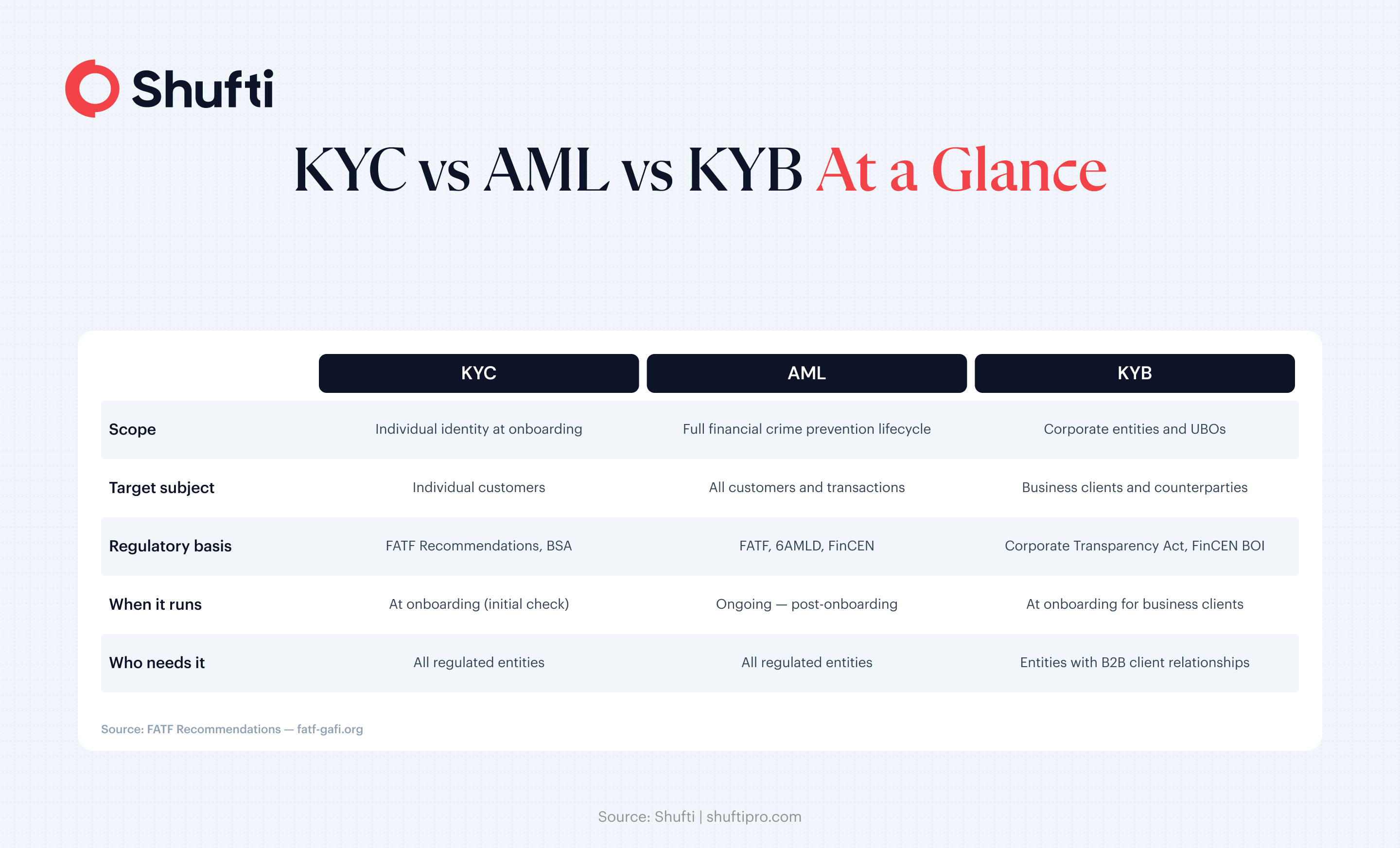
Understanding what KYC, AML, and KYB each require starts with recognising that they operate at different layers of your compliance programme. KYC covers individual identity at the point of onboarding; KYB extends that logic to corporate clients; AML is the broader framework that governs both and that continues well beyond onboarding into ongoing risk surveillance. Treating any one of the three as the whole is what produces the audit gaps regulators flag most consistently.
What is KYC (Know Your Customer)?
Know Your Customer (KYC) is the process of verifying the identity of individual customers before or during onboarding. It covers document verification, including passports, national IDs, and driver’s licences, alongside biometric checks such as facial matching and liveness detection, and a customer due diligence (CDD) assessment that assigns an initial risk rating. KYC requirements derive from frameworks such as the Financial Action Task Force (FATF) Recommendations and national legislation including the Bank Secrecy Act (BSA) in the United States. The outcome is a verified identity record tied to a customer risk profile.
What is AML (Anti-Money Laundering)?
Anti-Money Laundering (AML) is the regulatory framework inside which KYC sits. AML obliges financial institutions and regulated businesses to detect, prevent, and report transactions that may represent proceeds of crime. In practice, that means sanctions screening, Politically Exposed Persons (PEP) checks, adverse media monitoring, and transaction surveillance across the full customer lifecycle. FATF estimates that money laundering represents 2 to 5 percent of global GDP annually, an exposure that explains why AML obligations extend far beyond the initial onboarding check. The difference between KYC and AML matters most when scoping a compliance programme. KYC delivers the verified identity data that AML monitoring depends on, but AML does not stop when KYC is done.
What is KYB (Know Your Business)?
Know Your Business (KYB) applies KYC-level scrutiny to corporate entities rather than individuals. When onboarding a business client or a B2B counterparty, KYB requires verifying company registration, ownership structure, and the Ultimate Beneficial Owners (UBOs) who control the entity. FinCEN’s beneficial ownership reporting rules, reinforced by the US Corporate Transparency Act, reflect the global push to surface the real individuals behind corporate structures, a risk layer that standard KYC cannot reach. KYB sits inside AML obligations but targets the corporate layer that consumer-grade identity checks leave unverified.
How do KYC vs AML and KYB work as a compliance stack?
Understanding KYC vs AML is most productive when you treat them as layers rather than parallel programmes running independently. AML sets the obligation; KYC and KYB supply the verified identity data that makes AML monitoring meaningful. When a sanctions hit surfaces six months after onboarding, the investigation depends on a clean KYC record from day one. When that record sits in a separate system from the AML alert, the audit trail breaks, and that breakdown is precisely what regulators penalise.
US regulators issued $4.3 billion in financial penalties in 2024, with banks accounting for 82 percent of fines levied, according to Corporate Compliance Insights. The majority of enforcement actions cited gaps between identity verification and ongoing monitoring. This is the gap that opens when KYC vs KYB vs AML compliance runs through disconnected vendors. The EU’s Anti-Money Laundering Authority (AMLA), operational from mid-2025, is designed to close that gap at the regulatory level by standardising how member states implement both the identity-check and the ongoing monitoring layer under one framework.
AI has changed how all three functions operate. Machine learning now drives document forgery detection in KYC, entity graph analysis in KYB, and real-time risk scoring in AML monitoring. These capabilities compound when they share a data layer. A biometric match at onboarding should inform the AML risk score applied to the same customer later. Platforms that connect the three on a single API deliver this. Those that don’t create the fragmented stacks that regulators are most consistently penalising. For how KYC, KYB, and transaction monitoring connect at the workflow level, see the KYC, KYB and KYT compliance overview.
Which industries need KYC, AML, and KYB compliance?
The KYB vs KYC distinction determines which verification process applies to a given onboarding flow, and that split varies by sector. Most regulated industries globally must run some combination of all three frameworks, but the balance shifts depending on whether you are onboarding individuals, corporate entities, or both. Understanding where your regulator places the most weight helps compliance teams sequence their programmes without over-engineering every flow.
Banking and fintech
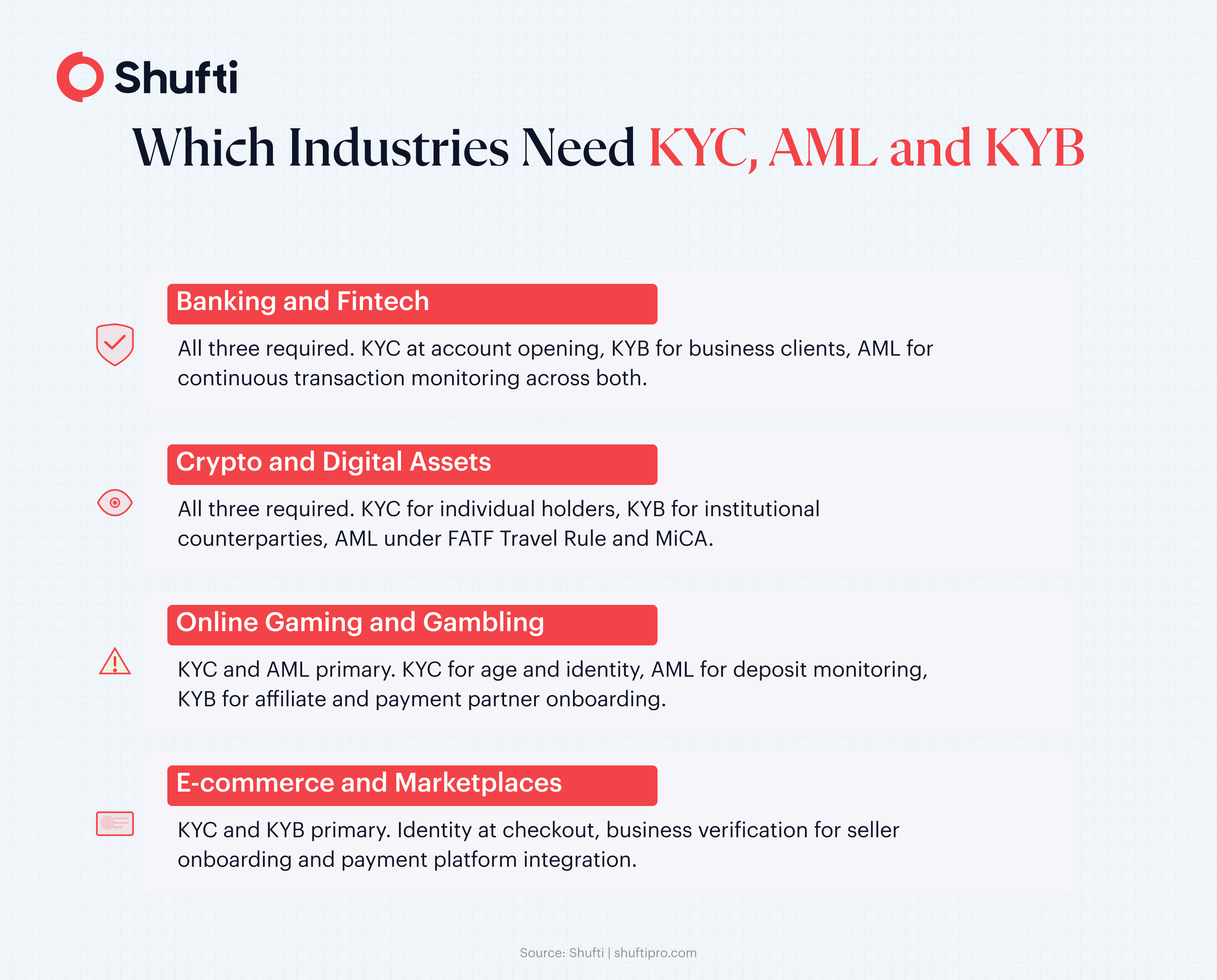
Banks and fintech platforms carry the most comprehensive obligations across all three areas. KYC applies to individual account opening. Business verification requirements govern corporate accounts, SME lending, and business banking relationships. AML governs continuous transaction monitoring across both. The FCA, the European Banking Authority (EBA), and FinCEN each publish guidance that treats the three as a unified compliance obligation, not a menu. For digital banks, elevated identity fraud risk at the application stage and stricter beneficial ownership checks for corporate clients make a connected compliance stack a licensing requirement rather than a strategic choice.
Crypto and digital assets
Crypto exchanges and virtual asset service providers (VASPs) operate under AML obligations in every major jurisdiction, including the FATF Travel Rule, the EU’s Markets in Crypto-Assets Regulation (MiCA), and BSA requirements administered by FinCEN. KYC applies to individual account holders; KYB applies to institutional clients and corporate counterparties. Transaction monitoring in crypto carries the added complexity of wallet anonymity and cross-chain flows, which makes continuous AML screening harder to automate than in traditional finance. For a full breakdown of regulatory timelines across regions, the KYC compliance regulations guide covers current global requirements.
Online gaming and gambling
Gaming and gambling operators require KYC for age verification and identity confirmation, AML for monitoring deposit and withdrawal patterns that signal layering, and KYB when onboarding affiliates, payment processors, or game publishers as business partners. Regulators including the UK Gambling Commission treat AML failures in this sector as a priority enforcement area, given its documented exposure to layering and placement schemes. Operators that apply KYC rigour at the player level without equivalent scrutiny on business partners carry a compliance gap that regulators increasingly flag.
How Shufti helps businesses run KYC, AML, and KYB
A fragmented KYC, AML, and KYB stack creates an audit trail problem that becomes a regulatory liability. When an AML screening hits the surface on a customer who passed identity verification six months earlier, the compliance team needs a single record connecting both events. Disconnected systems rarely produce one.
Shufti connects identity verification and AML screening on one platform. The KYC identity record from onboarding feeds directly into ongoing sanctions, PEP, and adverse media monitoring without requiring a separate system lookup. The AML layer covers 100,000+ data sources and 3,500+ global watchlists, updated every 15 minutes, so a risk change post-onboarding surfaces in the same workflow the compliance team already uses. KYB checks reach across 250+ countries, covering UBO identification, company registry lookups, and corporate structure mapping without a manual handoff. The result is a connected compliance record, not three separate reports.
When fragmented compliance stacks create audit gaps between identity verification and ongoing risk monitoring, regulators treat it as a systemic failure, not an oversight. Shufti connects KYC, KYB, and AML monitoring through a single API so compliance teams have one audit trail, not three. Request a demo to see how the full stack runs on your own onboarding volumes.
Frequently Asked Questions
How do KYC, KYB, and AML relate to each other?
AML is the overarching regulatory obligation. KYC and KYB are how businesses fulfil the identity-verification portion of that obligation. After identity is confirmed, AML requires continuous monitoring, including sanctions, PEP checks, and adverse media, that applies to both individual customers verified through KYC and corporate clients verified through KYB.
Is AML the same as KYC, or is it a broader framework?
AML is broader. KYC covers the identity-verification step at onboarding. AML extends to transaction monitoring, suspicious activity reporting, sanctions screening, and adverse media checks that run throughout the customer relationship, not just at sign-up.
Why do businesses need KYC, AML, and KYB together?
Each framework covers a different risk layer. KYC confirms who an individual is. KYB confirms who controls a business. AML monitors for financial crime signals across both. A single platform for all three prevents audit gaps where a risk event in one layer is invisible in another.
How is AI used in KYC, AML, and KYB processes?
AI powers document forgery detection in KYC, entity graph analysis in KYB, and real-time risk scoring in AML monitoring. Platforms that share a data layer across all three allow a biometric flag at KYC onboarding to inform the AML risk score applied to the same customer. CMS Note: FAQPage schema markup required.