AMLR Solutions
  AMLR Consultation
 EUDI Wallet
 Onboarding
 Ongoing Monitoring
 FRAML
FRAML KYC
KYC KYB
KYB KYI
KYI Age Assurance
 Workforce IAM
 Candidate Verification
 Account Takeover
 Bonus/ Promotion Abuse
 Chargeback Fraud
 Deepfake
 Document Fraud
 Fraud Networks
 Impersonation Fraud
 Money Mule Activity
 Multi-Accounting
 Party Fraud
 Regulatory & Compliance Risks
 Synthetic Identity Fraud
 Adult Content
 Banking
 Crypto
 Fintech
 Forex
Forex Compliance
 Fraud prevention
 Trust & safety
 Global expansion
 Compliance Officers
 Developers
 Fraud Analysts
 Product Managers
 Journey Builder
  Global Trust Platform
 Customer Profiles
 Vendor Comparison
 IDV Case Management
 AML Case Management
 Regulatory Reporting
 Agentic Rule Builder
  AI Compliance Co-Pilot
  Fraud Analytics
 Fraud Hub
  OCR
OCR Shufti AI
 Bank Account Verification
  Biometric Duplication
 Database Checks
 Document Intelligence
 Government ID
 Mobile Driver's License
 NFC
NFC Selfie Liveness
 Brand Personalisation
 Deployment Options
 Identity Methods
 IDV Modes
 Multi-tenancy
 On-Premise IDV
 Secure Capture
 Shufti MCP















Most compliance teams look at automation once they have tried the manual work and failed to scale it. A periodic review of a low-risk customer, meaning a scheduled re-check of someone who is already on the books, takes about 100 minutes to complete on average. At organisations in the best-performing quartile it takes 30 minutes, according to McKinsey’s 2021 benchmark analysis.
Automation cuts down this time by taking analysts off the files that follow the rules and moving them onto the files that do not, which also results in the best possible use of an analyst’s time.
This guide covers which parts of KYC can be automated, how automated KYC compares with manual KYC, and the one number that shows whether your programme is worth your investment.
What is KYC automation?
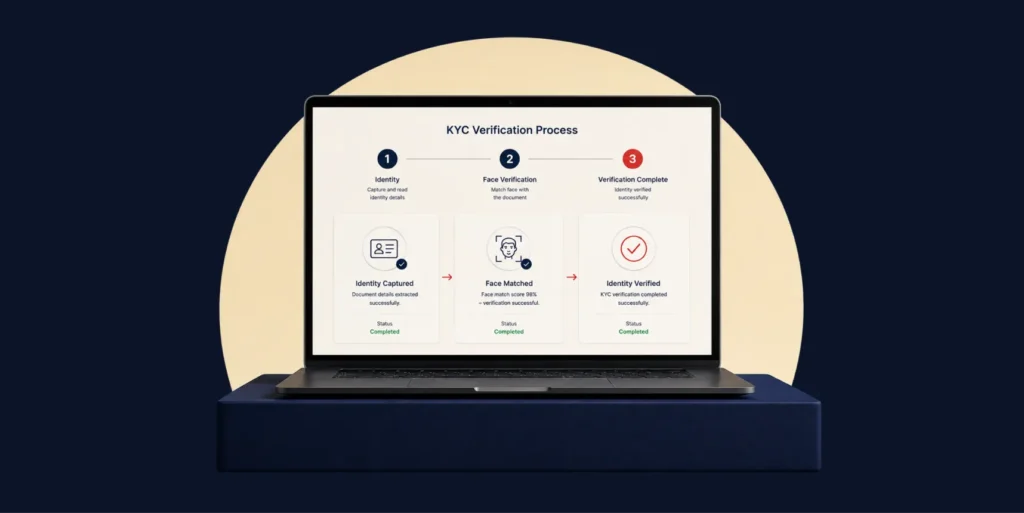
KYC automation is the use of software to run the identity and risk checks inside customer due diligence without an analyst handling every step. Know your customer automation covers document capture, authenticity checks, biometric matching, watchlist screening and risk scoring. Anything the software cannot settle on its own goes to a person.
Which parts of KYC can be automated
The following parts of KYC are often automated:
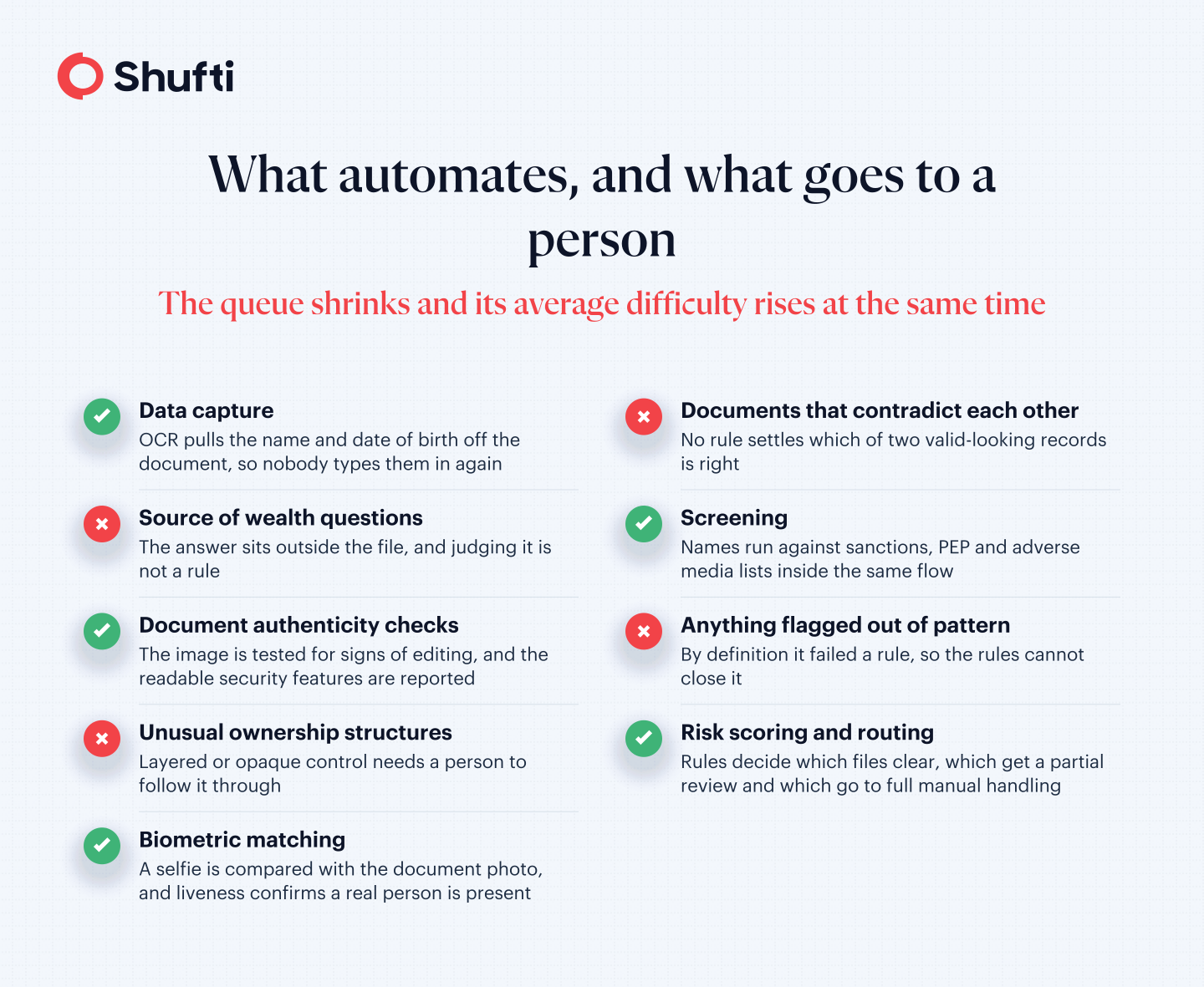
- Data capture: Optical character recognition, which is software that reads printed text from a photograph, pulls the name and date of birth off an identity document so nobody types them in again.
- Document authenticity checks: The software tests the document image for signs of editing and reports on the security features it can read.
- Biometric matching: A selfie is compared with the photo on the document, and a liveness check confirms the image comes from a real person in front of the camera rather than from a printout or a recording.
- Screening: Names run against sanctions, PEP and adverse media lists inside the same flow.
- Risk scoring and routing: Rules decide which files clear, which get a partial review, and which go to full manual handling.
Which parts of KYC still need a person
Source of wealth questions, unusual ownership structures, documents that contradict each other and anything the rules flag as out of pattern- all of this still has to go to an analyst. Under FATF’s Recommendation 10 (2025 consolidated version), financial institutions must apply customer due diligence measures and decide how far to take those measures using a risk-based approach.
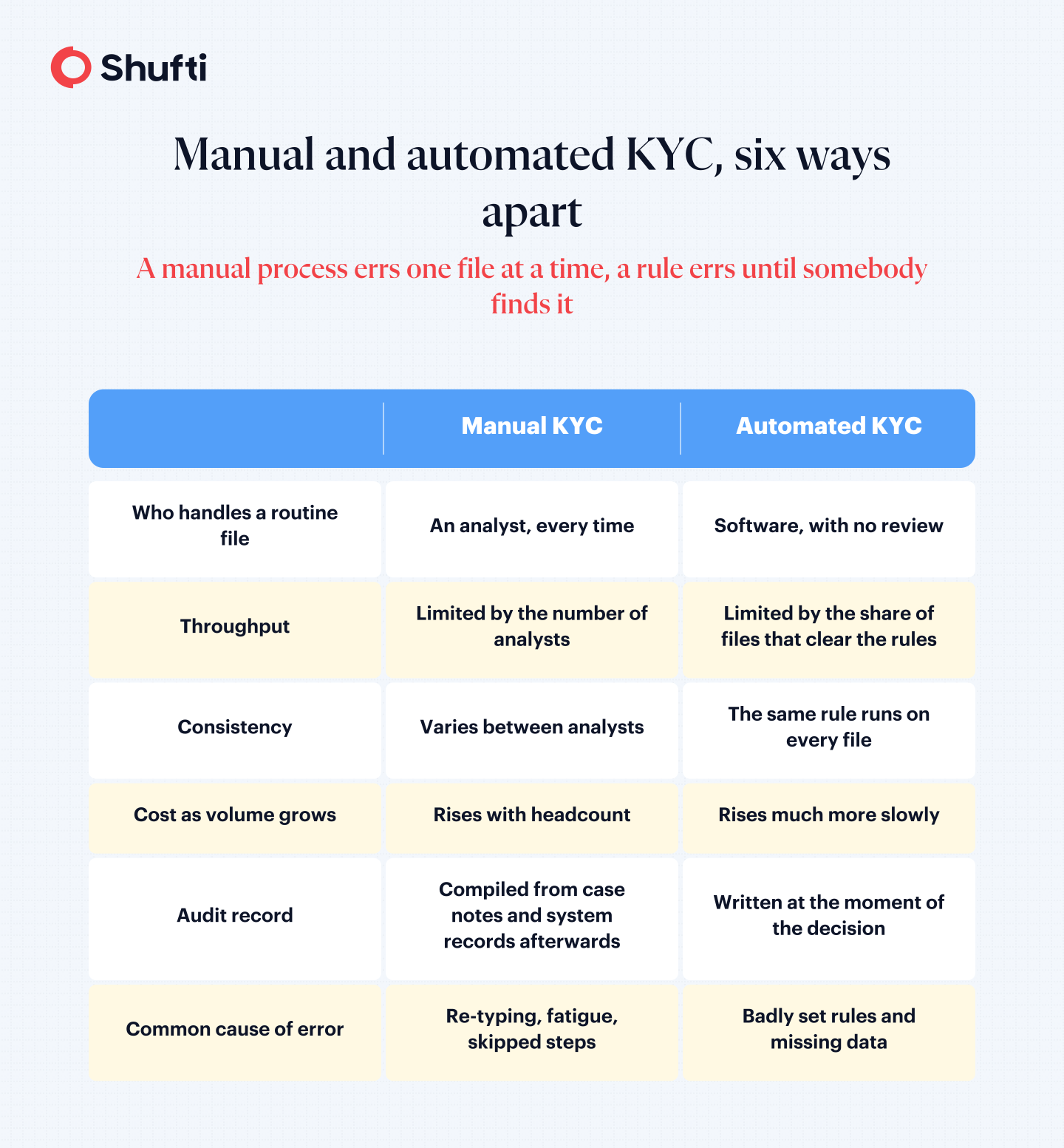
Manual KYC vs automated KYC
| Comparison | Manual KYC | Automated KYC |
| Who handles a routine file | An analyst, every time | Software, with no review |
| Throughput | Limited by the number of analysts | Limited by the share of files that clear the rules |
| Consistency | Varies between analysts | The same rule runs on every file |
| Cost as volume grows | Rises with headcount | Rises much more slowly |
| Audit record | Compiled from case notes and system records afterwards | Written at the moment of the decision |
| Common cause of error | Re-typing, fatigue, skipped steps | Badly set rules and missing data |
What are the benefits of automating KYC?
These are the four core benefits of automating your KYC process:
Benefit 1: Faster reviews for low-risk customers
McKinsey’s benchmark put average periodic reviews of low-risk customers at 100 minutes, and at 30 minutes for the best-performing quartile.
Benefit 2: More consistent decisions
A document submitted twice returns the same answer both times, which removes the variation that comes from two analysts reading one case differently.
Benefit 3: Lower cost per file as volume rises
Manual KYC scales by hiring, because throughput is set by how many analysts are working the queue. Automated checks add very little cost for each extra file, so growth in customer numbers stops translating directly into growth in compliance headcount.
Benefit 4: Better records for audits and inspections
An automated check records what ran, what it returned and when, at the time it happened. That removes most of the work of reconstructing a decision months later when a supervisor or an auditor asks how it was reached.
Your straight-through rate decides whether KYC automation pays
The only metric that will decide if you’re getting a good ROI on your KYC automation program is ‘straight-through’ rate, which defines how many files are cleared accurately without the involvement of an analyst.
Why automating only low-risk files misses most of the savings
McKinsey names the restriction of straight-through processing to low-risk customers as a common pitfall. Higher-risk reviews take the most analyst time per case, so leaving all of them manual keeps the most expensive work exactly as it was. Parts of a higher-risk review can be automated too, with escalation rules setting the point where a person takes over.
What KYC automation cannot fix
Automated checks apply the policy you tune them for. Here are two things they cannot fix:
-
Automation does not fix an out-of-date policy
Rules are a written version of a policy. If the policy is out of date, or if nobody owns the decision to move a threshold, the software applies the wrong standard faster and more consistently than the manual process did. Someone has to own the rules, record why each threshold was set, and be able to explain that reasoning to a supervisor.
-
Automation does not make the remaining cases easier
Automation cuts the number of decisions an analyst makes without making the remaining ones easier. Every case still in the queue has already failed a rule, so the queue shrinks and its average difficulty rises at the same time. A team sized for the smaller queue but staffed for the easier one ends up with the same backlog.
How to check KYC automation tools against your own data
Test a KYC automation tool on your own funnel rather than on the marketing figures, because they’re often based on clean, lab data. Here are the three questions you can ask to check a tool’s accuracy:
Ask for the straight-through rate, not the accuracy rate
Ask what share of files clear with no analyst involvement for a customer base similar to yours, and ask which rules produced that share. An accuracy figure cannot answer that, because it describes how well a check performs when it runs, not how often it finishes without a person.
Ask where applicants stop in the flow
Ask the vendor to show you the drop-off point at every step, not just a total pass rate. If a hundred applicants start and seventy finish, you need to know which step each of the other thirty stopped at. A drop can mean fraud being blocked or genuine customers failing on a document type or a device the flow handles badly, and a single total cannot tell those apart.
Ask how the tool handles periodic reviews and rule audits
Ask whether the automation runs across existing customers on a review schedule or only at sign-up, and ask how rule changes are documented and versioned. Periodic review cycles cover the back book, and in banking a supervisor can examine the rule logic itself.
How Shufti handles the cases automation cannot clear
Teams that automate the routine checks often find the cases left over are harder to work, because each one has already failed a rule and the context needed to settle it sits in another system.
Shufti’s Case Management is the workspace for that remaining queue. Alerts arrive carrying the match signals an analyst needs in order to decide, including role, tenure, source and a sanction summary, so the review starts with context instead of a name.
Every action on the case, from receipt through review, escalation, override and decision, writes to a tamper-evident log with the user and timestamp attached. Rescreening frequency and the sources included are set per profile, and alerts reach the team through the console, an API, a webhook or email.
Frequently Asked Questions
What is automated KYC?
Automated KYC uses software to run identity and risk checks without an analyst working through each step. It covers document capture, authenticity checks, biometric matching, watchlist screening and risk scoring, and sends anything the rules cannot settle to a person.
What are the benefits of automating KYC?
Reviews of low-risk customers finish faster, decisions stay consistent across the queue, cost per file falls as volume rises, and the audit record is written when the decision is made instead of reconstructed later.
What is the difference between manual KYC and automated KYC?
Manual KYC puts an analyst on every file and scales by hiring. Automated KYC clears routine files by rule and routes the rest to people. A manual process makes mistakes one file at a time, while a rules error repeats until someone finds it.