









 AMLR Solutions
  AMLR Consultation
 EUDI Wallet
 Onboarding
 Ongoing Monitoring
 FRAML
FRAML KYC
KYC KYB
KYB KYI
KYI Age Assurance
 Workforce IAM
 Candidate Verification
 Account Takeover
 Bonus/ Promotion Abuse
 Chargeback Fraud
 Deepfake
 Document Fraud
 Fraud Networks
 Impersonation Fraud
 Money Mule Activity
 Multi-Accounting
 Party Fraud
 Regulatory & Compliance Risks
 Synthetic Identity Fraud
 Adult Content
 Banking
 Crypto
 Fintech
 Forex
Forex Compliance
 Fraud prevention
 Trust & safety
 Global expansion
 Compliance Officers
 Developers
 Fraud Analysts
 Product Managers
 Journey Builder
  Global Trust Platform
 Customer Profiles
 Vendor Comparison
 IDV Case Management
 AML Case Management
 Regulatory Reporting
 Agentic Rule Builder
  AI Compliance Co-Pilot
  Fraud Analytics
 Fraud Hub
  OCR
OCR Shufti AI
 Bank Account Verification
  Biometric Duplication
 Database Checks
 Document Intelligence
 Government ID
 Mobile Driver's License
 NFC
NFC Selfie Liveness
 Brand Personalisation
 Deployment Options
 Identity Methods
 IDV Modes
 Multi-tenancy
 On-Premise IDV
 Secure Capture
 Shufti MCP


Agentic Rule Builder
Configure Detection Rules Without an Engineering Ticket
Detect new structuring patterns without waiting on engineering. Shufti’s agentic rule builder gives compliance direct control over detection logic, with three condition primitives powering 50+ industry-ready rule sets and every change routed through compliance review before go-live.
Book a Demo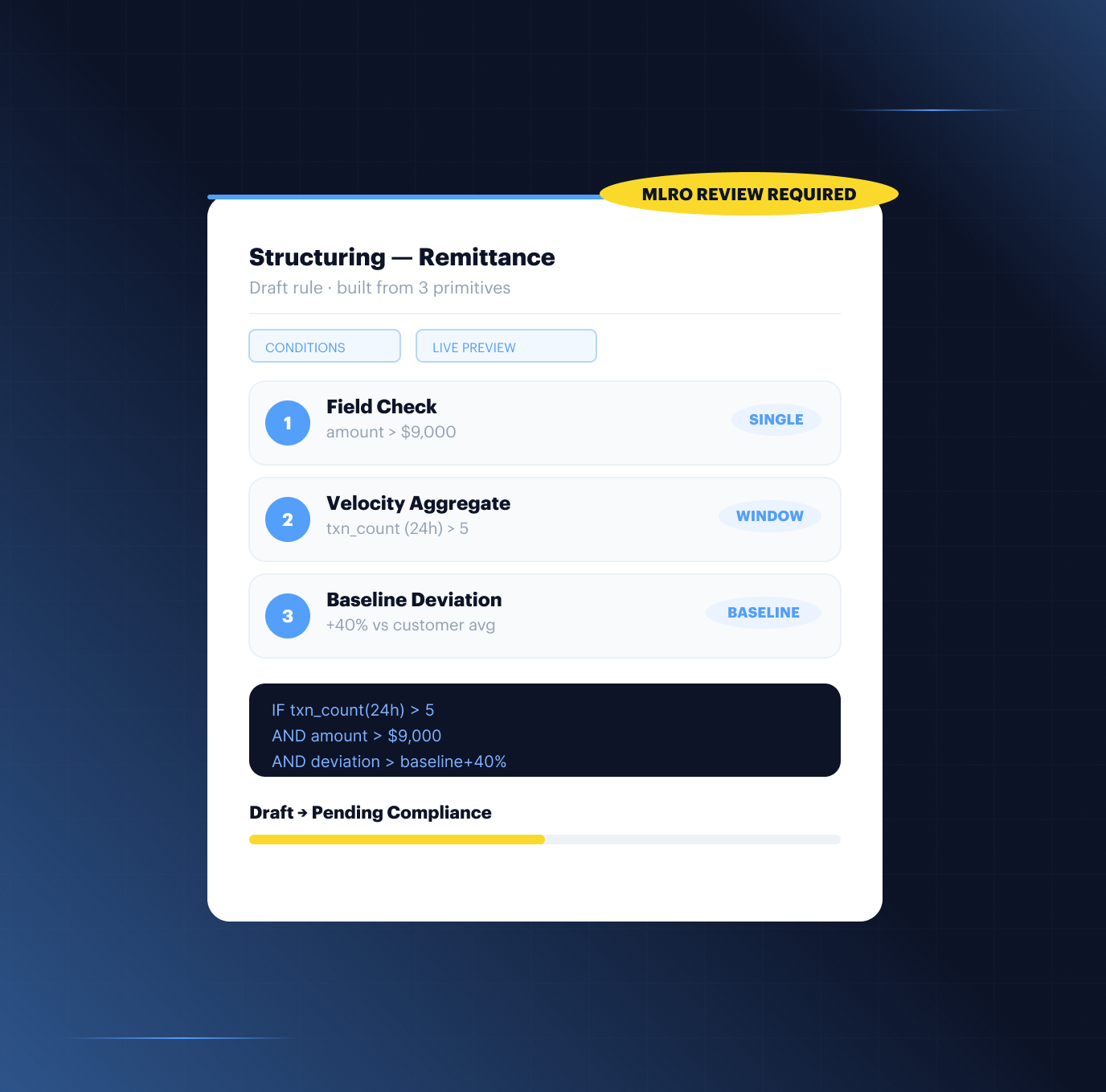
Built on Rules Already Running in Production






One Library,Four Jobs
Configure,Simulate,and Publish From One Library
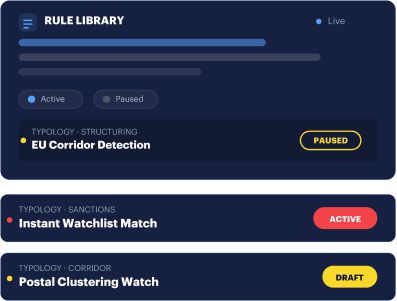
See Every Rule,Live or in Review
Filter by industry,discipline,typology,priority or status across every published rule. Each row shows whether a rule is active,paused or archived,with edit,duplicate,backtest and archive actions one click away. The benefit:an MLRO can answer "what is currently detecting structuring" without asking engineering to pull a config file.
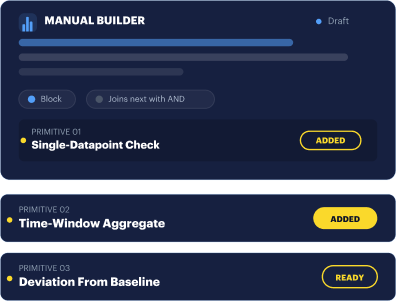
Build a Rule From Three Primitives
A single-datapoint check,a time-window aggregate,or a deviation from a customer's own baseline cover all 50+ pre-built rule sets today. Each block joins the next with the same explicit logic an auditor could read line by line, and a live preview renders the canonical expression as blocks are added.
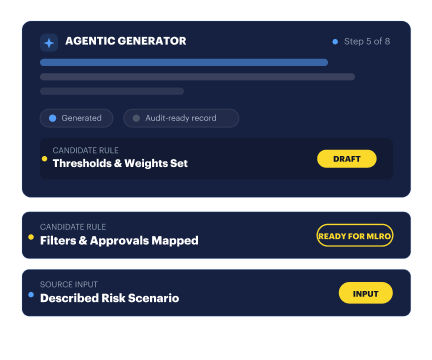
Describe the Risk. Get a Candidate Rule Set.
An agentic, eight-step question pack adapts to industry and sub-industry, then drafts reviewable rules from the described risk scenario on its own. Every generated rule still carries the same audit-ready record, thresholds, filters, weights and approvals, as one written by hand, and none goes live without compliance review.
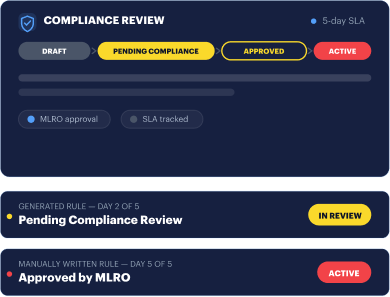
Every Rule Enters Compliance Review Before It’s Active
A rule moves through four states: Draft, Pending Compliance, Approved, Active. Only an MLRO can move a rule into Active, and the five-business-day review SLA applies whether the rule was written manually or generated from a described risk scenario.
Four Steps,No Engineering Ticket
From Blank Rule to Compliance Review in Four Steps
01
STEP 01
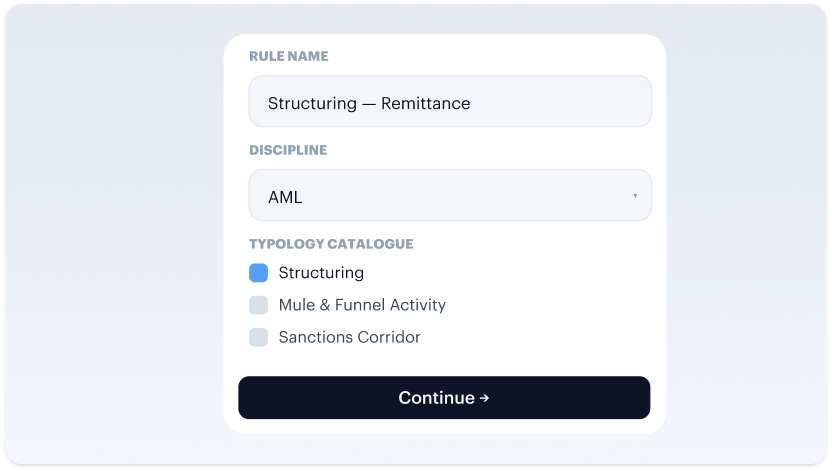
Basics
Name the rule,tag its discipline (AML or Fraud),and select a typology from the catalogue.
02
STEP 02
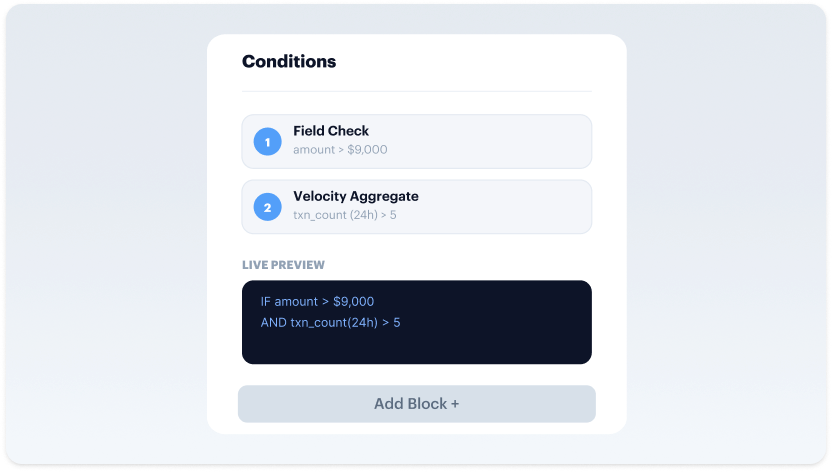
Conditions
Add field,velocity or baseline blocks. A live preview renders the canonical rule expression as each block is added.
03
STEP 03
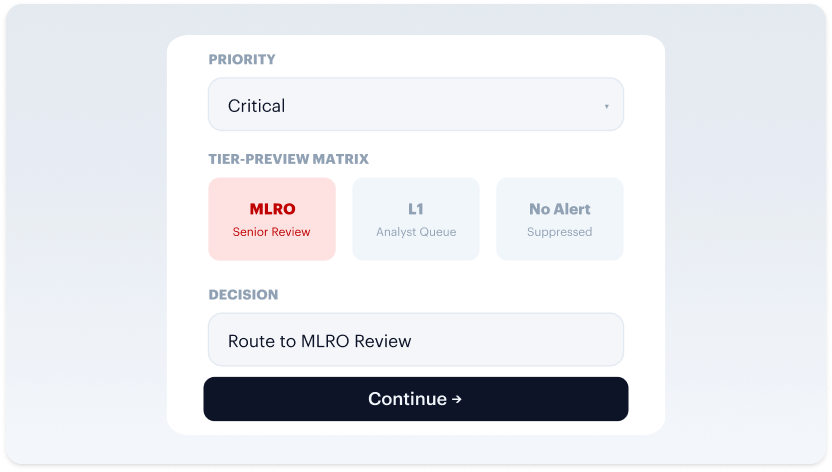
Actions
Set priority,score and decision. A tier-preview matrix shows the provisional analyst queue routing before publish.
04
STEP 04
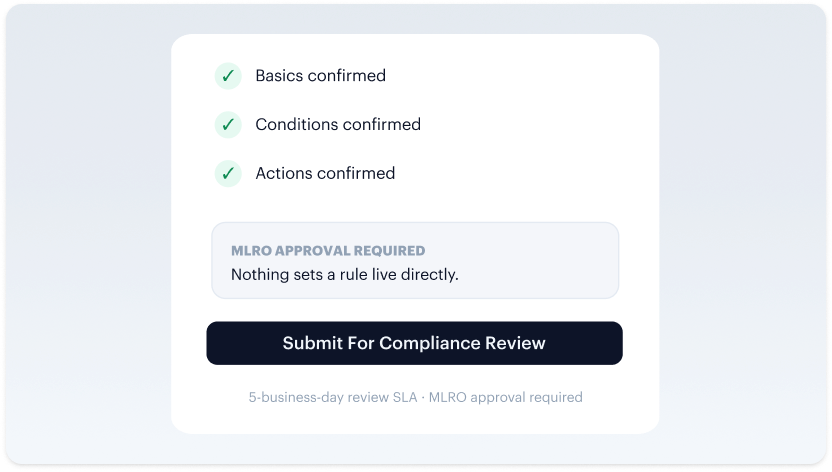
Review &Publish
Confirm all four steps,then submit for compliance review. Nothing sets a rule live directly,an MLRO approves first.
Inside the Rule Engine
What Compliance Sees That an Engineering Ticket Never Showed
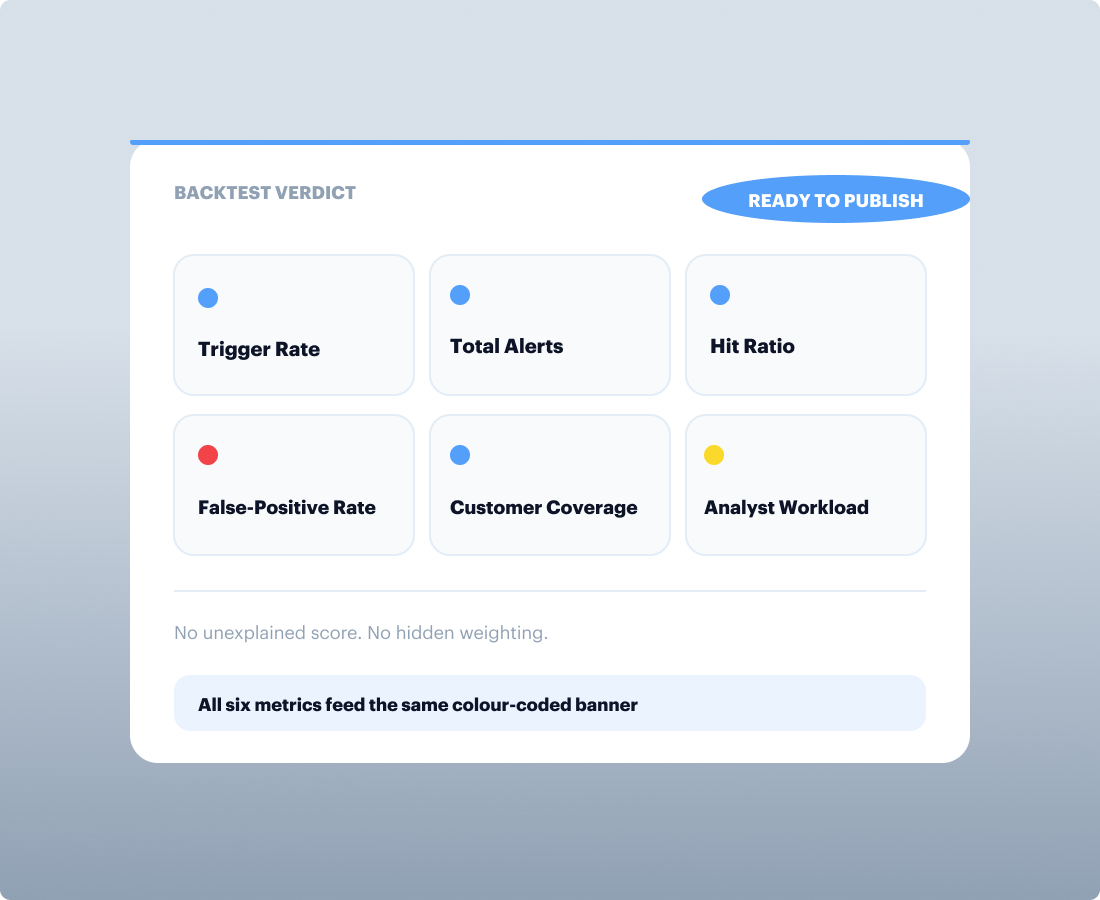
Six KPIs Decide the Backtest Verdict
Trigger rate,total alerts,hit ratio,false-positive rate,customer coverage and projected analyst workload all feed the same colour-coded banner. No unexplained score,no hidden weighting.
The same proposed thresholds return the same six metrics every time,so a backtest signed off today reads the same way in an audit next year.
The banner names the exact delta in alert volume and hit ratio that drove the recommendation,so a reviewer signing off can point to the number,not just trust the colour.
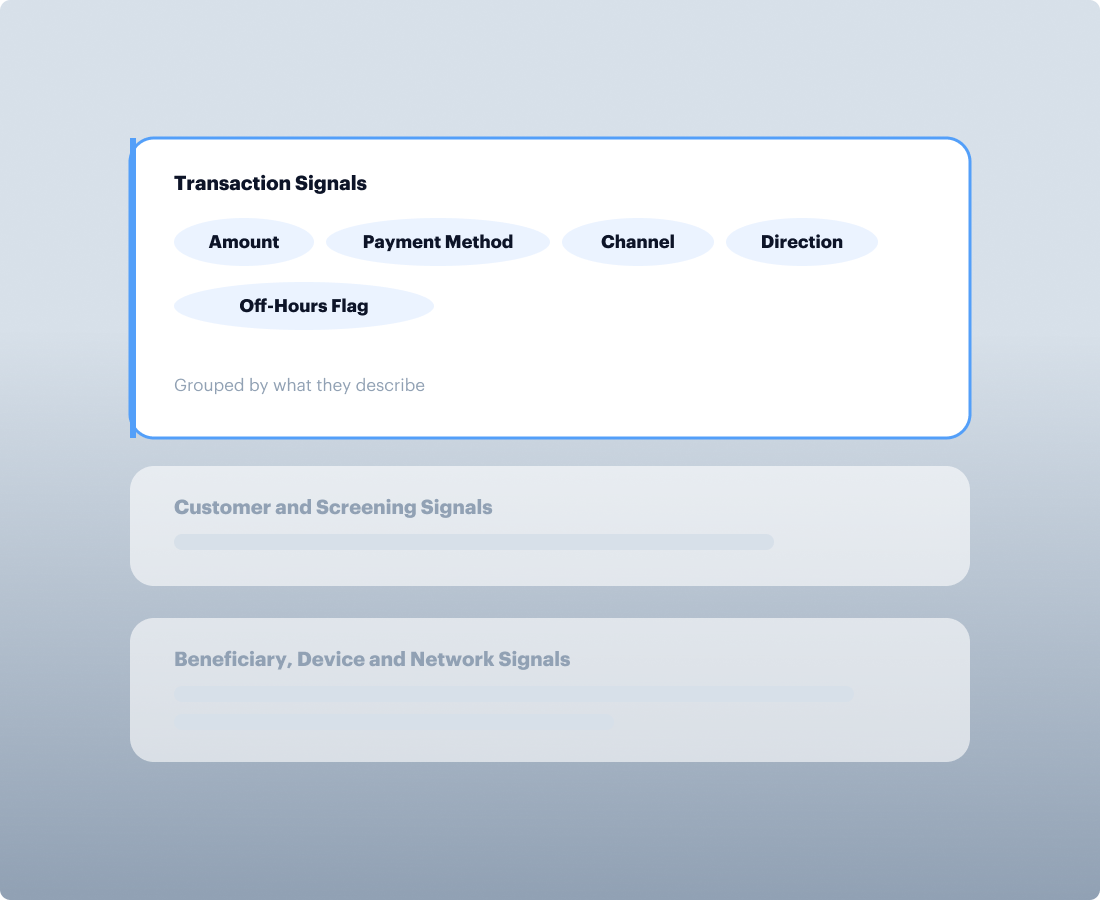
Every Datapoint Grouped by Entity
Amount,payment method,channel,direction and off-hours flag sit together,grouped by what they describe,not left in one alphabetical list.
KYC tier,risk tier,screening status and maturity tier sit beside each other,so a condition on customer state stays in one place.
New-beneficiary flags and sanctions status join device,IP and pre-computed network flags for circular flow and postal clustering.
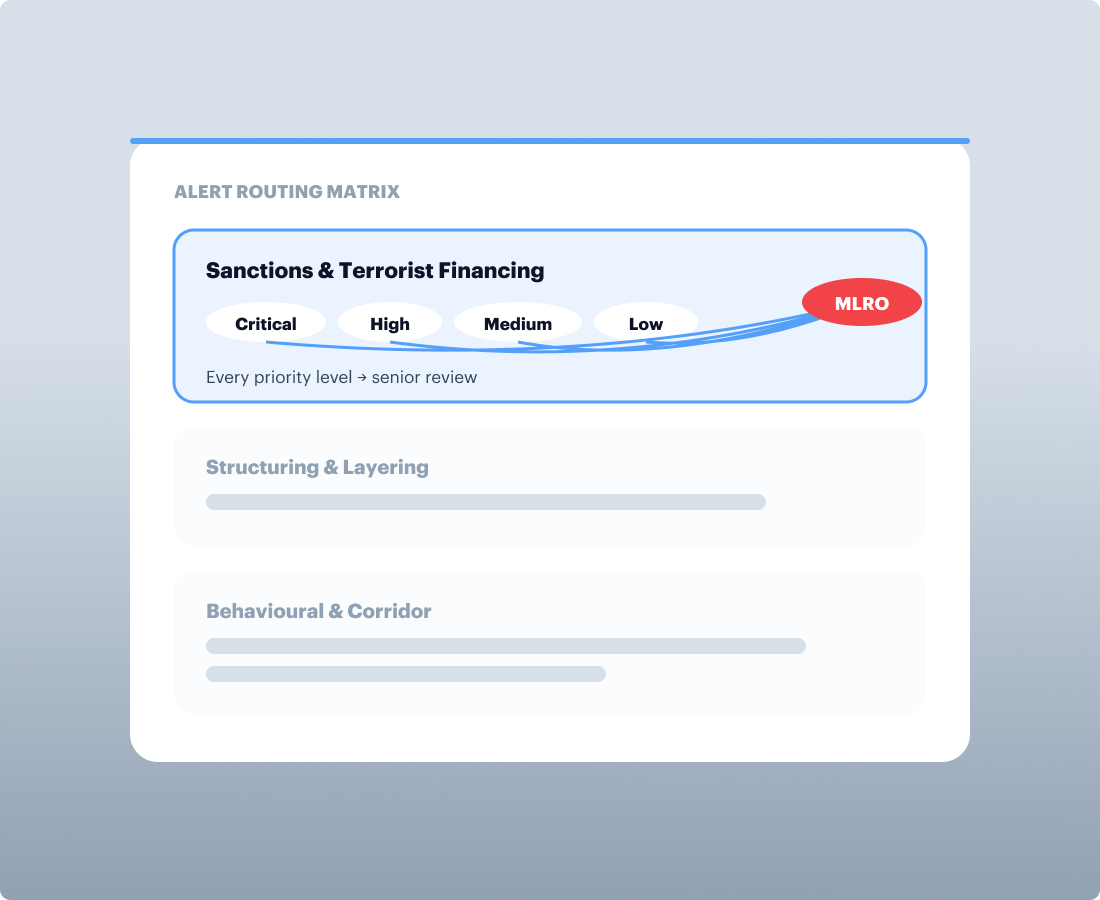
A Matrix Decides Where Every Alert Lands
Regardless of priority,these typologies route to senior review every time,with no configuration path that softens it.
A critical-priority structuring rule reaches an MLRO;the same typology at low priority can start at L1 instead.
A medium-priority corridor rule can route to L1 or generate no alert at all,while the same typology at critical priority still escalates.
AGENTIC RULE BUILDER RUNS INSIDE ONE PLATFORM
One Platform. Full Identity Lifecycle
User Verification
Onboard and authenticate legitimate users in seconds.
Business Onboarding
Perform global KYB and due diligence with confidence
Fraud Prevention
Detect and block fraud at every touchpoint
Transaction & Ongoing
Proactively manage risk and maintain regulatory compliance






AGENTIC RULE BUILDER RUNS INSIDE ONE PLATFORM
One Platform. Full Identity Lifecycle
User Verification
Onboard and authenticate legitimate users in seconds.
Business Onboarding
Perform global KYB and due diligence with confidence
Fraud Prevention
Detect and block fraud at every touchpoint
Transaction & Ongoing
Proactively manage risk and maintain regulatory compliance
User Verification
Onboard and authenticate legitimate users in seconds.

Document Verification

Instantly verify government-issued identity documents from over 230 countries and territories.

eIDV
Confirm user details against trusted government and financial data sources for added confidence.

Age Verification
Reliably verify user age to meet regulatory requirements and protect your platform.

Address Verification
Instantly confirm a user's address from utility bills,bank statements,and other documents against global database.

NFC Verification
Read the secure chip in a passport with a simple phone tap for the highest identity assurance.
Business Onboarding
Perform global KYB and due diligence with confidence

Business Verification
Automate the verification of business entities by checking data from global corporate registries.

Due Diligence
Streamline your enhanced due diligence process with customizable risk assessment and data collection.

Investor Verification
Securely verify the identity and accreditation status of investors for your platform.

Fraud Prevention
Detect and block fraud at every touchpoint.


Transaction & Ongoing
Proactively manage risk and maintain regulatory compliance with continuous user and transaction monitoring.

AML Screening
Screen users and businesses against global sanctions, PEPs, and adverse media watchlists in real-time.

User Risk Assessment
Generate dynamic risk scores for every user based on their profile, behavior, and transaction history.

Transaction Screening
Monitor financial transactions in real-time to detect and block illicit or fraudulent activity.
BUILT FOR YOUR INDUSTRY
Investor Qualification for Every Regulated Industry
Verify on every admission
Equity and investment marketplaces need investor verification on every offering admission,often at scale. Shufti verifies at admission speed and stores documentary evidence in one place.

Don’t just take our word for it,hear from our customers
The Confidence Our Clients Share

The future of digital identity is defined by trust,interoperability,and regulatory alignment,so our partnership with Shufti reinforces DevCode Identity’s commitment to supporting our global customers with the most secure,best-in-class,compliant identity verification solutions available today.
Combining our Conversion Driven Compliance Orchestration Platform with Shufti’s global KYC and IDV capabilities allows our customers not only to navigate complex regulatory demands but also to maintain a seamless customer onboarding experience with the highest achievable conversion rates.
We’re proud to continue our partnership with Shufti as we expand into new jurisdictions.
Shufti’s verification technology not only strengthens our compliance framework but also ensures our players enjoy a smooth,secure onboarding experience.
We aim to offer our clients and their traders the very best tools with which to do their jobs,we’re excited to be able to work with Shufti.
They’re a leading company,and we’re looking forward to offering their solutions to our clients through our CRM.
The relationship with Shufti was born out of frustration with an existing provider,so we started our discussion with Shufti.
The response time was excellent,from the start of speaking to sales to getting up and running with the demo.
Industry Recognition & Awards

TOP 10 KYC SOLUTION PROVIDER 2023GRC Outlook

BEST USE OF TECHNOLOGY IN ID VERIFICATIONGlobal brands magazine

FASTEST GROWING KYC SOLUTIONS PROVIDERGlobal brands magazine

TOP PERFORMER IDENTITY VERIFICATION SOFTWARE SUMMER 2023Featured Customers

EXCELLENCE IN IDENTITY VERIFICATION SOLUTIONSGlobal brands magazine

BEST CLIENT ONBOARDING SOLUTION - MEAUltimate Fintech

BEST REGTECH REPORTING SOLUTION - MEAUltimate Fintech

BEST CLIENT ONBOARDING SOLUTION UFAWARDS 2023
COMMON QUESTIONS
Frequently Asked Questions
A no-code rule builder lets compliance define detection logic,thresholds and time-window aggregates directly,without an engineering release. Shufti’s agentic rule builder uses three condition primitives (field,velocity,baseline) that already back 50+pre-built rule sets for remittance.
No. Publishing submits a rule for compliance review on a five-business-day SLA. An MLRO must approve before the rule can be set active,whether the rule was written manually or drafted by the AI generator.
An eight-step question pack collects industry,product,regulatory and risk-appetite context,then drafts a candidate set of rules on its own for compliance to accept,edit or reject individually. It does not auto-publish,and sanctions,structuring and terrorist-financing rules are always forced to non-suppressible regardless of what is proposed.
Today’s backtest simulates a proposed threshold against the rule’s recent firing pattern using an estimation model,and the results say so explicitly. Full historical replay across frozen transaction snapshots is on the roadmap.
Two conditions,clear screening and no prior filing,are locked and cannot be edited,removed or overridden through the UI or the API. Every other suppression condition is configurable and logged.
Remittance has a complete,live pack of 50+pre-built rule sets today. Fintech is scheduled for Q3 2026,Banking and Gambling for Q4 2026,Trading and Crypto for Q1 2027,and Lending for Q2 2027. Other industries appear in the AI generator’s question packs now,ahead of live rule generation.
Every rule published here runs inside Shufti’s transaction monitoring engine,scored against the same identity and screening result established at onboarding. There is no separate rule-evaluation stack to keep in sync.
Standard SaaS,private cloud,or fully on-premise,with identical rule-builder capability across all three,for institutions that cannot move transaction data across borders.
Publish a Rule That’s Reviewed,Not Guessed.
Three condition primitives,an eight-step AI generator,and a locked suppression engine,all inside the same platform running Shufti’s transaction monitoring.
Your Go-To for KYC/AML & Fraud
Resources

11 August, 2026
Shufti's 2026 Context Gap in AML Risk Assessment
False positives climb when alerts reach analysts without context. Shufti's 2026 report shows what customer and risk context teams need to decide cases much faster.
Guide