









 AMLR Solutions
  AMLR Consultation
 EUDI Wallet
 Onboarding
 Ongoing Monitoring
 FRAML
FRAML KYC
KYC KYB
KYB KYI
KYI Age Assurance
 Workforce IAM
 Candidate Verification
 Account Takeover
 Bonus/ Promotion Abuse
 Chargeback Fraud
 Deepfake
 Document Fraud
 Fraud Networks
 Impersonation Fraud
 Money Mule Activity
 Multi-Accounting
 Party Fraud
 Regulatory & Compliance Risks
 Synthetic Identity Fraud
 Adult Content
 Banking
 Crypto
 Fintech
 Forex
Forex Compliance
 Fraud prevention
 Trust & safety
 Global expansion
 Compliance Officers
 Developers
 Fraud Analysts
 Product Managers
 Journey Builder
  Global Trust Platform
 Customer Profiles
 Vendor Comparison
 IDV Case Management
 AML Case Management
 Regulatory Reporting
 Agentic Rule Builder
  AI Compliance Co-Pilot
  Fraud Analytics
 Fraud Hub
  OCR
OCR Shufti AI
 Bank Account Verification
  Biometric Duplication
 Database Checks
 Document Intelligence
 Government ID
 Mobile Driver's License
 NFC
NFC Selfie Liveness
 Brand Personalisation
 Deployment Options
 Identity Methods
 IDV Modes
 Multi-tenancy
 On-Premise IDV
 Secure Capture
 Shufti MCP


GEOLOCATION COMPLIANCE
Strengthen Geolocation Compliance With Verified User Location
Shufti Geolocation Compliance links geolocation verification to an identity already confirmed through KYC and AML, so businesses control access across permitted and restricted jurisdictions from one integration.
Geolocation Compliance, Bound To Identity










Run Location Verification
That Holds Up Under Audit
Three Signals Resolved Into One Position
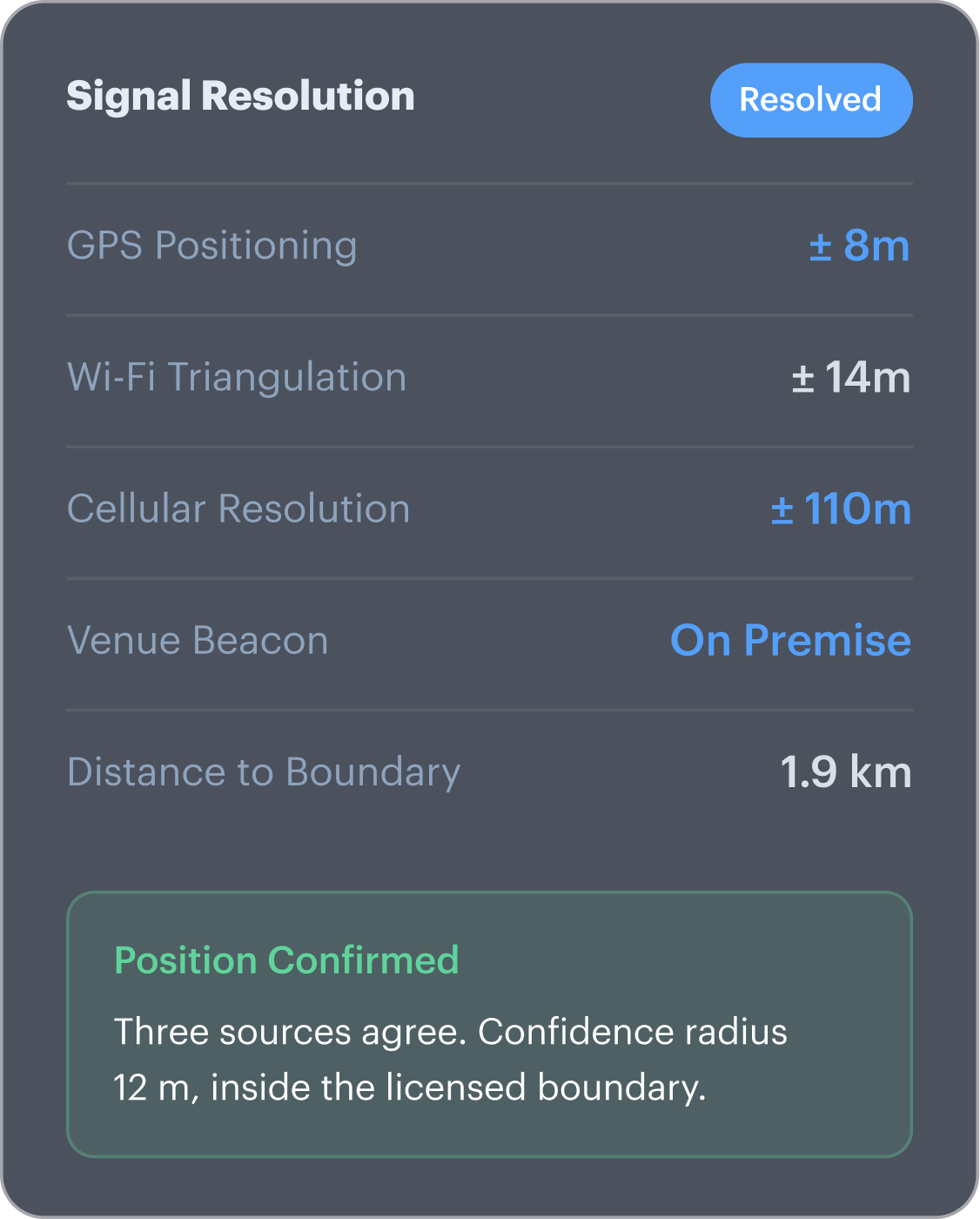
A VPN defeats an IP lookup in seconds, which is why regulators ask for device-level geolocation. Shufti reads GPS, Wi-Fi and cellular independently, then resolves them into one position.
- Every position carries a confidence radius, not a single point
- Permitted area drawn as a polygon, not a radius guess
- Where two sources disagree, it is flagged as fraud

Every Override Linked To A Verified Identity
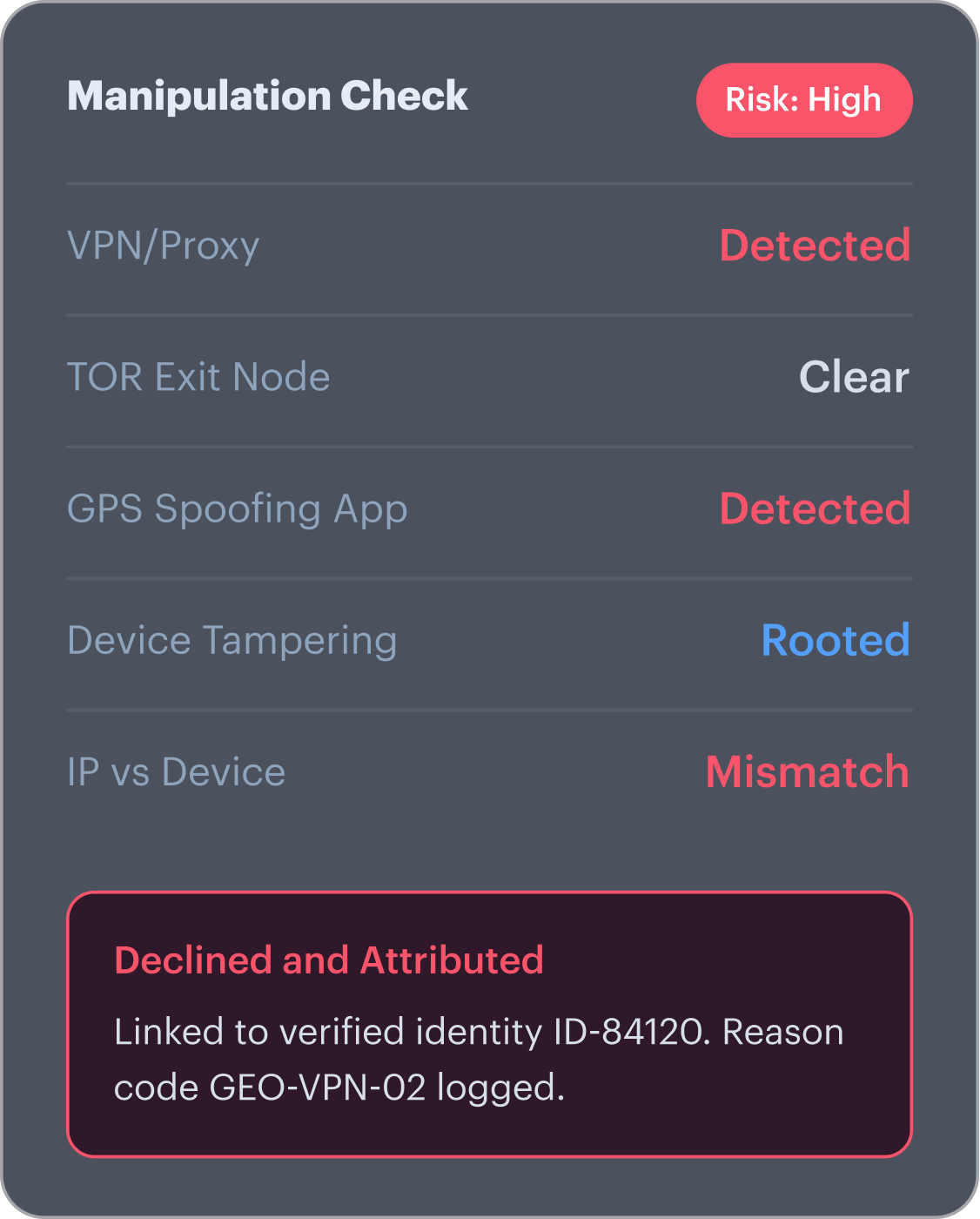
A location-only vendor returns where a device appears to be. It cannot say who is behind a masked connection, because location verification and identity sit in separate products.
- VPN, proxy and Tor declined outright
- GPS spoofing apps caught at the device layer
- Every override tied to a KYC-verified identity
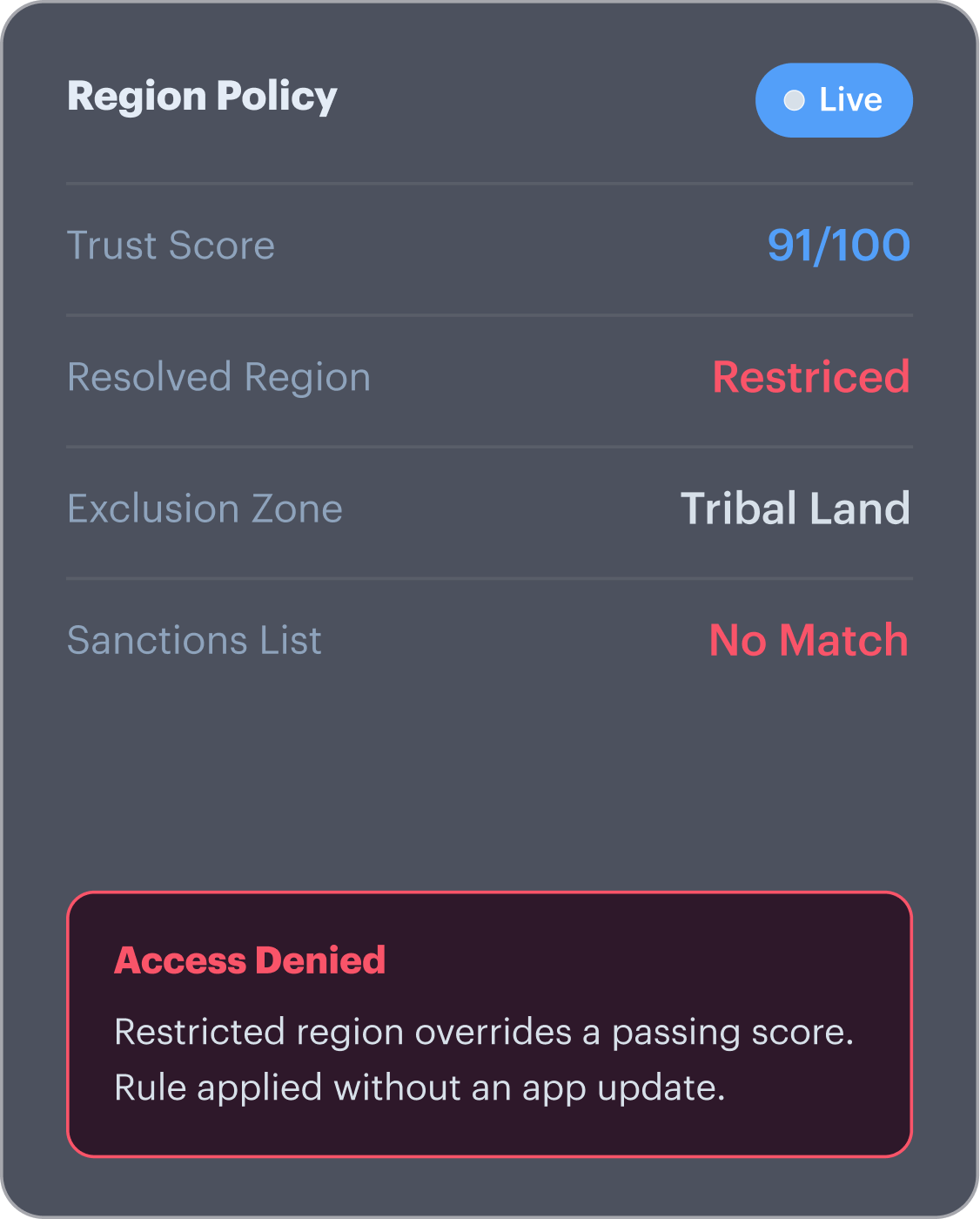
A Restricted Region Beats A Passing Score
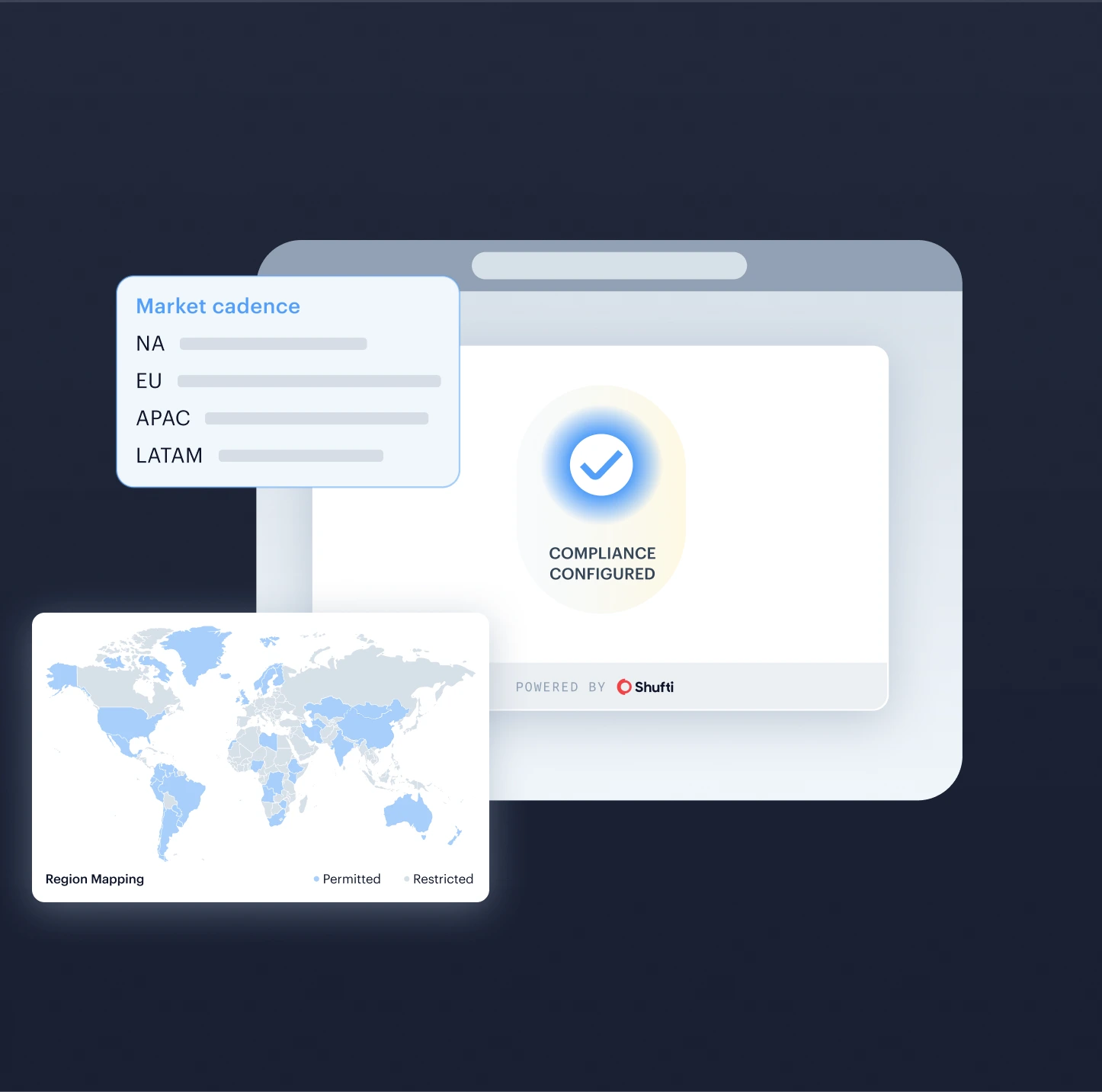
Access is permitted everywhere by default, except the restricted jurisdictions set in the console. A confirmed restricted position wins, whatever the trust score says.
- Exclusion zones geofenced inside permitted states
- OFAC and MiCA geoblocking on the same map
- Rule changes apply with no app update
A Logged Verdict At Every Checkpoint
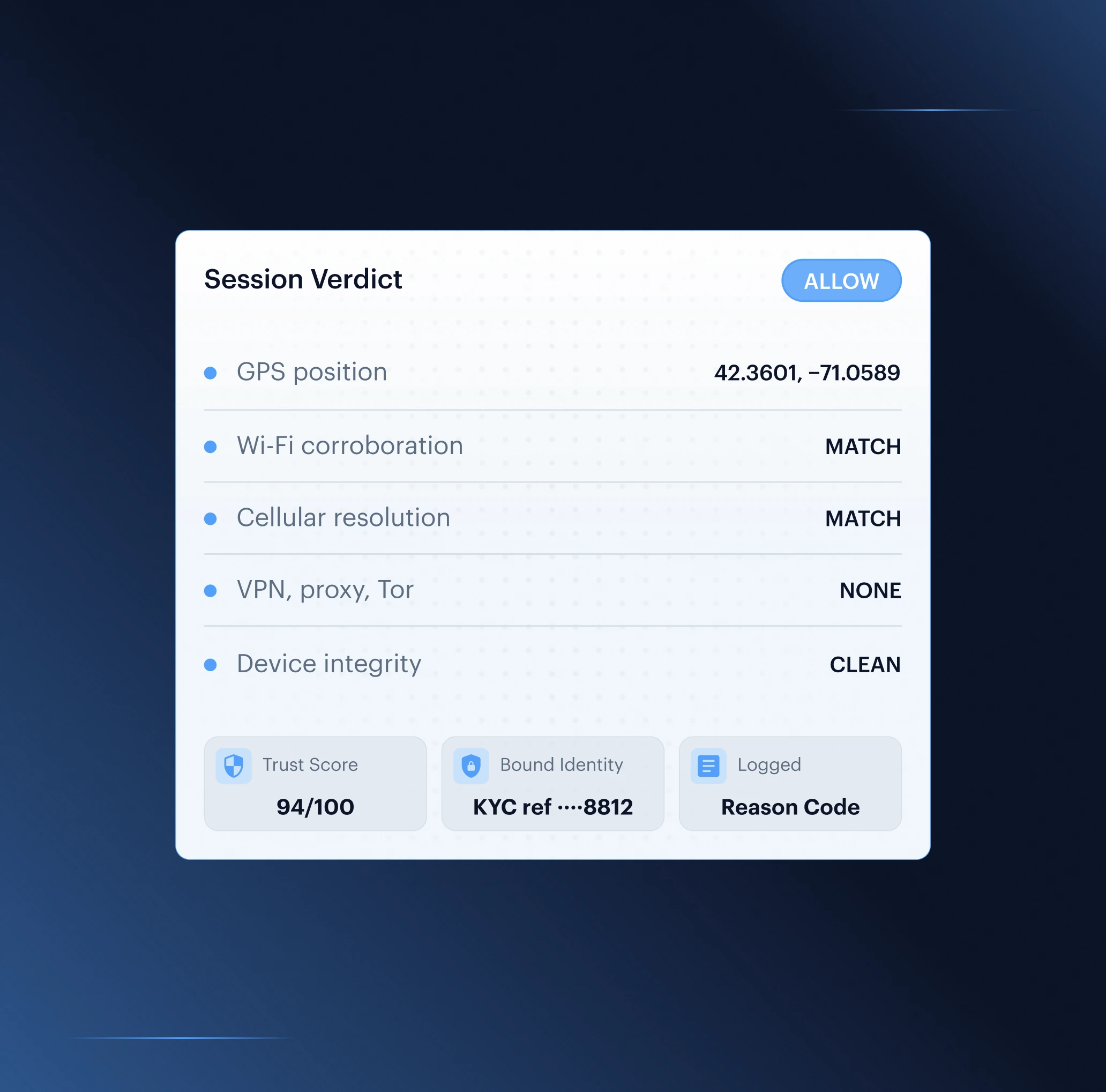
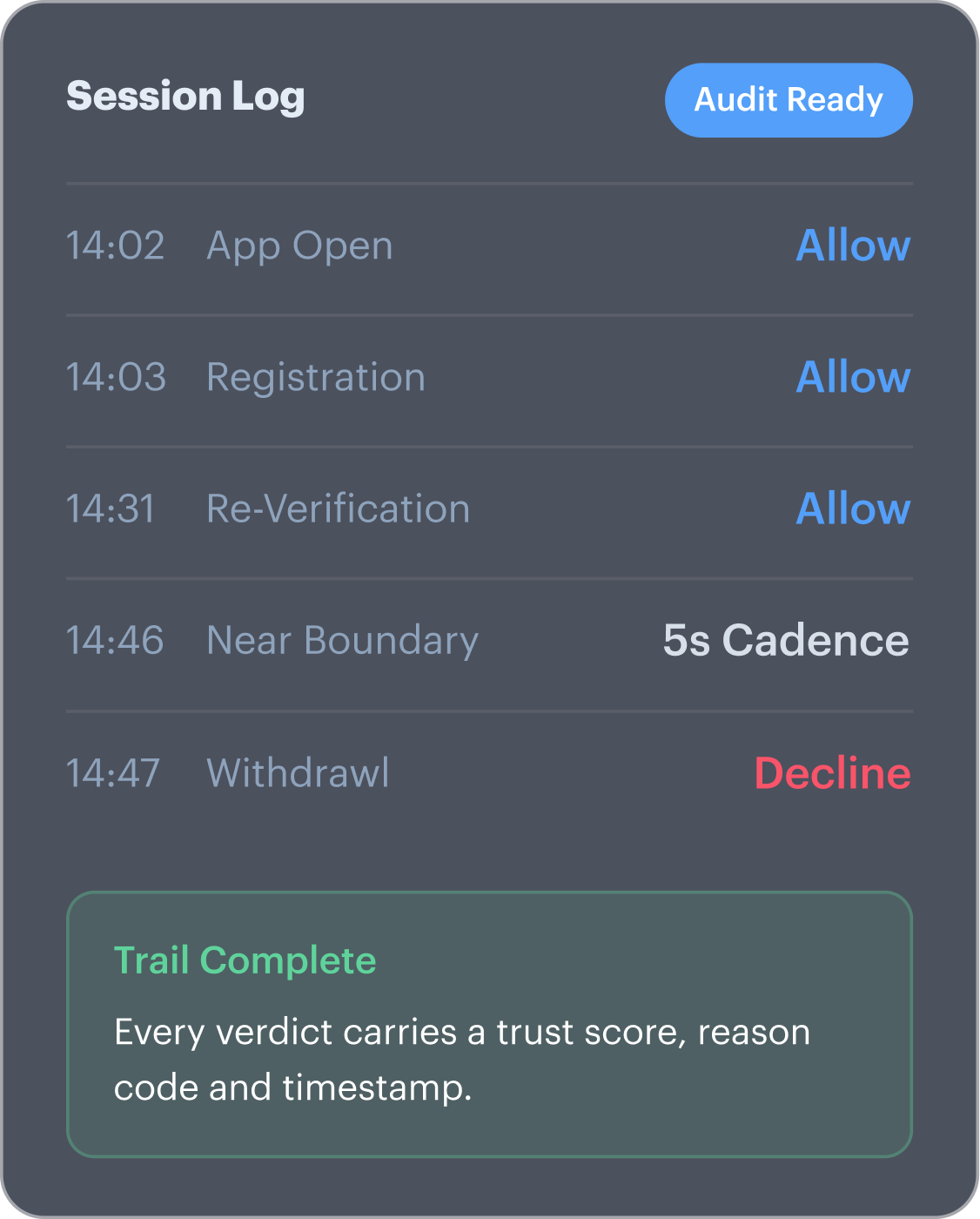
A regulator does not inspect the engine. It inspects the location verification record. Geo Compliance writes that record as the session runs, so the evidence exists before anyone asks for it.
- Checks at app open, login, registration and withdrawal
- Cadence set per market, tightens near a border
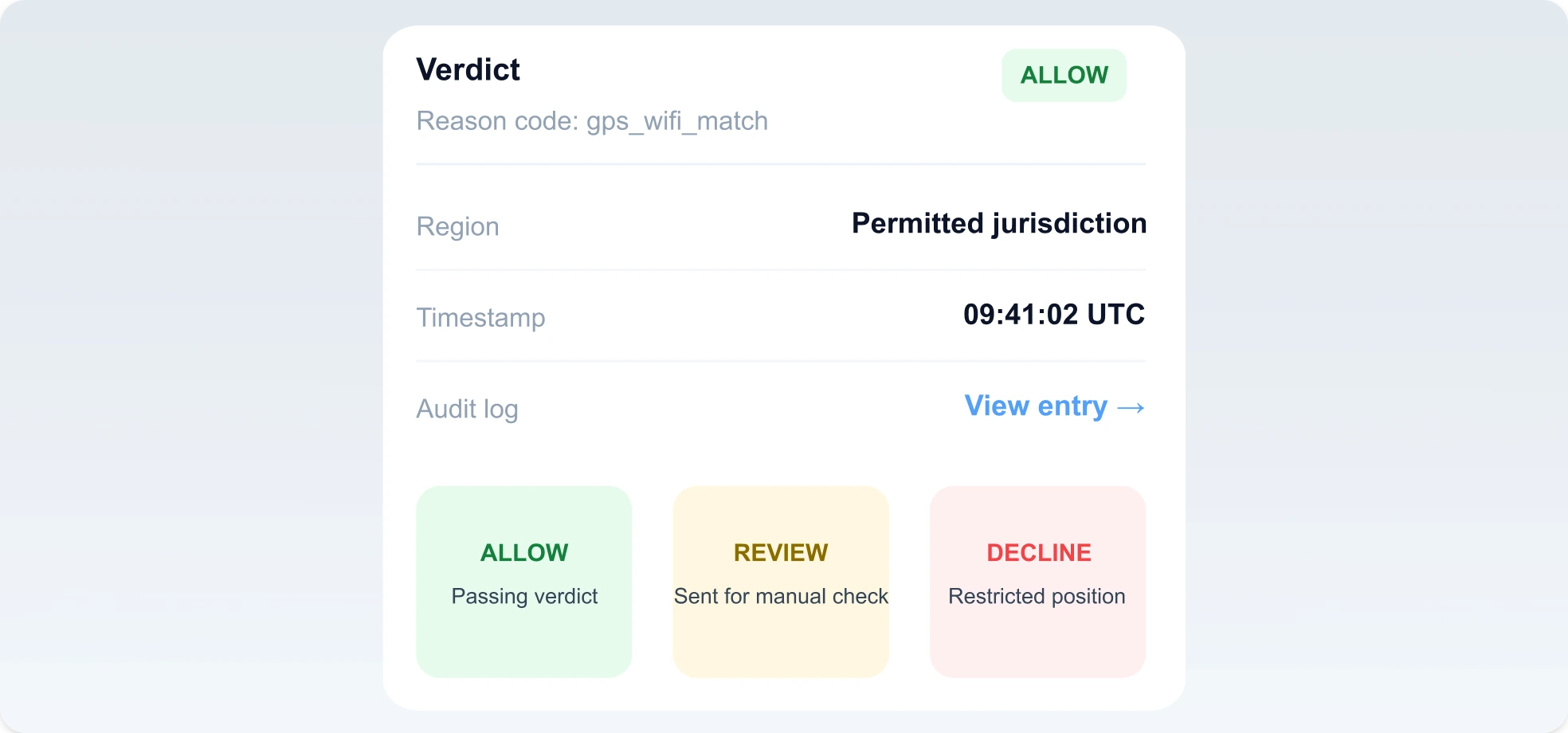
- Trust score, reason code and timestamp on every verdict
DECISION ARCHITECTURE
Three Layers Behind Every Geolocation Compliance Verdict
01
STEP 01
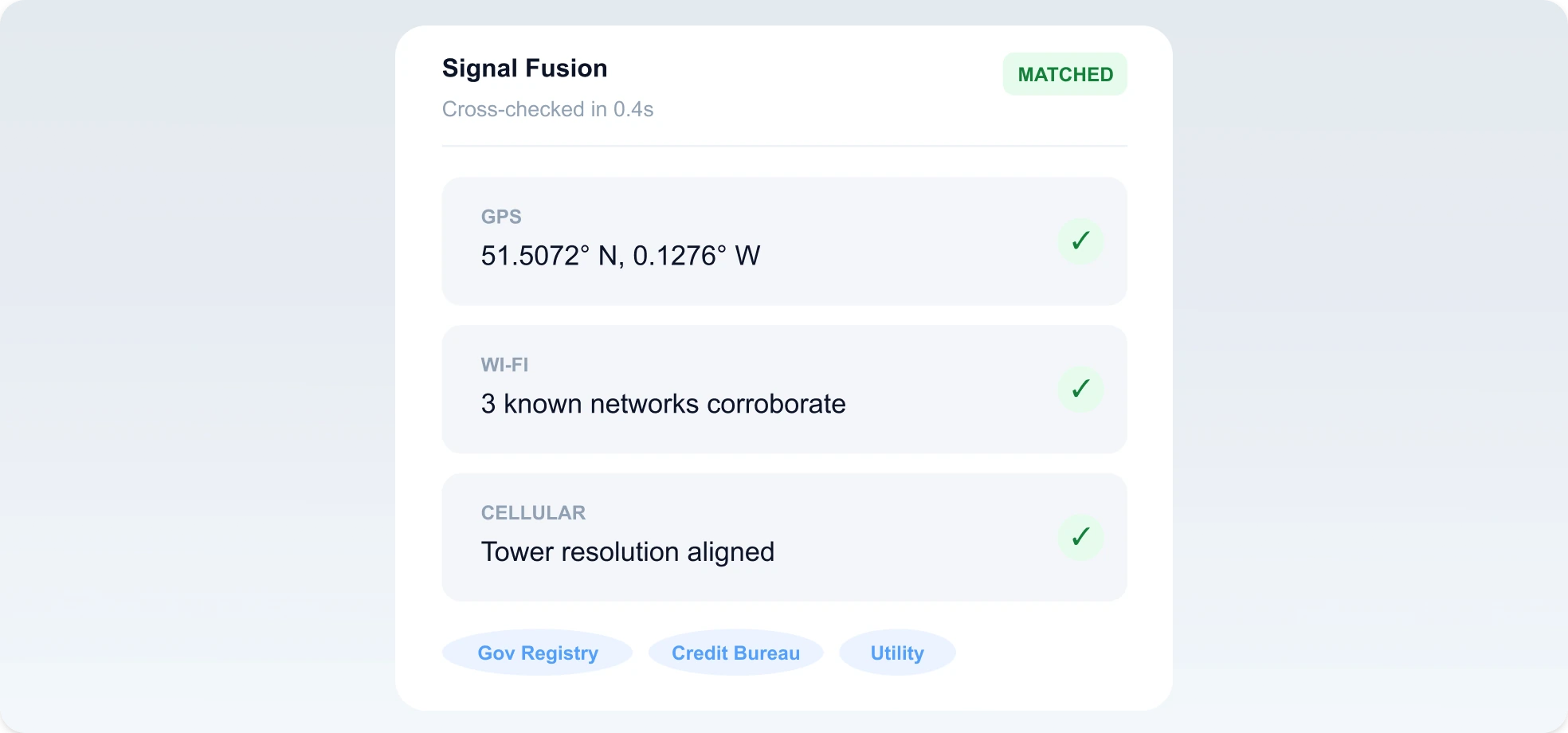
Signal Layer
Independent inputs are cross-checked against one another before a position is issued.
02
STEP 02
Trust Layer
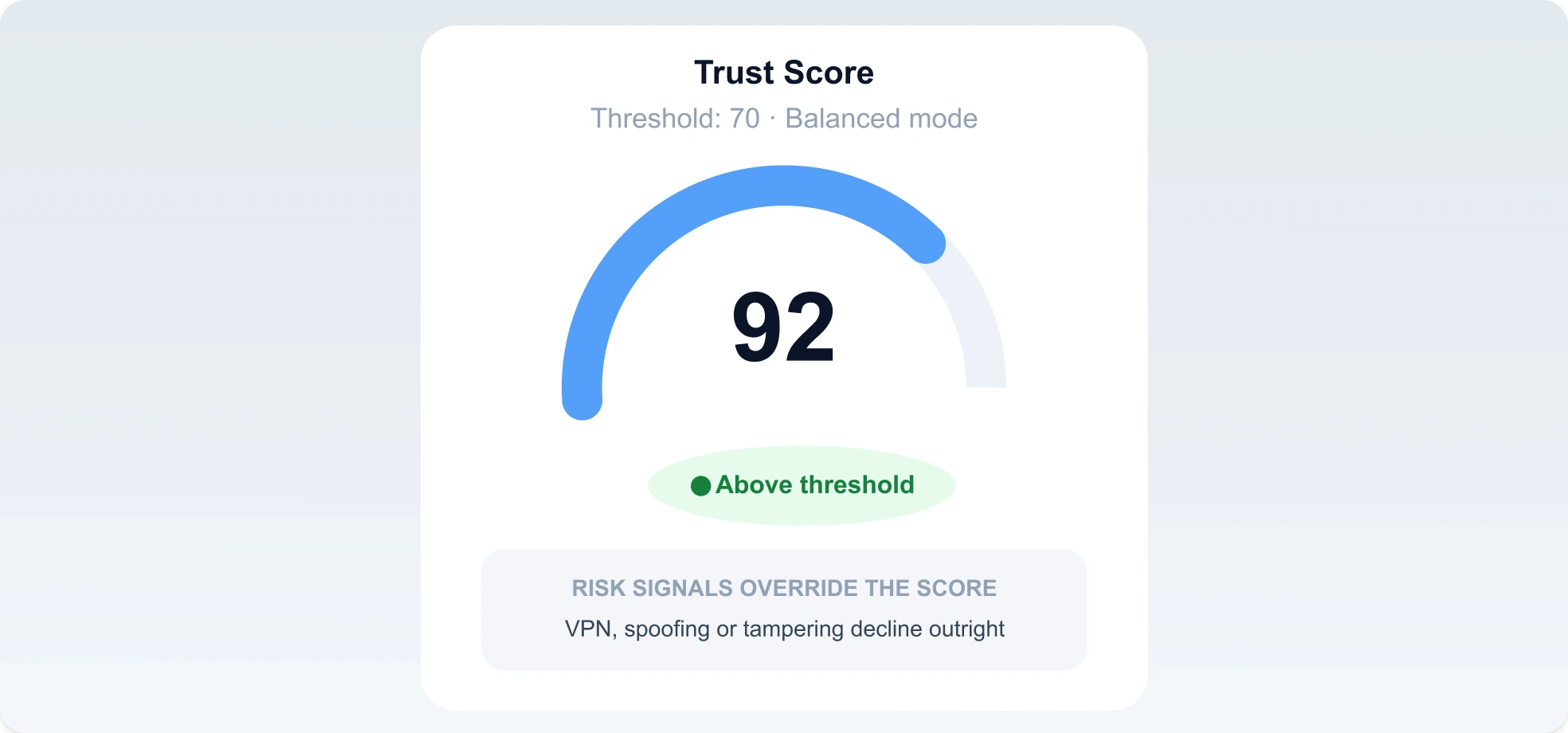
Each check returns a trust score from 0 to 100 against a configurable threshold, 70 in Balanced mode. Risk signals override the score outright.
03
STEP 03
Decision Layer
The position is checked against the region map. Shufti returns Allow, Review or Decline with a reason code and audit log.

BUILT FOR COMPLIANCE, DESIGNED FOR EASY INTEGRATION
Geo Compliance, Ready for Your Stack
Consume Geo Compliance verdicts through a REST API, with location verification and identity running on one integration and one audit trail.
- Return the verdict, trust score and reason code in one response.
- Link each location decision to the KYC-verified identity.
- Integrate as a second source with no exclusivity or per-ping penalty.


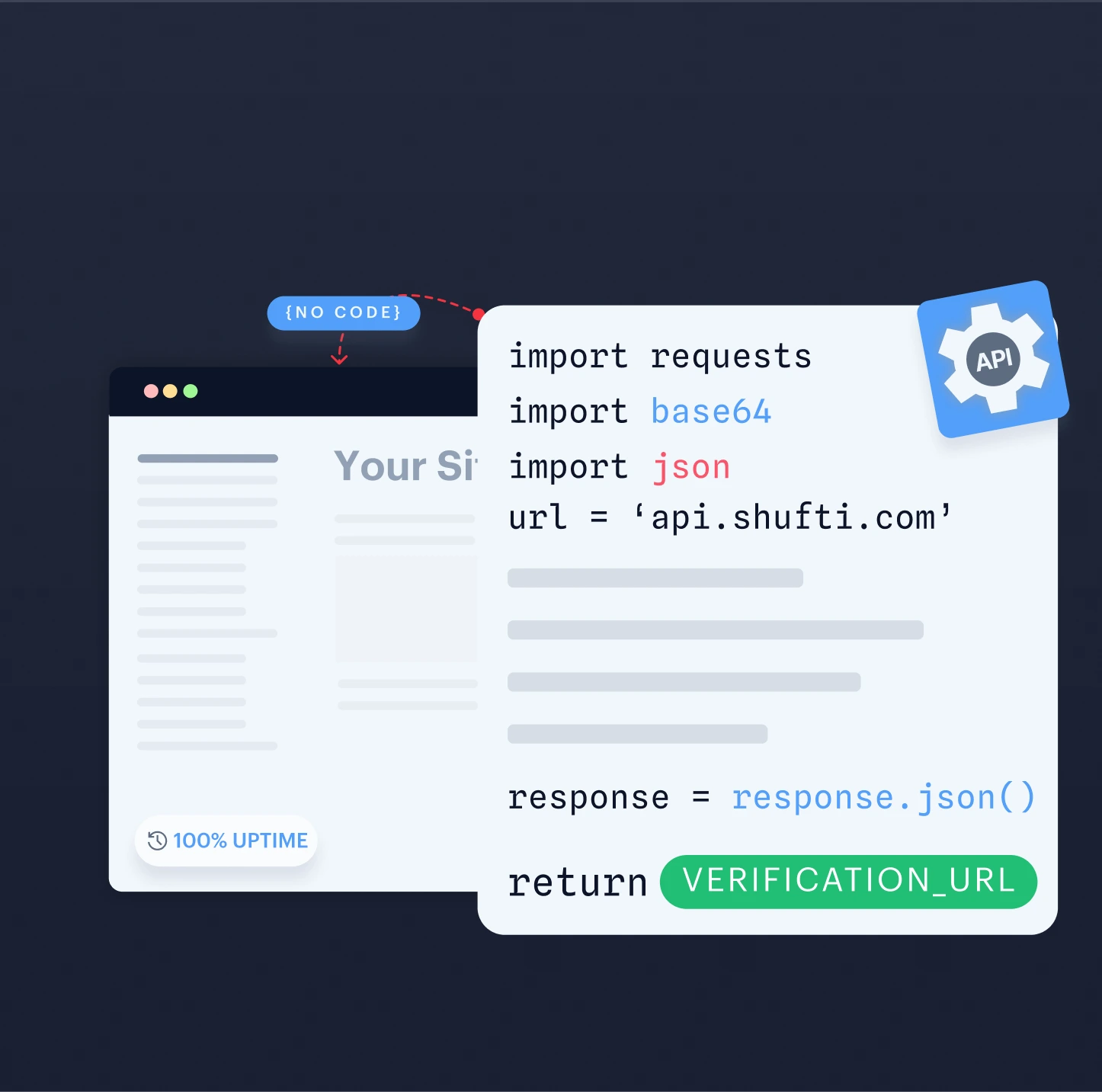
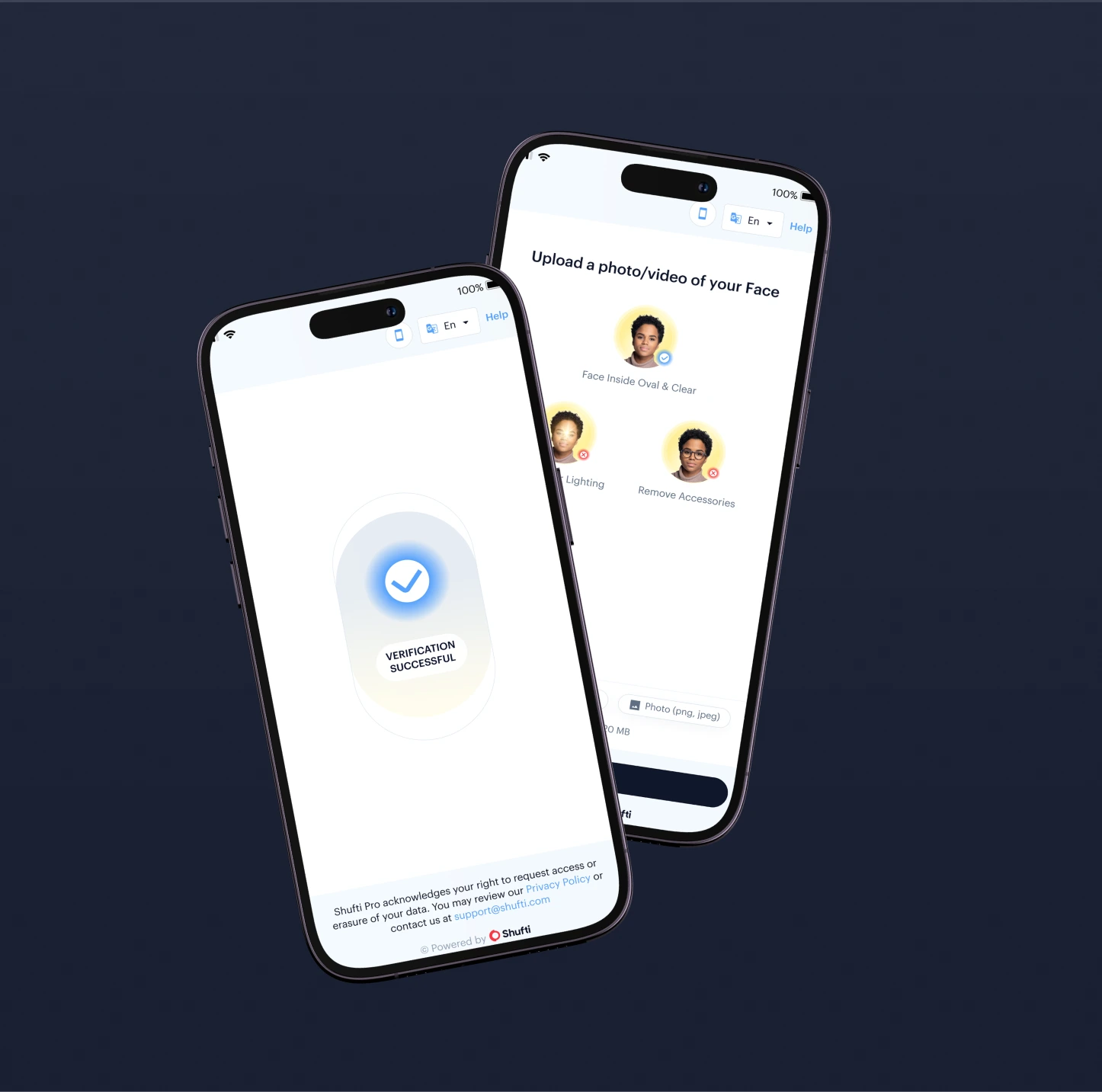
Embed Geo Compliance directly into your stack with native SDKs for iOS, Android, Web and React Native.
- Support the platforms your users already rely on.
- Run location verification and identity through one integration.
- Move from sandbox to a typical deployment in around five days.
Use webhooks to receive session events as location conditions change during an active journey.
- Trigger an event when a user crosses a boundary mid-session.
- Re-verify at the cadence configured for each market.
- Keep every event on the same audit trail.

Configure every Geo Compliance rule in the console without shipping an app update.
- Set triggers, thresholds and failure actions.
- Draw permitted and restricted regions on the region map.
- Adjust rules and verification cadence market by market.
BY JURISDICTION
Geolocation Compliance, Ready for Your Stack

Division of Gaming Enforcement
REGULATOR REQUIRES
Player location confirmed at every wager attempt, with demonstrable accuracy and periodic audits.
WHAT SHUFTI DELIVERS
A check fires before funds leave the platform, re-verification runs at the cadence set for the market, and every verdict is logged.

Gaming Control Board
REGULATOR REQUIRES
Proof that the system geofences operations accurately and reliably, verified by audit.
WHAT SHUFTI DELIVERS
Three signals resolve into one position with a confidence radius, and the permitted area is drawn as a polygon mapped to the licence.

Gaming Control Board
REGULATOR REQUIRES
The same demonstrable geofencing obligation, applied to internet gaming and sports betting alike.
WHAT SHUFTI DELIVERS
One region map covers both product lines, configured state by state, with changes applied from the console.

AGCO
REGULATOR REQUIRES
Location assurance controls for internet gaming, in force since April 2022.
WHAT SHUFTI DELIVERS
The location verdict is bound to an identity already verified through KYC and AML, so the person and the place sit in one record.

SPA, Ministry of Finance
REGULATOR REQUIRES
Continuous per-session location verification across the regulated market.
WHAT SHUFTI DELIVERS
Re-verification holds the session, the rate rises near a boundary, and a 30-second grace period absorbs a signal drop.
BY INDUSTRY
Geolocation Compliance Across Regulated Sectors
Sell Only Where Licensed
Region-restricted goods sold in unlicensed markets expose operators to regulatory fines and enforcement action with little warning. Shufti gates each listing to its permitted jurisdictions against the configured region map, keeping buyers and sellers inside markets the operator is cleared to serve.




Regulators expect a complete audit trail linking verified identity to confirmed location. Shufti logs every decision with trust score, reason code and timestamp, keeping every Geo Compliance check audit-ready under examination.
See Compliance Officer
Separate location vendors slow launches and add integration overhead. Shufti combines identity and location verification in one SDK, accelerating market entry with fewer integration points.
See Product ManagerComplex location verification integrations increase development and maintenance effort. Shufti provides native SDKs, REST APIs, webhooks and a same-day sandbox, with typical deployment in around five days.
See DeveloperLocation data alone cannot identify the person behind spoofed or masked connections. Shufti links VPN, proxy and location spoofing signals to verified identities, giving fraud teams stronger evidence for investigations.
See Fraud Analyst
CERTIFICATIONS AND ASSURANCE
The Controls Behind Every Geolocation Compliance Verdict
 iBETA
iBETA






DON’T JUST TAKE OUR WORD FOR IT, HEAR FROM OUR CUSTOMERS
The Confidence Our Clients Share

The future of digital identity is defined by trust, interoperability, and regulatory alignment, so our partnership with Shufti reinforces DevCode Identity’s commitment to supporting our global customers with the most secure, best-in-class, compliant identity verification solutions available today.
Combining our Conversion Driven Compliance Orchestration Platform with Shufti’s global KYC and IDV capabilities allows our customers not only to navigate complex regulatory demands but also to maintain a seamless customer onboarding experience with the highest achievable conversion rates.
We’re proud to continue our partnership with Shufti as we expand into new jurisdictions. Shufti’s verification technology not only strengthens our compliance framework but also ensures our players enjoy a smooth, secure onboarding experience.
We aim to offer our clients and their traders the very best tools with which to do their jobs, we’re excited to be able to work with Shufti. They’re a leading company, and we’re looking forward to offering their solutions to our clients through our CRM.
The relationship with Shufti was born out of frustration with an existing provider, so we started our discussion with Shufti. The reponse time was excellent, from the start of speaking to sales to getting up and running with the demo.
PROCUREMENT AND TECHNICAL QUESTIONS
Geo Compliance Questions Buyers Ask
What is Geolocation Compliance?
Geolocation Compliance confirms where a user physically is at the moment they act, then binds that position to the identity already verified through KYC and AML. GPS, Wi-Fi and cellular are read independently and resolved into one position, and any VPN, proxy or spoofing attempt overrides the result. Regulated operators use it to keep access inside the jurisdictions they are licensed to serve, and to hold a logged record of every decision. It answers two questions in one call: where the device is, and who is behind it.
Why use three location signals instead of one?
GPS alone is easy to spoof. IP alone is unreliable indoors. Wi-Fi triangulation alone degrades in open areas. Fusing all three means each signal validates the others, so location verification holds up in an audit rather than only in good network conditions.
Is location only checked at the point of login?
No, and the required cadence differs by market. Brazil requires re-verification every 30 minutes through an active session; New Jersey's 2026 technical standards require every five minutes on mobile and an immediate re-check on any network change. Cadence is set per market in the console, increases to every 5 seconds as a user nears a restricted border, and a 30-second grace period absorbs a brief signal drop.
What happens to a player sitting close to a state line?
Each position carries a confidence radius, so the engine knows how certain a reading is rather than treating every fix as equal. A player genuinely inside the boundary is approved on that evidence instead of being refused on a weak signal, and re-check frequency rises as the line nears. A location verification check that declines a legitimate player is a lost deposit, not a prevented breach.
How is this different from proof of address?
Proof of address confirms where someone is registered at one point in time. Geo Compliance confirms where the user physically is during the session and detects manipulation no document can reveal. Most regulated operators run both: proof of address at onboarding, Geo Compliance checks continuously.
Who makes the final allow or decline call?
The operator does. Shufti returns a verdict of Allow, Review or Decline with a reason code, and the platform enforces it. Shufti never takes unilateral action on a user's session. That distinction matters in regulated markets where audit accountability sits with the licence holder.
A user passes the trust score but has a VPN active. What happens?
The check is declined. Risk signals override the score regardless of threshold. VPN, proxy, TOR and GPS spoofing are declined outright, and an IP-device mismatch or device tampering routes to review. The override is linked to the verified identity, so the fraud team knows exactly whose account it is.
How does the restricted-region policy work in practice?
Access is allowed everywhere by default, except the regions explicitly restricted in the console. Restrictions are configured per market across 240+ regions. When a user lands on a restricted position, that always wins regardless of their trust score. Region map changes apply from the console in real time with no app update required.
Can the compliance team adjust settings without a developer?
Yes. Triggers, the trust threshold, the failure action and the region map are all managed in the console, and changes apply with no app update. Developer involvement is only needed for the initial location verification integration, not for ongoing configuration.
How do you stop someone placing bets on behalf of a player in another state?
The device is genuinely inside the boundary, so every signal returns clean and location verification alone has nothing to flag. Shufti binds each session to the identity verified at onboarding, so a geo-anomaly triggers identity step-up before play continues. Device fingerprinting surfaces the same handset appearing under multiple accounts, which turns the question from where the device is into who is using it.
How is this different from a location-only vendor?
A location-only vendor returns where a device is. It cannot tell a fraud team whose account is behind a masked connection, because identity sits in a separate product with a separate integration and a separate contract. Shufti delivers Geo Compliance and the verified identity from one integration, so every override is already attributable when the fraud team opens the case. Device Fingerprinting adds a further signal on the same call.
How does it deploy and what does the contract cover?
Geo Compliance deploys as a native SDK for iOS, Android, Web and React Native, with a REST API and webhooks for server-side enforcement. One contract covers identity and location together. Shufti is second-source friendly with no exclusivity clause, and pricing is per verification with no per-ping penalty.
Evaluate Your Geolocation Compliance Coverage
Bring a market you operate in and a boundary case that worries you. The walkthrough runs location verification against your own region map, not a demo dataset.