










 AMLR Solutions
  AMLR Consultation
 EUDI Wallet
 Onboarding
 Ongoing Monitoring
 FRAML
FRAML KYC
KYC KYB
KYB KYI
KYI Age Assurance
 Workforce IAM
 Candidate Verification
 Account Takeover
 Bonus/ Promotion Abuse
 Chargeback Fraud
 Deepfake
 Document Fraud
 Fraud Networks
 Impersonation Fraud
 Money Mule Activity
 Multi-Accounting
 Party Fraud
 Regulatory & Compliance Risks
 Synthetic Identity Fraud
 Adult Content
 Banking
 Crypto
 Fintech
 Forex
Forex Compliance
 Fraud prevention
 Trust & safety
 Global expansion
 Compliance Officers
 Developers
 Fraud Analysts
 Product Managers
 Journey Builder
  Global Trust Platform
 Customer Profiles
 Vendor Comparison
 IDV Case Management
 AML Case Management
 Regulatory Reporting
 Agentic Rule Builder
  AI Compliance Co-Pilot
  Fraud Analytics
 Fraud Hub
  OCR
OCR Shufti AI
 Bank Account Verification
  Biometric Duplication
 Database Checks
 Document Intelligence
 Government ID
 Mobile Driver's License
 NFC
NFC Selfie Liveness
 Brand Personalisation
 Deployment Options
 Identity Methods
 IDV Modes
 Multi-tenancy
 On-Premise IDV
 Secure Capture
 Shufti MCP


Regulatory Reporting
File SAR, STR and CTR Reports Without Re-Keying Case Data
Turn the same alerts, transactions and customer data already inside Shufti into regulator-ready reports. MLRO approval controls suspicious activity filings, while CTRs batch automatically. Filing status, FIU responses and a five-year audit trail stay attached to the same record throughout.
Book a Demo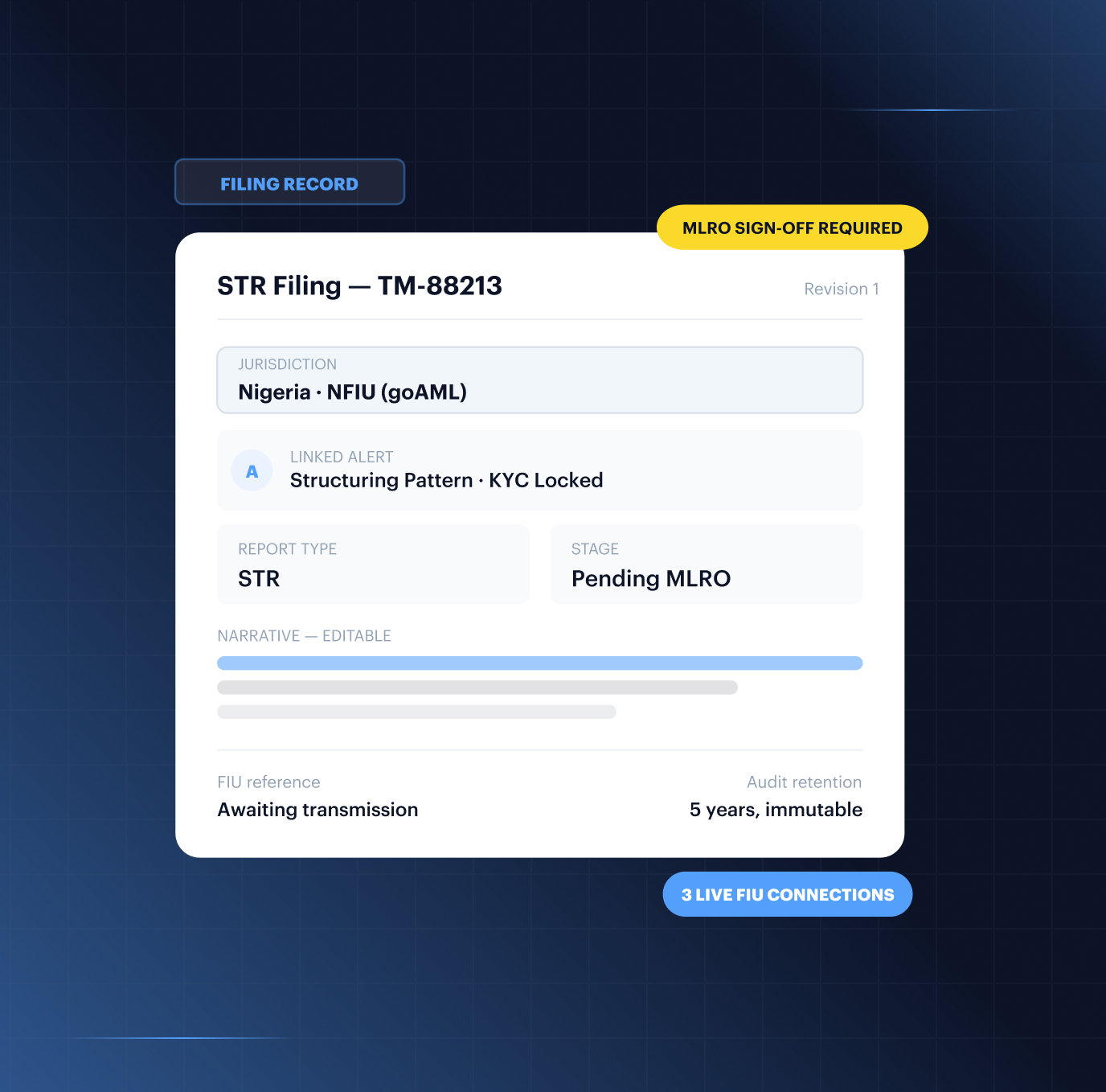
Built to File Correctly the First Time






ONE ENGINE,TWO REPORT TYPES
Discretionary and Scheduled Filings on the Same Rail
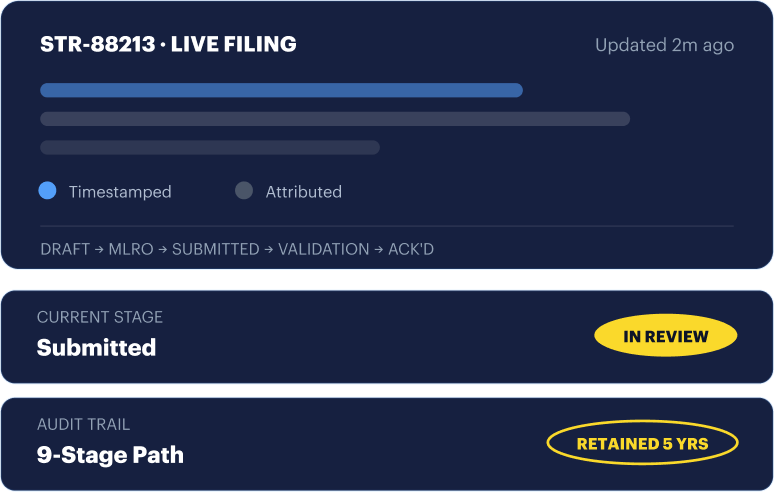
Nine Stages,One Auditable Record
A filing moves from Draft through Pending MLRO,Submitted,Validation Received for goAML or straight to Acknowledged for BSA,then to Acknowledged,Accepted with Warnings,FIU Info Requested or Rejected. Every stage change is timestamped,attributed and retained for five years.
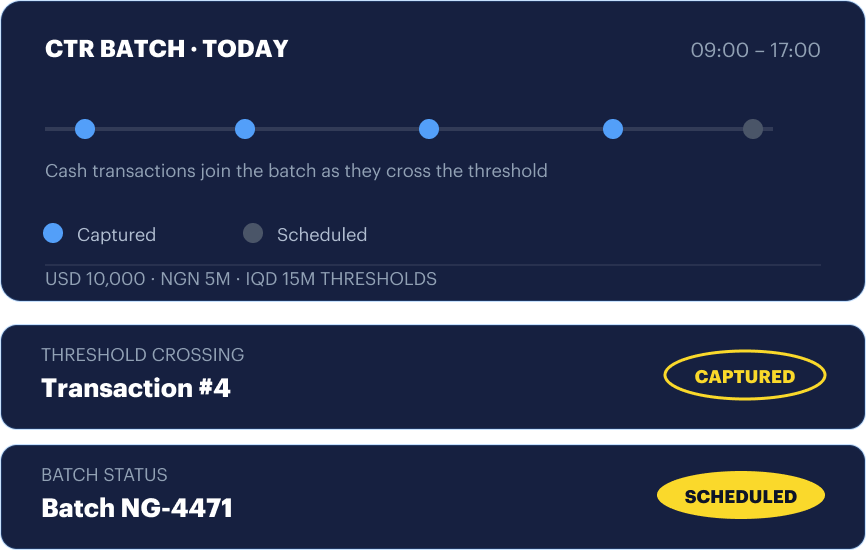
Every Threshold Crossing,Captured Without a Queue
Cash transactions over a jurisdiction's threshold are collected through the day and submitted as a scheduled batch: USD 10,000 in the US, NGN 5 million for individuals in Nigeria, IQD 15 million in Iraq. An MLRO can pause a batch with a logged reason if a data-quality issue appears, without missing the filing deadline.
One Format Generator per Regulator, Not per Filing
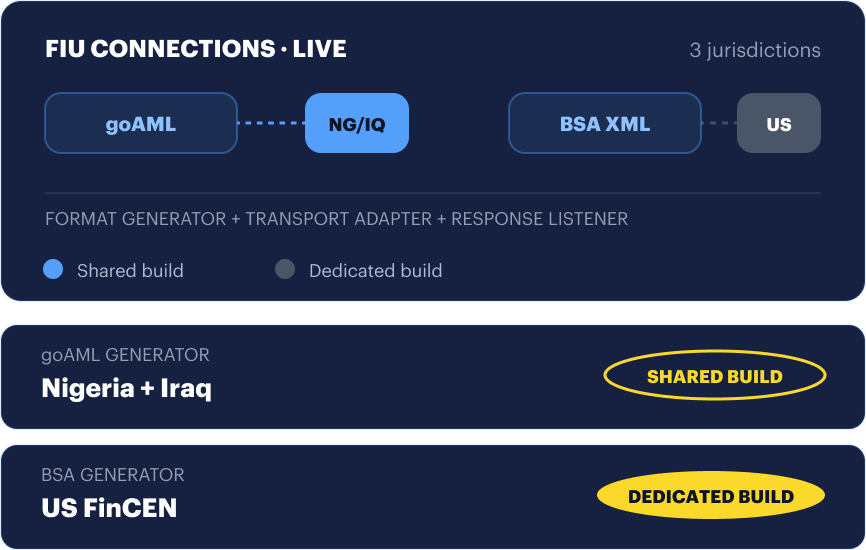
Each live jurisdiction pairs a format generator, a transport adapter and a response listener. Nigeria and Iraq share one goAML generator and web-service adapter, only the schema version and indicator codes differ, while US FinCEN BSA runs its own dedicated build.
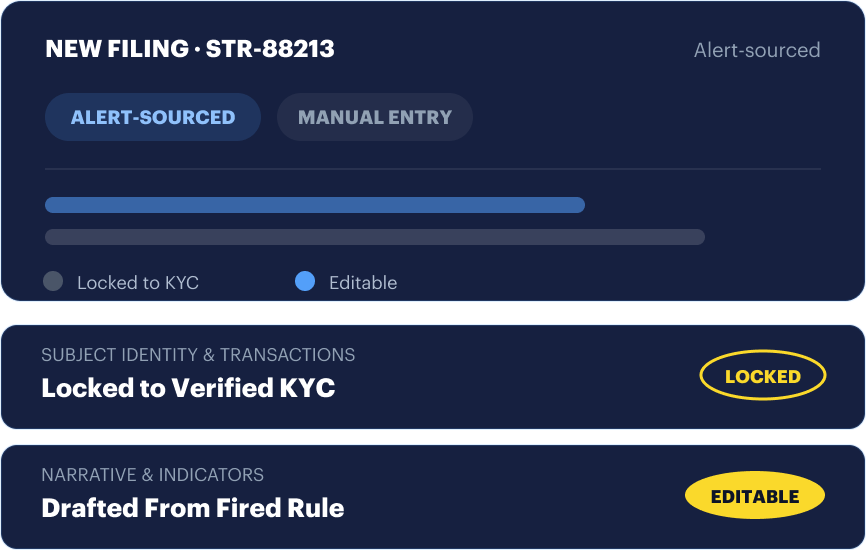
Alert-Sourced Fields Lock, Narrative Stays Editable
A filing sourced from an alert locks subject identity and linked transactions to the verified KYC record, while the narrative and suspicious indicators stay editable for the analyst. A standalone manual filing takes the same required fields with nothing pre-filled.
Inside the Reporting Engine
What an Examiner Finds When They Ask for the Filing Trail
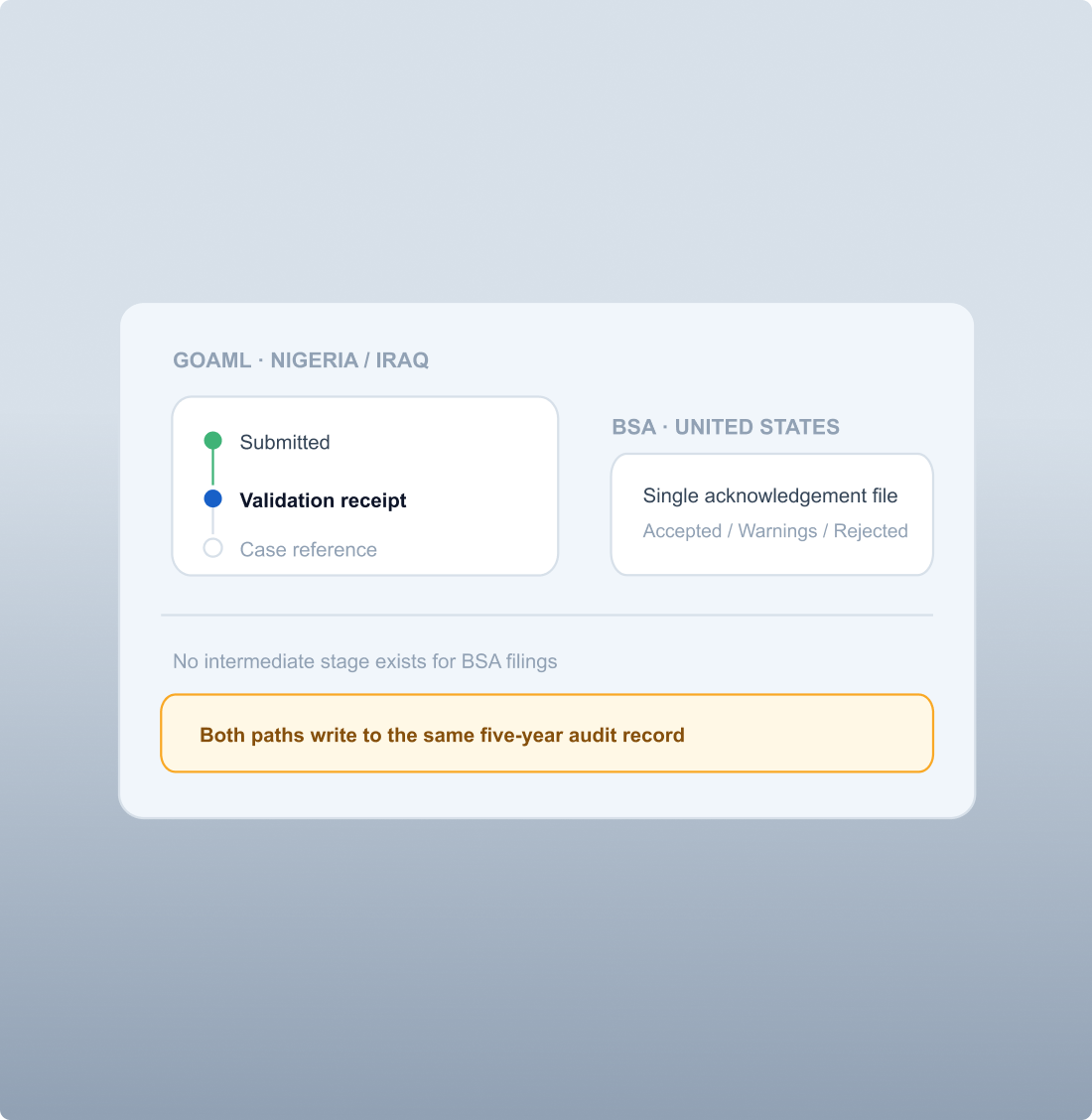
Every FIU Response Maps Back to One Status
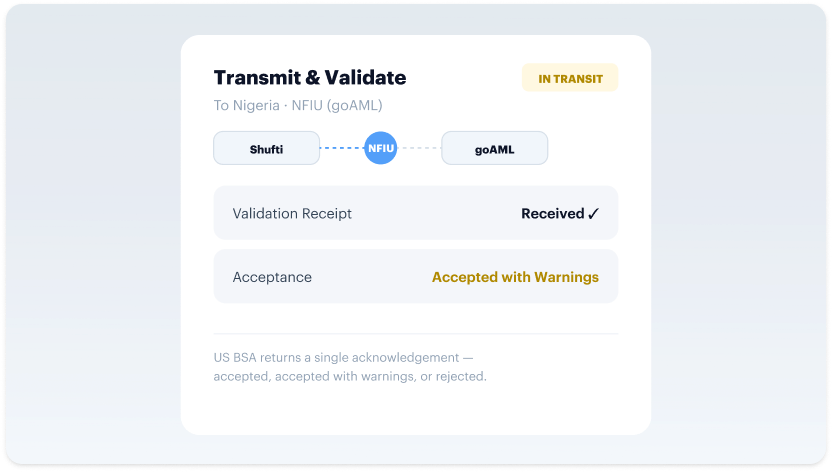
Nigeria and Iraq return a validation receipt before acceptance into casework. US FinCEN returns a single acknowledgement file, accepted, accepted with warnings, or rejected, with no intermediate stage.
When a FIU asks for follow-up evidence, the filing moves to FIU Info Requested and stores the query and due date. Responding attaches evidence and transmits it back on the same channel.
Fix and re-file opens the existing filing pre-filled, with the rejection reason and stage, gateway schema or FIU review, shown on a banner. Resubmitting updates the same record.
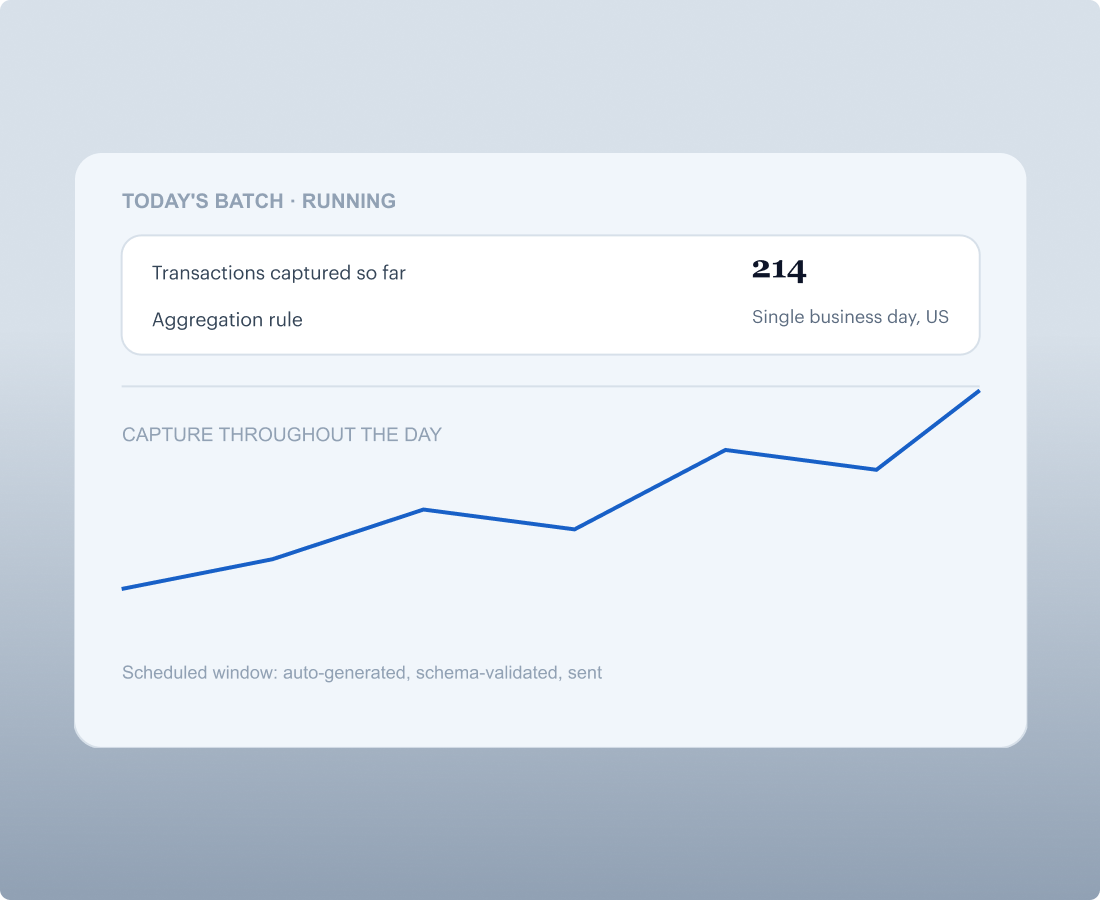
CTR Batches Run on a Schedule, Not a Queue
Cash transactions are added to that jurisdiction's batch as they cross the threshold, then aggregated by each FIU's own rule: a single business day in the US, same-day related transactions in Nigeria and Iraq.
An MLRO can pause a batch with a logged reason to fix a data-quality issue. An escalating deadline guard, amber then red then breach, tracks the tightest jurisdiction in the batch and notifies the MLRO before the window closes.
Batch history, count, total, status and FIU reference, is retained for audit alongside the individual filings it contains.
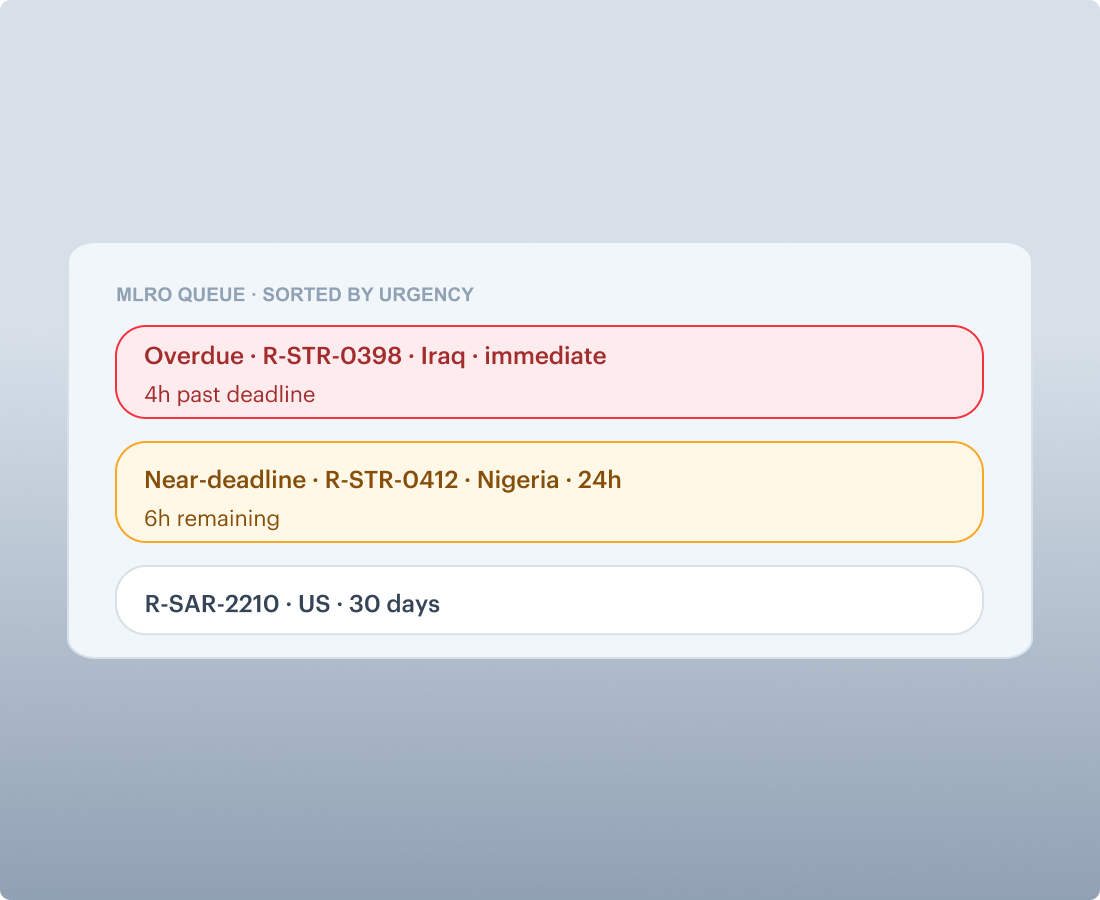
The MLRO Queue Surfaces the Most Urgent Filing First
Overdue and near-deadline filings sort to the top of the MLRO queue, so the most urgent sign-off decision is never buried under newer submissions.
Every filing preview opens in a regulator-facing plain English view. The exact XML submitted to the FIU is available in the same screen, for anyone who needs to check the wire format.
The submitted file and its FIU reference are retrievable at every post-submission status, for the full statutory retention period.
Four Steps, One Audit Trail
From Confirmed Suspicion to Acknowledged Filing
01
STEP 01
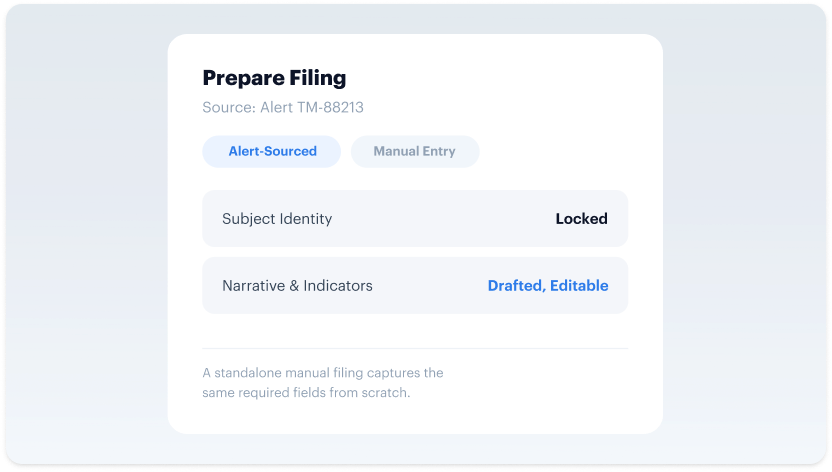
Prepare
Alert-sourced filings lock subject identity and linked transactions to the verified KYC record. A standalone manual filing captures the same required fields from scratch.
02
STEP 02
MLRO Review
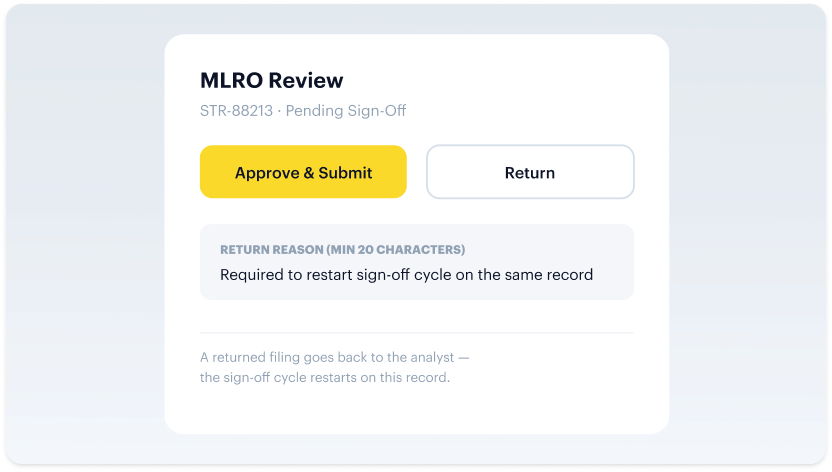
The MLRO approves and submits, or returns the filing with a reason of at least twenty characters. A returned filing goes back to the analyst and the sign-off cycle restarts on the same record.
03
STEP 03
Transmit & Validate
The engine transmits the approved file. GoAML jurisdictions return a validation receipt before acceptance, US BSA returns a single acknowledgement: accepted, accepted with warnings.
04
STEP 04
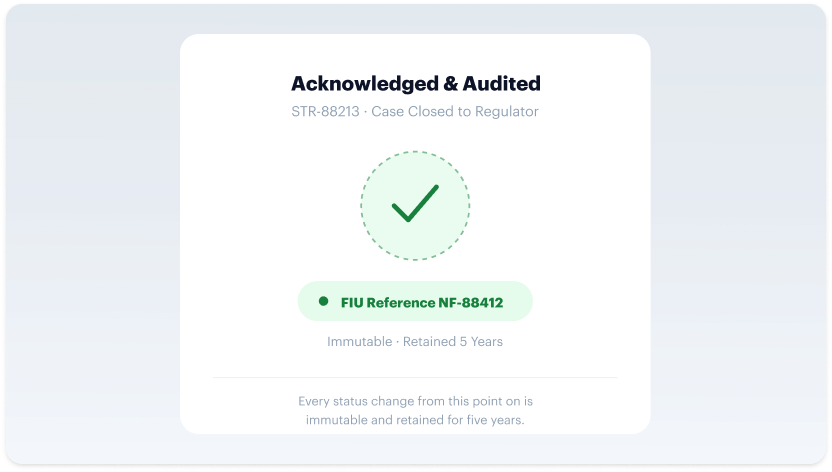
Acknowledged & Audited
The FIU case reference is stored alongside the validation receipt where one exists. Every status change from this point is immutable and retained for five years.
Three Live Jurisdictions
Built to Each Regulator's Own Format and Deadline
BUILT FOR YOUR INDUSTRY
Investor Qualification for Every Regulated Industry
Verify on every admission
Equity and investment marketplaces need investor verification on every offering admission, often at scale. Shufti verifies at admission speed and stores documentary evidence in one place.

REGULATORY REPORTING RUNS INSIDE ONE PLATFORM
One Platform. Full Identity Lifecycle
User Verification
Onboard and authenticate legitimate users in seconds.
Business Onboarding
Perform global KYB and due diligence with confidence
User Verification
Detect and block fraud at every touchpoint
Transaction & Ongoing
Proactively manage risk and maintain regulatory compliance






REGULATORY REPORTING RUNS INSIDE ONE PLATFORM
One Platform. Full Identity Lifecycle
User Verification
Onboard and authenticate legitimate users in seconds.
Business Onboarding
Perform global KYB and due diligence with confidence
User Verification
Detect and block fraud at every touchpoint
Transaction & Ongoing
Proactively manage risk and maintain regulatory compliance
User Verification
Onboard and authenticate legitimate users in seconds.

Document Verification
Instantly verify government-issued identity documents from 240+ regions actively processed.


eIDV
Confirm user details against trusted government and financial data sources for added confidence.

Age Verification
Reliably verify user age to meet regulatory requirements and protect your platform.

Address Verification
Instantly confirm a user's address from utility bills, bank statements, and other documents against global database.

NFC Verification
Read the secure chip in a passport with a simple phone tap for the highest identity assurance.
Business Onboarding
Perform global KYB and due diligence with confidence

Business Verification
Automate the verification of business entities by checking data from global corporate registries.

Due Diligence
Streamline your enhanced due diligence process with customizable risk assessment and data collection.

Investor Verification
Securely verify the identity and accreditation status of investors for your platform.

E-Signature
Finalise agreements and sign up new users with secure, legally binding e-signatures.
User Verification
Detect and block fraud at every touchpoint.

Behavioural Biometrics
Silently confirm it's your user based on their unique interaction patterns.

Device Intelligence
Identify devices in real-time by analysing unique attributes to block fraud.

Multi-Factor Authentication
Add a critical layer of security to user logins and high-risk actions.
Transaction & Ongoing
Proactively manage risk and maintain regulatory compliance with continuous user and transaction monitoring.

AML Screening
Screen users and businesses against global sanctions, PEPs, and adverse media watchlists in real-time.

User Risk Assessment
Generate dynamic risk scores for every user based on their profile, behavior, and transaction history.

Transaction Screening
Monitor financial transactions in real-time to detect and block illicit or fraudulent activity.
Industry Recognition & Awards

TOP 10 KYC SOLUTION PROVIDER 2023GRC Outlook

BEST USE OF TECHNOLOGY IN ID VERIFICATIONGlobal brands magazine

FASTEST GROWING KYC SOLUTIONS PROVIDERGlobal brands magazine

TOP PERFORMER IDENTITY VERIFICATION SOFTWARE SUMMER 2023Featured Customers

EXCELLENCE IN IDENTITY VERIFICATION SOLUTIONSGlobal brands magazine

BEST CLIENT ONBOARDING SOLUTION - MEAUltimate Fintech

BEST REGTECH REPORTING SOLUTION - MEAUltimate Fintech

BEST CLIENT ONBOARDING SOLUTION UFAWARDS 2023
Don’t just take our word for it, hear from our customers
The Confidence Our Clients Share

The future of digital identity is defined by trust, interoperability, and regulatory alignment, so our partnership with Shufti reinforces DevCode Identity’s commitment to supporting our global customers with the most secure, best-in-class, compliant identity verification solutions available today.
Combining our Conversion Driven Compliance Orchestration Platform with Shufti’s global KYC and IDV capabilities allows our customers not only to navigate complex regulatory demands but also to maintain a seamless customer onboarding experience with the highest achievable conversion rates.
We’re proud to continue our partnership with Shufti as we expand into new jurisdictions.
Shufti’s verification technology not only strengthens our compliance framework but also ensures our players enjoy a smooth, secure onboarding experience.
We aim to offer our clients and their traders the very best tools with which to do their jobs, we’re excited to be able to work with Shufti.
They’re a leading company, and we’re looking forward to offering their solutions to our clients through our CRM.
The relationship with Shufti was born out of frustration with an existing provider, so we started our discussion with Shufti.
The response time was excellent, from the start of speaking to sales to getting up and running with the demo.
COMMON QUESTIONS
Frequently Asked Questions
No. The engine prepares, formats and can transmit a filing, but an MLRO must approve and submit before it reaches a regulator. Only CTR batches are filed automatically, because they are non-discretionary by design.
For alert-sourced filings, no. The engine drafts the narrative and suspicious indicators directly from the fired rule and the linked evidence, and the analyst refines the wording from there. The MLRO still has to sign off; nothing reaches a regulator without human review.
Three live connections: US FinCEN, Nigeria NFIU and Iraq CBI. Nigeria and Iraq share one goAML generator and transport adapter, so a neighbouring goAML regulator is largely configuration rather than a new build.
Fix and re-file reopens the same filing, pre-filled, with the rejection reason and stage shown. Resubmitting updates that record and increments its revision; it does not create a duplicate filing.
Every filing, status change, MLRO action and FIU response is retained immutably for five years, and audit logs are exportable.
A SAR or STR is discretionary, raised when an analyst has reasonable grounds to suspect financial crime. A CTR is non-discretionary, filed automatically whenever a cash transaction crosses a jurisdiction's reporting threshold.
Compliance can request a jurisdiction from a catalogue or enter one manually. Engineering builds and tests the connection, then flips it live, selectable in New Filing and CTR batching.
The linked alert, transactions and narrative in a plain-English view, with the exact source XML one click away. Approve and submit transmits the filing; return sends it back with a mandatory reason.
Standard SaaS, private cloud, or fully on-premise, with identical regulatory reporting capability across all three, for institutions that cannot move transaction data across borders.
File With a Record a Regulator Can Follow
Three live FIU connections, MLRO sign-off on every SAR and STR, and a five-year audit trail a regulator can follow.