


 AMLR Solutions
  AMLR Consultation
 EUDI Wallet
 Onboarding
 Ongoing Monitoring
 FRAML
FRAML KYC
KYC KYB
KYB KYI
KYI Age Assurance
 Workforce IAM
 Candidate Verification
 Account Takeover
 Bonus/ Promotion Abuse
 Chargeback Fraud
 Deepfake
 Document Fraud
 Fraud Networks
 Impersonation Fraud
 Money Mule Activity
 Multi-Accounting
 Party Fraud
 Regulatory & Compliance Risks
 Synthetic Identity Fraud
 Adult Content
 Banking
 Crypto
 Fintech
 Forex
Forex Compliance
 Fraud prevention
 Trust & safety
 Global expansion
 Compliance Officers
 Developers
 Fraud Analysts
 Product Managers
 Journey Builder
  Global Trust Platform
 Customer Profiles
 Vendor Comparison
 IDV Case Management
 AML Case Management
 Regulatory Reporting
 Agentic Rule Builder
  AI Compliance Co-Pilot
  Fraud Analytics
 Fraud Hub
  OCR
OCR Shufti AI
 Bank Account Verification
  Biometric Duplication
 Database Checks
 Document Intelligence
 Government ID
 Mobile Driver's License
 NFC
NFC Selfie Liveness
 Brand Personalisation
 Deployment Options
 Identity Methods
 IDV Modes
 Multi-tenancy
 On-Premise IDV
 Secure Capture
 Shufti MCP















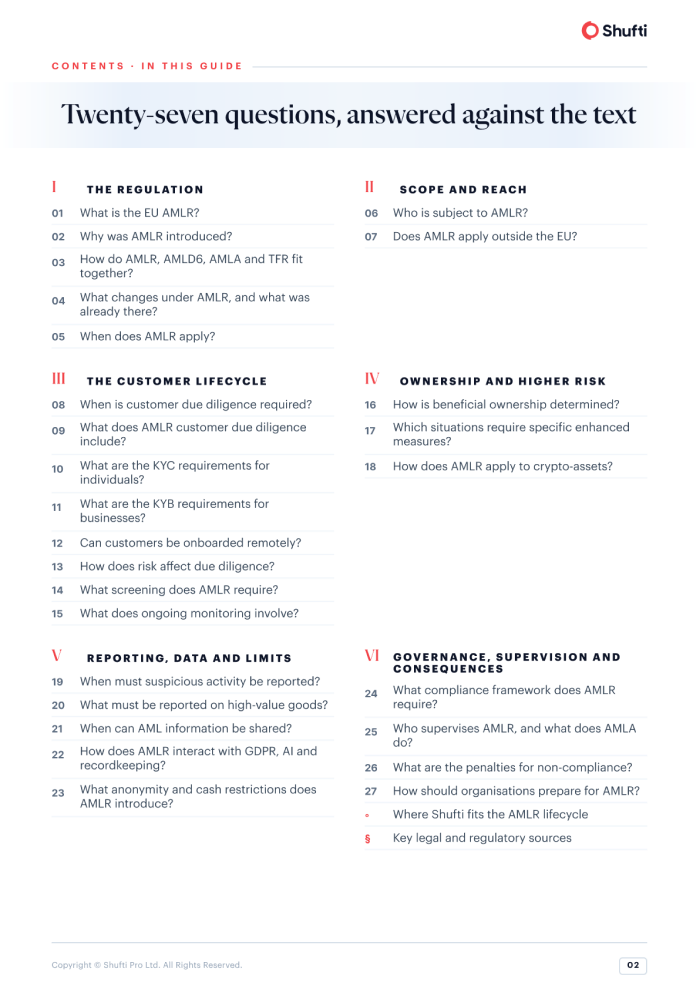
EU AMLR: The Complete Guide to 2027 Compliance
AMLR is final and in force, and most of it applies from 10 July 2027. For compliance teams working across EU markets, the question is not what the Regulation says, it is which of your existing controls it breaks. This guide walks the whole rulebook, separates what changed from what was already there, and cites the article behind every rule.
Request a demo- The ownership threshold moved from "more than 25%" to "25% or more." A rule engine testing > 25 is wrong from 10 July 2027; it needs to be >= 25.
- Ownership and control are now tested independently and in parallel, and control carries no percentage floor at all.
- Deadlines got harder EU-wide: 28 days to update beneficial-ownership information, 14 days to report a register discrepancy, a hard 1–5 year customer refresh cap.
- New EU-wide limits arrive: a €10,000 professional cash ceiling, €1,000 CDD trigger for crypto, and threshold reporting on high-value goods.
- AMLA directly supervises only a small cohort: up to 40 entities at first, from 2028. Most obliged entities keep their existing national supervisor.
- Football agents and clubs have until 10 July 2029, two years later than everyone else.
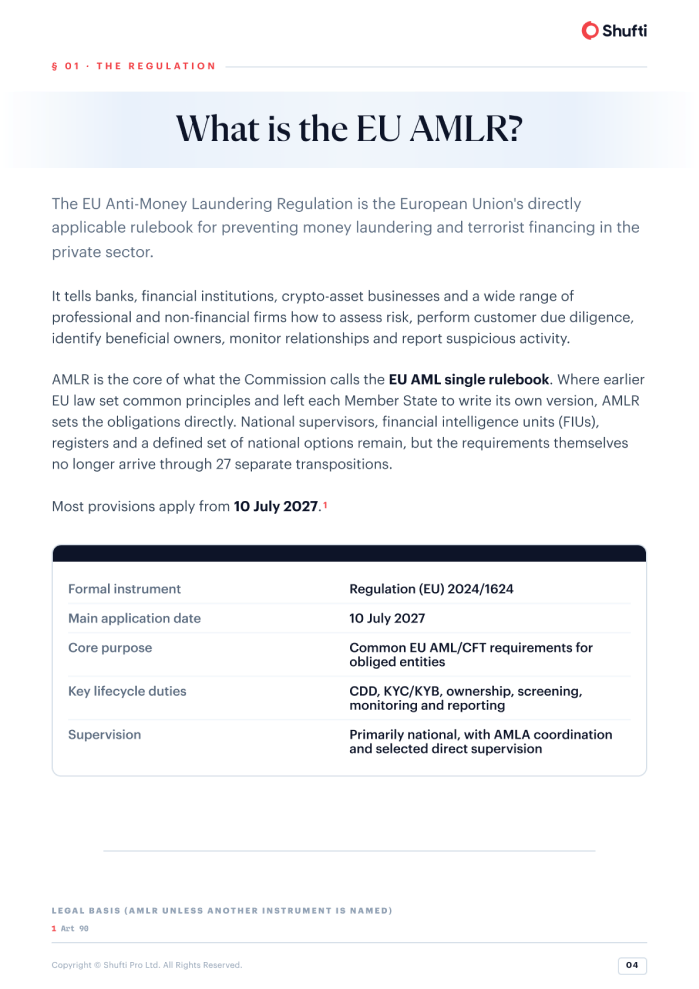
What is the EU AMLR?
The EU Anti-Money Laundering Regulation, AMLR, is the European Union’s directly applicable rulebook for preventing money laundering and terrorist financing in the private sector. It tells banks, financial institutions, crypto-asset businesses and a wide range of professional and non-financial firms how to assess risk, perform customer due diligence, identify beneficial owners, monitor relationships and report suspicious activity.
AMLR is the core of what the Commission calls the EU AML single rulebook. Where earlier EU law set common principles and left each Member State to write its own version, AMLR sets the obligations directly. National supervisors, financial intelligence units (FIUs), registers and a defined set of national options remain, but the requirements themselves no longer arrive through 27 separate transpositions.
Most provisions apply from 10 July 2027.1
Football is the one deferred sector, and it is narrower than it sounds
Two obliged-entity categories apply from 10 July 2029 rather than 2027: football agents, and professional football clubs.1 2
Clubs are not in scope for everything they do. They are obliged entities only for four transaction types: transactions with an investor, with a sponsor, with football agents or other intermediaries, and for the purpose of a player’s transfer.3
A top-division club selling season tickets to supporters is not acting as an obliged entity. The same club paying commission to an agent on a player transfer is, because that payment falls inside two of the four listed types at once.
Member States may also exempt clubs entirely or partly, by two separate routes. Top-division clubs qualify where total annual turnover was under EUR 5,000,000 in each of the previous two calendar years. Clubs in any lower division qualify with no turnover threshold at all. Both routes require a documented Member State risk assessment and are optional, not automatic.4
AMLR mandates measures that help businesses prevent crimes like money laundering. It does not replace the criminal law used to investigate and prosecute them.
Why was AMLR introduced?
Earlier EU directives created common principles, but each Member State implemented them through its own national AML regulations: different definitions, thresholds, supervision and operational expectations. A group operating in eight Member States maintained eight interpretations of the same rule.
The Commission put numbers on that before it drafted AMLR. Its impact assessment for the AML package found most Member States setting the beneficial-ownership register threshold at 25%, with Latvia and Spain at 10%. It also found that national rules for calculating indirect ownership diverged far enough that the same corporate structure could produce different beneficial owners depending on which Member State assessed it.
AMLR centralises that into one rulebook, directly applicable in every EU country.

Groups can design a stronger common EU baseline while retaining national overlays

Additional crypto, professional, high-value and other activities expressly covered

Identity, ownership, purpose, risk and monitoring operate as one lifecycle

Both ownership and control must be tested, discrepancies addressed

Customer data and expected activity must remain current after onboarding

Limits on anonymous instruments and large professional cash payments
What harmonisation does not remove
Direct applicability does not mean every national difference disappears. Member States retain responsibility for supervision, FIU processes, beneficial-ownership registers, sanctions machinery and the areas where AMLR permits national choices. A group operating in several Member States still needs a country overlay on top of the common baseline.
The overlay is thinner than it was. It is not gone.
How do AMLR, AMLD6, AMLA and TFR fit together?
The EU AML package contains four instruments, and each answers a different question.
Direct private-sector requirements
FIUs, registers, supervision, enforcement
Coordination, standards, direct supervision
Funds and crypto travel-rule information
| AMLR | AMLD6 | |
|---|---|---|
| Instrument type | Regulation, directly applicable | Directive, requires transposition |
| Binds | Obliged entities | Member States |
| Covers | CDD, KYC/KYB, beneficial ownership, screening, monitoring, reporting, cash and anonymity limits | Registers, FIUs, supervision, cooperation, penalties |
| Also called | The single rulebook | 6AMLD |
| Applies / transposed by | 10 July 2027 | 10 July 2027, with earlier deadlines for some articles |
| Replaces | National AML rulebooks built on Dir (EU) 2015/849 | Dir (EU) 2015/849, repealed from 10 July 2027 AMLD6 Art 77 |
Two naming traps are worth avoiding. AMLR should not be called “AMLD6”: the regulation carries the direct private-sector obligations, while the directive governs national machinery. And AMLD6 is the instrument informally called 6AMLD. It does not replace “6AMLD”; it repeals Directive (EU) 2015/849, the directive commonly called 4AMLD as amended by 5AMLD.
AMLD6 also transposes on a staggered schedule rather than a single date. General transposition is 10 July 2027, but Article 74 was due by 10 July 2025, the register-access provisions in Articles 11, 12, 13 and 15 by 10 July 2026, and the real-estate single access point by 10 July 2029.1
The updated Transfer of Funds Regulation has applied since 30 December 2024. Its payment and crypto travel-rule requirements are already live. They are not postponed until AMLR applies.
What changes under AMLR, and what was already there?
Most AMLR coverage reads as though every requirement is new. For a firm already running a compliant 5AMLD programme, that is not useful. This section separates the genuinely new obligations from the ones that have simply moved instrument.
Start with the beneficial-ownership threshold, because it moved twice
Under the previous regime, the corporate ownership indicator read:
“A shareholding of 25% plus one share or an ownership interest of more than 25% in the customer held by a natural person shall be an indication of direct ownership.”1
Under AMLR it reads:
“direct or indirect ownership of 25% or more of the shares or voting rights or other ownership interest”2
A natural person holding exactly 25.00% was not caught by the ownership indicator before. They are now.
A customer company owned by four natural persons at exactly 25.00% each produced no beneficial owner under the ownership limb of the previous test. From 10 July 2027 it produces four.
If any KYB rule engine, screening configuration or onboarding form you run carries a > 25 test, it is wrong from 10 July 2027. It needs to be >= 25. A one-line change, and easy to miss precisely because the headline number did not move.
The second change sits in the same sentence. The old provision continued: “This applies without prejudice to the right of Member States to decide that a lower percentage may be an indication of ownership or control.” A Member State could unilaterally drop the threshold. Under AMLR it cannot. It may notify the Commission of higher-risk categories, and only the Commission sets a lower category-specific threshold, by delegated act, floored at 15% and in any case below 25%.3
So the trigger got lower and the ability of 27 Member States to diverge on it was removed. If you built country-by-country UBO threshold logic to handle national variation, you are maintaining machinery AMLR is designed to make unnecessary.
The rest of the change map
| Area | Previously | Under AMLR |
|---|---|---|
| Instrument | Directive, transposed 27 ways | Regulation, directly applicable Art 90 |
| UBO threshold | More than 25%, or 25% plus one share | 25% or more Art 52(1) |
| Lowering the threshold | Member State discretion | Commission delegated act only, floor 15% Art 52(2) |
| Ownership vs control | Control assessed, relationship to ownership left to national practice | Control tested independently of and in parallel to ownership, no percentage floor Art 51 Art 53 |
| Mixed ownership/control chains | Not addressed | Art 54 replaces percentage arithmetic where the two coexist across layers Art 54 |
| No beneficial owner found | Identify senior managing officials, keep records | Statement, justification, full senior-managing-official details, term now defined Art 63(3)-(4) |
| Who holds BO information | Obliged entity investigates | Entities, owners, chain entities, trustees and nominees carry their own duties Arts 62-67 |
| BO refresh | Risk-based, no EU deadline | 28 calendar days from change, plus annual verification Art 62(2) Art 63(2) |
| Register discrepancies | Report, no EU day count | Without undue delay and in any case within 14 calendar days of detection Art 24(1) |
| Customer refresh | Risk-based, no EU cap | Hard maximum 1 year under EDD, 5 years otherwise Art 26(2) |
| Deferred verification | Risk-based | Hard 60-day cap for qualifying low-risk relationships Art 33(1)(a) |
| High-net-worth EDD | General risk-based approach | Prescribed gate at EUR 5m handled and EUR 50m held Art 34(5) |
| Cash | National limits only | EU-wide EUR 10,000 ceiling on professional cash payments Art 80(1) |
| High-value goods | Traders as obliged entities | Plus threshold reports to the FIU at EUR 250,000 and EUR 7.5m Art 74 |
| Crypto | Partial coverage | CASPs as full obliged entities, EUR 1,000 occasional threshold Art 19(3) |
| Crypto anonymity | Not addressed | Anonymous crypto accounts and anonymity-enhancing features prohibited Art 79(1) |
| Bearer shares | National treatment | Conversion or immobilisation by 10 July 2029, cancellation by 10 July 2030 Art 79(3) |
| New sectors | · | Football agents and clubs, crowdfunding, investment migration, wider high-value trading Art 3(3) |
| Supervision | National only | National, plus AMLA direct supervision of a selected cohort from 2028 AMLA Art 13 |
↳ Fig 04 · the UBO threshold row is the one to flag first internally, it is the single most common implementation miss.
What did not change
The risk-based approach survives intact. So does the structure of customer due diligence, the tipping-off prohibition, the duty to report suspicion irrespective of amount, and the principle that simplified due diligence is a calibration rather than an exemption. If you have a working 5AMLD programme you are not starting again. You are tightening deadlines, widening scope, and rebuilding the ownership layer.
When does AMLR apply?
AMLR entered into force in 2024, but most operative requirements have a later application date. “In force” and “fully applicable” are not the same thing.1
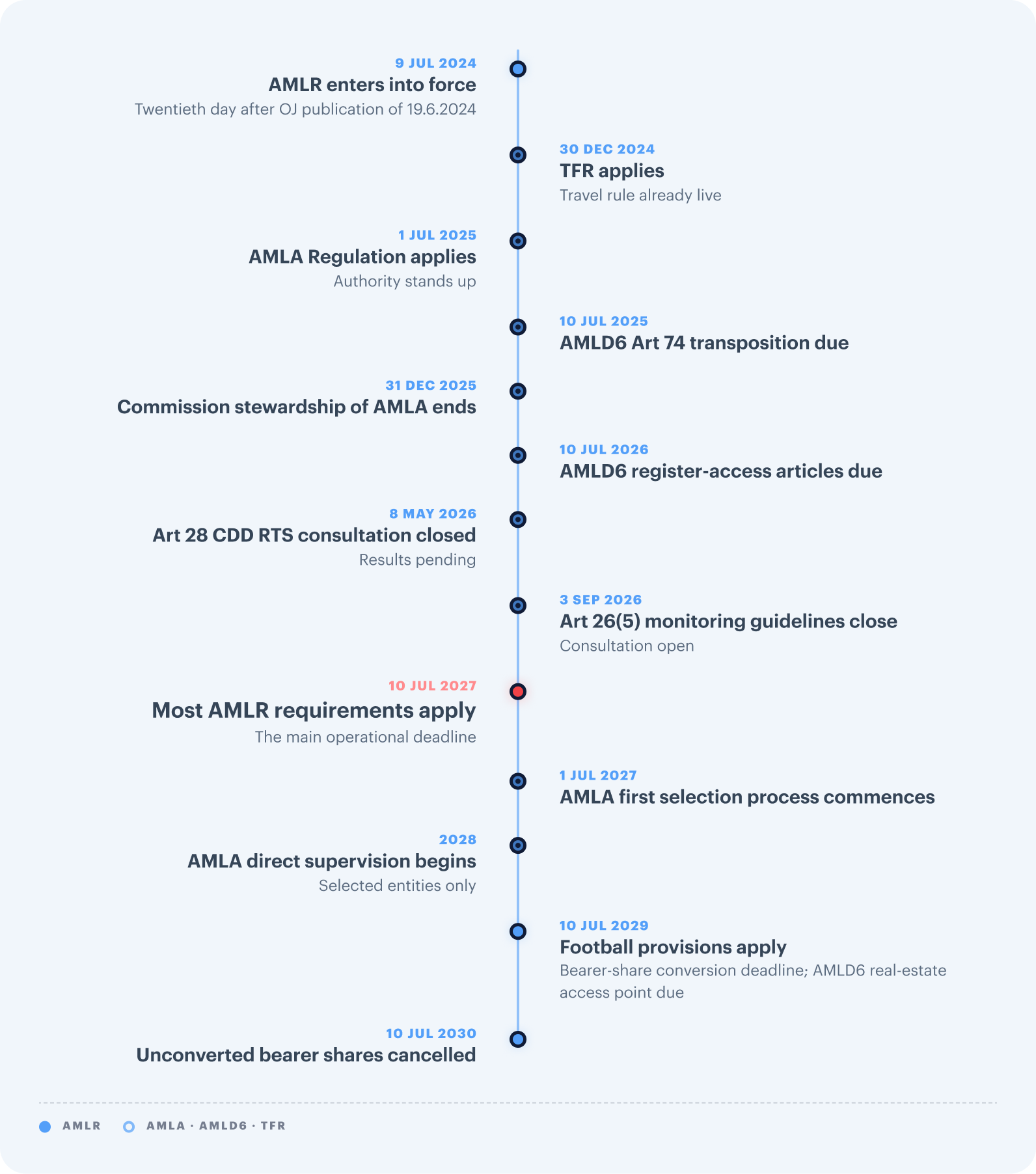
One date matters most: 10 July 2027.1 Track final law, draft Level 2 measures (the technical standards and guidelines that sit beneath the Regulation), transitional guidance and national rules as four separate workstreams. They move at different speeds, and collapsing them into one plan is how a programme ends up waiting on a standard it did not need.
AMLA’s regulatory-instruments tracker lists the Article 28 CDD regulatory technical standard (RTS) as draft. Its consultation closed on 8 May 2026 and results are pending. The Article 26(5) ongoing-monitoring consultation remains open until 3 September 2026. Existing EBA instruments identified by AMLA continue to apply until replacement measures take effect. Re-check this status before relying on any Level 2 detail.
Who is subject to AMLR?
AMLR applies to obliged entities. Scope can attach to an entire regulated business, or only to specified professional activities and transactions.1
| Sector | Who is covered | Scope note |
|---|---|---|
| Banks and credit | Banks, credit institutions | Whole business |
| Payments and fintech | Payment and e-money institutions, payment initiation and account information providers | Whole business |
| Investment and insurance | Investment firms, relevant life and investment insurers and intermediaries | Whole business |
| Crypto | In-scope crypto-asset service providers | Whole business. Authorisation and definitions sit in MiCA |
| Lawyers and notaries | Notaries, lawyers and other independent legal professionals | Only for defined activities and transactions |
| Accountants and tax | Auditors, external accountants, tax advisers | Only for defined activities |
| Trust and company services | Trust or company service providers | Whole business |
| Real estate | Estate agents and defined real-estate professionals | Activity-dependent. Both parties count as customers Art 19(6)(c) |
| Gambling | Providers of gambling services | Member States may exempt defined low-risk services Art 4 |
| High-value and luxury goods | Traders in and intermediaries for precious metals and stones, jewellery, watches, luxury motor vehicles, aircraft and watercraft | Threshold and activity-dependent |
| Art and culture | Art-market participants, including intermediaries and those storing art in free zones | Threshold-dependent |
| Crowdfunding | Crowdfunding service providers and intermediaries | Whole business |
| Investment migration | Operators involved in residence-by-investment schemes | Activity-dependent |
| Holding companies | Certain non-financial mixed-activity holding companies | Structure-dependent |
| Football | Football agents; professional football clubs for four transaction types | From 10 July 2029. Member State exemptions available Art 5 |
Not every person working in a listed sector is automatically covered. For legal professionals, goods traders, property businesses and football organisations, the activity and transaction conditions are decisive. Member States may also add sectors or apply defined exemptions, so test the specific activity against the Regulation first and the national overlay second.
Confirm which entities, branches and activities are covered before designing controls. A scope error propagates through every downstream decision. Where scope is unclear across entities, branches or activities, an AMLR consultation works it through case by case.
Does AMLR apply outside the EU?
AMLR binds the 27 Member States, with EEA relevance. It is not a universal worldwide regime. A non-EU organisation should look for a specific EU nexus rather than assume it is either fully in or fully out.
Does AMLR apply to UK businesses?
For a UK business the position is interpretive rather than a single article. The UK remains under the Money Laundering Regulations 2017. But EU subsidiaries and branches of UK groups are obliged entities in their own right, and AMLR’s group-wide policy obligations reach EU-facing UK parents.1 2 A UK firm asked by an EU counterparty for identity, ownership or source-of-funds information is usually seeing that counterparty’s duties at work, which does not by itself make the UK firm an obliged entity.
Foreign entities can also acquire a direct register duty under Article 67, triggered by an EU business relationship, EU real estate, defined high-value goods purchases, or an EU public contract.3
When is customer due diligence required?
CDD is required when a business relationship is established, when specified occasional transactions occur, when there is suspicion, and when an obliged entity doubts previously obtained identity information or doubts who it is dealing with.1
Suspicion applies regardless of value · doubt about existing information refreshes the measures · exemption: €150 low-risk e-money, supervisor-granted Art 19(7)
Transactions that appear separate must be treated together when they are linked. Controls should catch structuring across time, channels, accounts and related people.
Three cash payments of EUR 1,200 on consecutive days each sit below the EUR 3,000 cash trigger, but aggregate to EUR 3,600 above it. Whether your controls see one customer or three transactions is the whole question.2
The cash trigger has a carve-out worth knowing: it does not apply where the Member State already operates a cash payment limit of EUR 3,000 or less under Article 80(2) and (3).
The one exemption most summaries miss
Supervisors may exempt an obliged entity, fully or partly, from the Article 20(1)(a), (b) and (c) measures for electronic money on proven low risk. All four conditions must be met:3
Note who grants it. This is a supervisor-granted exemption, not one you can assess for yourself.
Different products and activities trigger different measures, and suspicion overrides every monetary threshold. There is no single “AMLR threshold” to configure.
What does AMLR customer due diligence include?
AMLR treats CDD as a continuing process, not a one-time document check. It is also worth keeping three articles distinct, because they are routinely collapsed into one:
Says when CDD is required
Says what the measures are
Says how identity is identified and verified
Calling Article 22 “the CDD article” is the most common citation error in AMLR commentary, and it will send you to the wrong provision when you need the right one.

The core measures are identifying and verifying the customer, identifying and verifying beneficial owners, assessing the purpose and intended nature of the relationship, and conducting ongoing monitoring.1 2 3
Do not establish or execute the relationship or transaction, and an existing relationship may need to end. Document the outcome and consider whether the circumstances should be reported to the FIU.4
The final Article 28 CDD RTS will add detail on required information and evidence. Its consultation is closed but the standard remains draft, so proposed document lists should not yet be presented as the final universal AMLR checklist.5
What are the KYC requirements for individuals?
“Know your customer” is the operational process for performing CDD on a natural person. It is not a separate AMLR legal regime.
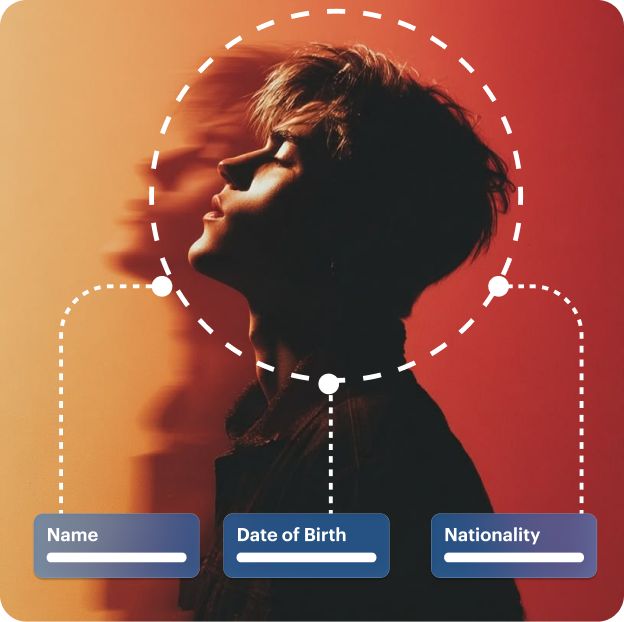
 Full name and any former or alternative names
- Place and date of birth
- Nationality or nationalities and legal status
- Identification or tax number, where applicable
- Usual residence and required contact information
- Any representative, and their authority to act
Verification must use reliable and independent documents, data or information. A successful document check establishes identity attributes. Purpose, occupation, source of funds, PEP exposure and overall risk still need their own evidence.1 2
Where a person acts for the customer, the firm must identify and verify the representative, identify the customer behind them, and confirm the authority to act. A mandate on file is not the same as evidence that the mandate is current.
A power of attorney executed four years ago and presented by a relative establishes that authority was granted once. It does not establish that it was never revoked, and the file should show which of those two things you verified.
A passing document and biometric check answers who this person is. It does not answer why the relationship exists, where the money comes from, or how risky it is.
What are the KYB requirements for businesses?
“Know your business” applies CDD to legal entities and arrangements: legal existence, authority, ownership, beneficial owners, purpose and risk in one assessment.
The structural change under AMLR is that the duty is no longer one-sided. Previously the obliged entity investigated and the customer cooperated or did not. AMLR places statutory obligations on the customer entity, its beneficial owners, the entities in its ownership chain, its trustees and its nominees. KYB becomes a two-sided information exchange with deadlines on both sides.
The six KYB questions
| Question | What it establishes |
|---|---|
| Does the entity legally exist? | Official name, legal form, registration and governing law |
| Where does it operate? | Registered or official office and, if different, principal place of business and country of creation |
| Who can act for it? | Directors, representatives, mandates and authority |
| Who owns it? | Direct and indirect ownership through every material layer |
| Who controls it? | Voting, appointment, contractual or other control |
| Why does the relationship exist? | Business activity, purpose and expected transactions |
Three data points older KYB models tend to miss
Article 22(1)(b) sets the legal-entity identification minimum, and three items in it are commonly absent from data models built for 4AMLD:
Companies, trusts, foundations, partnerships and collective-investment structures need different data models. A standard company checklist will not reliably identify all parties to a trust or similar arrangement.
Central-register information supports CDD but does not ordinarily replace independent identification and verification.
When no beneficial owner can be identified
AMLR is stricter than the old senior-managing-official shortcut. Where all means under Articles 51 to 57 are exhausted, or there is “substantial and justified uncertainty”, the entity keeps records of the actions taken and must supply:2
AMLR also defines senior managing officials, which the previous directive did not.
On the obliged-entity side, where verifying senior managing officials would signal that the firm doubts the ownership picture, it must abstain from that verification and instead record the steps taken and the difficulties encountered.3
Where CDD information conflicts with beneficial-ownership register data, report to the central registers without undue delay and in any case within 14 calendar days of detection. Defined minor cases let you ask the customer first instead, but not in higher-risk cases.4
Is “perpetual KYB” required?
No. “Perpetual KYB” and “perpetual KYC” are industry terms. Neither appears in AMLR, and neither removes the periodic duty.
The practical position is more demanding than the label suggests. AMLR stacks five clocks:
- 1. The entity updates its own BO information within 28 days of change, and annually. Art 62(2)
- 2. The entity reports register changes within 28 days and verifies at minimum annually. Art 63(2)
- 3. You refresh customer information within 5 years, or 1 year where enhanced measures apply. Art 26(2)
- 4. You review and update on three specific events, not on a schedule. Art 26(3)
- 5. You report register discrepancies within 14 days of detection. Art 24(1)
A five-year refresh cycle cannot detect a change the customer was obliged to register within 28 days, and the discrepancy clock only starts once you have looked. Event-driven KYB is not a legal requirement. It is the practical way to meet the requirements AMLR does impose.
A customer entity whose beneficial owner changes in September must update its own record within 28 days and report the change to the register within 28 days. An obliged entity that last refreshed that customer in 2028 is not due to look again until 2033, and the 14-day discrepancy clock does not start until it does.
Can customers be onboarded remotely?
Yes. Article 22(6) gives two routes and does not rank them. A proposed ranking exists, but only in draft Level 2, and the final text and the draft must be kept apart.
Identity document, passport or equivalent and, where relevant, information from reliable and independent sources
Electronic identification means meeting Reg (EU) No 910/2014 at assurance level substantial or high, and relevant qualified trust services
Article 22 itself does not rank the two routes
Used first for non-face-to-face verification
If the primary route is unavailable or cannot reasonably be expected ↓ then
Quality, presenter match, integrity, interruptions, validity and retained evidence, plus a justification to your supervisor
The priority-and-justification requirement sits in the draft Article 28 CDD RTS. Its consultation has closed, but it is not yet final adopted Level 2 law. Build for it, do not cite it as binding.1
An applicant onboarding at 22:00 during an outage of their national eID scheme can be verified under Article 22(6)(a) today, with no justification owed to anyone. Under the draft RTS the same journey would require a recorded reason why the primary route was unavailable. Building that field now costs little, and retrofitting it into a live journey later costs a great deal.
How eIDAS 2.0 and the EUDI Wallet connect to AMLR
AMLR never mentions the European Digital Identity Wallet. The connection runs through three instruments, and stating the chain explicitly is the difference between a claim you can defend and one you cannot.
Accepts electronic identification means at assurance level substantial or high Art 22(6)(b)

This is eIDAS. AMLR points at it by number.
Informally eIDAS 2.0. Amends 910/2014 and creates the European Digital Identity Wallet.
Meet Article 8 requirements Reg 2024/1183 Art 5a(4)(d), satisfying the AMLR condition by reference
Each Member State must provide at least one Wallet within 24 months of the relevant implementing acts entering into force.2 The Regulation sets no calendar date, so treat any specific month you see quoted as derived from implementing-act timing rather than from the Regulation itself.
Three things the Wallet does not do. It does not create a hierarchy in Article 22(6), which remains route-neutral in final law. It does not remove the obliged entity’s decision on whether the supplied attributes and assurance level meet the CDD requirement. And it answers who, not why: purpose, beneficial ownership and source of funds still need their own evidence.3 4 5
If Wallets must be “high”, what sits at “substantial”?
A fair question, and the answer matters more than it first appears. AMLR accepts electronic identification means at substantial or high. Wallets must be high. So what populates the substantial tier?
Notified national eID schemes. eIDAS 2.0 adds the Wallet; it does not abolish notification. Article 8(3) of Regulation (EU) No 910/2014, as amended, still sets minimum technical specifications for assurance levels low, substantial and high, and Article 9 still requires the Commission to publish the list of notified electronic identification schemes in the Official Journal and to publish amendments within one month.6
The substantial tier is therefore the existing installed base: national identity schemes, bank-identity schemes and equivalent means already notified by Member States and already listed.
Article 22(6)(b) does not wait for Wallet rollout. A notified scheme already on the Official Journal list, assessed at substantial or high, satisfies the electronic route today. Wallets widen coverage and raise the assurance floor. They do not open a route that was previously closed.
There is a filter here that is easy to miss. Notified schemes span three levels of assurance. AMLR accepts only two of them.
↳ Operational note: check the Official Journal list of notified schemes and exclude anything notified at low before accepting it as an Art 22(6)(b) route.
Does a substantial-level eID need supplementing?
Not as a matter of Article 22(6)(b). Substantial is accepted on its own terms, and there is no obligation to top it up.
Whether you choose to add measures is a risk question, governed by the ordinary rule that the extent and intensity of due diligence must reflect the customer, geography, product, transaction and delivery channel. A firm may reasonably decide that for a higher-risk customer a substantial-level eID alone is not enough, and layer additional verification on top. That decision is made under Articles 20 and 34, and it is documented and justified the same way any other risk-based calibration is.7 8
Qualified trust services
Qualified trust services are the second limb of Article 22(6)(b) and are not interchangeable with electronic identification means. The three that matter for identity work are the qualified electronic signature (QES), the qualified electronic seal and the qualified electronic timestamp.
Links a person to signed data
Supports the origin and integrity of legal-person data
Establishes that data existed at a particular time
None of them replaces purpose, beneficial-ownership or source-of-funds checks. Check qualified status against the national trusted list or the EU Trusted List Browser rather than a supplier’s own description.
Where video identification sits
AMLR does not name video identification as a distinct route. It falls under Article 22(6)(a) as a means of obtaining information from reliable and independent sources, which means it is governed by the general verification standard rather than by a bespoke rule. Several Member States operate detailed national video-identification requirements today, and the EBA Remote Customer Onboarding Guidelines remain relevant transitional guidance until AMLA’s replacement measures take effect.
Under the draft CDD RTS, remote capture routes of any kind would become a conditional fallback requiring justification. That status is draft.
What to keep configurable
If you are building a remote onboarding flow now, keep the following adjustable so the final RTS text can be applied without re-architecting the journey:
How does risk affect due diligence?
The extent and intensity of CDD must reflect risk, considering the customer, geography, product, transaction and delivery channel together.1 2
Adjust timing, extent or intensity, never skip CDD.
Complete the core measures at risk-sensitive depth, with evidence for each.
Additional evidence, senior approval, source-of-funds or wealth checks, transaction limits, closer monitoring.
Where verification is deferred for a qualifying low-risk relationship, it must be completed no later than 60 days after the relationship is established, and only where the specific lower risk identified justifies the postponement. Interim risk-management procedures are required in the meantime, such as limiting the amount, number or type of transactions.3 4
A qualifying low-risk relationship opened on 1 March with verification deferred and transaction limits applied must be fully verified by 30 April. On day 61 that file is not a backlog item, it is a breach.
Simplified due diligence must not be applied at all where there are doubts about veracity, where the lower-risk factors are no longer present, where monitoring excludes a lower-risk scenario, or where there is suspicion of money laundering, terrorist financing or sanctions evasion.5
Where the money used in this relationship or transaction came from.
How the customer’s or beneficial owner’s overall wealth was accumulated.
A numerical risk score can support consistency, but you have to be able to explain the rating, any material override, and the controls that follow from it.
What screening does AMLR require?
“Screening” is several controls with different legal purposes and different consequences.
Customer, ownership, operations and fund flows. Apply the prescribed enhanced measures or countermeasures.
Reliable reputation information. Reassess risk, investigate the facts, consider whether suspicion exists.
Customers, beneficial owners and relevant controllers. Validate matches, hand confirmed exposure to the sanctions process.
PEPs, family members and known close associates. Senior approval, source-of-funds and wealth measures, enhanced monitoring.
AMLR’s sanctions-risk controls do not replace the separate legal duty to freeze assets and avoid making funds available under applicable restrictive measures.1 2 PEP status indicates higher risk. It is not evidence of wrongdoing.3
“Adverse media screening” is not a standalone statutory duty under that name. Reliable public-source information can still affect customer risk, enhanced due diligence, ongoing review and suspicion assessment. Automated matches are not facts: identity resolution and human evaluation of source quality, recency and relevance come first.
Screening runs at onboarding, on list changes, on customer or ownership changes, at relevant transaction points, and on periodic or event-driven review. Your governance has to cover data quality, transliteration, fuzzy matching, ownership and control, alert priority, false positives, escalation and testing.
What does ongoing monitoring involve?
Article 26 requires firms to scrutinise transactions and activity, keep customer information current, and check that behaviour stays consistent with the customer’s purpose and risk profile.1 It contains four distinct duties, and they run on different clocks.
↳ The one-year and five-year figures are maximum intervals for updating customer information, not review targets. Three named events override the calendar, and sanctions verification runs regardless of either.
Two precision points that matter when you build the schedule. First, Article 26(2) governs updates of customer information; the word “review” belongs to Article 26(3), which is a different duty with a different trigger.2 3 Second, the one-year band is scoped to customers under Section 4 enhanced measures, not to every customer your internal model rates as higher risk. A customer can carry a high internal score without Section 4 applying, and that customer sits on the five-year clock.4
Automated monitoring needs scenario ownership, reliable data, calibration, validation and controlled case closure. Manual monitoring needs defined populations, frequency, trained reviewers and evidence. Neither model should rest on unexplained backlogs or blanket alert closure.
Alerts closed in volume, with no recorded reasoning, are read as a control that is not working, whatever the closure rate says.
How is beneficial ownership determined?
A beneficial owner is the natural person who ultimately owns or controls a legal entity or arrangement. AMLR runs two tests, and they are parallel rather than sequential.
The general corporate indicator is 25% or more of the shares, voting rights or other ownership interest, including rights to a share of profits, other internal resources or liquidation balance, held directly or indirectly.1
Control is assessed “independently of and in parallel to” the existence of an ownership interest.2 Control through ownership interest means 50% plus one.3 Control via other means carries no percentage floor at all: a majority of voting rights whether or not shared by persons acting in concert, the right to appoint or remove a majority of the board, relevant veto or decision rights attached to shares, decisions on profit distribution or asset shifts, and formal or informal agreements including relationships between family members and nominee arrangements.4
No at Test 3 · continue mapping, do not default to a director
↳ The senior-managing-official fallback is not permission to call a director the UBO because a database found nothing. It requires exhausted investigation and documented uncertainty.
Indirect ownership, and the case where arithmetic does not work
Indirect ownership is calculated by multiplying holdings through each chain and adding the chains together. All shareholdings at every level count.1
But that arithmetic is expressly disapplied where Article 54 applies. Where a multi-layered structure has ownership interest and control coexisting at different layers of a chain, the beneficial owners become the natural persons controlling the entities that hold a direct ownership interest, and the natural persons with an ownership interest in the entity that controls the corporate entity.5
A natural person holds 40% of a holding company, and that holding company holds 60% of the customer. Multiplying gives 24%, and a rule engine that stops there reports no beneficial owner. But 60% is control through ownership interest, so Article 54 applies in place of the arithmetic, and the person holding 40% of the entity that controls the customer is a beneficial owner.1 3 6
 Natural person
 40% OWNERSHIP
 Holding Co
40% OWNERSHIP
Holding Co
40% OWNERSHIP
 Customer
16% TOTAL · NO BENEFICIAL OWNER
Customer
16% TOTAL · NO BENEFICIAL OWNER
 Natural person
BENEFICIAL OWNER
40% OWNERSHIP
Natural person
BENEFICIAL OWNER
40% OWNERSHIP
 Holding Co
CONTROLS THE CUSTOMER
Holding Co
CONTROLS THE CUSTOMER
 60% = CONTROL ART 53(2)(C)
 Customer
ENTITY OF FOCUS
Customer
ENTITY OF FOCUS
↳ Left: no single layer reaches control, so multiply-and-add resolves the answer. Right: 60% at the middle layer is control through ownership, so Article 54 substitutes for the arithmetic and the 40% holder becomes a beneficial owner of the customer.
Where a legal arrangement or an Article 57 entity sits in the chain, the beneficial owners are the beneficial owners of that arrangement or entity.7
Trusts and complex structures
Trusts and similar arrangements need function-based identification. Relevant persons can include settlors, trustees, protectors, beneficiaries or classes of beneficiaries, and any person exercising ultimate control. A company-shaped checklist will miss several of these roles entirely.8
For a complex structure, map each ownership layer, calculate indirect interests, identify the natural persons behind intermediate entities, examine nominee arrangements, and understand the commercial rationale. A structure whose only apparent purpose is to obscure ownership is itself a risk indicator.
Ownership deadlines to build into the operating model
| Deadline | Duty |
|---|---|
| 28 calendar days | Entity obtains BO information after creation Art 62(2) |
| Promptly, 28 days max | Entity updates its own BO information after any change Art 62(2) |
| Undue delay, 28 days max | Report a change to the central register Art 63(2) Art 64(2) Art 67(5) |
| At minimum annually | Entity verifies it holds up-to-date BO information Art 63(2) |
| At least annually | Trustee verifies the wider information set held Art 64(2) |
| Undue delay, 14 days max | Obliged entity reports a register discrepancy after detection Art 24(1) |
| 5 years | Retention of specified ownership records after cessation Art 63(6) Art 64(1) |
Note that the initial register report differs by entity type. A legal entity reports “without undue delay after its creation” with no 28-day cap. A trustee reports without undue delay and in any case within 28 calendar days.9 10
A register entry supports the assessment. It is not, on its own, independent verification of who ultimately owns or controls the customer.
Which situations require specific enhanced measures?
Some relationships require prescribed enhanced due diligence in addition to the general customer-risk assessment.1
| Situation | What is required |
|---|---|
| High-risk third country | Additional customer, ownership, purpose, funds, wealth, approval and monitoring measures Arts 29-31 Art 35 |
| Correspondent banking | Respondent ownership, reputation, supervision, controls and responsibilities Art 36 |
| Correspondent crypto relationships | Equivalent measures for CASP correspondent relationships Art 37 |
| Shell institution | Prohibited relationship; guard against indirect access Art 39 |
| Self-hosted crypto address | Ownership or control, transfer risk and proportionate mitigation Art 40 |
| Residence-by-investment applicant | Funds, wealth, PEP exposure, intermediaries and structure Art 41 |
| PEP or former PEP | Senior approval, source-of-wealth and funds evidence, enhanced monitoring Arts 42-46 |
| Life or investment insurance | Beneficiary identity, ownership and PEP exposure Art 44 Art 47 |
| Higher-risk high-net-worth service | Prescribed gate, see below Art 34(5) |
Former PEPs
Mitigating measures continue until the risk no longer exists, and “in any case for not less than 12 months following the time when the individual ceased to be entrusted with a prominent public function”. The clock runs from the person leaving the function, not from your last review. The duty is to apply one or more of the Article 34(4) measures, not the full PEP regime. It applies equally to a new customer who formerly held such a function.2
The prescribed high-net-worth gate

All three elements required · applies only to credit/financial institutions and TCSPs
Then: prescribed EDD applies, in addition to Art 34(4) measures
↳ The Regulation contains no annual qualifier: the trigger is the value of assets handled through personalised services, not an annual flow. The duty binds only credit institutions, financial institutions and trust or company service providers, not obliged entities generally.3
Below any one of the three elements, the prescribed rule does not bite and the general risk-based approach applies.
A customer holding EUR 60,000,000 in total assets but running only EUR 2,000,000 through personalised services fails the first limb. The prescribed gate does not apply, and the relationship is assessed under the general risk-based approach like any other.3
How does AMLR apply to crypto-assets?
Crypto-asset service providers operate AMLR and the Transfer of Funds Regulation together. One customer, one transfer, two rulebooks. A third and a fourth instrument sit alongside them, and keeping the four apart is the single most useful thing a crypto compliance team can do with AMLR.
- CDD at €1,000 occasional Art 19(3)
- Self-hosted address risk mitigation Art 40
- Anonymity prohibitions Art 79
- Correspondent CASP relationships Art 37
- Originator and beneficiary information
- Transfer-message completeness
- Missing-information handling
- Travel-rule records · live since 30 Dec 2024
- What a CASP is, and who may operate as one MiCA Art 59
- Applies since 30 December 2024.
- No preventive AML/CFT duties sit here.
- Beneficial-ownership registers
- FIU powers, supervisory architecture, and the penalty regime for AMLR breaches. AMLD6 Art 55
- General transposition 10 July 2027.
↳ Attributing a rule to the wrong instrument is the most common error in crypto AML commentary.
What AMLR does and does not prohibit
Self-hosted addresses are not banned. CASPs must identify and assess the money laundering and terrorist financing risk of transfers to or from a self-hosted address, then apply mitigating measures commensurate with that risk. One or more of:1
There is no fixed threshold in this article.
The “verify who controls the wallet above EUR 1,000” rule that circulates in summaries is the Transfer of Funds Regulation, not AMLR.
Anonymity is where AMLR does prohibit. Credit institutions, financial institutions and CASPs are prohibited from keeping anonymous bank and payment accounts, anonymous passbooks, anonymous safe-deposit boxes or anonymous crypto-asset accounts, as well as any account otherwise allowing the anonymisation of the account holder or the anonymisation or increased obfuscation of transactions, including through anonymity-enhancing coins.2
Article 79(1) prohibits obliged entities from keeping accounts that enable anonymisation, including through anonymity-enhancing coins. It does not criminalise privacy coins, ban self-custody, or outlaw non-custodial software. “AMLR bans privacy coins” is a misreading of an account-level prohibition.
Existing anonymous accounts, passbooks, safe-deposit boxes and crypto-asset accounts must be subject to CDD before they are used in any way.2
Blockchain analytics supports risk assessment but is not an infallible identity source. Attribution confidence, chain coverage, clustering assumptions, privacy features and false positives all need governance.
When must suspicious activity be reported?
An obliged entity must report without delay to its national FIU when it knows, suspects or has reasonable grounds to suspect that funds or activity are connected to criminal conduct or terrorist financing. The duty applies irrespective of amount and can cover attempted transactions.1

Your internal assessment should preserve the relevant facts, transactions, ownership context, explanations, and the reason for the conclusion. Staff do not need to prove the underlying crime before escalating a concern, and a policy that implies otherwise suppresses reporting.
The tipping-off constraint has to be designed into customer-facing scripts, complaint handling, account-closure messaging and automated notifications, not bolted on afterwards.2
National filing portals and procedures remain important even as AMLA develops a common reporting-format standard. Firms operating in several Member States should treat filing mechanics as a per-country workstream.
A transaction that never completed can still require a report. The duty attaches to suspicion, not to settlement.
What must be reported on high-value goods?
Alongside suspicion-based reporting, AMLR introduces a threshold-based reporting duty that has nothing to do with suspicion. It is easy to miss because it sits at the end of the reporting chapter.
Persons trading in high-value goods must report to the FIU all transactions involving the sale of the following goods when those goods are acquired for non-commercial purposes:1
Second reporting population: credit and financial institutions servicing these purchases report too Art 74(2) ·
timing set by the FIU, not AMLR Art 74(3)
Two points that summaries routinely drop. The duty is not limited to the trader: credit institutions and financial institutions that provide services in relation to the purchase or transfer of ownership of these goods also report the transactions they carry out for their customers.2 And there is no fixed EU deadline: reporting is carried out “within the deadlines imposed by the FIU”.3
The commercial-purpose condition does real work. A dealership buying stock is outside paragraph 1.
A private buyer at or above the threshold is inside it.
A dealer acquiring three vehicles at EUR 300,000 each for resale reports nothing under this article. A private buyer acquiring one of those same vehicles at EUR 300,000 triggers the report.
These same thresholds also appear in Article 67 as one of the triggers that pull a foreign legal entity or arrangement into an EU central register.4
When can AML information be shared?
AMLR permits defined information sharing within groups and through qualifying information-sharing partnerships, with a clear AML/CFT purpose, restricted access, security, governance and data-protection safeguards.1 2
Each of those decisions has to rest on the obliged entity’s own assessment. Shared intelligence can direct attention, prompt a review or corroborate a finding, but the accountable decision stays with the firm that makes it.
The tipping-off prohibition still applies. Information that would disclose that a suspicious-activity report exists, or that an FIU analysis is under way, can be shared only where a specific legal exception permits it. Partnership design should assume that constraint from the start.3
A defined AML/CFT purpose, a lawful basis, role-restricted access, logging, retention limits, security controls, an assessment of accuracy and provenance, and a documented escalation route for disputes or corrections.
Sharing improves what you can see. It transfers nothing: not the decision, not the accountability, not the reporting duty.
How does AMLR interact with GDPR, AI and recordkeeping?
AMLR provides a legal framework for necessary AML/CFT data processing. It does not remove GDPR principles.1
| Principle | What it means in practice |
|---|---|
| Purpose limitation | Do not repurpose AML data for unrelated commercial activity |
| Data minimisation | Collect the attributes needed for the legal and risk outcome |
| Accuracy | Separate official facts, credible reporting, allegations and automated inference |
| Sensitive-data protection | Restrict special-category and criminal-offence data |
| Human intervention | Give reviewers evidence and authority to change automated outcomes |
| Security | Limit access, log activity and protect reporting confidentiality |
Automation can extract documents, triage alerts, score risk and identify patterns. It does not transfer accountability to the model or the provider. Where meaningful human intervention is required, the reviewer must understand the evidence and be able to alter the decision. An approval click alone is not enough.
Record keeping requirements
↳ The clock runs from termination of the business relationship, the occasional transaction, or a refusal to enter a relationship or carry out a transaction. The extension is a competent authority's case-by-case decision, not a blanket Member State option, and only where necessary for ML/TF prevention, detection, investigation or prosecution.2 A separate transitional Member State option exists for legal proceedings pending on 10 July 2027.3
Personal data must be deleted on expiry of the five-year period, without prejudice to retention periods set by other Union or national law compliant with GDPR.2
Your records should be able to reconstruct what was known, which sources were used, how ownership and risk were assessed, who approved the outcome, and what monitoring or reporting action followed.
What anonymity and cash restrictions does AMLR introduce?
AMLR prohibits anonymous instruments and puts an EU-wide ceiling on professional cash payments.
Prohibited or restricted instruments
Anonymous bank and payment accounts, anonymous passbooks, anonymous safe-deposit boxes and anonymous crypto-asset accounts, plus any account allowing anonymisation or increased obfuscation of transactions.1 Acquirers must not accept payments made with anonymous prepaid cards issued in third countries, subject to any RTS adopted under Article 28.2
Bearer shares now carry dates
Companies are prohibited from issuing bearer shares. Existing bearer shares must be converted into registered shares, immobilised, or deposited with a financial institution by 10 July 2029. Where that does not happen, all voting rights and rights to distribution are automatically suspended until conversion, immobilisation or deposit. Shares still not dealt with by 10 July 2030 are cancelled, reducing share capital accordingly. Listed companies and shares issued as intermediated securities are carved out. Bearer share warrants that are not in intermediated form are prohibited.3
The cash ceiling
Suspicion overrides any value
The cash ceiling is not the CDD threshold. A EUR 3,000 cash transaction can trigger identification and verification even though it sits below the payment ceiling, and suspicion triggers CDD and reporting at any value.
There are two carve-outs, not one:4
If you operate across Member States you need a country matrix covering lower national limits, exclusions, linked payments, mixed payment methods and refund controls.
What compliance framework does AMLR require?
AMLR requires a risk-based and proportionate programme. A smaller obliged entity may use simpler controls than a cross-border bank, but it must still achieve the required outcomes and prove that the controls work.1
The business-wide risk assessment should reflect actual customers, geographies, products, services, transactions, delivery channels and technology, and connect identified risk to control design and investment rather than read as a generic description of the sector.2
The compliance officer and the management body
AMLR separates responsibility rather than leaving it to organisational preference. The management body carries overall accountability. A member of the management body is designated as the compliance manager responsible for implementation. A compliance officer runs day-to-day compliance, reports to the management body, and must have the standing, resources and access to discharge the role.3
Training and employee integrity
Staff must be made aware of the requirements that apply to their role, with training proportionate to the risks and to what the person actually does. Employee integrity measures and protected internal reporting routes are part of the framework, not optional additions.4
Group-wide policies
Groups apply group-wide policies, procedures and controls, including information sharing for AML/CFT purposes within the group. Where a third country’s law prevents implementation, the conflict must be escalated and additional measures applied.5
Outsourcing and reliance are not the same thing
Neither route transfers accountability. In both cases the obliged entity has to produce the underlying information and evidence on request, and demonstrate that the arrangement was assessed, documented and monitored. Contractual language alone is not a control.
Proportionality governs how a control is built, never whether the outcome is achieved. A small firm may run simpler processes, but it still has to evidence them.
Who supervises AMLR, and what does AMLA do?
AMLA is the most misunderstood part of the package. The short answer is that for most obliged entities, the supervisor on 10 July 2027 is the same national authority as today.
The Anti-Money Laundering Authority was created by Regulation (EU) 2024/1620, which applies from 1 July 2025. The Commission was responsible for its establishment and initial operation until 31 December 2025.1 2
Credit and financial institutions and groups whose residual risk profile is classified high. Art 13(1)
Up to 40 in the first selection round Art 106(2) ; a number greater than 40 may be agreed subsequently. Art 13(2)
First selection commences by 1 July 2027, concludes within six months, direct supervision begins six months after the list is published. Art 13(4)
Everyone else. Powers, resources, risk-based supervision, colleges and cooperation sit in AMLD6. AMLD6 Arts 37-52
This is where almost every obliged entity in the EU sits on 10 July 2027: the directly supervised cohort is a few dozen entities out of many thousands.
For everyone outside the selected cohort, AMLA still matters, but indirectly. It writes regulatory and implementing technical standards, issues guidelines, oversees national supervisors and supports FIU cooperation. The Article 28 CDD RTS and the Article 26(5) monitoring guidelines are AMLA products, and they will shape day-to-day practice far more than direct supervision will.
AMLA is not permanently capped at 40 entities. Article 13(2) allows a specific different number greater than 40 to be agreed with supervisors. The hard 40 applies only to the first selection process under Article 106(2).
What are the penalties for non-compliance?
Penalties sit in two instruments, and neither of them is AMLR.
AMLR Article 68 is titled “Penalties” but covers Chapter IV, beneficial ownership transparency, only. It delegates to Member States and contains no monetary figure. Citing it for the EUR 10 million number is wrong.
Tier 1, national penalties for most obliged entities
AMLD6 requires Member States to make pecuniary sanctions available for serious, repeated or systematic breaches of AMLR Chapter II (internal policies), Chapter III (customer due diligence), Chapter V (reporting) and Article 77 (record retention), and for non-compliance with administrative measures.1
Minimum maxima · floors on the ceiling each Member State must provide, not the sanction a firm will face
Three qualifications travel with the headline number. AMLD6 says “maximum pecuniary sanctions of at least”, which makes it a floor on the ceiling. The EUR 10 million and 10% tier applies only to credit and financial institutions; every other obliged entity sits on the EUR 1 million tier. And Member States may empower authorities to exceed these amounts, while ability to pay must be taken into account.2
Tier 3 is structured differently, and the difference matters
For entities under AMLA direct supervision the structure is not “EUR 10 million or 10%, whichever is higher”. AMLA sets a basic amount within ranges that vary by breach type and by whether the breach spans one Member State or several, adjusts it using aggravating and mitigating coefficients, and then applies one of two separate caps depending on the breach category.3
Writing the two regimes as though they share a formula is the most common error in AMLR penalty commentary.
Periodic penalty payments
Less discussed, and operationally sharper. Where an obliged entity fails to comply with certain administrative measures within the deadline, supervisors may impose periodic penalty payments until it does. They are capped at 3% of average daily turnover for legal persons, or 2% of average daily income for natural persons. They run for no more than six months, extendable once by a further six months.4
A sanction is a single event. A periodic penalty payment accrues daily until the control is fixed.
How should organisations prepare for AMLR?
National supervisors remain responsible for most obliged entities. AMLA will coordinate the EU system and directly supervise only a selected group of higher-risk cross-border financial entities, with preparations for the 2027 selection exercise under way and direct supervision expected from 2028.
Those four are the fastest way in. The full readiness checklist runs the same method across eight domains and 35 checks.
A gap analysis is the practical starting point, and it is more specific than a generic readiness assessment. Four questions produce most of the findings:
Work through these four questions with a specialist: book an AMLR Consultation
Where the work concentrates, by sector
Scope analysis, governance, data remediation, ownership logic, architecture and testing can proceed now. Keep draft-dependent details configurable and give them a final-text review before closing implementation.
Where Shufti fits the AMLR lifecycle
AMLR does not split neatly into products. It runs as one lifecycle: identify, verify, establish ownership, assess risk, screen, monitor, refresh, report. Shufti is a glocal platform that runs that full compliance lifecycle, from sign-up and onboarding through authentication and monitoring to remediation, across 240+ countries and territories and 10,000+ document types actively verified each month.
For remote onboarding it supports both Article 22(6) routes, and it is prepared to accept European Digital Identity Wallet attributes as EUDI Wallets become available. Its single-selfie passive liveness is assessed at iBeta PAD Level 3 under ISO/IEC 30107-3 on both iOS and Android, returning 0% APCER and 0% BPCER. Shufti was the first European company to achieve that conformance.

Identity Verification
The Art 22(6)(a) route, and the compliant fallback where a primary electronic route is unavailable. Document and biometric checks against reliable, independent sources
KYC
The Art 22(1)(a) attribute set, including place of birth, national identification number and tax identification number where available
KYB
Art 22(1)(b) entity data, UBO mapping across Arts 51 to 55, and the register-discrepancy duty in Art 24
AML Screening
Sanctions, PEP and adverse-information screening with human-review workflows for identity resolution and escalation
Ongoing Monitoring
The four Art 26 clocks, including event-driven refresh and the Art 26(4) sanctions verification duty
eIDV
Electronic identity verification where a notified eID scheme is available at substantial or high
Explore each capability: Identity Verification · KYC · KYB · AML Screening · Ongoing Monitoring · eIDV
AMLR’s real test is whether identity, ownership, screening, monitoring and reporting behave as one connected record. Where those functions sit with separate suppliers, officers reconcile them by hand, and the context needed to resolve an alert arrives late or not at all.
AMLR’s real test is whether identity, ownership, screening, monitoring and reporting behave as one connected record. The verified identity captured at onboarding should be the same record that screening, monitoring and reporting rely on for the life of the relationship.
One glocal platform. The full compliance lifecycle, from sign-up to remediation. Every industry, every region, every use case.
See the full AMLR SolutionKey legal and regulatory sources
- 01Regulation (EU) 2024/1624 · AMLR
- 02Directive (EU) 2024/1640 · AMLD6
- 03Regulation (EU) 2024/1620 · AMLA
- 04Regulation (EU) 2023/1113 · TFR
- 05Directive (EU) 2015/849 · the repealed directive, for comparison
- 06Regulation (EU) 2024/1183 · eIDAS 2.0
- 07Regulation (EU) No 910/2014 · eIDAS
- 08AMLA regulatory-instruments tracker
- 09AMLA CDD RTS consultation
- 10AMLA ongoing-monitoring consultation
- 11European Commission · eIDAS framework
- 12EU Trusted List Browser
- 13EBA Remote Customer Onboarding Guidelines
- 14European Commission · Impact assessment accompanying the AML package, SWD(2021) 190 final, 20 July 2021
This guide provides general regulatory information, not legal advice. Final AMLA measures, Member State rules, sector legislation and applicable sanctions should be assessed for the organisation’s own circumstances. Draft Level 2 measures are identified as draft throughout and should be re-checked against the adopted text before implementation is closed.
Last reviewed 28 July 2026.




Certifications
Independently audited and certified for enterprise-grade security and data protection.







Frequently asked questions (FAQs)
Start with scope: confirm which entities, branches and activities are covered, then inventory each obligation against a named control owner. Risk assessment, customer data remediation, onboarding, lifecycle controls, governance and a Level 2 tracker follow from there.
Four questions produce most of the findings: does any rule engine still test beneficial ownership at > 25% rather than >= 25%, can you evidence when each customer’s information was last updated, do your KYB records capture LEI, principal place of business and nominee status, and can you produce the reasoning behind any closed alert.
Scope analysis, governance, data remediation, ownership logic, architecture and testing can all proceed now. Keep draft-dependent details configurable and give them a final-text review before closing implementation.
Shufti’s AMLR readiness checklist maps the Regulation’s obligations to the controls each one requires, so the gap analysis can be worked against a single list rather than against the Regulation itself.

Form submitted successfully!
Thank you for your interest — your report is loading now.
Download the AMLR guide as a PDF
The same 27 sections, all 33 figures and the full sources list, laid out for reference and internal sharing.
- Share it with legal, product and engineering in one document
- Every draft Level 2 measure flagged as draft
- Updated 28 July 2026