










 AMLR Solutions
  AMLR Consultation
 EUDI Wallet
 Onboarding
 Ongoing Monitoring
 FRAML
FRAML KYC
KYC KYB
KYB KYI
KYI Age Assurance
 Workforce IAM
 Candidate Verification
 Account Takeover
 Bonus/ Promotion Abuse
 Chargeback Fraud
 Deepfake
 Document Fraud
 Fraud Networks
 Impersonation Fraud
 Money Mule Activity
 Multi-Accounting
 Party Fraud
 Regulatory & Compliance Risks
 Synthetic Identity Fraud
 Adult Content
 Banking
 Crypto
 Fintech
 Forex
Forex Compliance
 Fraud prevention
 Trust & safety
 Global expansion
 Compliance Officers
 Developers
 Fraud Analysts
 Product Managers
 Journey Builder
  Global Trust Platform
 Customer Profiles
 Vendor Comparison
 IDV Case Management
 AML Case Management
 Regulatory Reporting
 Agentic Rule Builder
  AI Compliance Co-Pilot
  Fraud Analytics
 Fraud Hub
  OCR
OCR Shufti AI
 Bank Account Verification
  Biometric Duplication
 Database Checks
 Document Intelligence
 Government ID
 Mobile Driver's License
 NFC
NFC Selfie Liveness
 Brand Personalisation
 Deployment Options
 Identity Methods
 IDV Modes
 Multi-tenancy
 On-Premise IDV
 Secure Capture
 Shufti MCP


SANCTIONS SCREENING
From Name Screening to Sanctions Control
Shufti Sanctions Screening software screens against 215+ global sanctions regimes, refreshed every 15 minutes, with multilingual matching across 80+ languages that cuts noise and surfaces genuine hits across every jurisdiction.

Coverage, Speed, and Control at Scale
regimes covered
sources monitored
refresh cycle







How Shufti Screens Sanctions Efficiently
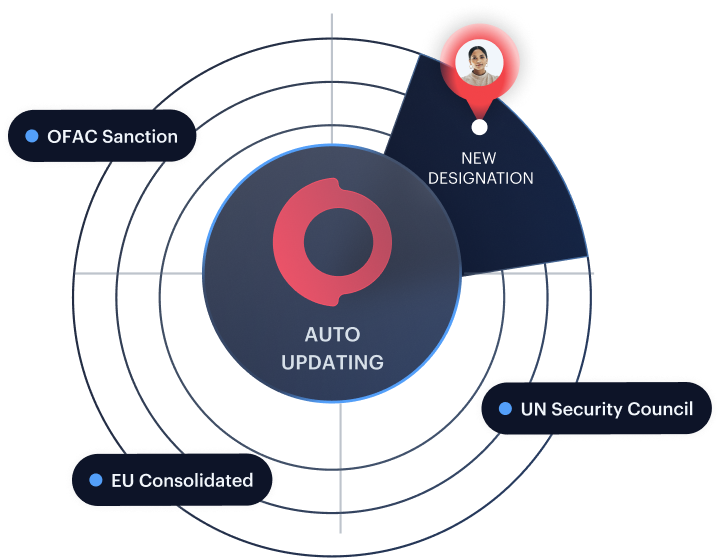
15-minute refresh across 215+ regimes, not daily batches
The database refreshes every 15 minutes, capturing new designations from OFAC SDN, UN Security Council, EU Consolidated, UK HMT and OFSI, and 200+ more regimes as they are published. Enrolled profiles re-screen automatically each cycle, so the control runs continuously, not point-in-time.
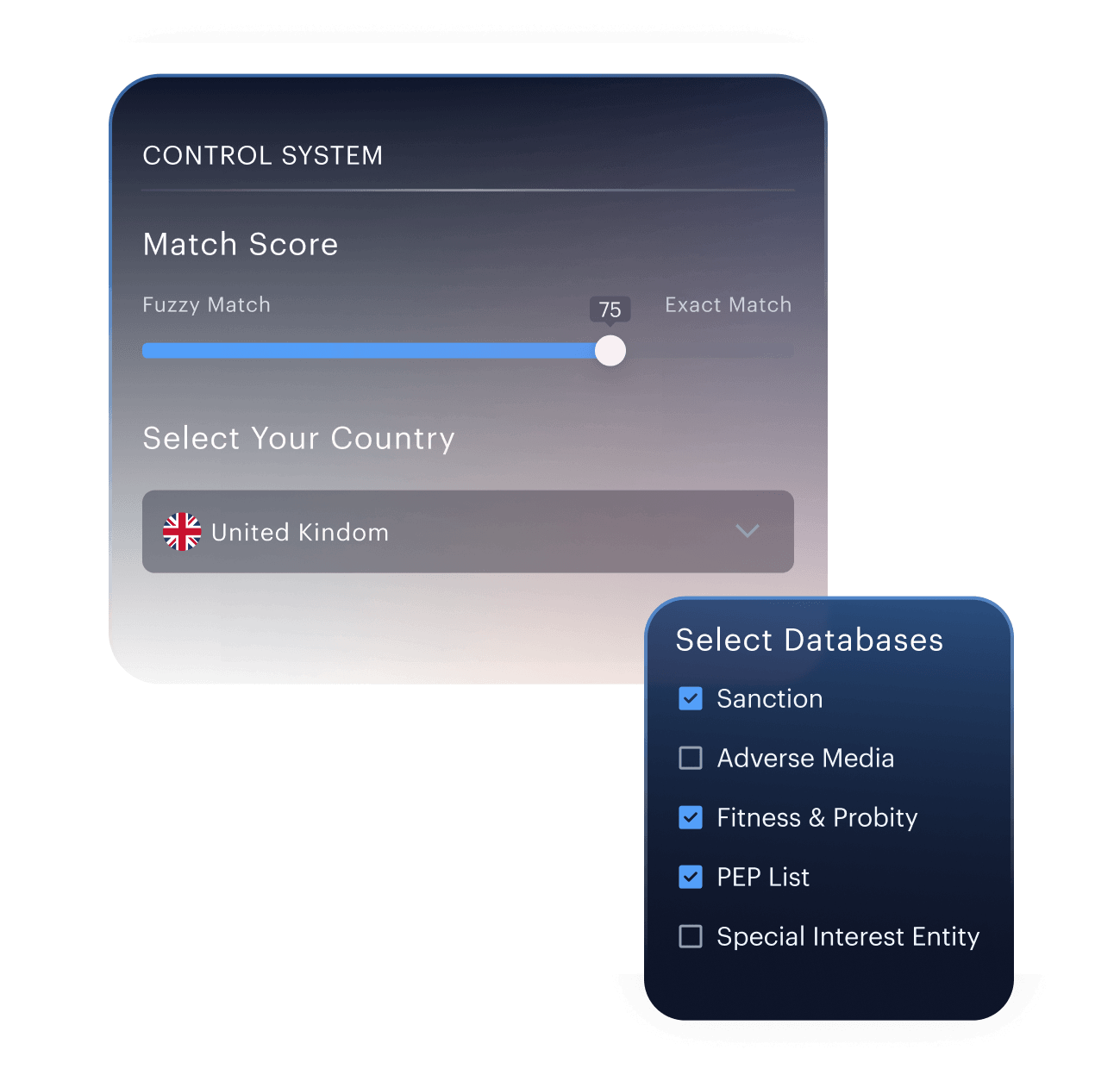
Configurable scoring and thresholds, not vendor defaults
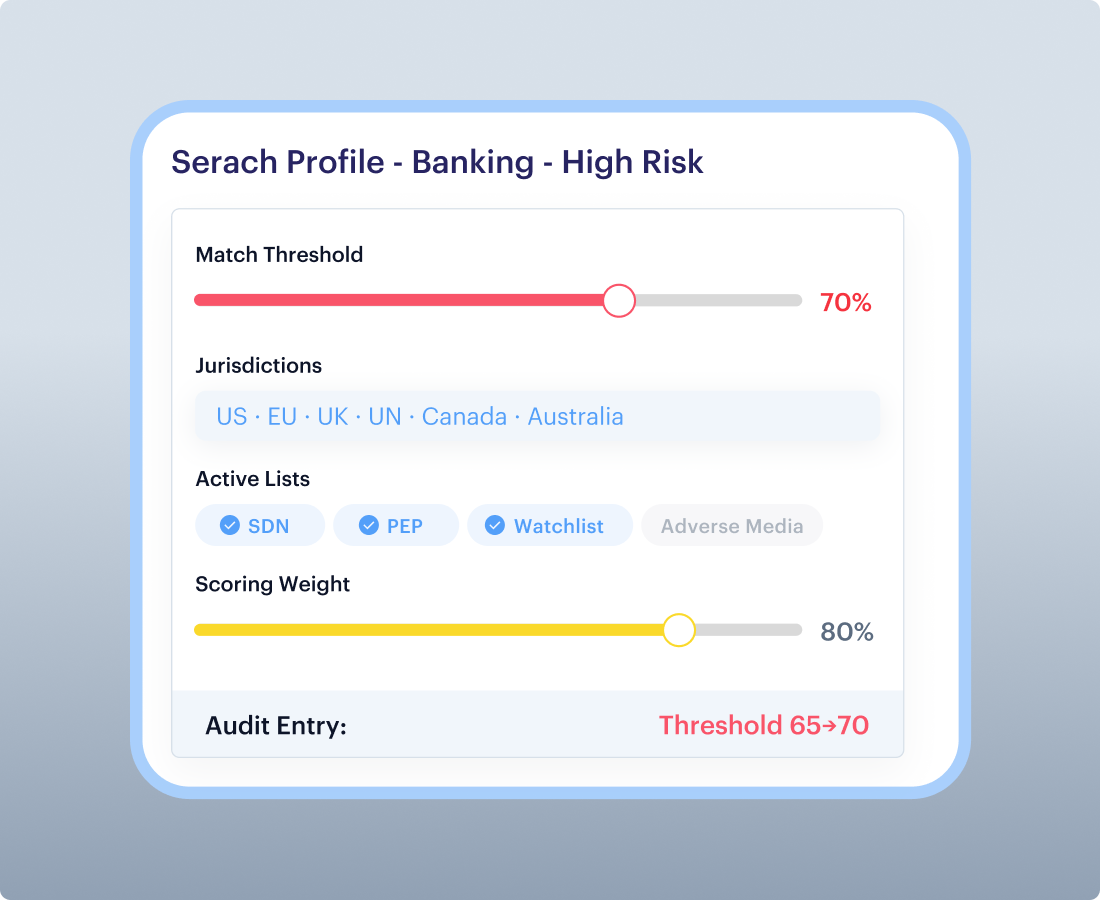
The compliance team controls scoring weights, match thresholds on a 1-to-100 scale, country filters, and list-type toggles, tuned by product line, customer segment, or jurisdiction. Every configuration change writes an audit entry, so the calibration trail supports defensible regulatory review.
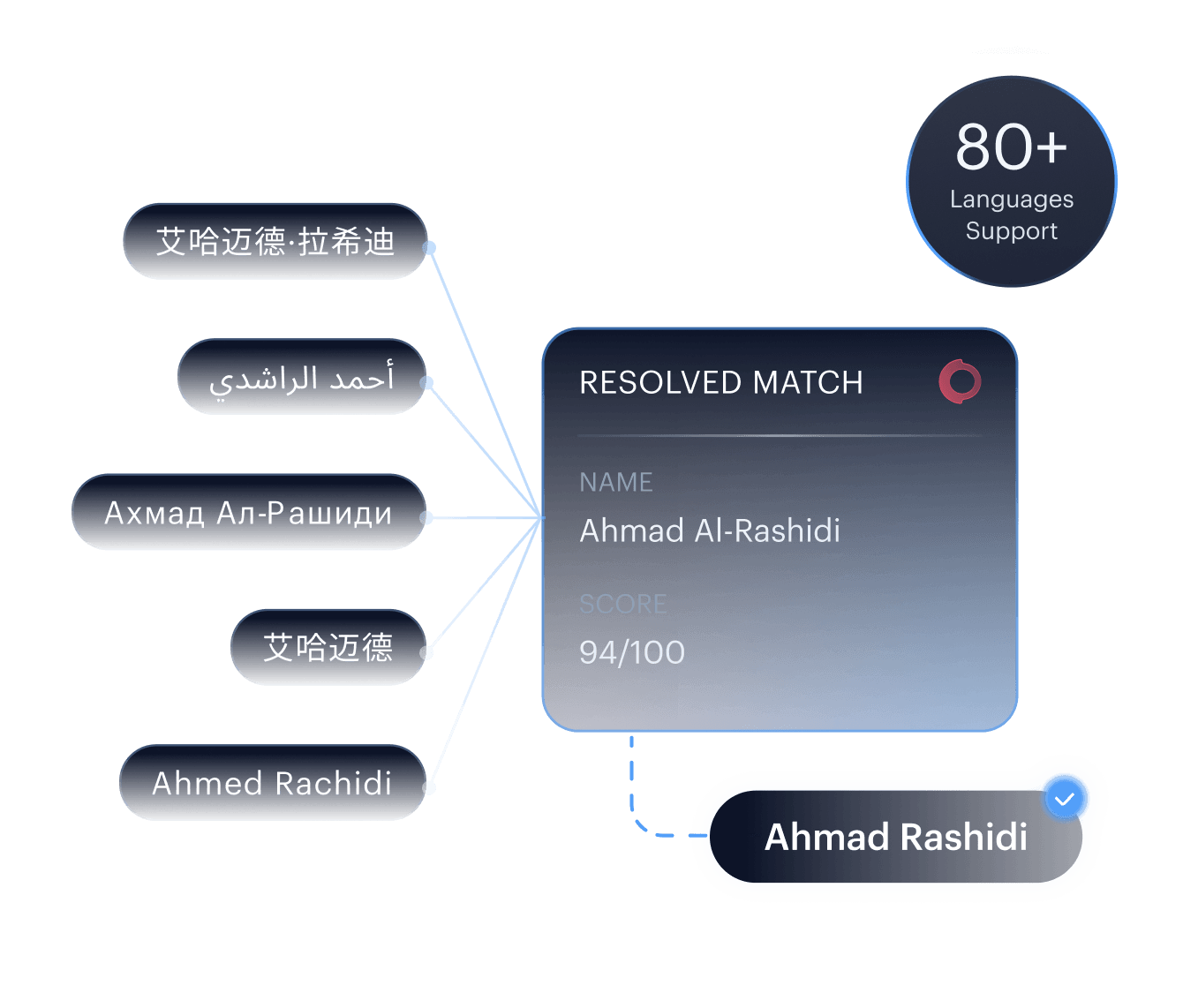
Cross-script matching across 80+ languages, not Latin-only
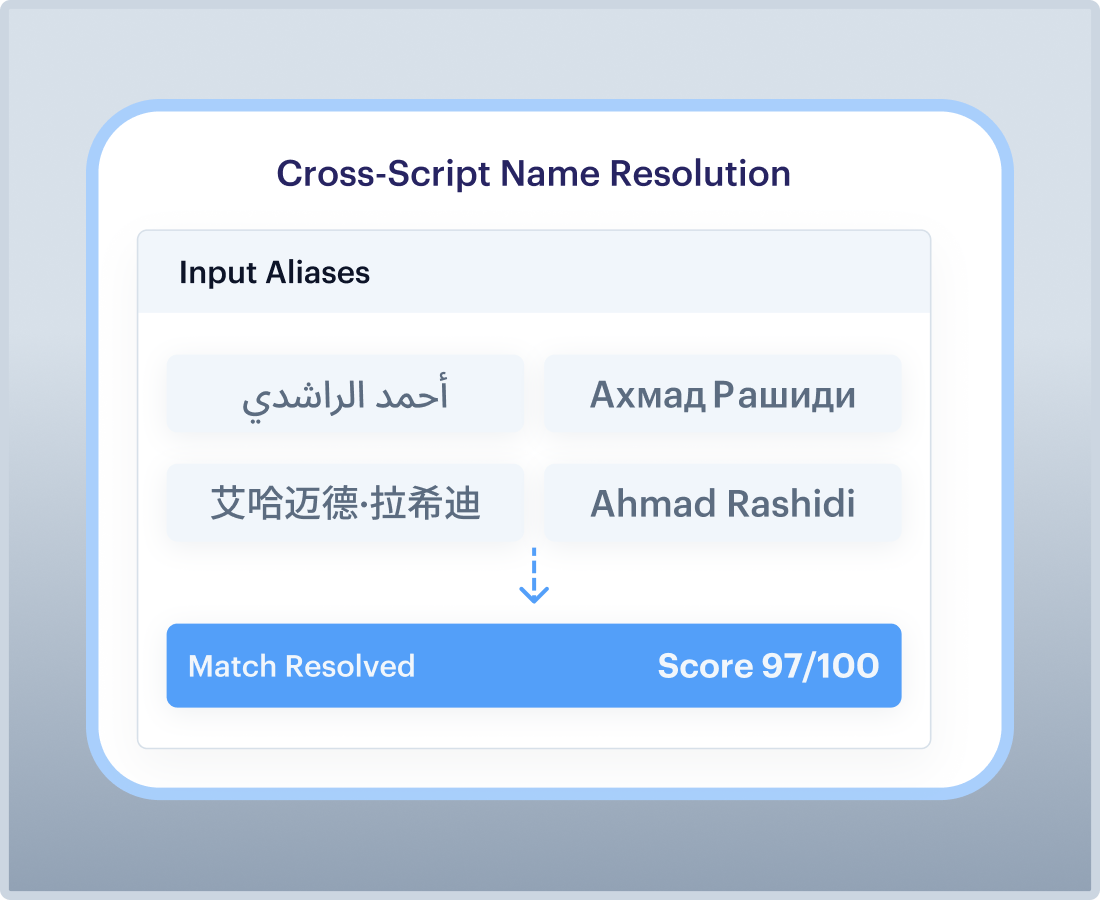
Shufti's proprietary fuzzy, phonetic, and transliteration matching run in parallel across 80+ languages, so a Cyrillic, Arabic, Chinese, or Persian designation surfaces the same record as its Latin-script transliteration. Single-script engines miss the names that sit outside their default input format.
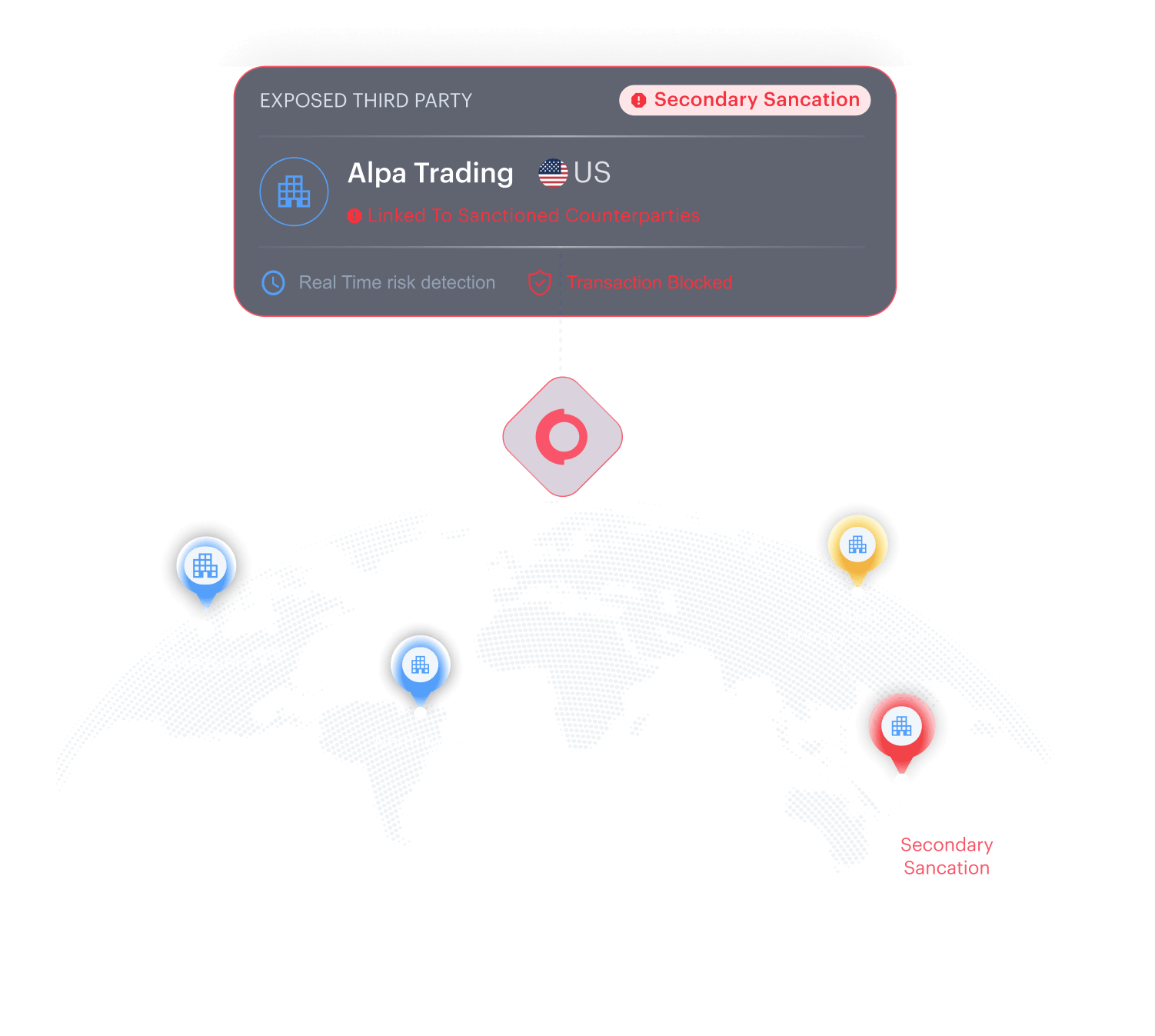
Secondary sanctions detection
Secondary sanctions are penalties imposed by a sanctioning country (primarily the U.S.) on third-party individuals or entities, Shufti continuously identifies and prevents such exposure in real time, helping you stay compliant and avoid prohibited transactions.
EXPLORE THE FULL AML SUITE
Sanctions Screening Is One Layer. Here Is the Rest

PEP & RCA Screening
Surface political exposure and map relatives and close associates across jurisdictions with real-time multilingual profiling.
Learn More
Adverse Media Screening
Detects negative news across global sources with real-time multilingual monitoring and contextual risk insights.
Learn More
Watchlist Screening
Screen against global watchlists including enforcement registers, criminal records, and law-enforcement lists with continuous refresh cycles.
Learn MoreSTRUCTURED SANCTIONS LIST SCREENING SIGNALS
Screening That Fits Compliance Programmes
Real-Time Coverage and Data
Real-time sanctions coverage
Screen against leading global sanctions regimes and watchlists, with coverage across OFAC, UN, EU, UK, and other key international sources.
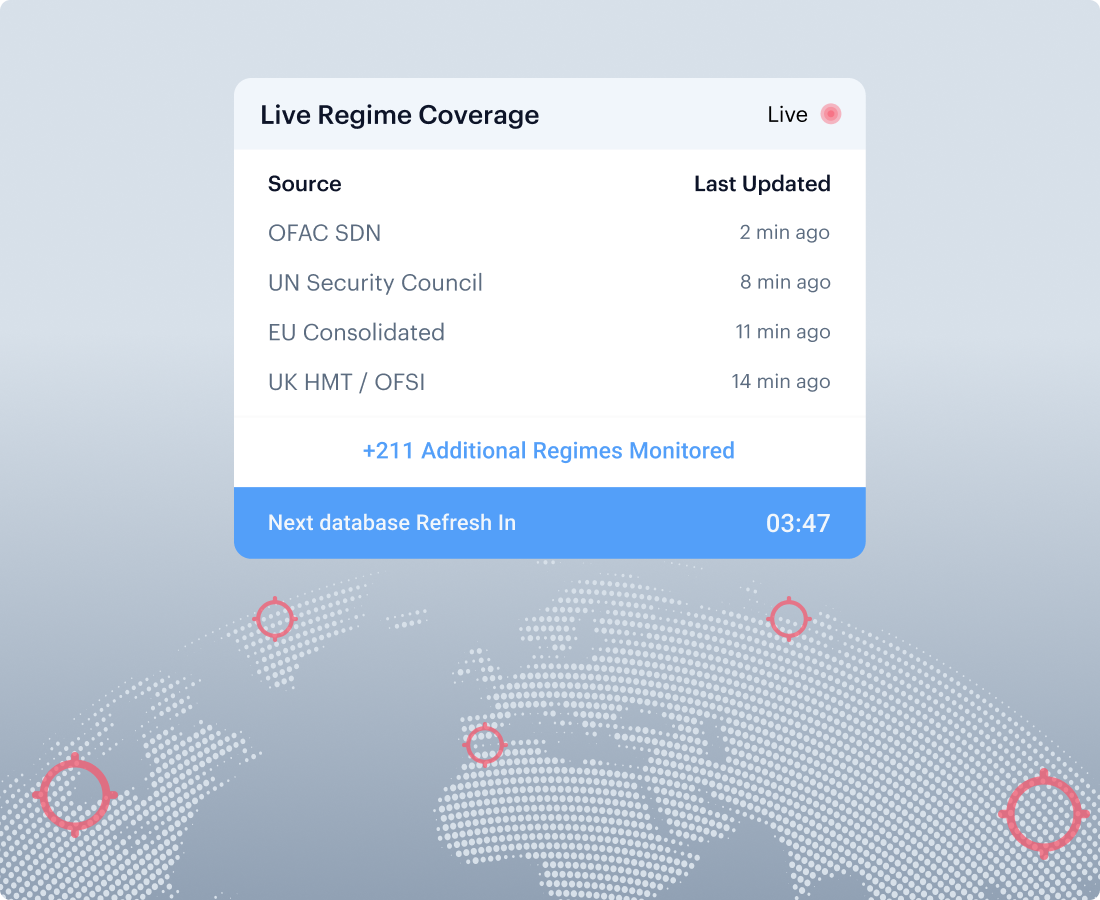
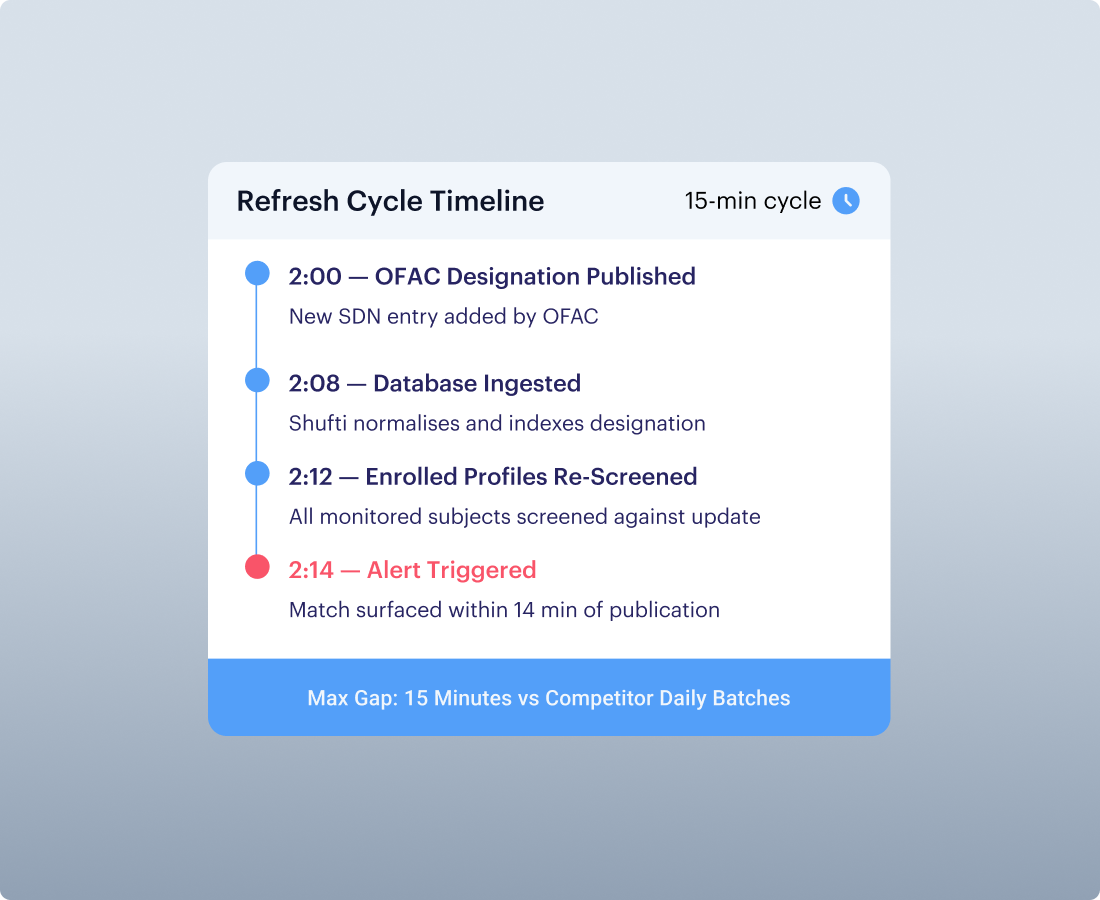
15-minute refresh cycles
The entire sanctions database refreshes every 15 minutes. New designations, removals, and amendments are captured as they are published. Organisations screening on daily or weekly cycles accept a predictable gap; Shufti closes it by design.
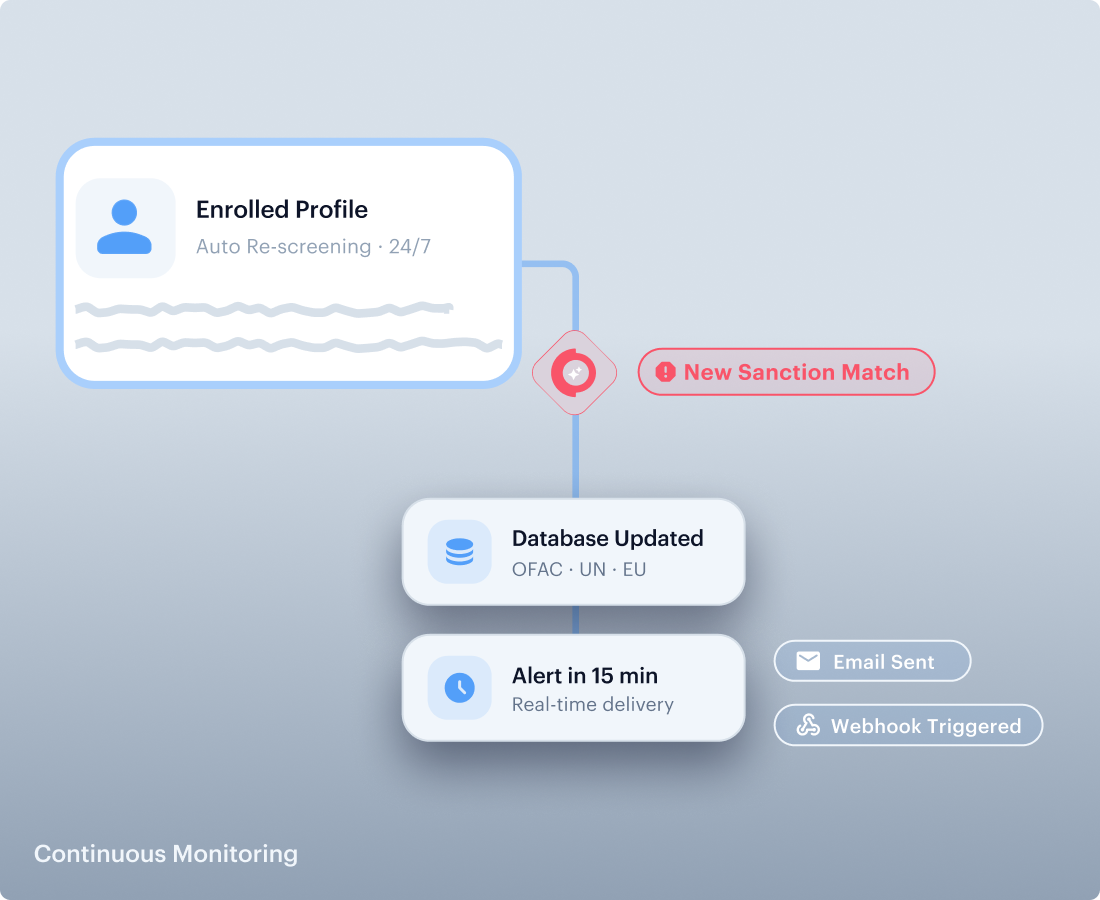
Continuous monitoring
Once a profile is enrolled, Shufti re-screens it automatically each time the database updates. Any match against a newly sanctioned entity surfaces in the alert queue within 15 minutes of that designation being published, delivered via email or webhook per team configuration.
Accurate Matching Across Markets
Multilingual cross-script name matching
Name matching operates across 80+ languages and multiple scripts simultaneously. Transliterations, script variants, name-order differences, and alias structures resolve without requiring a separate query per language. Genuine hits surface regardless of how a name appears across Arabic, Cyrillic, Chinese, Persian, Hebrew, or Latin sources.
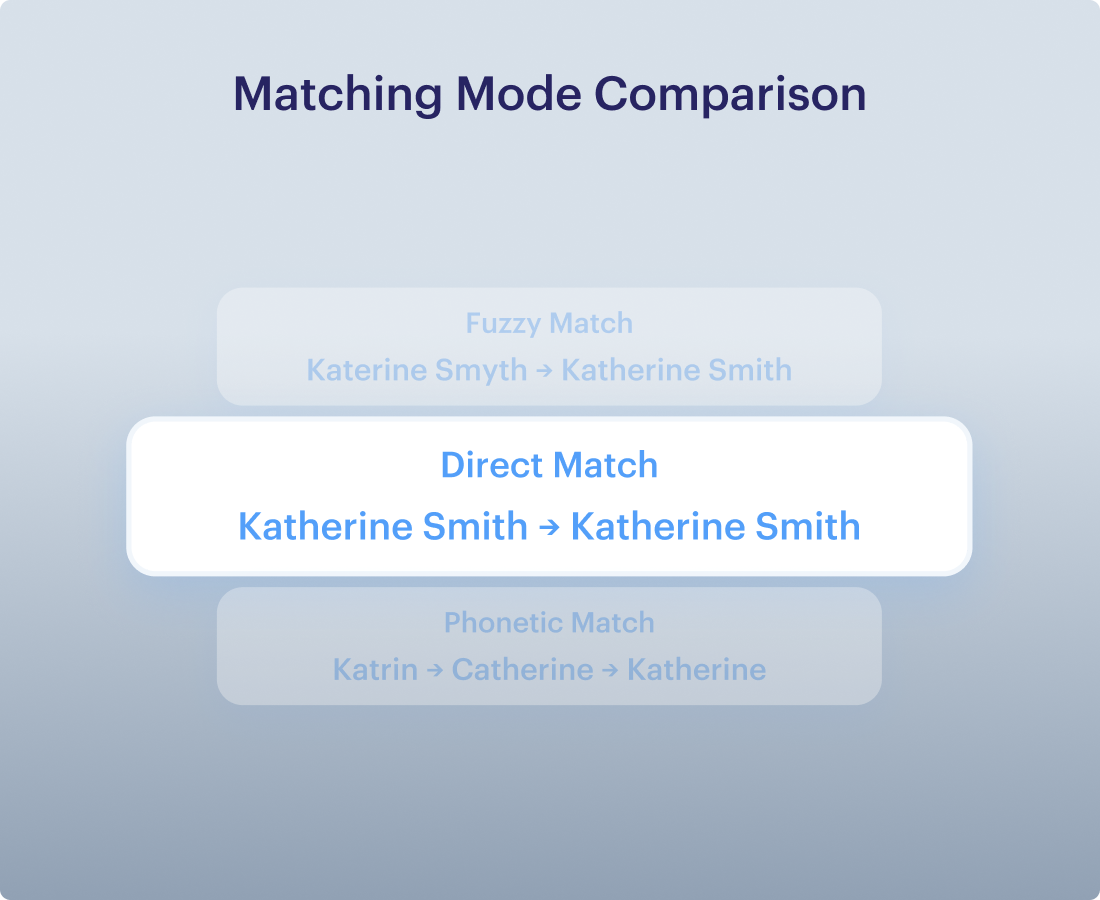
Fuzzy, phonetic, and direct matching modes
Direct matching applies exact or near-exact logic for high-precision use cases. Fuzzy matching extends coverage to names with spelling variations or incomplete data. Phonetic matching catches similar-sounding names written differently, such as Catherine, Katherine, and Katrin, across different list sources.
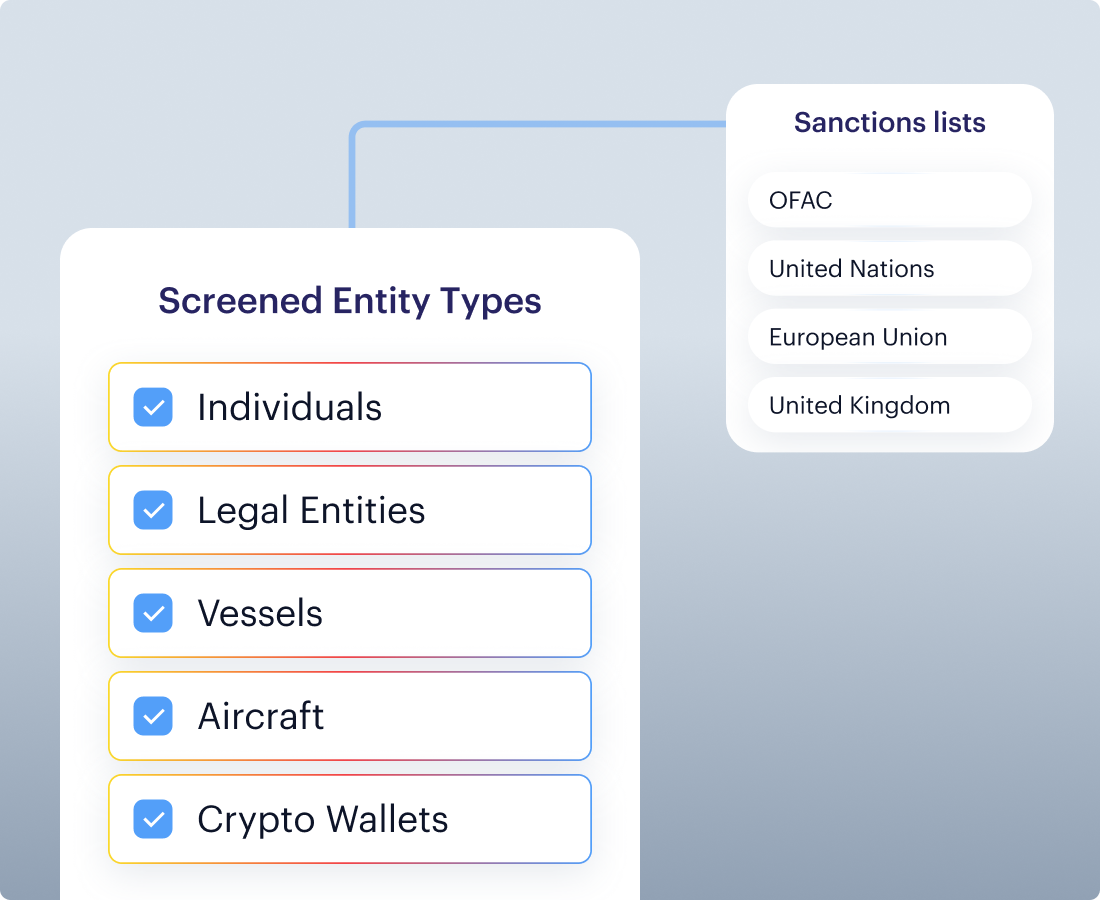
Entity-type coverage
Screening is not limited to individuals. Legal entities, vessels, aircraft, and crypto wallets are all supported against OFAC, UN, EU, and UK lists. Ownership-and-control resolution captures indirect exposure via the OFAC and equivalent EU and UK control rules.
Configurable Controls and Workflow
Configurable scoring and threshold controls
Scoring weights, match thresholds, country filters, and list-type selections are adjustable by the compliance team. Controls are configurable by product line, customer segment, or jurisdiction to reflect tiered risk policies rather than a single universal rule. Every configuration change writes to the consolidated audit trail.
Reusable Search Profiles
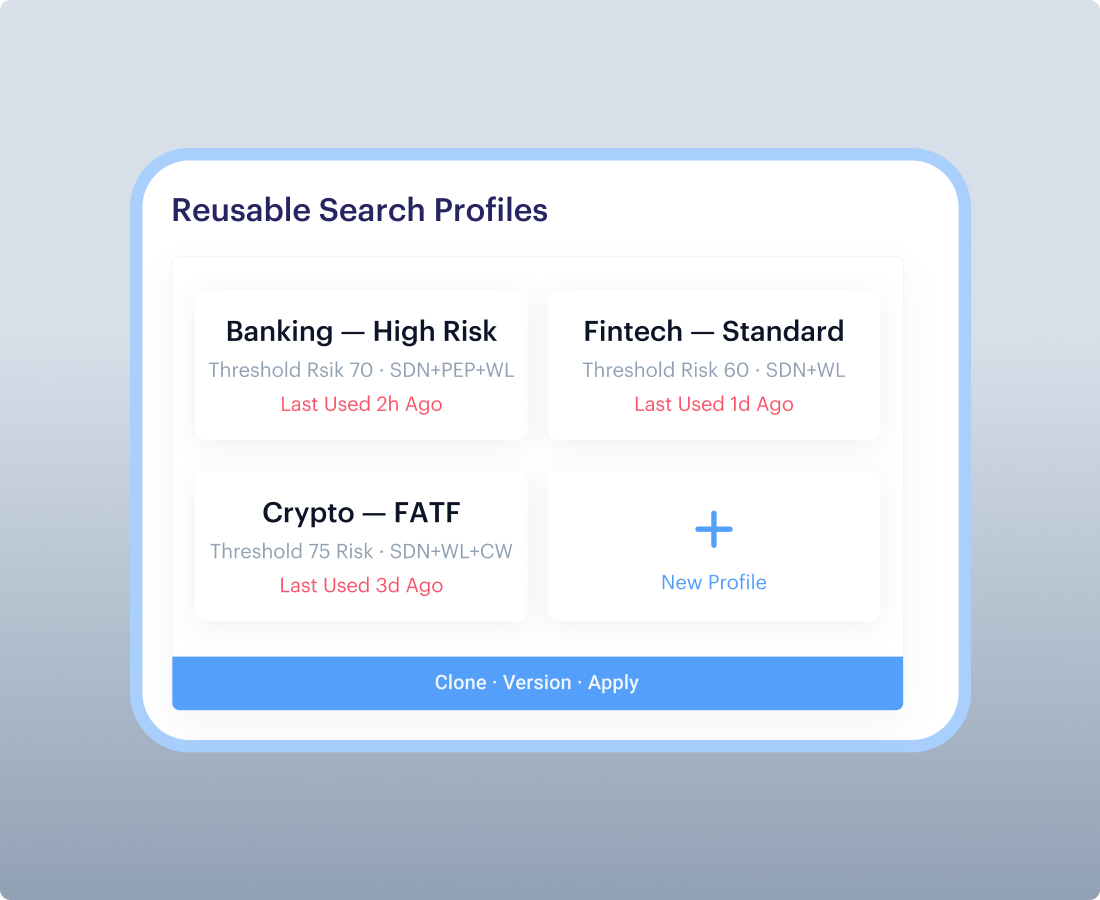
Screening configurations, list selections, scoring parameters, and matching modes save as reusable profiles. Compliance teams apply a consistent, validated configuration to new subjects without rebuilding settings each time. Profile versions are tracked and cloneable across product lines.
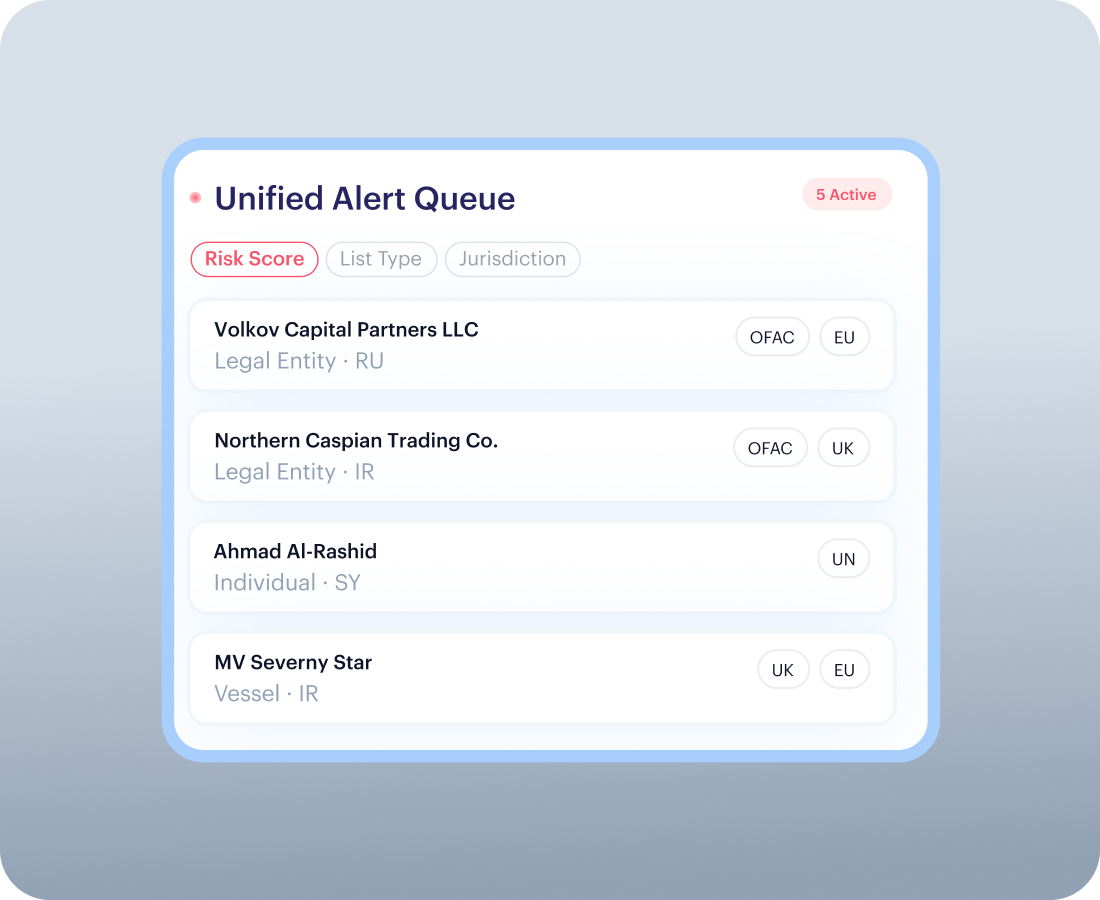
Unified alert queue
All sanctions hit land in a single workspace, ranked by risk score, list type, and jurisdiction. Investigators see what requires immediate attention without cross-referencing parallel systems; notes, evidence, and decisions write to the audit trail inside the same surface.
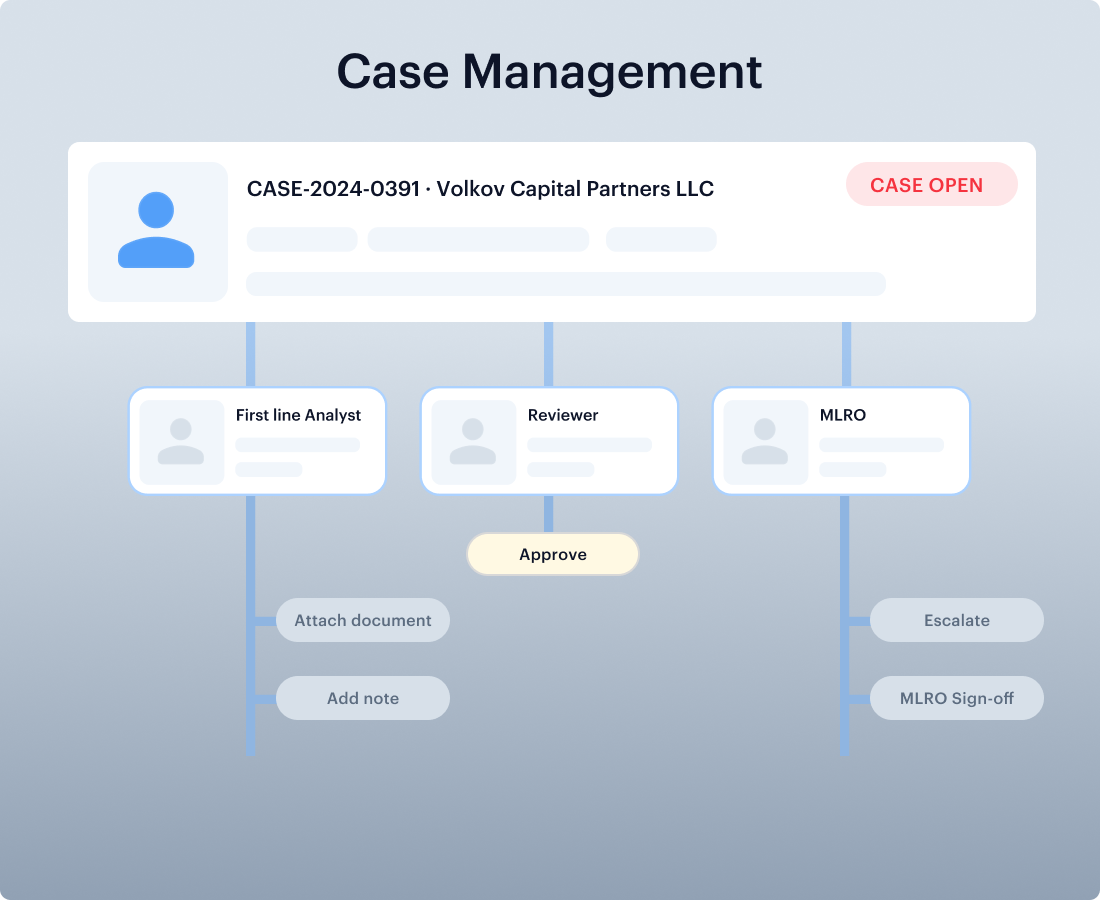
Monitoring and Evidence
Case management workspace
Every alert opens as a case with structured investigation context. Investigators attach documents, correspondence, and screening evidence to a single record, reviewers approve, escalate, or close with written rationale. Role-based access separates first-line review from MLRO sign-off, and every action writes to the consolidated audit trail automatically.
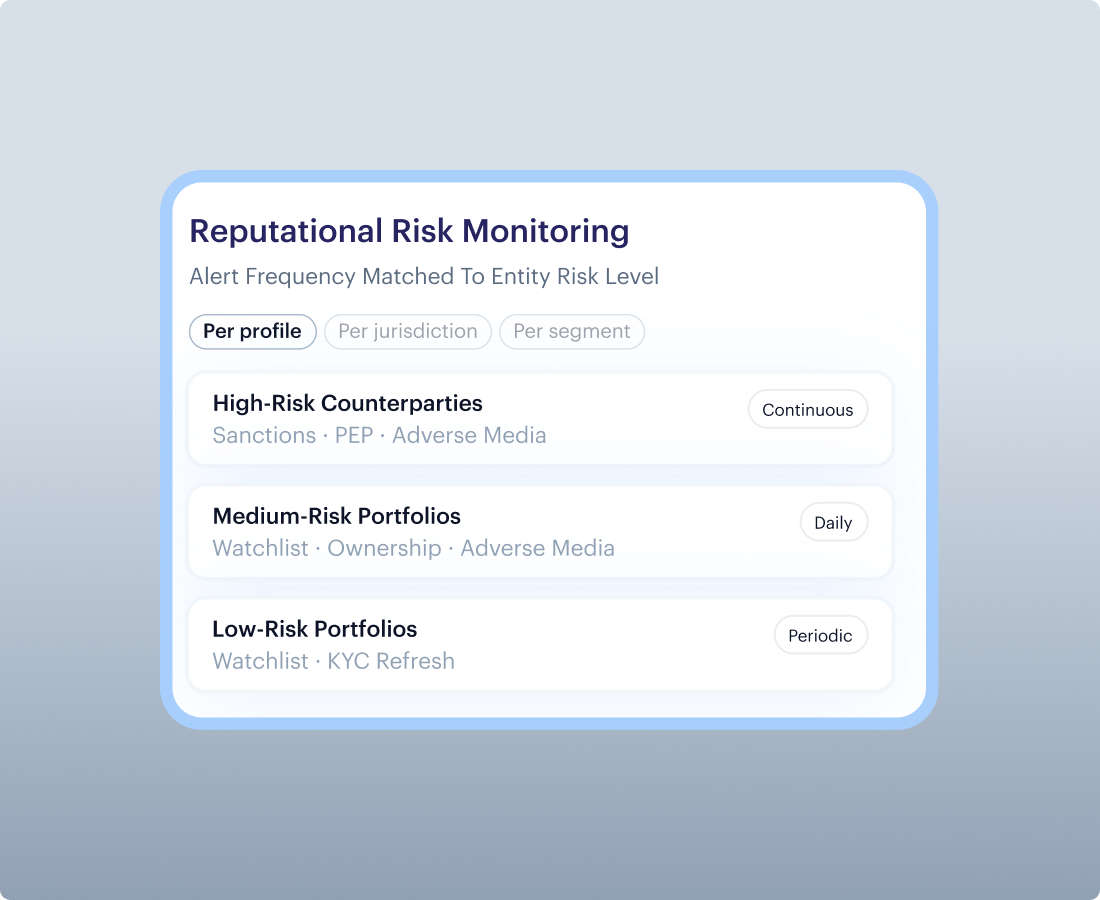
Reputational Risk Monitoring
Monitoring durations and alert frequencies intelligently match entity risk levels, from continuous monitoring on high-risk counterparties to periodic reviews on lower-risk portfolios. Configurable per profile, per jurisdiction, per customer segment.
AI Compliance Co-Pilot
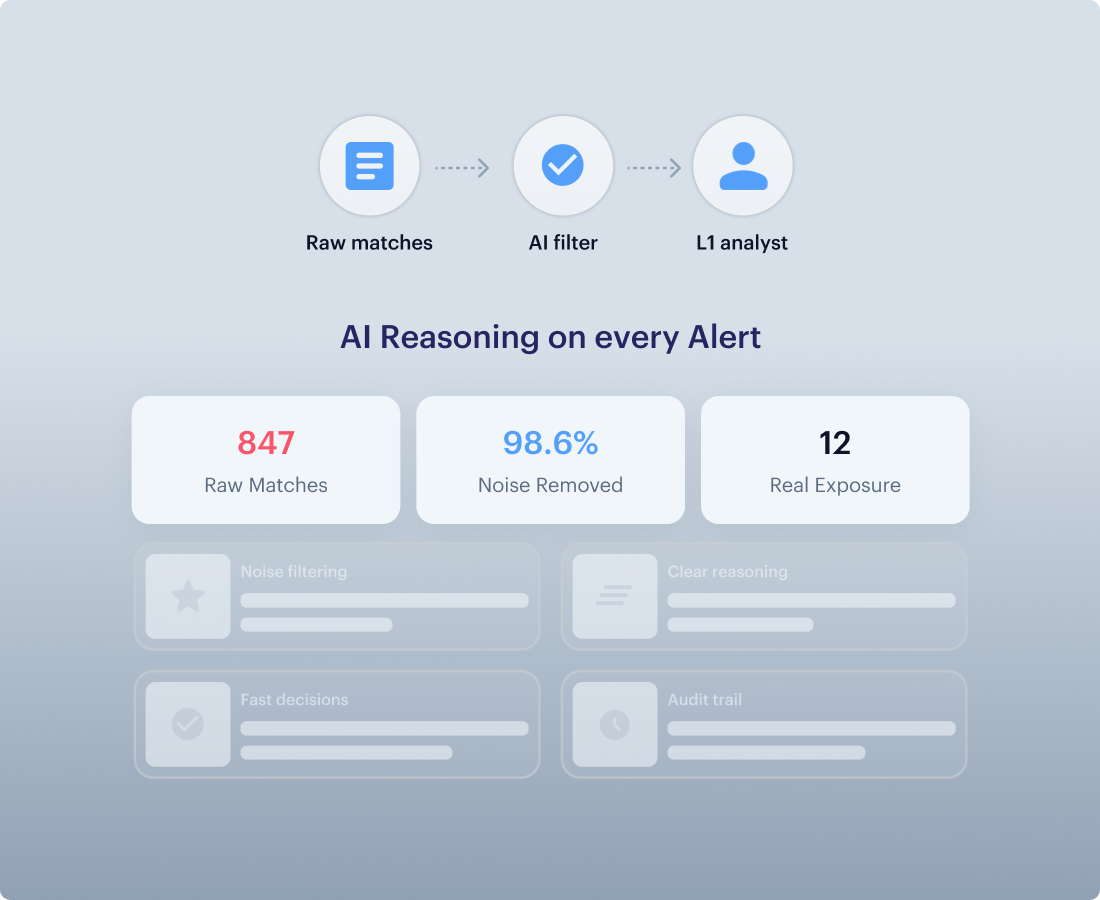
Shufti's proprietary AI layer reads every sanctions match before it reaches an analyst, filtering out common-name noise and low-relevance hits. L1 reviewers see only the matches that carry real exposure, with clear reasoning attached to every alert so decisions are fast, consistent, and defensible.
Who It's Built For
Built for Regulated and High-Risk Businesses
Cleaner Seller Networks, Fewer Cycled Identities
Seller cycling and re-entered identities slip past name-only screening, letting off-boarded actors return under new names. Shufti's ownership-and-control resolution catches indirect exposure, and custom internal lists block previously removed sellers from re-onboarding.

Recognized as a G2 Leader, Summer 2026
Shufti has earned multiple G2 distinctions this season, rated by real users and trusted by enterprises worldwide.
See All Reviews




Don’t just take our word for it, hear from our customers
The Confidence Our Clients Share

The future of digital identity is defined by trust, interoperability, and regulatory alignment, so our partnership with Shufti reinforces DevCode Identity’s commitment to supporting our global customers with the most secure, best-in-class, compliant identity verification solutions available today.
Combining our Conversion Driven Compliance Orchestration Platform with Shufti’s global KYC and IDV capabilities allows our customers not only to navigate complex regulatory demands but also to maintain a seamless customer onboarding experience with the highest achievable conversion rates.
We’re proud to continue our partnership with Shufti as we expand into new jurisdictions.
Shufti’s verification technology not only strengthens our compliance framework but also ensures our players enjoy a smooth, secure onboarding experience.
We aim to offer our clients and their traders the very best tools with which to do their jobs, we’re excited to be able to work with Shufti.
They’re a leading company, and we’re looking forward to offering their solutions to our clients through our CRM.
The relationship with Shufti was born out of frustration with an existing provider, so we started our discussion with Shufti.
The response time was excellent, from the start of speaking to sales to getting up and running with the demo.
EVERYTHING YOU NEED TO KNOW IN ONE PLACE
Frequently Asked Questions
What is sanctions and watchlist screening?
Sanctions and watchlist screening checks individuals, businesses, vessels, aircraft, and crypto wallets against global sanctions regimes, enforcement records, and regulatory watchlists to identify restricted parties before they access a service or complete a transaction. It is a required component of risk-based AML due diligence under FATF guidance, EU AML Directives, OFAC frameworks, and national sanctions regimes.
How does structured screening differ from keyword or link-list tools?
Basic tools return link lists or yes/no hit outputs. Shufti structures each match into decision-ready attributes including entity matching, ownership-and-control relationships, match-logic explanation, jurisdiction tags, and a full decision export, so reviewers assess exposure faster and more consistently.
Which sanctions lists does Shufti cover?
Coverage includes OFAC SDN, UN Security Council Consolidated List, EU Consolidated Financial Sanctions List screening provider , UK HMT Financial Sanctions Targets, UK OFSI Consolidated List, Canada OSFI, Australia DFAT, Japan METI End User List, Singapore MAS, and FATF high-risk and monitored jurisdictions, alongside 4000+ watchlist and enforcement sources across 215+ regulatory regimes. A full coverage matrix is available on request.
How often does Shufti update its sanctions data?
The database refreshes every 15 minutes, capturing new designations, amendments, and removals from all 215+ regimes as they are published. Continuous monitoring re-screens enrolled profiles each cycle, so the control is persistent rather than point-in-time.
How does multilingual and cross-script matching work?
Fuzzy, phonetic, and transliteration matching run in parallel across 80+ languages and multiple scripts. A Cyrillic, Arabic, Chinese, or Persian designation surfaces the same record as its Latin-script transliteration. Results consolidate into a single ranked output per subject.
What happens if a country does not publish a sanctions list Shufti supports natively?
Custom Sources ingestion covers any regulatory feed, customs-authority list, or regional enforcement database the client needs to screen against. Once ingested, the custom source normalises into the Shufti screening environment and appears in every future screen alongside the global regimes.
Can Shufti screen entities, vessels, aircraft, and crypto wallets?
Yes. Natural persons, legal entities, vessels and aircraft, and crypto wallet addresses are all supported. Ownership-and-control resolution captures companies indirectly sanctioned through the OFAC 50 per cent rule and equivalent EU and UK control rules.
Ready To Strengthen Sanctions Controls
See how 15-minute refresh cycles, multilingual matching, and ownership-and-control screening help your team catch real exposure faster.