












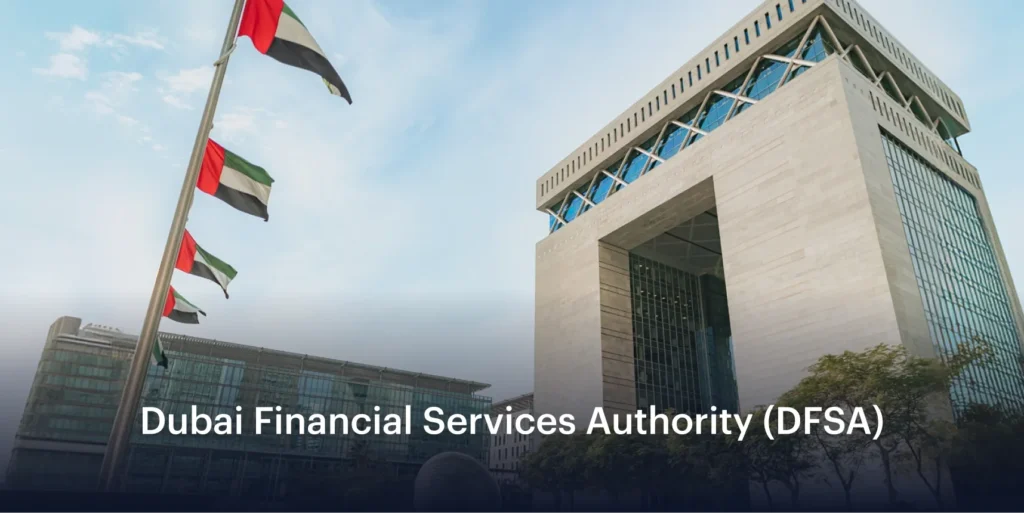

The Dubai Financial Services Authority (DFSA) is the independent regulator of financial services that are either conducted in or from the Dubai International Financial Centre (DIFC), a financial free zone in Dubai, operating under the DIFC Regulatory Law, DIFC Law No. 1 of 2004. It licenses firms, supervises their conduct and their relevant prudential soundness. It is also responsible for enforcing anti-money laundering (AML) and counter-terrorist financing (CTF) rules across the Centre.
What is the DFSA and what does it regulate?
The DFSA is a body established under Dubai law and is often called the Dubai financial regulator, but its remit stops at the DIFC boundary. There are some other financial centers like DIFC, where CBUAE or SCA do not supervise directly, for example, ADGM.
Within the DIFC, the DFSA’s mandate covers:
- Asset management, banking and credit services, and securities
- Collective investment funds, custody, and trust services
- Commodities futures trading and Islamic finance
- Insurance, an international equities exchange, and an international commodities derivatives exchange
- Supervision and enforcement of AML and CTF requirements applicable in the DIFC
What does the DFSA do inside the DIFC?
DIFC regulations sit on a layered legal base. Federal Law No. 8 of 2004 gives financial free zones the freedom to operate outside federal civil and commercial law, Federal Decree No. 35 of 2004 created the DIFC, and Dubai Law No. 5 of 2021 establishes the DIFC bodies, including the DFSA. The practical point remains the split of duties.
| Body | What it controls in the DIFC |
| DFSA | Financial services licensing, conduct, prudential supervision, AML/CTF enforcement |
| DIFC Authority | Company registration, commercial licensing, office space, non-financial businesses |
DFSA licensing process for Authorised Firms
Any firm carrying on financial services in or from the DIFC must be authorised and licensed by the DFSA before it trades. The DFSA licensing process runs in parallel with DIFC Authority incorporation.
Steps to get a DFSA licence:
- Engage the DIFC Authority’s business development team on the commercial setup and obtain the application forms.
- Prepare a Regulatory Business Plan and submit it to the DFSA’s Authorisation Enquiries team.
- Complete the application forms and pay the application fee in advance.
- Respond to DFSA review questions on governance, systems, capital, and controls.
- Receive an in-principle approval letter with conditions attached.
- Incorporate with the DIFC Registrar of Companies and satisfy the remaining conditions.
- Receive the DFSA licence once every condition is evidenced.
The DFSA expects named individuals for its licensed functions; this includes a Senior Executive Officer, Finance Officer, Compliance Officer, and Money Laundering Reporting Officer (MLRO). It also approves them as authorised individuals.
DFSA rules and standards that are mandatory for firms to follow
DFSA rules and standards are set out in the DFSA Rulebook, which the DFSA is empowered to make under the Regulatory Law. Each module governs one area, and an authorised firm typically falls under several at once.
| Module | What it covers |
| General (GEN) | Licensing, authorisation, systems and controls, core principles |
| Conduct of Business (COB) | Client classification, disclosure, suitability, client assets |
| Anti-Money Laundering (AML) | AML, CTF, counter-proliferation financing, and sanctions obligations |
| Prudential modules | Capital, liquidity, and reporting, scaled to the firm’s licence category |
DFSA compliance is judged against these modules continuously, not only at licensing. Supervisors review risk assessments, compliance monitoring, and regulatory returns, and can impose conditions, fines, or licence withdrawal under the regulatory law.
DFSA AML Requirements for all Relevant Persons
The DFSA is the competent authority for federal AML legislation as it applies in the DIFC. Article 70(3) of the Regulatory Law gives it AML jurisdiction, and Article 71(1) obliges every Relevant Person to comply with federal AML law, so a federal breach is also a DIFC breach.
Who counts as a Relevant Person?
- Authorised Firms (other than Credit Rating Agencies)
- Authorised Market Institutions
- Designated Non-Financial Businesses or Professions (DNFBPs), such as law firms, accountants, real estate agencies, precious metals dealers, and company service providers
- Registered Auditors
What are the Core Obligations?
DFSA AML requirements follow a risk-based approach and are also in alignment with Federal Decree-Law No. 10 of 2025, the UAE’s current AML, CTF, and proliferation financing law. On 2 March 2026, the DFSA amended its AML Module to reflect that law and Cabinet Resolution No. 134 of 2025.
In practice, the following must be done:
- Run a business risk assessment along with a customer risk assessment, and scale due diligence to the result
- Identification and verification of customers and beneficial owners before establishing a relationship, with enhanced measures for higher-risk cases
- Appoint an MLRO and register with the UAE Financial Intelligence Unit on the goAML portal
- File suspicious transaction reports to the FIU through goAML, then notify the DFSA immediately afterwards
- Screen customers and transactions against the UN Security Council and the UAE sanctions lists, and report matches immediately but no later than 24 hours.
- Accountability demand for senior management for AML compliance, which the DFSA places on every member of senior management, not the MLRO alone
A risk-based regime expects the customer file, the risk rating, and the screening result to move together when the customer’s circumstances are subject to change. For example, suppose a corporate customer informs a DIFC firm that a new shareholder has acquired a controlling interest. The firm should revisit the customer’s ownership structure, identify and verify any new beneficial owners, and screen the relevant parties against applicable sanctions lists. It should then reassess whether the change affects the customer’s risk rating or calls for enhanced due diligence.
The customer file should record the updated information, checks performed, assessment, and reasons for any decisions. This illustrates how ongoing due diligence connects changes in customer circumstances with verification, screening, and risk assessment.
Frequently Asked Questions
Who needs a DFSA licence?
Any firm carrying on financial services in or from the DIFC, including banks, asset managers, brokers, insurers, and fund managers.
Does the DFSA enforce AML rules on non-financial firms?
Yes. Law firms, accountants, real estate agencies, precious metals dealers, and company service providers in the DIFC register as DNFBPs and fall under the DFSA AML Module.