AMLR Solutions
  AMLR Consultation
 EUDI Wallet
 Onboarding
 Ongoing Monitoring
 FRAML
FRAML KYC
KYC KYB
KYB KYI
KYI Age Assurance
 Workforce IAM
 Candidate Verification
 Account Takeover
 Bonus/ Promotion Abuse
 Chargeback Fraud
 Deepfake
 Document Fraud
 Fraud Networks
 Impersonation Fraud
 Money Mule Activity
 Multi-Accounting
 Party Fraud
 Regulatory & Compliance Risks
 Synthetic Identity Fraud
 Adult Content
 Banking
 Crypto
 Fintech
 Forex
Forex Compliance
 Fraud prevention
 Trust & safety
 Global expansion
 Compliance Officers
 Developers
 Fraud Analysts
 Product Managers
 Journey Builder
  Global Trust Platform
 Customer Profiles
 Vendor Comparison
 IDV Case Management
 AML Case Management
 Regulatory Reporting
 Agentic Rule Builder
  AI Compliance Co-Pilot
  Fraud Analytics
 Fraud Hub
  OCR
OCR Shufti AI
 Bank Account Verification
  Biometric Duplication
 Database Checks
 Document Intelligence
 Government ID
 Mobile Driver's License
 NFC
NFC Selfie Liveness
 Brand Personalisation
 Deployment Options
 Identity Methods
 IDV Modes
 Multi-tenancy
 On-Premise IDV
 Secure Capture
 Shufti MCP












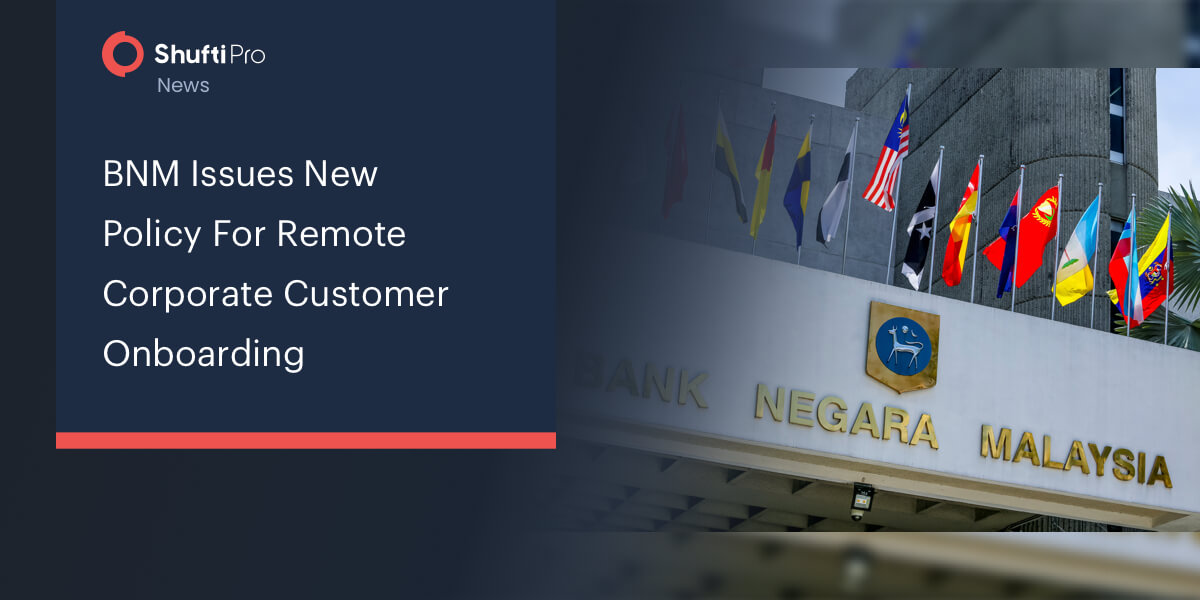
BNM has issued a new policy document that permits MSBs to onboard customers remotely in the corporate sector.
The Central Bank of Malaysia, also known as Bank Negara Malaysia (BNM), recently published a new policy document permitting Money Service Businesses to use non-face-to-face verification processes while onboarding new clients.
E-KYC verification procedures were introduced for individual remittance customers in 2017, while the scope of e-KYC was expanded to money-changing businesses in 2019.
E-KYC verification processes are implemented by money service businesses to ensure compliance with AML/CFT regulations and to safeguard the safety and integrity of money services. BNM’s policy document sets out the minimum requirements that licensed MSBs must fulfil during remote customer onboarding.
The document states that Money Service Businesses must first obtain approval from their Board of Directors and Central Bank of Malaysia prior to the implementation of e-KYC verification in corporate customer onboarding.
It also states that corporations need to ensure proper identification and verification procedures of customer identities on a continuing basis in a remote setting in the same way as implemented during in-person verification. Money laundering risks and suspicious transaction reports must also be filed to prevent ML/CFT activities.
MSBs must also implement at least one additional verification method on top of the mandatory verification procedure, BNM says. Video calls to the customers must be made to ensure they are actually who they claim to be, requiring them to show proof of their business. However, an unannounced introductory phone call must be made prior to the video call.
During the video call, MSBs may request the person to show proof of business existence. This can include the use of consent notes or inventories.
“Reporting institutions must ensure the systems and technologies developed and used for the purpose of establishing business relationships using non-face-to-face channels (including verification of identification documents) have capabilities to support an effective AML/CFT compliance programme,” the document says.
BNM adds that the companies that fail to comply with the new rules will be facing appropriate enforcement action, including licence suspension or direct action against MSB directors, managerial staff, and other employees.
Suggested Read: What is Biometric Consent Authentication?