










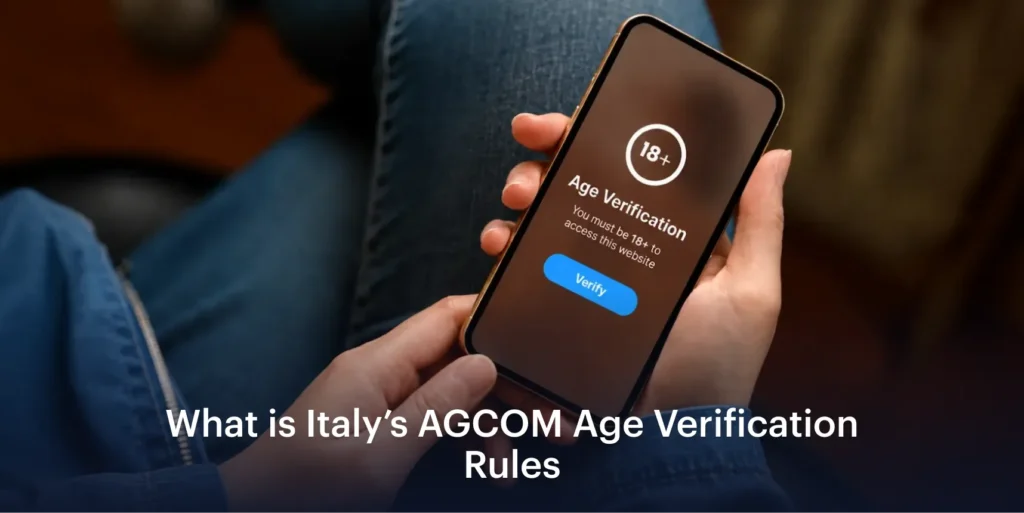

Italy’s age verification law requires adult content websites and video-sharing platforms to check that the users are 18 or older before granting access to adult content. For the operators, compliance involves more than adding an age-check prompt. The verification process must protect the user’s identities, keep the verification provider independent and prevent it from learning which adult service the user visits.
What is the AGCOM Age Verification Regulation?
AGCOM Resolution No. 96/25/CONS establishes the technical and the procedural requirements implementing Article 13-bis of Decree-Law 123/2023, converted into Law 159/2023, known as the Decreto Caivano. Its purpose is to prevent minors from accessing pornographic content.
Which Platforms are covered?
AGCOM age verification concerns websites and video-sharing platforms disturbing pornographic images and videos in Italy. It maintains a list of covered operators, which is subject to updates. Operators should check that list alongside their service’s activities and establishment location.
For services that are established in another EU member state, Annex A identifies Italian-market indicators that include the Italian-language availability, significantly Italian audiences, Italian revenues, marketing to Italian users and the Italian domains or contact details. Therefore, an overseas headquarters should necessitate a scope assessment, rather than making the assumption that Italian requirements are not relevant.
Changes after 12 November 2025
The implementation dates differ by the establishment location:
| Operator Establishment | Obligations Applied From |
| Italy or Outside the EU | 12 November 2025 |
| Another EU member State | 1 February 2026 |
The AGCOM’s February 2026 announcement confirmed the second phase and the monitoring of implementation. It explained that an operator found to be non-compliant receives a notice that would require correction within 20 days. Anyone failing to comply can lead to blocking and proceedings for the financial penalties. These are existing obligations, rather than an upcoming deadline.
What does ‘double anonymity’ require
Double-blind age verification checks that someone is old enough to visit a site without linking their identity. AGCOM’s has a similar model known as ‘double anonymity’ that protects privacy in both directions:
- The content platform receives proof of adulthood without identifying information.
- The age-proof provider does not learn which website or the service the user intends to access.
A provider returning only an “18+” result addresses the first point, but does not fulfill the second. AGCOM age verification describes an anonymous proof supplied to the user, who presents it to the platform. During the procurement, ask the supplier to showcase the complete data flow. Then, review the requests, logs, redirects and the analytics integrations for the information that would disclose the destination website.
Are there AGCOM-approved verification methods
The resolution sets the requirements but it does not certify the technical solutions. Its technology-neutral approach enables different implementations, provided that they satisfy those requirements. Annex A identifies privacy-incompatible approaches, including direct collection of identity documents by the pornographic publisher, browsing history-based age estimation, and the biometric processing against a selfie. An ordinary digital identity login is also insufficient if it reveals the destination site to the identity provider. AGCOM describes the app-based and non-app-based approaches involving the independent providers and the age proofs. However, the presence of an app or wallet alone does not establish compliance.
What does Age Verification Look Like for Users in Italy?
The following showcases the user journey that is based on the AGCOM’s age verification requirements; it is not a prescribed interface or any kind of sequence.
Age Verification Prompt:
The user should encounter an age check before accessing the restricted content. The website should also explain what that check establishes, who handles it and how the user can obtain help.
Obtain Proof of Adulthood:
The user gets age proof through the independent provider supported process. This can involve an appropriate app based credential or non-app route. The website should provide clear instructions and an accessible alternative if the primary route is not available.
Present the Proof:
The user presents the proof through the chosen privacy-preserving process. The issuer should not learn which adult service receives it, and the platform does not itself require the underlying identity information.
Validation of Proof:
The platform validates the proof before granting access. AGCOM describes two separate stages for it.
- Identification: Establishing the user’s identity
- Authentication: verifying that the proof that is being presented is valid or not.
However, this does not bind the user to upload a new identity document every time they visit the site.
Grant Access:
There are two possible outcomes for this; successful or unsuccessful verification. For the unsuccessful checks, the site needs to provide a clear retry, alternative route or compliant process without exposing the restricted content.
How Should Platforms Compare Age-Assurance Providers?
| Comparison Area | Evidence to request | Decision to make |
| Privacy architecture | Data-flow diagram, sample messages and logging configuration | Can either party obtain information that defeats double anonymity? |
| Method and independence | Exact checking method, provider relationships and independent assessment scope | Does this specific configuration fit the Italian requirements? |
| Tested performance | Dated results for the deployed version, including minors incorrectly accepted and adults incorrectly rejected | Are results relevant to the age threshold and intended users? |
| Resistance to misuse | Tests involving borrowed credentials, altered proofs, replay and bypass attempts | What happens when someone deliberately tries to defeat the check? |
| Accessibility and fallback | Supported devices, alternative routes and complaint handling | Can eligible adults complete the process when the main route fails? |
| Data handling | Retention schedule, deletion process, subprocessors and incident responsibilities | What information exists, who can access it and for how long? |