








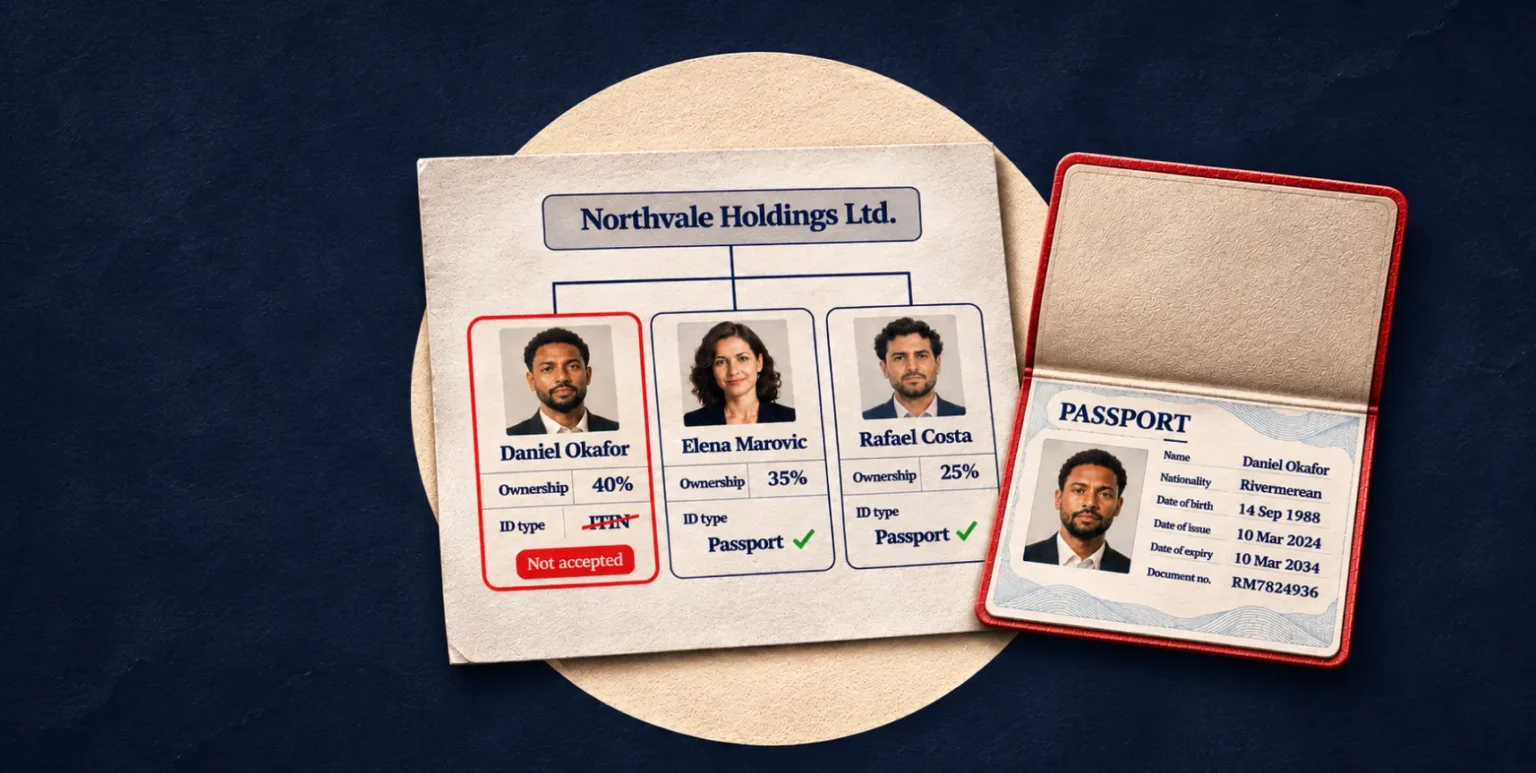

The US Financial Crimes Enforcement Network (FinCEN) on November 17, 2026, proposed a customer due diligence rule that would write into regulation the information covered institutions must collect on each beneficial owner of a legal entity customer, and would stop them from accepting an Individual Taxpayer Identification Number (ITIN) in place of a Social Security number. The proposed rule would also make permanent FinCEN’s February relief from re-verifying beneficial owners each time an existing legal entity customer opens an account.
FinCEN’s customer due diligence proposed rule amends 31 CFR 1010.230, the Customer Due Diligence (CDD) Rule, and implements Executive Order 14406, Restoring Integrity to America’s Financial System, signed on May 19, 2026, according to FinCEN’s announcement. The required data, now in the rule’s optional Appendix A certification form, would move into the rule text largely unchanged, per FinCEN’s fact sheet. As the identifying number for a beneficial owner, institutions could accept a Social Security number or, for non-US persons, a passport number with country of issuance, an alien identification card, or the number of another government-issued photo document showing nationality or residence.
Institutions would identify beneficial owners when a legal entity customer first opens an account, whenever they learn facts that reasonably call into question the reliability of information already on file, and as their risk-based ongoing due diligence procedures require. That timing mirrors the corrective relief order FinCEN issued on February 13, 2026. Institutions could also source beneficial owner information from third parties, though the individual opening the first account must still certify it. Where other risk indicators or supervisory concerns warrant it, institutions could collect more, including information on lawful immigration status and employment authorization in the US when relevant to assessing fraud or other illicit finance risks.
FinCEN’s notice says the Internal Revenue Service issues ITINs “for federal tax purposes only” and cites a June 5, 2026, joint advisory that flagged ITIN use in place of a Social Security number as a possible risk factor requiring enhanced due diligence. FinCEN expects ITIN holders who are lawfully in the US and authorized to work to have alternatives such as a foreign passport or an alien identification card.
Treasury Secretary Scott Bessent said the proposal would cut unnecessary burden, and Comptroller of the Currency Jonathan V. Gould backed it in a same-day statement, saying “reducing unnecessary regulatory burden and maintaining strong safeguards against financial crime are complementary goals.”
The rule would cover banks, broker-dealers, mutual funds, futures commission merchants and introducing brokers in commodities, about 14,554 institutions by FinCEN’s estimate, 8,988 of them banks. Comments are due 60 days after the notice appears in the Federal Register, under docket FINCEN-2026-0298, and a final rule would take effect 90 days after its own publication. FinCEN is asking in particular whether the “reliability” trigger should be defined more precisely and whether the ITIN exclusion is workable.
FinCEN says the proposal is not the CDD revision the Corporate Transparency Act requires, which it will address in a separate rulemaking.
The heavier lift for compliance teams is in onboarding data and record-keeping. Certification forms and data validation that accept an ITIN in the Social Security number field would need to change, and FinCEN’s notice says a US-resident beneficial owner presenting a foreign government-issued document instead of a US federal or state ID may be judged a heightened risk. The trigger-based refresh model also depends on records of when, and from which source, ownership information was last collected, because the relief holds only while an institution has no knowledge of facts that call that information into question.
Compliance teams revising how they collect and refresh beneficial owner information in response to the proposal can see how Shufti handles both through its UBO verification solution.