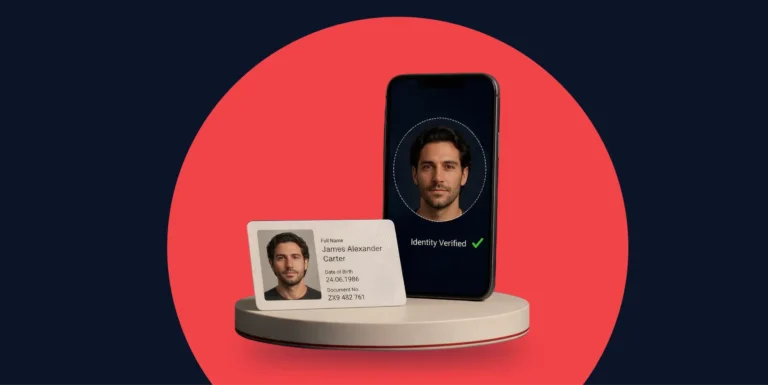













Identity verification is a process that confirms that a person is who they claim to be by verifying their details against reliable, independent evidence, which ranges from identity documents to biometric matches or an official database. Recommendation 10 of the Financial Action Task Force (FATF) makes it part of customer due diligence, requiring regulated businesses to verify identity using “reliable, independent source documents, data or information.”
Identification is collecting the name, date of birth and address a customer gives you. Verification proves those details are real and belong to that person. A file with a typed name and no evidence behind it meets the first duty and fails the second. Identity authentication comes later: it confirms that a returning user is the same person who was verified at sign-up.
Why is Identity Verification Important?
With the advent of AI and its prevalence in every industry and sector, it is having a great influence on day-to-day operations. While it is time and cost efficient, generative AI has also posed a grave threat which businesses struggle to deal with.
This is because fraudsters have become equipped with using deepfakes, synthetic identities, and forged documents to start even stronger and more sophisticated attacks, making identity verification an important tool for businesses to hold on to. Identity verification also builds trust, because customers and partners know that the people on a platform are who they say they are.
Industries that need Identity Verification?
Businesses that require to know who is on the other end of a transaction, it could be an account on an age-restricted service that, as a result, needs identity verification. In banking, crypto, and online gambling it is a legal duty under anti-money laundering (AML) and licensing rules depending upon their relevant jurisdictions.
1. Banking and Lending
Since AML rules require verifying a customer before opening an account, it also stops fraudsters from opening mule accounts with stolen or synthetic identities.
Example: A digital bank matches a new customer’s passport to a live selfie before the account goes live
2. Payments and e-wallets
Payment providers carry the same money laundering exposure as banks, and weak onboarding turns them into a fast route for illicit funds.
Example: A remittance app verifies a sender’s ID before it releases a first cross-border transfer.
3. Online Gambling
Under the Gambling Commission’s identity verification rules, remote operators in Great Britain must verify a customer’s name, address and date of birth before that customer can gamble.
Example: An online casino blocks deposits until the player’s age and identity check passes.
4. Real Estate and Legal Services
AML rules extend beyond banks to estate agents, lawyers and notaries because property deals give criminals a way to move large sums in a single transaction.
Example: An estate agent verifies a buyer’s identity before a property sale proceeds.
5. Online Marketplaces
Platforms that connect strangers need to be aware of who their sellers, hosts, and drivers are; this is to build trust and to stop banned users from returning under new accounts.
Example: A ride-hailing app verifies a driver’s ID and licence before they make a first trip.
How does the identity verification process work?
The identity verification process moves a customer from claim to proof in four steps. In Special Publication 800-63A-4, finalised in July 2025, the US National Institute of Standards and Technology (NIST) had split identity proofing into resolution, validation and verification, and regulated onboarding adds a recorded decision at the end.
- Collection of identity data and evidence. The customer would supply a name, date of birth, address and identification number, plus an ID document or consent to a database check. For bank accounts, the US Customer Identification Program (CIP) rule sets this as the minimum.
- Validation of evidence: the document is confirmed to be genuine, unexpired, and unaltered, and that its data matches what the customer entered.
- Verification of the person: a selfie is compared with the document photo, and a liveness check confirms a live human took it.
- Decide and keep records. The case is approved, rejected or referred to manual review. FATF Recommendation 11 requires CDD records to be kept for at least five years after the relationship ends.
Step 2 is often treated as the last point, which should not be the case. A stolen passport is a genuine document, so it passes every validation check and only fails when the face on the selfie does not match the photo.
Identity Verification Methods
Identity verification methods fall into three groups, and these are the three steps involved in the identity verification process. The following are the three main steps involved in the identity verification process:
- Resolution:
A CSP collects one or two pieces of identity evidence of the relevant and required strength. They also collect any relevant or any added core attributes as per requirement from the applicant in order to supplement those that are contained in the presented identity evidence.
- Validation
This step confirms the authenticity, accuracy, and validity of the given evidence. Another step in this process includes the CSP validating the attributes that were obtained in the first step by fact-checking them against authoritative or credible validation sources.
- Verification
The Credential Service Provider opts for a previously approved identity verification process in order to confirm that the applicant is the genuine owner of the evidence which was presented.
and each answers a different question. Document checks test whether the evidence is real, biometric checks test whether the person owns it, and database checks test whether the identity exists in independent records. The US CIP rule calls the database route non-documentary verification.
| Method | What it confirms | Typical checks | Where it breaks |
| Document verification | The ID document is genuine, valid and unaltered | Security features, MRZ, e-passport chip data, expiry date, signs of tampering | A real document in the wrong hands still passes |
| Biometric verification | The person presenting the document owns it and is physically present | Face match against the document photo, liveness detection | Poor-quality photos and presentation attacks such as masks, replays and deepfakes |
| Database verification | The identity exists and its details are consistent | Name, date of birth and address matched against credit bureau, government or other reliable records | Coverage varies by country, and synthetic identities can build a credit history over time |
No single method covers every gap. A document check paired with a face match covers both the evidence and the person, while a database check adds a second independent source for higher-risk customers. Most businesses run these checks through identity verification software rather than by hand.
Types of Identity Verification
The types of identity verification differ by where the check happens and what form or shape the evidence takes next. NIST SP 800-63A-4 separates on-site from remote proofing, and attended checks run by a trained agent from unattended ones that run automatically. Digital identity verification goes a step further and replaces photographed documents with signed electronic credentials.
| Type | How it works | Where you see it | Main risk |
| In-person | The customer shows a physical ID to staff, who compare the photo with the face in front of them | Bank branches, notaries, land-based casinos | Staff miss high-quality forgeries |
| Online | The customer uploads ID images and a selfie for automated checks, or joins a video call with an agent | App and web onboarding | Injection attacks feed pre-recorded or synthetic video into the camera |
| Digital | The customer shares an issuer-signed credential, such as e-passport chip data read by near-field communication (NFC), a national eID or a digital identity wallet | National eID schemes, European Digital Identity (EUDI) Wallets | Coverage depends on which credentials your customers hold |
Regulators accept the digital route where the process is secure. In the UK, regulation 28(19) of the Money Laundering Regulations 2017 treats an electronic identification process as a reliable, independent source if it is secure from fraud and misuse and gives adequate assurance of identity. EU eID schemes and EUDI Wallets fall under the electronic identification, authentication and trust services (eIDAS) framework, Regulation (EU) No 910/2014, as amended by Regulation (EU) 2024/1183.
Frequently Asked Questions
What is digital identity verification?
Digital identity verification confirms a person's identity using an electronic credential signed by its issuer, such as e-passport chip data, a national eID or a digital identity wallet, instead of an image of a physical document. The signature shows the data has not been altered.
How long does identity verification take?
Automated online checks usually return a result within seconds to a few minutes, while video calls, in-person checks and manual reviews take longer. Under Article 14 of Directive (EU) 2015/849, verification normally has to finish before the business relationship starts.
What is the difference between identity verification and KYC?
Identity verification confirms that a customer is who they claim to be. Know Your Customer (KYC) is the wider customer due diligence process set by FATF Recommendation 10, which also covers beneficial ownership, the purpose of the relationship and ongoing monitoring.