AMLR Solutions
 AMLR Consultation
 EUDI Wallet
 Onboarding
 Ongoing Monitoring
 FRAML
 KYC
 KYB
 KYI
 Age Assurance
 Workforce IAM
 Candidate Verification
 Account Takeover
 Bonus/ Promotion Abuse
 Chargeback Fraud
 Deepfake
 Document Fraud
 Fraud Networks
 Impersonation Fraud
 Money Mule Activity
 Multi-Accounting
 Party Fraud
 Regulatory & Compliance Risks
 Synthetic Identity Fraud
 Adult Content
 Banking
 Crypto
 Fintech
 Forex
 Compliance
 Fraud prevention
 Trust & safety
 Global expansion
 Compliance Officers
 Developers
 Fraud Analysts
 Product Managers
 Journey Builder
 Global Trust Platform
 Customer Profiles
 Vendor Comparison
 IDV Case Management
 AML Case Management
 Regulatory Reporting
 Agentic Rule Builder
 AI Compliance Co-Pilot
 Fraud Analytics
 Fraud Hub
 OCR
 Shufti AI
 Bank Account Verification
 Biometric Duplication
 Database Checks
 Document Intelligence
 Government ID
 Mobile Driver's License
 NFC
 Selfie Liveness
 Brand Personalisation
 Deployment Options
 Identity Methods
 IDV Modes
 Multi-tenancy
 On-Premise IDV
 Secure Capture
 Shufti MCP













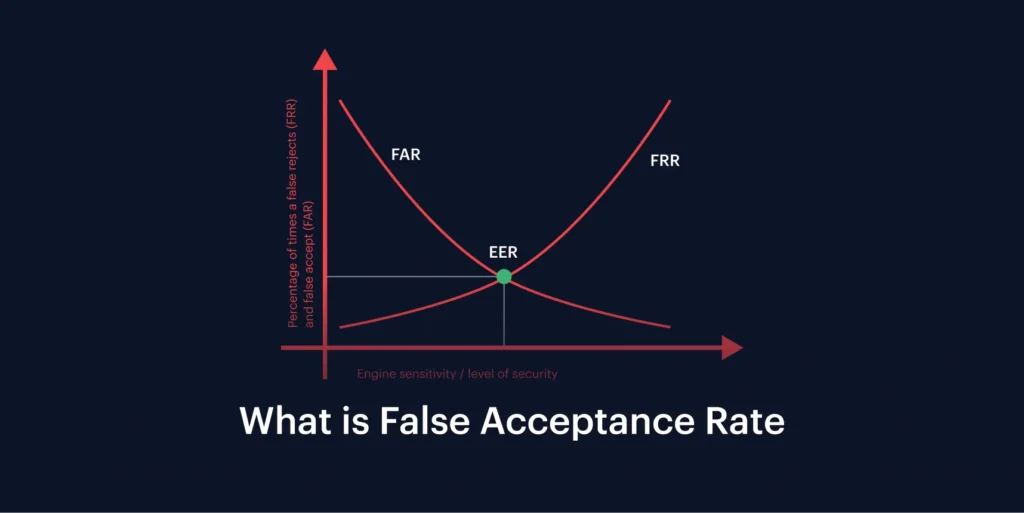

False Acceptance Rate (FAR) measures how often a verification system incorrectly approves the wrong person.
In identity verification, FAR is used as a biometric performance measure to evaluate how accurately a system distinguishes between genuine users and incorrect matches. It is commonly used when assessing biometric technologies such as face verification, fingerprint recognition, and other authentication methods.
A lower FAR means that a system is less likely to approve an incorrect identity match. However, achieving a lower FAR usually requires stricter matching criteria, which can increase the chances of rejecting genuine users.
How Is False Acceptance Rate Calculated?
FAR is calculated by dividing the number of incorrect approvals by the total number of attempts made by users who should not have been accepted.
The formula is:
FAR = (Number of False Acceptances ÷ Total Number of Impostor Attempts) × 100
For example, if a biometric verification system incorrectly accepts 8 attempts out of 200,000 verification attempts made by unauthorized users:
FAR = (8 ÷ 200,000) × 100 = 0.004%
Biometric testing standards use performance measures such as FAR and FRR to assess how accurately a system performs during verification.
False Acceptance Rate (FAR) vs False Rejection Rate (FRR)
The biometric systems can make two types of verification errors. FAR and FRR measure different outcomes.
| False Acceptance Rate (FAR) | False Rejection Rate (FRR) |
| An incorrect approval where an unauthorized person passes verification. | An incorrect rejection where a genuine user fails verification. |
| Focuses on preventing false approvals. | Focuses on reducing unnecessary rejection. |
| Creates a higher security risk of unauthorized access. | Can increase verification failures for legitimate users. |
For example, If a biometric system incorrectly matches one person’s facial features with another person’s identity and approves the verification, it contributes to a False Acceptance Rate. If a genuine customer is rejected despite providing valid biometric information then it contributes to FRR.
Both measures are used together when assessing biometric system performance.
What Is Considered a Good False Acceptance Rate?
There is no universal FAR value that works for every biometric application.
The appropriate FAR depends on factors such as:
- Required security level
- Industry risk exposure
- Type of biometric technology
- User experience expectations
For example, a high-risk identity verification process may prioritize reducing incorrect approvals while other applications may place more emphasis on faster user access. FAR should be reviewed alongside other performance indicators including FRR, because biometric accuracy depends on the overall balance between security and usability. However, specific FIDO biometric certification levels use a FAR below 1 in 10,000 with an FRR below 5%.
FAR Threshold and Biometric Accuracy
A FAR threshold is the matching setting a biometric system uses to decide whether a verification attempt should be accepted as a match. The threshold determines how similar two biometric samples must be before the system considers them a valid match.
A stricter threshold can reduce the chance of accepting an incorrect match, but it may also cause genuine users to be rejected if their biometric information does not meet the required matching criteria. The right threshold depends on the purpose of the biometric system, security requirements, and the level of assurance needed. (NIST Face Recognition Technology Evaluation)
Examples of False Acceptance Rate
A false acceptance can happen when a biometric system approves an identity that should have been rejected.
Here are some scenarios:
- A person’s facial biometric data is incorrectly matched with another individual’s enrolled identity, and the system approves the verification.
- Two individuals have similar biometric characteristics, and the system incorrectly identifies them as the same person.
- The matching settings allow a biometric comparison that should not have passed.
During digital onboarding, a false acceptance could occur when the wrong person is incorrectly approved during biometric verification.
Why FAR Matters in Identity Verification?
FAR helps businesses understand how effectively a biometric verification system prevents incorrect identity approvals.
It is particularly important for businesses and any organizations using biometric checks for:
- Digital onboarding
- Account access
- Financial services
- Fraud prevention
By reviewing FAR alongside other biometric performance measures helps businesses understand whether their verification process provides the right balance between preventing fraud and allowing genuine users to complete verification successfully.
Frequently Asked Questions
What is False Acceptance Rate (FAR)?
False Acceptance Rate (FAR) is a biometric performance measure that shows how often a system incorrectly approves an unauthorized user during verification.
Is False Acceptance Rate (FAR) the same as False Match Rate (FMR)?
False Acceptance rate (FAR) and False Match Rate (FMR) are closely related biometric performance measures. FAR refers to the percentage of incorrect acceptances where an unauthorized user is incorrectly approved while FMR measures incorrect matches between biometric samples.
Which standards are used to test False Acceptance Rate?
False Acceptance Rate is commonly evaluated using biometric testing standards and evaluation frameworks such as those published by NIST. These standards assess biometric systems using performance measures including FAR, False Rejection Rate (FRR), and other accuracy metrics.
Can a biometric system achieve a zero False Acceptance Rate?
A biometric system achieving a true zero False Acceptance Rate is extremely difficult in real world conditions. Reducing FAR usually requires stricter matching thresholds which can increase false rejections of genuine users. Businesses typically balance FAR with other performance measures to achieve the required level of security and usability.