AMLR Solutions
 AMLR Consultation
 EUDI Wallet
 Onboarding
 Ongoing Monitoring
 FRAML
 KYC
 KYB
 KYI
 Age Assurance
 Workforce IAM
 Candidate Verification
 Account Takeover
 Bonus/ Promotion Abuse
 Chargeback Fraud
 Deepfake
 Document Fraud
 Fraud Networks
 Impersonation Fraud
 Money Mule Activity
 Multi-Accounting
 Party Fraud
 Regulatory & Compliance Risks
 Synthetic Identity Fraud
 Adult Content
 Banking
 Crypto
 Fintech
 Forex
 Compliance
 Fraud prevention
 Trust & safety
 Global expansion
 Compliance Officers
 Developers
 Fraud Analysts
 Product Managers
 Journey Builder
 Global Trust Platform
 Customer Profiles
 Vendor Comparison
 IDV Case Management
 AML Case Management
 Regulatory Reporting
 Agentic Rule Builder
 AI Compliance Co-Pilot
 Fraud Analytics
 Fraud Hub
 OCR
 Shufti AI
 Bank Account Verification
 Biometric Duplication
 Database Checks
 Document Intelligence
 Government ID
 Mobile Driver's License
 NFC
 Selfie Liveness
 Brand Personalisation
 Deployment Options
 Identity Methods
 IDV Modes
 Multi-tenancy
 On-Premise IDV
 Secure Capture
 Shufti MCP













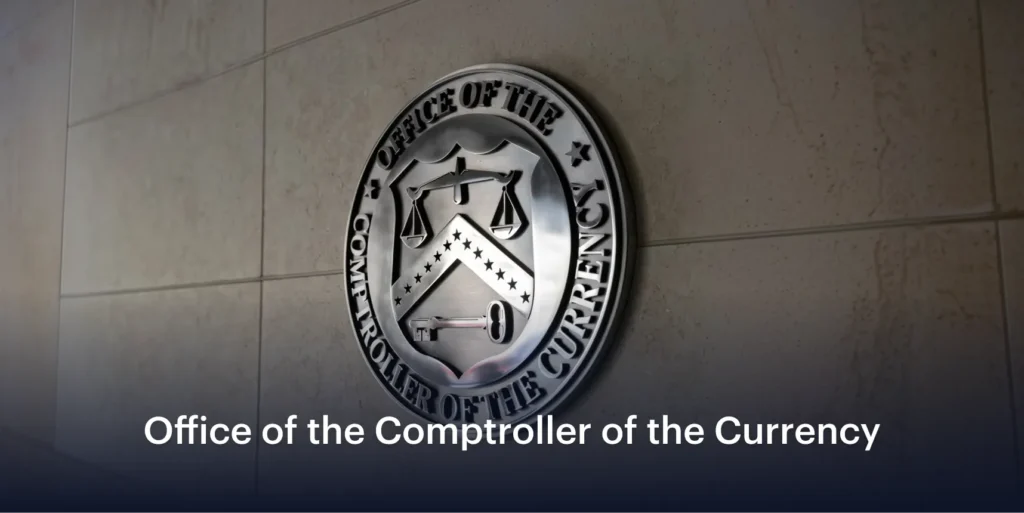

The Office of the Comptroller of the Currency (OCC) is the independent bureau of the U.S. Department of the Treasury that charters, regulates, and supervises all national banks, federal savings associations, and federal branches and agencies of foreign banks. It was created by the National Currency Act of 1863, and its mission is to ensure those institutions operate safely and soundly, provide fair access to financial services, treat customers fairly, and also comply with all applicable laws.
The OCC as the primary regulator for Federally Chartered Banks
The OCC supervises the federal banking system, not the whole U.S. financial sector. Its scope of authority covers:
- National banks
- Federal savings associations
- Federal branches and agencies of foreign banks
The Comptroller of the Currency is the one who heads the agency; the budget comes primarily from assessments and fees paid by supervised banks rather than congressional appropriations, and more than 2,500 OCC examiners carry out its bank examinations.
State-chartered banks sit outside the OCC and answer to their state regulator and either the Federal Reserve or the FDIC, so check the charter before assuming OCC rules apply to a partner bank.
OCC Compliance Requirements for Supervised Banks
Every OCC-supervised bank must meet safety and soundness standards and run a BSA/AML programme, and covered institutions must also carry a formal risk governance layer on top.
| Requirement | Rule | What it means for your compliance team |
| Safety and soundness standards | 12 CFR 30 | Standards for internal controls, information systems, audit, and information security |
| BSA/AML compliance programme | 12 CFR 21.21 | A written programme, approved by a board with internal controls, independent testing, a named BSA compliance officer, and training |
| Customer Identification Program (CIP) | 31 CFR 1020.220 | Verify the identity of every customer and keep the required records |
| Suspicious activity reporting | 12 CFR 21.11 | File a SAR within 30 calendar days of detecting reportable activity |
| Heightened standards | 12 CFR 30, Appendix D | A formal risk governance framework generally covering banks with $50 billion or more in average total consolidated assets |
Third-Party and Vendor Risk Management when Outsourcing KYC, screening or monitoring
Under the Integration Guidance on Third-Party Relationships: Risk Management, a bank’s use of third parties does not diminish its responsibility to operate safely and in compliance with applicable law. A vendor can run identity verification, transaction monitoring, and sanctions screening, but the 12 CFR 21.21 programme, and any examination finding against it, is to stay with the bank. The guidance expects some oversight across the whole relationship lifecycle, this is scaled to how critical the outsourced activity is:
- Planning: Assessment of the risk of outsourcing the activity before selecting the provider
- Due Diligence and selection: Testing the provider’s legal and regulatory compliance, information security, and reliance on subcontractors.
- Contract Negotiation: Set performance standards, audit rights, and exit terms in writing
- Ongoing Monitoring: Tracking of performance and compliance for the life of the relationship.
- Termination: Plan how the activity moves back in-house to the other provider.
Customer Identification Program (CIP) requirements under 31 CFR 1020.220
| CIP Element | What the rule Requires |
| Data Collected | Name, date of birth for individuals, a residential or business street address along with an identification number.A taxpayer identification number for US persons, a TIN, passport number with country of issuance, or it can be another government-issued ID number for non-US persons |
| Verification Methods | Documentary: an unexpired government-issued photo ID for individuals or formation documents like certified articles of incorporation for entities.Non-documentary: Contacting the customer, checking the consumer reporting agencies or public databases, references from other financial institutions, or a financial statement |
| Record Retention | Identifying information for five years after the account closes; descriptions of the documents relied on, verification methods and results, and any discrepancy resolution for five years after the record is made. |
The CIP must also screen customers against government terrorist lists and give notice that identity information is being requested.
OCC AML Compliance Expectations
The OCC runs an examination against the Bank Secrecy Act using the FFIEC BSA/AML Examination Manual. Under 12 CFR 21.21, the programme must be in writing, approved by the board, and at minimum include:
- Provide a system of internal controls to assure ongoing compliance
- Provide independent testing, by bank staff or an outside party
- Designate an individual responsible for day-to-day compliance
- Provide training for appropriate personnel
- Implement a CIP, including beneficial ownership checks
Not to mention, FinCEN rules separately require risk based ongoing customer due diligence. Banks are also required to have appropriate controls to screen against Office of Foreign Assets Control (OFAC) sanctions lists and file SARs within 30 calendar days of initial detection. If no suspect was identified, an additional 30 days is allowed to identify such suspect, keeping each SAR and its supporting records for five years after filing.
Examinations often found that the program is complete on paper, but its different functions & controls lack a coherent view of customer risk. For example, customers’ onboarding documents record a subsequent change, but monitoring keeps running on old risk profiles. In this example, the bank should have updated the risk profile and adjusted the monitoring accordingly. Banks with up to $30 billion in assets have been examined under the Community Bank Minimum BSA/AML Examination Procedures since February 1, 2026.
OCC Risk Management Standards
The OCC assesses banks against certain defined risk categories, which are credit, interest rate, liquidity, price, operational, compliance, and strategic risk. For covered banks, 12 CFR 30, Appendix D requires:
- A written risk governance framework approved by the board
- Three lines of defence: front line units, independent risk management, and internal audit
- A risk appetite statement with qualitative and quantitative limits
- Board oversight with independent directors and annual self-assessments
In December 2025, the OCC proposed raising the covered-bank threshold from $50 billion to $700 billion. The $50 billion threshold remains in the rule text at the time of writing.
OCC Bank Enforcement Actions
The OCC can act against a bank or an institution-affiliated party (IAP) if there are any violations of laws, unsafe or unsound practices, or any sort of breach of fiduciary duty. Formal actions are published through the Enforcement Actions Search Tool, and the main enforcement action types are:
| Action | Authority | Effect |
| Cease and desist order | 12 U.S.C. 1818(b) | Stops a practice and requires corrective action, including restitution |
| Formal agreement | Written agreement | Signed by the OCC and the board, binding the bank to corrective steps |
| Civil money penalty | 12 U.S.C. 1818(i) | Monetary penalty on a bank or an individual |
| Prohibition order | 12 U.S.C. 1818(e) | Bars an individual from the affairs of any insured depository institution |
| Safety and soundness order | 12 CFR 30 | Issued when a bank fails to submit or implement an acceptable compliance plan |
| Capital directive | 12 U.S.C. 3907 | Requires the bank to restore minimum capital by a set date |
Before any of these, the OCC can take informal action also like a memorandum of understanding (MOU), it is a bilateral document drafted by the OCC and signed by the board; neither is it legally binding nor is it published, but a board that fails to honor it hands the OCC some strong evidence for a formal action.
Concerns usually surface first as Matters Requiring Attention (MRAs) in an examination report. MRAs are not enforcement actions like a cease-and-desist order, and can be resolved by applying required corrections. On August 27, 2026, the OCC revised its enforcement policy and published its MRA policy for the first time, directing examiners to prioritise material financial risks and substantive violations over documentation concerns.
The new policy directs examiners to prioritize substantial violations and material financial risks over minor documentation concerns. OCC generally gives banks a chance to remediate deficiencies before escalating and taking enforcement action, however, it remains OCC’s discretion to take any legally supportable action if the situation requires an enforcement action.
Frequently Asked Questions
What is the OCC?
The OCC is an independent bureau of the U.S. Treasury that charters, regulates, and supervises national banks, federal savings associations, and federal branches and agencies of foreign banks.
What is the OCC’s role in approving bank applications?
The OCC decides applications from national banks and federal savings associations under Article 12 CFR 5, including new charters, conversions, mergers, branches, changes in control, and fiduciary powers.
Does the OCC ensure bank deposits?
Deposit insurance comes from the FDIC at $250,000 per depositor, per insured bank, for each account ownership category; the OCC supervises the bank, but does not insure it.
How is the OCC different from FinCEN, the Fed and the FDIC?
The OCC charters and supervises federally chartered banks; the Federal Reserve supervises state member banks and bank holding companies; the FDIC insures deposits and supervises state non-member banks; FinCEN remains the Treasury Bureau that writes BSA rules and collects and analyses financial intelligence like SARs without directly supervising banks.