AMLR Solutions
  AMLR Consultation
 EUDI Wallet
 Onboarding
 Ongoing Monitoring
 FRAML
FRAML KYC
KYC KYB
KYB KYI
KYI Age Assurance
 Workforce IAM
 Candidate Verification
 Account Takeover
 Bonus/ Promotion Abuse
 Chargeback Fraud
 Deepfake
 Document Fraud
 Fraud Networks
 Impersonation Fraud
 Money Mule Activity
 Multi-Accounting
 Party Fraud
 Regulatory & Compliance Risks
 Synthetic Identity Fraud
 Adult Content
 Banking
 Crypto
 Fintech
 Forex
Forex Compliance
 Fraud prevention
 Trust & safety
 Global expansion
 Compliance Officers
 Developers
 Fraud Analysts
 Product Managers
 Journey Builder
  Global Trust Platform
 Customer Profiles
 Vendor Comparison
 IDV Case Management
 AML Case Management
 Regulatory Reporting
 Agentic Rule Builder
  AI Compliance Co-Pilot
  Fraud Analytics
 Fraud Hub
  OCR
OCR Shufti AI
 Bank Account Verification
  Biometric Duplication
 Database Checks
 Document Intelligence
 Government ID
 Mobile Driver's License
 NFC
NFC Selfie Liveness
 Brand Personalisation
 Deployment Options
 Identity Methods
 IDV Modes
 Multi-tenancy
 On-Premise IDV
 Secure Capture
 Shufti MCP















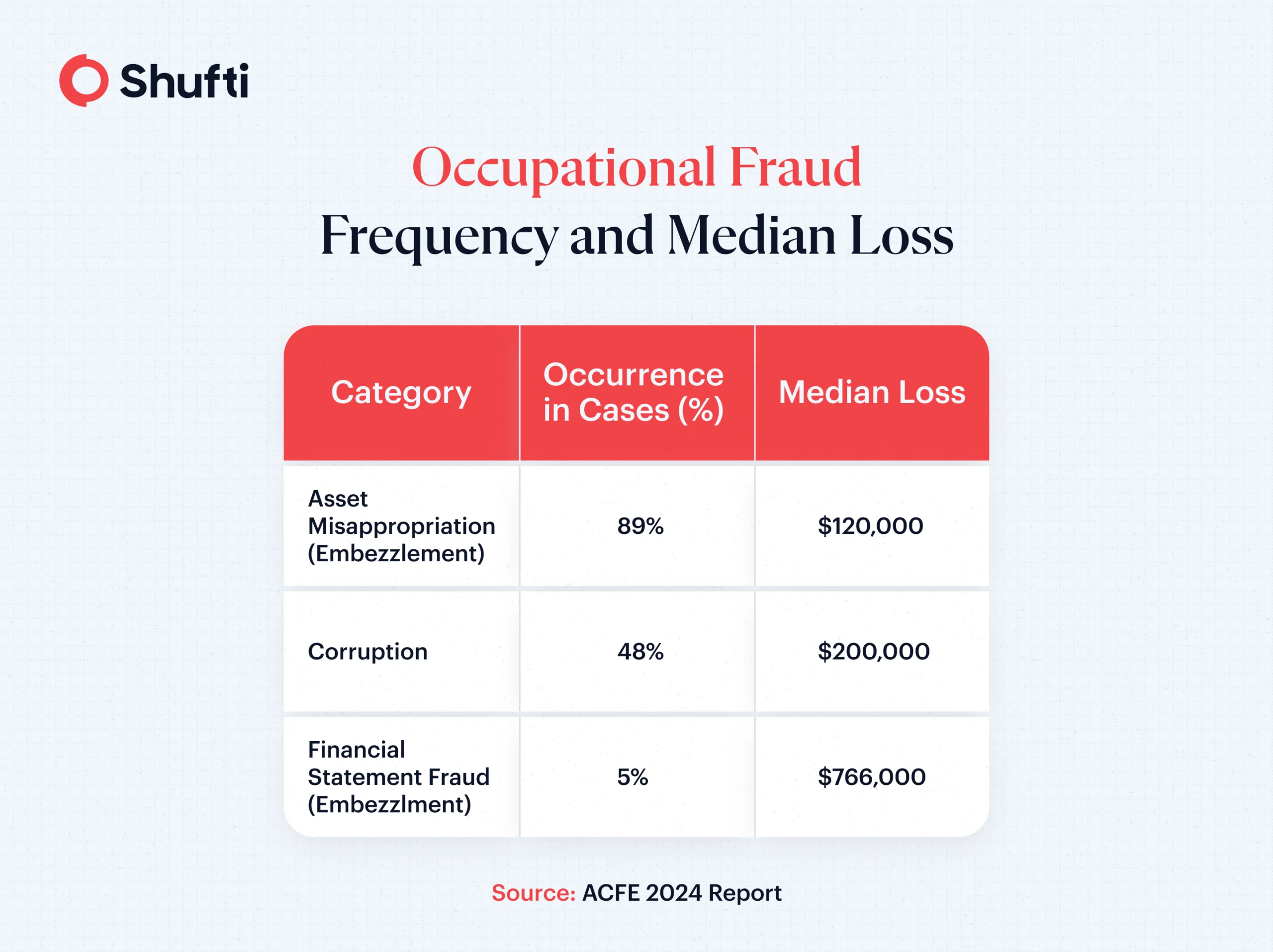
Embezzlement is the misappropriation of assets by a person who was lawfully entrusted with those assets. It is a form of white collar crime in which a trusted employee, executive, or fiduciary converts someone else’s property, usually money, to personal use without authorisation. According to the Association of Certified Fraud Examiners (ACFE) 2024 Report to the Nations, embezzlement drives 89% of occupational fraud cases, with a median loss of $120,000 per incident. More than half of all schemes exploit weak internal controls that organisations could have strengthened at minimal cost.
Key Takeaways
- Embezzlement is the misappropriation of money, property, or assets by someone who was legally entrusted with them.
- Unlike theft, embezzlement involves lawful initial possession of the assets before they are misused.
- According to the ACFE 2024 Report, embezzlement is involved in 89% of occupational fraud cases.
- The Fraud Triangle (Pressure, Opportunity, and Rationalisation) explains why individuals commit embezzlement.
- Common schemes include payroll fraud, expense reimbursement fraud, cash skimming, lapping, and inventory theft.
- Employee tips are the most effective fraud detection method, identifying 43% of cases.
- Embezzlement is a predicate offence for money laundering under FATF standards.
- Strong internal controls, segregation of duties, audits, and whistleblower programmes significantly reduce risk.
- Emerging threats include AI generated invoices, remote-work payroll fraud, and cryptocurrency misappropriation.
- AML screening, transaction monitoring, and KYC procedures play a critical role in detecting and preventing embezzlement related activities.
Unlike ordinary theft, embezzlement does not require unlawful initial possession. The perpetrator holds the assets legally by virtue of their role or relationship, which makes detection far harder and the resulting breach of trust far more damaging.
Embezzlement is a criminal offence in which a person who is lawfully entrusted with property or funds misappropriates those assets for personal benefit, typically without the knowledge or consent of the rightful owner. The key legal distinction from theft is that the perpetrator had lawful initial possession of the assets.
In practical terms, embezzlement requires three elements to be present simultaneously. First, a relationship of trust or fiduciary duty must exist between the perpetrator and the victim. Second, the perpetrator must have obtained the assets lawfully by virtue of that relationship. Third, there must be a fraudulent conversion of those assets to personal use, whether permanently or temporarily.
Courts in most jurisdictions have ruled that the intent to return the funds does not negate liability. If a payroll officer transfers company money into a personal account, even briefly, that may constitute embezzlement.
The crime is most commonly associated with corporate environments, but it also occurs in government institutions, non profit organisations, charities, and religious bodies where individuals manage funds on behalf of others.
Embezzlement vs. Theft vs. Fraud: Key Differences
Embezzlement, theft, and fraud are frequently conflated, but they are legally distinct offences with different elements of proof, penalties, and fact patterns. The comparison table below targets Google’s Featured Snippet for the query ’embezzlement vs theft’.
| Element | Embezzlement | Theft / Larceny |
| Initial possession | Lawful (entrusted) | Unlawful (taken without permission) |
| Trust relationship | Required | Not required |
| Method | Conversion or misuse | Physical taking or removal |
| Deception involved | Yes, typically | Not necessarily |
| Example | Payroll officer diverts wages | Shoplifting, burglary |
| AML relevance | High (predicate offence) | Moderate |
| Typical classification | Felony (severe) | Misdemeanour to felony |
| Element | Embezzlement | Fraud |
| Initial possession | Lawful (entrusted) | Never lawful |
| Method | Conversion of held assets | Deception to obtain assets |
| Deception involved | Yes | Yes (central element) |
| Example | CFO transfers funds to personal account | Fake invoice submission |
| AML relevance | High | High |
| Typical classification | Felony | Felony |
The key distinguishing feature of embezzlement is lawful initial possession. A bank teller who pockets cash from the till was authorised to handle that cash, making the offence embezzlement rather than theft. A fraudster who submits false invoices was never in lawful possession, making it fraud.
The Fraud Triangle: Why Embezzlement Happens
Criminologist Donald Cressey’s Fraud Triangle, published in 1953, remains the most widely cited model for understanding why individuals commit embezzlement. The model identifies three conditions that must be simultaneously present.
- Pressure (Motivation): The perpetrator faces a personal financial problem, such as debt, gambling losses, substance dependence, or lifestyle inflation, that they feel cannot be shared openly.
- Opportunity: A weakness in internal controls gives the perpetrator access to assets and the belief that they can exploit them without detection. Lack of segregation of duties is the most common enabler.
- Rationalisation: The perpetrator convinces themselves the act is justified: ‘I will pay it back’, ‘the company owes me’, or ‘nobody will be hurt’.
ACFE Finding
The ACFE 2024 Report to the Nations found that 43% of occupational fraud cases were detected by employee tips, compared to only 15% by internal audits and 13% by management review. Anonymous whistleblower hotlines are the single most cost-effective detection tool available to any organisation.
Organisations can interrupt the fraud triangle by reducing opportunity through stronger internal controls, even when they cannot influence pressure or rationalisation. This is the foundation of effective embezzlement prevention.
10 Most Common Types of Embezzlement
Embezzlement manifests across a wide range of schemes. Below are the ten types most commonly encountered by compliance professionals, auditors, and law enforcement.
1. Payroll Fraud and Ghost Employees
The perpetrator creates fictitious employees in the payroll system, or retains former employees who have left, and directs wages to accounts under their own control. Organisations with weak HR-to-payroll segregation or rapid headcount growth are most vulnerable. The ACFE 2024 report puts the median loss at $90,000 per scheme.
2. Expense Reimbursement Fraud
Employees submit fabricated receipts, duplicate claims, or personal expenses disguised as business costs. Common variants include inflated mileage claims, personal meals submitted as client entertainment, and hotel upgrades billed to the company.
3. Check Tampering and Forgery
The perpetrator alters payee names on legitimate cheques, forges authorised signatures, or intercepts cheques in transit. Electronic payment platforms have reduced physical cheque fraud but have not eliminated it. Fraudsters have increasingly shifted to manipulating ACH and BACS batch files to redirect payments.
4. Cash Skimming
Cash is removed before it is recorded in the accounting system. Because the transaction is never entered, there is no paper trail to audit. Retail, hospitality, and ticketing environments are at highest risk. Skimming is one of the hardest embezzlement types to detect through standard reconciliation.
5. Lapping
An accounts receivable scheme in which the perpetrator steals a customer’s payment and conceals the shortage by applying a subsequent payment to the first account. The fraud requires constant maintenance and typically collapses when the perpetrator takes annual leave and a colleague discovers the discrepancy.
6. Siphoning and Electronic Diversion
Small, irregular amounts are diverted from high volume transaction flows, often through expense management software, digital wallets, or manual journal entries. The scheme exploits automated reconciliation thresholds, which are configured to ignore below-threshold discrepancies.
7. Inventory Theft
Physical assets, whether raw materials, finished goods, or equipment, are misappropriated for personal sale or use. It is prevalent in manufacturing, pharmaceutical, and technology businesses where components carry a high resale value.
8. Financial Statement Fraud
Senior executives manipulate reported financials to conceal losses or inflate profits, often to protect bonuses, maintain share price, or hide ongoing misappropriation. The ACFE 2024 report notes this is the rarest category (9% of cases) but carries the highest median loss: $766,000 per incident.
9. Ponzi Scheme and Investment Misappropriation
Investment managers misappropriate client funds by commingling them with personal assets or using new investor capital to pay returns to existing investors. These schemes depend on a perpetual flow of new investment and collapse when redemption requests exceed available funds.
10. Digital and Cryptocurrency Misappropriation
An emerging category involves the misappropriation of digital assets, including company cryptocurrency holdings and digital expense account balances. Remote work environments have created new vectors: phantom hours in digital timekeeping systems, abused cloud software subscriptions, and manipulated online expense platforms.
Real World Embezzlement Examples
Historical and recent case studies provide the clearest illustration of how embezzlement occurs at scale and the lasting harm it causes to organisations, employees, and investors.
Enron Corporation, United States (2001)
Enron executives created special purpose entities to hide over $1 billion in debt and artificially inflate reported profits. When the scheme collapsed, Enron filed for bankruptcy with $63 billion in shareholder value destroyed and approximately 20,000 employees losing their jobs. The scandal led directly to the Sarbanes Oxley Act of 2002, which significantly strengthened corporate governance, auditor independence, and financial reporting standards across the United States.
Rita Crundwell, Dixon, Illinois, United States (2001-2012)
The city comptroller of Dixon, Illinois, embezzled approximately $53.7 million from the municipal government over eleven years by creating a secret bank account and redirecting tax revenues. She used the funds to support a champion quarter horse breeding operation. The fraud was discovered only when a temporary employee noticed a suspicious bank statement during her absence. Crundwell received a 19.5 year federal prison sentence.
Bernie Madoff, United States (1960s-2008)
Bernie Madoff operated history’s largest documented Ponzi scheme through his investment advisory firm, defrauding approximately 37,000 clients of an estimated $17 billion in actual losses (with fictitious account balances reported at $65 billion). The scheme survived for decades in part because of Madoff’s standing as a former NASDAQ chairman and his firm’s legitimate market making operations. He received a 150 year prison sentence in 2009.
WorldCom, United States (2002)
WorldCom executives, led by CFO Scott Sullivan, falsely capitalised $3.8 billion in routine operating expenses to inflate reported profits and conceal declining revenues. At the time, it was the largest accounting fraud in US history. CEO Bernie Ebbers received a 25-year prison sentence.
Operation Car Wash, Petrobras, Brazil (2014-2021)
Brazilian authorities uncovered a multi million dollar embezzlement and bribery scheme at the state-owned oil company Petrobras, in which executives awarded contracts at inflated prices and diverted kickbacks to politicians and themselves. Losses exceeded $2 billion, and the investigation resulted in over 180 convictions including a former president of Brazil.
Industries at Highest Risk of Embezzlement
While embezzlement can occur in any organisation, certain industries carry structurally elevated risk due to the nature of their operations, fund flows, or governance arrangements.
| Industry | Primary Risk Factor |
| Financial Services | Direct access to client funds; high transaction volumes obscure small diversions |
| Government / Public Sector | Complex procurement; large fund flows; weaker private sector accountability mechanisms |
| Healthcare | High volume billing; pharmaceutical inventory; insurance claim manipulation |
| Non-Profit / Charities | Weaker governance; high donor trust; limited audit budgets |
| Retail / Hospitality | Cash heavy environments; high staff turnover; difficult POS reconciliation |
| Professional Services | Client account misappropriation; billing fraud; expense manipulation |
| Real Estate | Escrow account misappropriation; property management fee fraud |
| Construction | Materials diversion; ghost subcontractors; overbilling |
12 Red Flags That May Signal Embezzlement
Early detection limits losses significantly. Compliance officers, internal auditors, and managers should treat the following indicators as triggers for immediate investigation rather than assumptions of wrongdoing.
- Unexplained financial discrepancies, missing receipts, or reconciliation gaps that recur month on month.
- An employee living visibly beyond their salary, including luxury purchases, foreign travel, or property acquisitions inconsistent with their compensation.
- Refusal to take annual leave or insistence on handling specific financial processes alone, both common patterns in lapping and siphoning schemes.
- Unexplained vendor relationships, particularly with recently registered companies sharing addresses with employees, or vendors with no verifiable online presence.
- Duplicate payments to the same vendor or payee within a short period.
- Round dollar transactions, which are statistically rare in legitimate business and may indicate manual journal entries designed to conceal theft.
- Unusual or unauthorised access to financial systems outside normal working hours.
- Complaints from customers, suppliers, or employees about missing payments, double billing, or incorrect account statements.
- Financial statements that do not reconcile with bank statements.
- Frequent corrections, voids, or overrides in point of sale, payroll, or expense systems.
- Key employees who resist or obstruct audits, or who are unusually defensive about their financial workflows.
- Sudden departure of a finance employee followed by unexplained account discrepancies.
Forensic Tip: Benford’s Law
Benford’s Law analysis is a cost-effective forensic tool for detecting embezzlement in large transaction datasets. The law predicts the expected frequency distribution of leading digits in naturally occurring numerical data. Deviations from this distribution often indicate manipulation and can be applied to payroll files, accounts payable ledgers, and expense claim datasets with minimal technical overhead.
How Is Embezzlement Investigated?
The investigation process for embezzlement typically follows a structured sequence from initial suspicion through to prosecution or civil recovery.
Stage 1: Internal Audit Trigger
Most investigations begin with an anomaly identified during a routine audit, a whistleblower tip, or a customer complaint. The ACFE 2024 report found that organisations with active internal audit functions detect fraud 33% faster than those without. Establishing an anonymous reporting channel dramatically increases the volume and quality of tips received.
Stage 2: Forensic Accounting Review
A forensic accountant examines financial records, bank statements, payroll files, and transaction logs to trace the flow of funds and quantify losses. Modern forensic accounting deploys data analytics tools including Benford’s Law analysis, duplicate payment screening, and time-series anomaly detection to identify patterns invisible to manual review.
Stage 3: Digital Forensics
Electronic evidence, including email records, system access logs, and digital communications, is preserved and examined to establish the timeline of the scheme and identify co-conspirators. Chain of custody is critical: improperly handled digital evidence may be inadmissible in criminal proceedings.
Stage 4: Law Enforcement Referral
Once sufficient evidence is gathered, the organisation typically reports the matter to the relevant law enforcement authority, whether local police, the FBI for US federal matters, or the Serious Fraud Office in the UK. A Suspicious Activity Report (SAR) may also be required under AML compliance obligations in most jurisdictions.
Stage 5: Civil and Criminal Proceedings
Organisations may pursue civil asset recovery concurrently with supporting a criminal prosecution. Civil proceedings can result in restitution orders and asset freezes even before a criminal verdict is reached, which is important where the perpetrator may attempt to dissipate stolen assets.
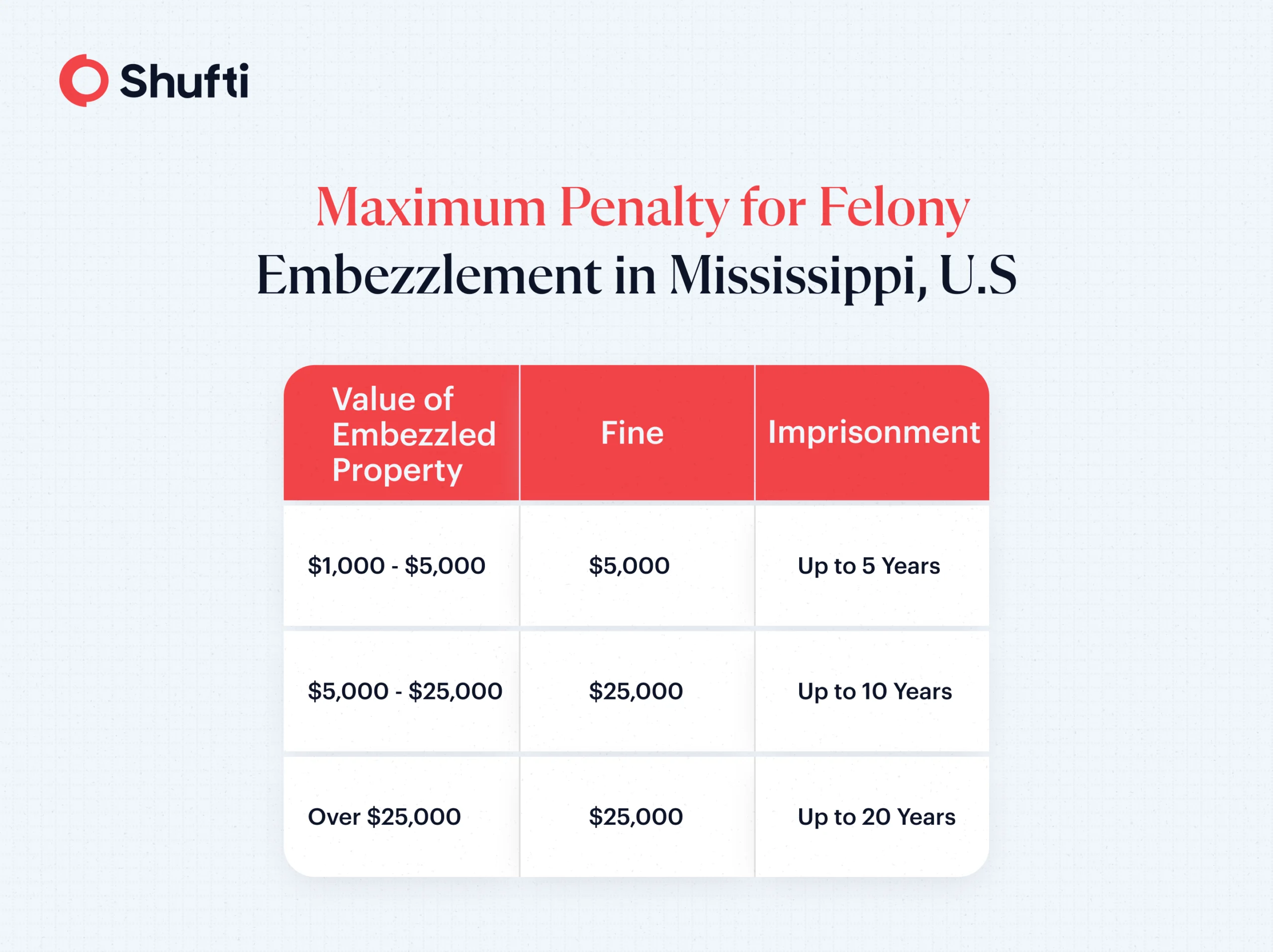
Embezzlement Penalties by Jurisdiction
Embezzlement is a criminal offence in virtually every jurisdiction globally. Severity of penalties depends on the value of assets misappropriated, the perpetrator’s position, and the victim type.
| Jurisdiction | Threshold | Classification | Maximum Penalty |
| US Federal | Under $1,000 | Misdemeanour | 1 year + $100,000 fine |
| US Federal | Over $1,000 | Felony | 30 years + $250,000 fine |
| US State (typical) | Under $1,500 | Misdemeanour | 1 year + $1,000 fine |
| US State (typical) | Over $25,000 | Felony | 2 to 20 years |
| United Kingdom | Any amount | Either way offence | 10 years (Fraud Act 2006) |
| European Union | Varies | Criminal offence | 1 to 10 years (varies) |
| Australia | Any amount | Criminal offence | 10 years (Corporations Act) |
| Singapore | Any amount | Criminal offence | 7 to 20 years |
| UAE | Any amount | Criminal offence | Up to 5 years + restitution |
| Canada | Over CAD $5,000 | Indictable offence | 14 years (Criminal Code) |
Beyond criminal penalties, convicted embezzlers typically face civil restitution orders, professional debarment, reputational damage, and significant barriers to future employment in any regulated industry.
Statute of Limitations
In the United States, the federal statute of limitations for embezzlement is generally five years from the date the offence was committed, though this can be extended where the perpetrator actively concealed the crime. In the UK, there is no general statute of limitations for serious criminal offences. Organisations should take qualified legal advice on jurisdictional timelines before deciding whether to pursue prosecution.
Embezzlement and AML Compliance
Embezzlement is classified as a predicate offence under the Financial Action Task Force (FATF) Recommendations, meaning that laundering the proceeds of embezzlement constitutes a standalone money laundering offence. Financial institutions are therefore required to screen for, monitor, and report embezzlement related activity as part of their AML compliance obligations.
How Embezzled Funds Enter the Financial System
Once assets are misappropriated, perpetrators typically move them through three stages recognised by FATF and FinCEN as the standard money laundering typology.
- Placement: Embezzled cash or funds are introduced into the financial system via bank deposits, purchase of monetary instruments, or transfer to cryptocurrency exchanges.
- Layering: The origin of funds is obscured through international wire transfers, shell company transactions, and asset purchases.
- Integration: The cleaned funds re enter the legitimate economy through property purchases, luxury goods, or business investments.
KYC and Identity Verification
Know Your Customer (KYC) processes are the first line of defence against embezzlers accessing the financial system.
Robust KYC includes identity document verification, biometric checks, beneficial ownership screening, and PEP and sanctions screening.
Embezzlers who are Politically Exposed Persons (PEPs) or who have family or business ties to PEPs require Enhanced Due Diligence (EDD) under FATF Recommendation 12 and most local regulations.
Transaction Monitoring Red Flags
AML transaction monitoring systems should be configured to flag the following patterns as potentially indicative of embezzlement proceeds.
- Rapid movement of funds between multiple accounts across jurisdictions.
- Round-dollar or structurally regular wire transfers inconsistent with a client’s stated business profile.
- Large cash deposits or cryptocurrency conversions by individuals whose income profile does not support such activity.
- Transfers to recently formed entities with no established business history.
- Payments to vendors sharing addresses, phone numbers, or beneficial owners with the account holder.
- Sudden changes in transaction volume following a change in employment status.
SAR Filing and Regulatory Reporting
Financial institutions that identify activity consistent with embezzlement proceeds are required in most jurisdictions to file a Suspicious Activity Report (SAR) or Suspicious Transaction Report (STR). Failure to file, or tipping off the subject, may itself constitute a criminal offence. In the UK, this obligation falls under the Proceeds of Crime Act 2002; in the US, under the Bank Secrecy Act.
How to Prevent Embezzlement in Your Organisation
Prevention is significantly less costly than detection and recovery. The following measures, when implemented together, reduce embezzlement risk substantially.
Segregation of Duties
No single employee should control all stages of a financial transaction: authorisation, recording, and custody of assets. Where small team sizes make full segregation impractical, compensating controls such as management review of all transactions above a defined threshold should be implemented.
Regular Internal and External Audits
Audits conducted on an unpredictable schedule are more effective than calendar-fixed reviews, as they do not allow perpetrators to prepare. Surprise audits are particularly valuable. External auditors provide an independent check that internal teams cannot replicate and carry a stronger deterrent effect.
Automated AML Screening and Transaction Monitoring
Integrating automated AML screening tools enables organisations to screen employees, vendors, and counterparties against global sanctions lists, PEP databases, and adverse media sources. Real-time transaction monitoring flags anomalous patterns before they escalate, providing compliance teams with actionable alerts rather than retrospective reports.
Whistleblower Channels
Anonymous reporting channels, whether telephone hotlines, web forms, or third-party services, are the most effective detection mechanism available according to the ACFE. Organisations should ensure whistleblowers are legally protected from retaliation under applicable law, including the UK’s Public Interest Disclosure Act 1998 and the US Dodd-Frank Act.
Background Checks and Ongoing Monitoring
Pre-employment background checks for roles with financial access should include criminal record checks, credit history where legally permitted, and professional reference verification alongside rigorous identity verification. Ongoing monitoring throughout employment ensures that changes in an employee’s financial circumstances or public profile are flagged promptly.
Clear Policies and Employee Training
All employees should understand what embezzlement is, the consequences it carries, and how to report suspicions. Regular training reduces both accidental non-compliance and the rationalisation component of the fraud triangle by making clear that the organisation takes enforcement seriously.
Emerging Embezzlement Threats in 2026 and 2027
The embezzlement threat landscape is evolving rapidly in response to technology adoption, remote work, and the growth of digital assets.
- AI-Generated Invoices and Deepfake Authorisation: Generative AI tools now enable fraudsters to create convincing fake invoices, falsified contracts, and deepfake video calls impersonating senior executives to authorise fraudulent payments. These AI-assisted schemes represent a growing frontier for embezzlement detection.
- Remote-Work Payroll Schemes: The normalisation of remote working has made ghost-employee and inflated hours schemes harder to detect, as managers have reduced visibility into actual working patterns.
- Cryptocurrency Misappropriation: As organisations hold or transact in cryptocurrency, embezzlers are exploiting weak private key management and multi-signature controls to divert digital assets. Blockchain analytics tools are increasingly deployed in response.
- Expense Management Platform Abuse: Cloud-based expense platforms with automated approval workflows create new opportunities for small, recurring diversions that fall below manual review thresholds.
- Vendor Master File Manipulation: Fraudsters are exploiting ERP system access to insert ghost vendors or alter payment details on legitimate vendor records, redirecting payments before detection occurs.
Protect Your Business Against Embezzlement
Embezzlement is one of the most persistent and damaging forms of financial crime. It erodes trust, destroys financial value, and exposes organisations to regulatory liability. The combination of robust internal controls, regular auditing, and technology-driven AML compliance provides the strongest available defence.
Shufti provides financial institutions, fintechs, and enterprises with advanced AML screening capabilities covering 240+ countries, real-time sanctions and PEP screening, adverse media monitoring, and transaction monitoring built to detect the behavioural patterns associated with embezzlement and money laundering. To see how Shufti can strengthen your compliance programme against internal fraud and embezzlement risk, request a demo today.
Frequently Asked Questions
What is embezzlement?
Embezzlement is the unlawful use or conversion of money, property, or assets by a person who was legally entrusted with them. Unlike theft, the offender initially has authorised access to the assets.
What is the difference between embezzlement and theft?
The key difference is possession. In embezzlement, the perpetrator legally possesses the assets before misusing them. In theft, the assets are taken without permission from the beginning.
What are the most common types of embezzlement?
Common forms of embezzlement include payroll fraud, expense reimbursement fraud, cash skimming, lapping schemes, inventory theft, cheque tampering, and digital asset misappropriation.
Is embezzlement a felony?
In most jurisdictions, embezzlement is considered a serious criminal offence. Depending on the value of the assets involved, charges may range from misdemeanours to felonies with significant penalties.
How do companies detect embezzlement?
Companies commonly detect embezzlement through employee tips, internal audits, forensic accounting reviews, transaction monitoring systems, and investigations into suspicious financial activity.
What are the warning signs of embezzlement?
Common red flags include unexplained financial discrepancies, duplicate payments, missing records, employees living beyond their means, refusal to take leave, and unusual access to financial systems.
How does embezzlement relate to money laundering?
Embezzlement is a predicate offence for money laundering. Offenders often attempt to conceal stolen funds through layered transactions, shell companies, cryptocurrency transfers, or other laundering techniques.
How can organisations prevent embezzlement?
Organisations can reduce risk by implementing segregation of duties, regular audits, employee background checks, whistleblower channels, staff training, and automated AML monitoring solutions.
Which industries are most vulnerable to embezzlement?
Industries with the highest risk include financial services, government agencies, healthcare organisations, non profits, retail businesses, real estate firms, and construction companies due to their handling of funds and assets.