AMLR Solutions
  AMLR Consultation
 EUDI Wallet
 Onboarding
 Ongoing Monitoring
 FRAML
FRAML KYC
KYC KYB
KYB KYI
KYI Age Assurance
 Workforce IAM
 Candidate Verification
 Account Takeover
 Bonus/ Promotion Abuse
 Chargeback Fraud
 Deepfake
 Document Fraud
 Fraud Networks
 Impersonation Fraud
 Money Mule Activity
 Multi-Accounting
 Party Fraud
 Regulatory & Compliance Risks
 Synthetic Identity Fraud
 Adult Content
 Banking
 Crypto
 Fintech
 Forex
Forex Compliance
 Fraud prevention
 Trust & safety
 Global expansion
 Compliance Officers
 Developers
 Fraud Analysts
 Product Managers
 Journey Builder
  Global Trust Platform
 Customer Profiles
 Vendor Comparison
 IDV Case Management
 AML Case Management
 Regulatory Reporting
 Agentic Rule Builder
  AI Compliance Co-Pilot
  Fraud Analytics
 Fraud Hub
  OCR
OCR Shufti AI
 Bank Account Verification
  Biometric Duplication
 Database Checks
 Document Intelligence
 Government ID
 Mobile Driver's License
 NFC
NFC Selfie Liveness
 Brand Personalisation
 Deployment Options
 Identity Methods
 IDV Modes
 Multi-tenancy
 On-Premise IDV
 Secure Capture
 Shufti MCP












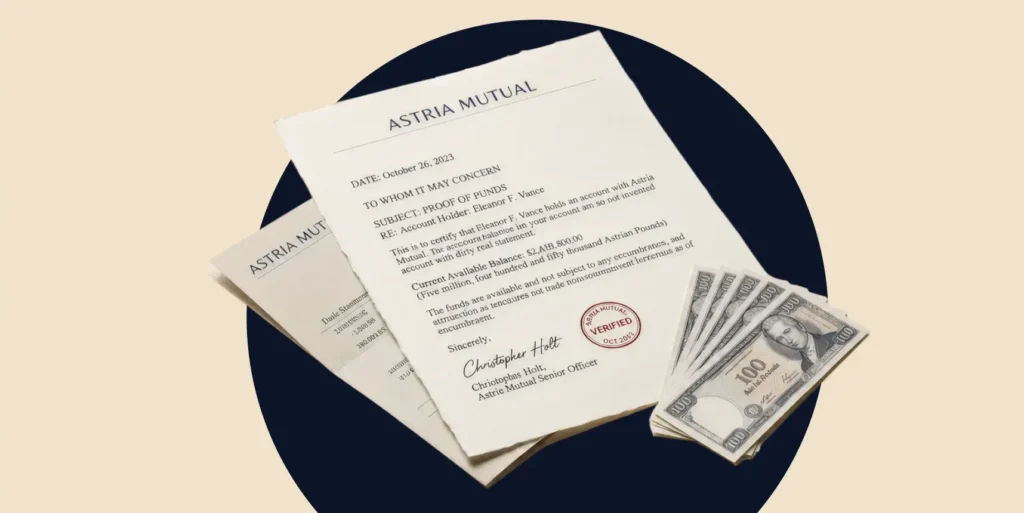

| Proof of funds proves the money exists. It does not prove the money is clean or that the document is real. Here is what qualifies and how to verify it properly. |
For most of the last decade, proof of funds was the least contested document in a customer file. A bank letter arrived, somebody read the balance, and the file progressed. That habit is now the weak point. Shufti’s Identity Fraud Index Report 2026 projects that attacks using deepfaked identity documents will run roughly 39 times higher in 2026 than in 2025, an estimate which was annualised from fraud attempts recorded between January and May 2026. Financial paperwork sits in the same radius, because a bank statement carries no chip, no hologram and no security thread that a checker can hold up to the light.
The document that used to be the easiest thing in the file to accept has become one of the easiest things to fabricate. This guide covers what proof of funds is, when counterparties and regulators require it, which documents qualify, how it differs from source of funds, and how a business actually verifies it rather than simply filing it.
What is Proof of Funds (PoF)?
Proof of funds is documentary evidence that a person or business holds enough accessible money to complete a specific transaction. It is handed to whoever carries the risk of the deal not closing, usually a seller, a broker, an escrow agent, a regulator or a bank onboarding a new customer, and it answers one narrow question about whether the money is genuinely available today.
A complete proof of funds document establishes three things at once:
- The money exists: A named financial institution confirms a stated balance in a stated currency.
- The money is liquid: The funds can be moved now rather than released after a sale, a vesting date or a withdrawal penalty.
- The money belongs to the named party: The account holder on the document is the person or entity presenting it.
What proof of funds does not prove
Proof of funds says nothing about the origin of the money. A balance letter for two million euros looks identical whether the money arrived from a salaried career, a property sale or a laundering chain, which is exactly why regulated firms treat proof of funds as a starting point rather than a conclusion. It also says nothing about whether the document itself is real. Both of those gaps are the reason customer due diligence exists as a separate discipline.
What is the difference between proof of funds and source of funds?
Proof of funds answers whether you have the money. Source of funds answers where that specific money originated. The distinction barely matters when a seller wants comfort that a cash offer will close, and it becomes the whole point once a regulated institution is deciding whether to take someone on as a customer.
Four related terms get used interchangeably and mean genuinely different things:
|
Term |
The question it answers | Typical evidence | Who usually asks |
| Proof of funds (PoF) | Do you have the money available now? | Bank statement, proof of funds letter, brokerage statement |
Sellers, brokers, escrow agents, banks |
|
Source of funds (SoF) |
Where did this particular money come from? | Sale contract, salary records, dividend statements, transaction trail | Banks and regulated firms under AML rules |
| Source of wealth (SoW) | How was your overall net worth built? | Career history, business ownership, inheritance records, tax filings |
Banks and regulated firms, mandatory for PEPs |
| Proof of income | How much do you earn, and how regularly? | Payslips, employment contract, tax returns |
Lenders, landlords, immigration authorities |
The practical trap is treating a strong proof of funds document as though it discharged the source of funds obligation. It does not, and the two checks catch different problems.
Shufti’s guide to source of funds in money laundering risk covers the origin question in more depth.
When is Proof of Funds required?
Proof of funds is required whenever a large sum is about to change hands, and the receiving party needs certainty before committing time, inventory, or regulatory exposure. The trigger is rarely a fixed threshold. It is usually the point at which walking away later would be expensive for somebody.
Real Estate and Property Purchases
Cash buyers are routinely asked for proof of funds before a seller will take a property off the market, and many agents will not present an offer without it. Financing buyers get asked too, because a mortgage pre-approval shows a lender is willing to lend, while proof of funds shows the deposit and closing costs actually exist.
Business acquisitions, investments and wealth management
Acquirers are asked to evidence funds before a seller opens the data room, since diligence is expensive and sellers do not want to run it for a buyer who cannot close. Brokerages and private banks ask at account opening, and investment platforms ask again when a client qualifies as an accredited or professional investor.
Immigration and Visa Applications
Many visa categories require applicants to show they can support themselves without recourse to public funds, and the maintenance requirement is usually expressed as a specific balance held for a specific number of consecutive days. Immigration authorities tend to be stricter than commercial counterparties about the age of the evidence and about unexplained deposits.
Crypto and Virtual Asset Onboarding
Virtual asset service providers face heightened expectations around large fiat deposits, withdrawals and conversions, so crypto platforms often request proof of funds alongside proof that the customer controls the wallet in question. Because crypto wealth is harder to trace back through conventional records, providers frequently ask for both proof of funds and source of funds in the same request.
Regulated onboarding and enhanced due diligence triggers
Banks, payment firms, brokers and gaming operators request proof of funds when a customer’s activity stops matching their profile. A retail customer who has moved four figures a month for two years and suddenly instructs a six-figure transfer has triggered a review, and proof of funds is normally the first document requested.
What documents count as proof of funds?
Acceptable proof of funds documents share one property. They evidence money that is liquid, recent and traceable to a named institution. Assets that cannot be spent this week are usually rejected, however large they are.
|
Usually accepted |
Usually rejected |
| Proof of funds letter on bank letterhead |
Stock and bond holdings |
|
Recent current or savings account statement |
Retirement accounts such as a 401(k) or pension |
| Money market account statement |
Proceeds of a property sale that has not completed |
|
Brokerage or investment account statement showing cash |
Credit lines, overdrafts and loan pre-approvals |
| Certified or cashier’s cheque |
Screenshots and cropped images |
|
Escrow or client account confirmation |
Documents naming a third party rather than the customer |
The line between the two columns is liquidity plus attribution. A brokerage statement showing a settled cash balance is often accepted, while the same statement showing only equity positions is not, because selling those positions takes days and carries price risk.
What a valid proof of funds document must show
Whatever format arrives, the counterparty is looking for six fields, and a document missing any one of them tends to come back:
- The financial institution’s name and address: A statement from an unnamed or unidentifiable entity cannot be corroborated.
- The full legal name of the account holder: This must match the identity documents already on file, not a shortened or trading name.
- The available balance and currency: Available balance, rather than total balance, is the figure that matters.
- The issue or statement date: Most counterparties expect a document dated within the last 30 to 90 days.
- A partially masked account number: Enough to tie the document to an account without exposing full credentials.
- A signature, stamp or verification mark: Something that attributes the document to an authorised person at the institution.
What is a proof of funds letter, and how do you get one from your bank?
A proof of funds letter is a short document issued by a bank on its own letterhead confirming that a named customer holds a stated amount of available money as of a stated date. It is the most widely accepted format because it is written for the purpose, unlike a statement, which is a routine account record that happens to show a balance.
What the letter must contain
The letter names the account holder, states the available balance and currency, gives the date on which the balance was confirmed, and carries the signature and contact details of a bank officer. Most banks add a line clarifying that the letter confirms a balance rather than committing the bank to anything, which is normal and does not weaken the document.
How to request one and when?
Contact your branch, relationship manager or online banking portal, and ask specifically for a proof of funds letter rather than a statement. Tell the bank the purpose and, where the counterparty has specified one, the amount you need to evidence. Most institutions issue the letter within one to three business days, and some produce it at a branch immediately.
One element which gets people caught is timing. Request it too early, and the document is stale by the time the deal closes. Request it too late and the offer window shuts. The workable approach is to request it once the transaction is real but before the counterparty formally asks, since a 30- to 90-day validity window gives most deals enough room.
Why proof of funds letters get rejected
Rejections are rarely about the money. They are almost always about the paperwork, and the fixes are mechanical.
| Reason for rejection | How to fix it |
| Document is older than the accepted window | Request a reissue dated within the last 30 days |
| Balance is below the required threshold | Consolidate funds into one account before requesting the letter |
| Funds are held but not liquid | Move the money to a current or savings account first |
| Name does not match the identity documents on file | Ask the bank to issue it in the exact legal name |
| No letterhead, stamp or signature | Request an official reissue rather than a printout |
| Screenshot or cropped image supplied | Provide the complete original document as a PDF |
Is proof of funds required for AML and KYC compliance?
Yes, in the specific sense that regulated firms are obliged to understand a customer’s funds, and proof of funds is one of the documents used to discharge that obligation. No regulation names “a proof of funds letter” as a mandatory artefact. What regulators require is that the firm takes reasonable measures to establish where a higher-risk customer’s money comes from and to satisfy itself that the activity matches the profile.
Four frameworks set the expectation that most global programmes are written against:
- FATF Recommendation 10: The Financial Action Task Force requires customer due diligence across the whole relationship, and its interpretive note lists obtaining information on the source of funds or source of wealth as an enhanced due diligence measure for higher-risk customers. Recommendation 12 goes further for politically exposed persons, where taking reasonable measures to establish the source of wealth and the source of funds is expected rather than optional.
- The UK Money Laundering Regulations 2017: Regulation 33 requires enhanced due diligence for FATF call-for-action countries, politically exposed persons and any other case that by its nature presents a higher risk, and its listed measures include seeking additional independent, reliable sources to verify the information a customer has supplied.
- The EU Anti-Money Laundering Regulation: Regulation (EU) 2024/1624 applies directly across all member states from 10 July 2027 and harmonises due diligence obligations that member states previously implemented in different ways, which is why EU firms are rewriting source of funds procedures now rather than in 2027.
- The US Bank Secrecy Act framework: FinCEN requires customer identification, risk-based ongoing monitoring and reporting of activity that does not fit a customer’s known profile.
Where proof of funds sits in the due diligence lifecycle
Proof of funds is a mid-chain control rather than a standalone one. Identity is confirmed first, so the firm knows exactly who its customer is. Sanctions, politically exposed persons and adverse media screening are run next. Proof of funds and source of funds then attach financial context to a verified person, and for higher-risk customers that context becomes enhanced due diligence. A verified proof of funds record also improves ongoing monitoring afterwards, because a transaction that contradicts a documented financial profile is a much stronger alert than one flagged on volume alone.
How do you verify proof of funds?
A business verifies proof of funds by testing the document against four questions in order, and a document that fails any one of them should not clear the review regardless of how large the balance is. Most teams check only the fourth, which is why forged financial documents get through.
Ammara Mukhtar, Regional Vice President at Shufti, argues that the useful question about any document is not whether it can be removed from a flow but “what risk variable still requires the document to exist”. Applied to proof of funds, the document earns its place only if somebody actually verifies it
Test 1. Is the Document Authentic?
Confirm the file is a genuine, unaltered document issued by a real institution. This means checking the document’s structure, fonts, layout and embedded metadata for signs of editing rather than reading the balance and accepting it. Document verification with forensic checks does this at scale, and it is the test that the deepfake trajectory described at the top of this page makes non-negotiable.
Test 2. Does the document belong to the customer?
Match the account holder name against the verified identity already on file and against the address where the document carries one. A genuine document belonging to somebody else is a common and easily missed failure, particularly where a third party is funding the transaction.
Test 3. Is it current, and is the money actually able to move?
Check the date against your accepted window and confirm the balance is available rather than merely held. A statement showing pending settlements or restricted funds does not evidence money that can move on the closing date.
Test 4. Is it consistent with the customer’s profile?
Compare the balance against everything else you know about the customer. A sum that has no relationship to their stated occupation, declared wealth or account history is the point at which proof of funds is handed over to the source of funds and to AML screening against sanctions, politically exposed persons and adverse media lists.
Red flags that a proof of funds document has been faked or manipulated
Forged financial documents used to require skill. Generative tools have removed that barrier, so review teams need a specific list rather than general suspicion:
- Inconsistent fonts, kerning, logo resolution or branding within a single document.
- Metadata that shows the file was edited after the issue or that names creation software rather than a banking system.
- A round balance sitting just above the required threshold, particularly where earlier records show nothing like it.
- Funds that appear suddenly with no supporting history, which suggests money borrowed and staged for the check.
- Names, addresses or account details that do not match the identity record already verified.
- Screenshots, photographs of screens and cropped images are offered instead of the original file.
- A document naming a third party, offered without an explanation of the relationship.
Where automation helps, and where a human still decides
Automation handles the volume work well. Optical character recognition reads balances, dates and names across formats and languages without manual keying, forensic models flag edited pixels and cloned templates that a reviewer’s eye will miss, and identity matching runs instantly against records already held.
A person is still liable to make the final call. Stephen Geerman, Founder and Managing Director at Shufti reseller partner Axioma, warns that the biggest risk with automated review is when “institutions treat the output as the decision”, because no regulator will accept that the software decided and the firm simply agreed. The split that works is straightforward. Software picks out the files worth a closer look, a named person decides what happens to each one, and the reason gets written down either way. This is not a theoretical concern, because 76% of US organisations faced attempted or actual payments fraud during 2025. When that many firms are being targeted, a review that only reads the balance is not really a check.
How Shufti helps compliance teams verify proof of funds
If your team collects financial documents at onboarding, the balance is the easy part. The hard part is proving the statement was not edited, that it belongs to the person who sent it, and that the whole review can be reconstructed for an auditor months later, all without adding days of friction that push good applicants away.
Shufti’s document verification closes that specific gap. Forensic AI inspects a document’s structure and security features rather than only reading what it says, so an edited or generated file is flagged before a reviewer ever sees the number. Because Shufti built and owns that layer rather than licensing it from a third party, detection models are updated on Shufti’s own timeline as new forgery techniques appear, and every decision carries an explanation a compliance officer can defend.
| See how Shufti authenticates financial documents against your real onboarding traffic, then book a 20-minute demo. |
Frequently Asked Questions
What is proof of funds (PoF)?
Proof of funds (PoF) is an official document that confirms an individual or business has enough available funds to complete a financial transaction. It is typically provided as a recent bank statement or a bank-issued proof of funds letter showing the account holder's name, available balance, currency, and date.
Why do businesses ask for proof of funds?
Businesses request proof of funds to verify that a customer or counterparty has the financial capacity to complete a transaction. It also helps prevent fraud, supports AML and KYC compliance, and reduces the risk of dealing with illegitimate or unavailable funds.
What is the difference between proof of funds and source of funds?
Proof of funds confirms that money is currently available for a transaction, while source of funds explains where that specific money came from, such as salary, business profits, investments, or a property sale. Many regulated businesses require both to meet AML compliance requirements.
What documents count as proof of funds?
Accepted proof of funds documents include recent bank statements, bank-issued proof of funds letters, brokerage or investment account statements, escrow confirmations, and certified financial statements. The document should clearly display the account holder's name, financial institution, available balance, currency, and issue date.
When is proof of funds required?
Proof of funds is commonly required for property purchases, business acquisitions, investment transactions, mortgage applications, immigration and visa processes, cryptocurrency onboarding, and other high-value or high-risk transactions where financial capacity must be verified.
How do I get a proof of funds letter from my bank?
You can request a proof of funds letter through your bank branch, online banking portal, or relationship manager. After verifying your identity, the bank will issue an official letter on its letterhead confirming your available balance and account details. Processing usually takes one to several business days.
Why does proof of funds get rejected?
Proof of funds may be rejected if the document is outdated, shows an insufficient balance, contains incomplete information, lacks official bank details, or the account holder's name does not match the verified identity. Screenshots, edited documents, and poor-quality scans are also commonly rejected.
Is proof of funds required for AML compliance?
Yes. Proof of funds is an important part of Anti-Money Laundering (AML) and Know Your Customer (KYC) procedures. It helps regulated businesses confirm that funds are available and consistent with a customer's financial profile. In higher-risk cases, organizations may also request source of funds or source of wealth documentation.
Can a business verify proof of funds automatically?
Yes. Modern verification platforms can automatically authenticate proof of funds documents using OCR, document validation, identity matching, and fraud detection technologies. Automated verification speeds up onboarding while helping organizations comply with AML regulations and identify suspicious activity.
What should a proof of funds letter include?
A valid proof of funds letter should include the account holder's full name, a partially masked account number, available balance, currency, issue date, and the bank's official letterhead, signature, or seal. These details help verify that the funds are genuine, available, and belong to the customer.