














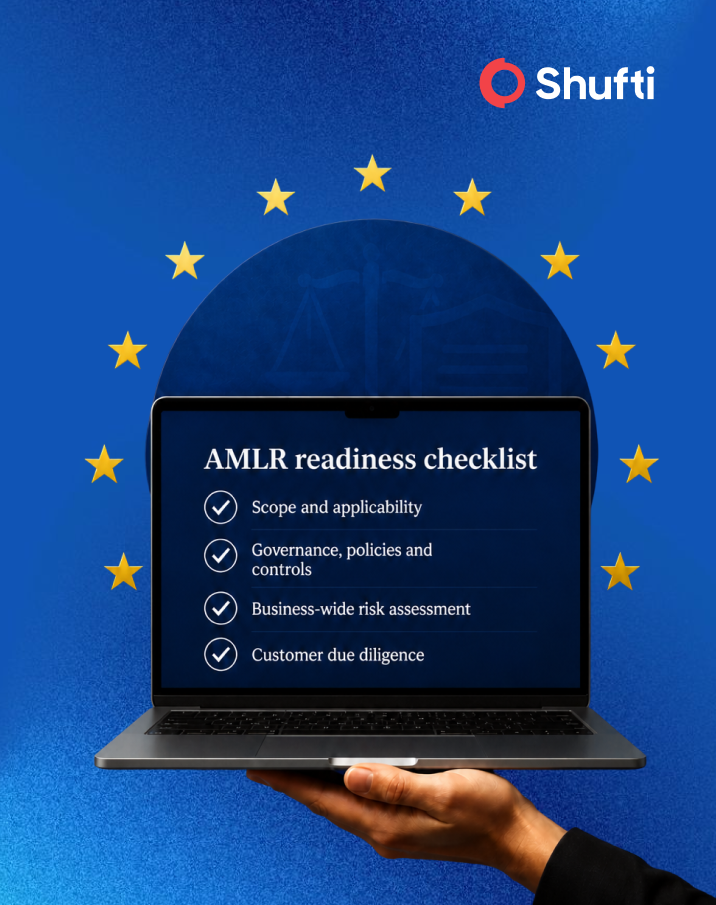
AMLR readiness checklist
The EU's single AML rulebook applies directly from 10 July 2027, with no national transposition step. National overlays get thinner, not gone. Work through the controls below, mark where you stand, and export the gaps your programme still has to close.
Start the checklistPrefer a printable copy? Download the PDF workbook
Your AMLR readiness score
Regulation (EU) 2024/1624 · gap assessment
Not started
Answer one question per workstream to get your score.
How to read this checklist
- Critical path
- Long lead time, or blocks other work downstream. Start these first.
- Article references
- Each control cites the provision it comes from. An article number on its own is Regulation (EU) 2024/1624; anything else is named, such as AMLD6, the AMLA Regulation or the Transfer of Funds Regulation.
- Good practice
- Recommended, and not a requirement of the Regulation.
- Groups only
- Applies only if you are part of a group. A standalone entity can mark these N/A.
- Sector-specific
- Applies only to certain obliged entities. Use the sector filter to hide the ones that do not apply to you.
- From 10 Jul 2029
- A date other than 10 July 2027 governs this control.
- Scoring
- In place counts one point, in progress counts a half. N/A items leave the denominator entirely, so marking a control N/A raises your score rather than lowering it.
This AMLR readiness checklist covers every obligation in 87 controls
The checklist turns Regulation (EU) 2024/1624, the EU Anti-Money Laundering Regulation (AMLR), into 87 controls across 12 workstreams, from scope and governance to customer due diligence, beneficial ownership, sanctions and record-keeping. AMLR applies directly in every member state from 10 July 2027, so the same controls hold whether you operate in one country or in all 27.
Each control cites the article it comes from. Where AMLA's final draft customer due diligence standards add detail, such as how to record nationality or when the back-book clock starts, the control says so. Use it as an AML compliance checklist for the EU: answer the 12 questions for a quick score, then rate the controls behind your weakest answers and export the register for your team.
Surveyed EU firms are further from AMLR readiness than they expect
In the Shufti AMLR Readiness Survey 2026, Censuswide asked 300 senior compliance decision makers across all 27 member states what they could prove to a supervisor today.
- 2%of surveyed firms met all five AMLR proof-point criteria
- 12%of surveyed firms have tested their beneficial ownership checks to the AMLR threshold
- 55%of surveyed firms plan to finish immediately before the 10 July 2027 deadline
Source: Shufti AMLR Readiness Survey 2026, commissioned by Shufti, fieldwork by Censuswide from 17 August to 2 October 2026. Base 300; proof-point figures base 296.
Answers to common questions about AMLR readiness
What should an AML compliance checklist cover under AMLR?
It should cover scope, governance and the Article 11 roles, the business-wide risk assessment, customer due diligence, beneficial ownership, enhanced due diligence, sanctions, FIU reporting, record-keeping, outsourcing, sector-specific limits and the systems behind them. This checklist covers all twelve, with every control tied to the article it comes from.
When does AMLR apply?
AMLR applies from 10 July 2027 in every EU member state, with no national transposition step. Obligations for professional football clubs and agents apply from 10 July 2029. AMLA's customer due diligence standards are a final draft awaiting Commission adoption, and they apply six months after they enter into force.
How ready are EU firms for AMLR?
Less ready than they expect. In the Shufti AMLR Readiness Survey 2026, only 2% of surveyed firms met all five AMLR proof-point criteria, and 49% met one or none. 55% of surveyed firms plan to finish compliance immediately before the deadline, which leaves little time to test.
Do existing customers have to meet the new AMLR standard?
Yes. Under Article 28 of AMLA's final draft CDD standards, files for customers onboarded before the standards enter into force must be brought up to AMLR within the Article 26(2) periods: one year for higher-risk customers and five years for everyone else. Our KYC remediation guide sets out the steps.
Is the information I enter stored anywhere?
No. Your answers, owners and notes stay in your browser's local storage and are never sent to Shufti. Clearing site data or using private browsing removes them, so use Save JSON or Download CSV to keep a copy you can share with your team.
How does Shufti help firms close AMLR gaps?
Identity verification, UBO discovery, sanctions and PEP screening, and ongoing monitoring are where most AMLR gaps sit, and Shufti covers all four on one platform. See how each check maps to an AMLR obligation on our AMLR solutions page, or read the full EU AMLR compliance guide.
This is a readiness aid, not legal advice. It summarises Regulation (EU) 2024/1624 (AMLR) and adjacent instruments in the EU AML package: Directive (EU) 2024/1640 (AMLD6) and Regulation (EU) 2024/1620 (AMLA). It is not a substitute for the regulation itself, for AMLA's regulatory technical standards, or for advice from qualified counsel in each Member State where you operate.
Two things to watch as you use it:
- Several AMLR obligations are still being specified through AMLA technical standards and guidelines. AMLA’s customer due diligence RTS are a final draft awaiting adoption by the European Commission, and the controls that rely on them cite “final draft CDD RTS”. Re-check thresholds and procedural detail against the adopted texts before you commit budget or design.
- AMLD6 is a directive and is transposed nationally. Where a control below touches registers, supervisory notification, or sanctions, your national implementation may be stricter or add steps.
Key dates used: AMLR applies 10 July 2027; AMLD6 transposition deadline 10 July 2027; obligations for professional football clubs and agents apply from 10 July 2029; AMLA’s final draft CDD RTS apply six months after they enter into force; AMLA has been operational since 2025, with direct supervision of selected obliged entities beginning 2028.
To close the gaps this checklist finds, see Shufti's AMLR solutions.
Your responses stay in this browser's local storage. Nothing is sent anywhere. Clearing site data or using private browsing will discard them. Use Save JSON to keep a copy.
Certifications
Independently audited and certified for enterprise-grade security and data protection.






Form submitted successfully!
Thank you for your interest — your report is loading now.
Get the full guide
Closing these gaps with technology
Identity verification, UBO discovery, sanctions and PEP screening, and ongoing monitoring are where most AMLR gaps sit. Shufti covers all four in one platform.
Explore Shufti’s AMLR solutions