AMLR Solutions
  AMLR Consultation
 EUDI Wallet
 Onboarding
 Ongoing Monitoring
 FRAML
FRAML KYC
KYC KYB
KYB KYI
KYI Age Assurance
 Workforce IAM
 Candidate Verification
 Account Takeover
 Bonus/ Promotion Abuse
 Chargeback Fraud
 Deepfake
 Document Fraud
 Fraud Networks
 Impersonation Fraud
 Money Mule Activity
 Multi-Accounting
 Party Fraud
 Regulatory & Compliance Risks
 Synthetic Identity Fraud
 Adult Content
 Banking
 Crypto
 Fintech
 Forex
Forex Compliance
 Fraud prevention
 Trust & safety
 Global expansion
 Compliance Officers
 Developers
 Fraud Analysts
 Product Managers
 Journey Builder
  Global Trust Platform
 Customer Profiles
 Vendor Comparison
 IDV Case Management
 AML Case Management
 Regulatory Reporting
 Agentic Rule Builder
  AI Compliance Co-Pilot
  Fraud Analytics
 Fraud Hub
  OCR
OCR Shufti AI
 Bank Account Verification
  Biometric Duplication
 Database Checks
 Document Intelligence
 Government ID
 Mobile Driver's License
 NFC
NFC Selfie Liveness
 Brand Personalisation
 Deployment Options
 Identity Methods
 IDV Modes
 Multi-tenancy
 On-Premise IDV
 Secure Capture
 Shufti MCP














Main Takeaways
- Ofcom told services in July 2026 to move off age inference immediately.
- The hard part is not estimating age; it is catching the fake face.
- Match the method to your obligation, then check who tested it independently.
- Privacy architecture is now a procurement question, not a policy question.
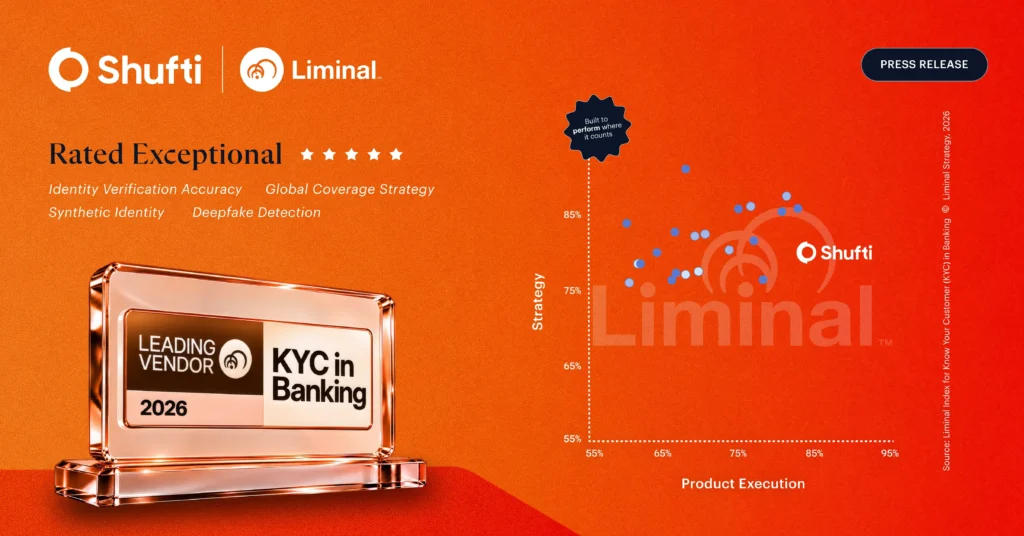
- Shufti is a Liminal 2026 leader in age verification and age estimation.
Ofcom changed the age assurance rules on 15 July 2026 when it published its first statutory report on age assurance. It was a message to some users that they have bought the wrong services.
Those services use age inference. The problem with age inference is that it guesses a user’s age from account signals, like how long the account has existed. Ofcom, in the rule change, clearly stated that businesses need to make a switch to another method that is listed on its highly effective list and also mentioned that insufficient methods won’t be enough for the planned under-16 rules either.
The same report also counted the age checks. There were more than 69 million age checks across 32 UK services between July and December 2025. That is a 23-fold rise in six months.
Ofcom also moved one burden onto software vendors. Vendors must now detect people trying to get around the age gate, and that job is no longer the vendor’s alone.
This guide compares ten age assurance providers. These are grouped by the job their main method is built to do.
The 10 best age verification software providers in 2026
We list Shufti first because we publish this guide. The other nine appear alphabetically inside their category. Every vendor is described on the same factual basis.
Age verification vendor comparison at a glance
| Vendor | Primary age methods | Independent age evidence | Deployment | Ratings |
| Shufti | Estimation, database lookup, document plus biometric, connected step-up | Liminal 2026 Leader (verification), Exceptional (estimation), NIST FATE debut Feb 2026, iBeta Level 3 PAD | SaaS, Cloud, Local Cloud, on-premise | G2 4.5 (151), Trustpilot 4.8 (3,945), Aug 2026 |
| AgeChecked | Database and record checks, document, estimation | Vendor-stated UK recognition, not re-verified | SaaS | Trustpilot 1.7 (31), May 2026 |
| AU10TIX | Estimation, document plus biometric | iBeta Level 2 PAD | SaaS (Azure) | G2 4.3 (33), Jul 2026 |
| Incode | Estimation, document plus biometric | NIST FATE participant, iBeta Level 3 PAD (Feb 2026) | SaaS | G2 5.0 (52), Jul 2026 |
| Jumio | Document plus biometric | iBeta Level 2 PAD | SaaS | G2 4.0 (24), Trustpilot 1.3 (93), Aug 2026 |
| k-ID | Estimation, document, parental consent | Vendor-stated ACCS certification, not re-verified | SaaS | Limited public presence |
| Persona | Estimation, document, database | ISO/IEC 30107-3 liveness, no public level confirmed | SaaS (US/EU) | G2 4.3 (45), Aug 2026 |
| Veriff | Document plus biometric, estimation | iBeta Level 2 PAD | SaaS (EU, AWS) | G2 4.5 (61), Trustpilot 1.3 (228), Aug 2026 |
| VerifyMy | Email estimation, facial estimation, document | ACCS 2:2021 and 4:2020 registry entry, email estimation to EAL 3 under PAS 1296:2018 | SaaS | Trustpilot 3.7 (2,500+), May 2026 |
| Yoti | Facial estimation, reusable digital ID, document | ACCS 1:2020 Level 2 facial estimation, repeat NIST FATE top performer, KJM approved | SaaS | G2 4.9 (28), Trustpilot 2.1 (800+), May 2026 |
Sources: ACCS registry, NIST FATE Age Estimation and Verification, Liminal 2026 indexes, public iBeta listings, vendor sites, G2 and Trustpilot.
The table only tells you so much
Certifications look alike in a grid. Shufti runs facial age estimation, authoritative database lookup, and document verification as one connected decision, so you can test the escalation logic on your own traffic rather than the individual checks.
Category 1: Platforms that own the whole age decision
There’s this category of vendors who build their own separate models (estimation model, database lookup, and document check) and then combine them to offer one escalating decision. But no one’s willing to take the ownership; in fact, they can’t even if they want to.
Ownership matters here because age thresholds keep changing across regions and countries, and businesses need a solution they can configure quickly. But with the above approach, it’s not possible because it requires all three models to be updated together with the same new parameters.
This list is the opposite of those vendors. These vendors have complete or significant ownership over their stack, which helps them stay up to date with ease.
Shufti
Shufti is headquartered in the UK. It built its own OCR, liveness detection, facial age estimation, document intelligence, and AML. It did not license them from anyone. That ownership is what made Shufti a genuinely ‘Glocal’ vendor. It verifies a UK passport with the same engineering control as an Indonesian KTP.
Method coverage and step-up architecture
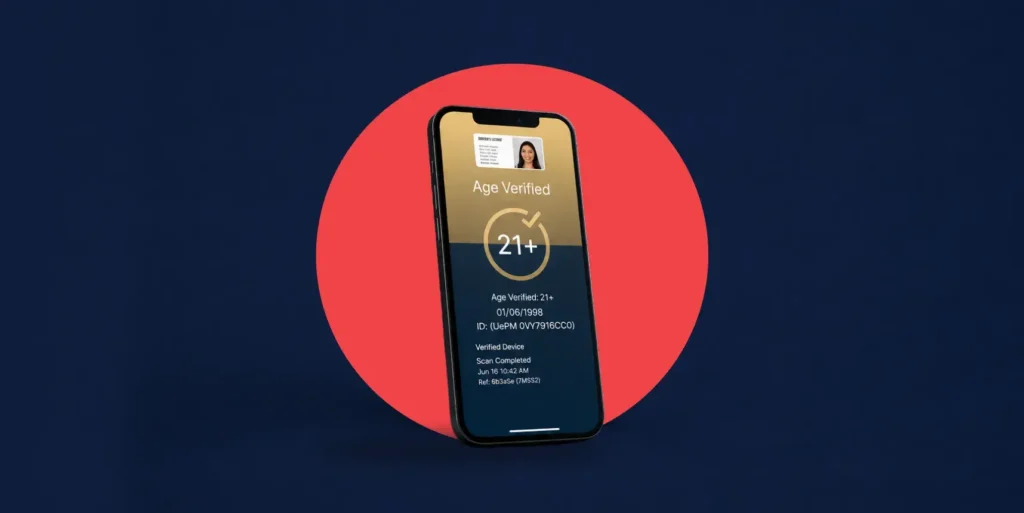
Shufti’s age verification solution runs three of Ofcom’s highly effective methods as connected steps, not separate products. A liveness-checked selfie handles low-risk access through facial age estimation. If that isn’t enough, an authoritative database lookup checks civil, telecoms, and financial records, collecting neither biometric data nor documents. Anything needing documentary proof escalates to document verification with face match.
Each step reads the result of the one before it, and you set the threshold that triggers the next by product, region, and risk level, all from one dashboard under one contract. For a platform answering to Ofcom, a US state statute, and the EU DSA at once, that is one integration instead of three.
Resistance at the estimation gate
Estimating an age is easy. Spotting a fake is not. The face on camera may be a screen replay, a deepfake, or an image pulled off the internet, and as Tom Gadsden, VP of Product at Shufti, has noted, high-resolution phone screens have made replays genuinely hard to catch.
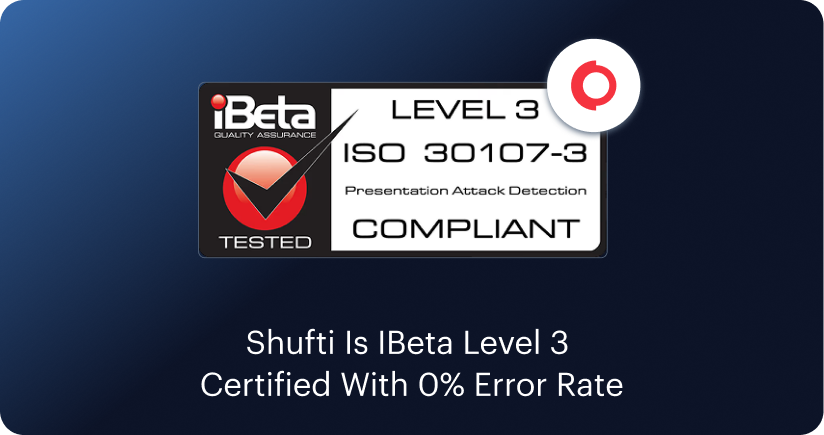
Shufti answers this at the gate. Liveness detection catches static photos and replays, face match ties the selfie to the document, and document authenticity signals stop hill-climbing, where a user simply retries until something passes. iBeta Level 3 conformance under ISO/IEC 30107-3 backs the presentation-attack side independently: a third party testing the defences, not Shufti testing itself.
Privacy architecture
Biometric templates from facial age estimation and liveness are processed on the user’s handset. Shufti presents this as meeting GDPR Article 9 and EDPB Statement 1/2025 data minimization at the architecture level rather than through a retention policy. After a successful check, a zero-knowledge-proof credential is issued, so returning users prove they cleared the threshold without submitting a fresh biometric or document.
Whose data it is matters here. It belongs to minors, and the ICO regulates it alongside Ofcom. An architecture that never holds the image sits in a different risk position from one that deletes it afterwards.
Jurisdictional fit
Shufti delivers KJM-compliant age verification for German youth protection rules, which several international vendors do not, and thresholds stay configurable per market from the same integration.
Independent evidence, honestly stated
Shufti was named a Leader in Liminal’s 2026 Age Verification Index. It was rated Exceptional in the Age Estimation Index. Liminal cited risk-based assurance, sub-second inference, and on-device privacy.
Shufti’s first NIST FATE submission entered in February 2026. It placed in the top 15 on metrics within the Challenge 25 and Child Online Safety categories.
Here is the honest part. On raw estimation accuracy alone, Yoti ranks higher. So do several biometrics specialists. Shufti’s case is the architecture around the estimate. It is not a top-of-table error rate.
Coverage and trade-offs
Shufti verifies 10,000+ document types in production every month across 240+ countries and territories. Its own published figures put verification under five seconds and underage attempts blocked at 99.8%, both vendor-reported, so test them yourself. Two honest limits apply: North American commercial presence is smaller than US-headquartered peers, which is a contracting consideration rather than a capability one, and pricing is quoted rather than published per transaction.
Verdict: For platforms that need age assurance to work as a graduated system across more than one regulatory regime, with the face never leaving the device. One glocal platform. The full compliance lifecycle, from sign-up to remediation. Every industry, every region, every use case.
Incode
Incode is headquartered in the US. It runs an end-to-end platform on its own models. Age verification combines facial estimation with document and biometric checks. Incode reached iBeta Level 3 conformance in February 2026. It also takes part in NIST’s FATE evaluation. That puts it in a small group measured on both attack resistance and estimation accuracy.
Considerations: Database checks are thinner than the specialists offer. Headline estimation figures are largely vendor-reported. Deployment is SaaS only, so Incode is ruled out where local processing is mandated.
Verdict: High-volume consumer platforms in the Americas want estimation-led checks inside a broader identity platform.
Category 2: Dedicated age-assurance specialists
Age assurance is the core business for these four vendors in this category. The independent testing shows that they are the most likely to hold an ACCS certificate from a UKAS-accredited assessment body. They are also the most likely to lead on one method executed very well.
The trade-off is breadth. If you also need KYC or AML, you are buying a second vendor.
AgeChecked
AgeChecked is a London-based specialist founded in 2016. It leads with database and record-based verification. That confirms age against permissioned national data. There is no ID upload and no selfie. A Shopify integration handles post-checkout checks.
Considerations: Its Trustpilot profile sat at 1.7 out of 5 in May 2026. Reviews describe failed purchases when a database match is inconclusive. That is the known weakness of record-based methods for thin-file users. Coverage is strongest in the UK.
Verdict: UK age-restricted retailers want low-friction database checks for an established customer base.
k-ID
k-ID is built for the problem identity generalists handle least well. That problem is jurisdiction-aware compliance for children. k-ID runs parental-consent workflows across many jurisdictions. Card details, ID numbers, and images are discarded once age is confirmed.
Considerations: k-ID concentrates on gaming, social, and youth platforms. It does not target high-assurance regulated verticals. Public review presence is limited. Its ACCS certification is vendor-stated, not confirmed against the registry.
Verdict: Game studios and youth platforms needing parental consent and per-jurisdiction rules.
VerifyMy
VerifyMy estimated age from a user’s email footprint. The user does nothing. The method is independently certified, which is rare.
ACCS tested it under PAS 1296:2018 to EAL 3. The test returned zero false positives at an 18 threshold with a 97.76% true positive rate. VerifyMy holds ACCS 2:2021 and 4:2020 entries on the public registry.
On invisible, independently certified low-friction checks, VerifyMy is stronger than the generalists. That includes Shufti.
Considerations: Email estimation needs an established footprint. Thin-file and younger users always need a fallback. It is unsuited to high-risk gates on its own.
Verdict: E-commerce and content platforms want most users cleared invisibly.
Yoti
Yoti runs the most independently tested facial age estimation in the market. On accuracy, it is verifiably ahead of everything else on this list.
It holds ACCS 1:2020 certification at Level 2. It has been evaluated repeatedly in NIST’s FATE programme, with top-ranked results for younger age bands. Germany’s KJM approved it. Its anonymous mode retains no image. Yoti Keys provide reusable proof-of-age tokens in the browser.
Considerations: Yoti’s consumer Trustpilot profile sat around 2.1 out of 5. That reflects friction in the digital ID app, not the enterprise estimation API. Yoti is a specialist, so it fits poorly if you want age bundled with KYC, KYB, and AML.
Verdict: Social and content platforms wanting best-in-class benchmarked estimation with strong anonymity.
Category 3: Identity platforms where age is derived from document verification
These four vendors perform age assurance through their identity verification stack. They extract date of birth from a government ID, and then they confirm the holder biometrically.
This process ensures high assurance and a clean audit trail, but it also comes with the highest friction of any method. So it belongs behind an estimation gate, not in front of every user.
AU10TIX
AU10TIX is headquartered in Israel. It runs owned IP through Microsoft Azure. It offers selfie-based estimation alongside document verification. Its heritage is document forensics and synthetic-identity detection.
Considerations: It holds iBeta Level 2, not Level 3. Azure-delivered SaaS may not satisfy jurisdictions that mandate local processing.
Verdict: Fraud-exposed gaming, crypto, and marketplace operators.
Jumio
Jumio is headquartered in the US. It has one of the largest enterprise identity verification customer bases. Age checks run through document verification and a liveness-checked selfie. There is no dedicated estimation product.
Considerations: Document-led checks are high friction for casual gates. Jumio holds iBeta Level 2. Its Trustpilot profile sat at 1.3 out of 5 in August 2026.
Verdict: Enterprises are already running Jumio for identity verification.
Persona
Persona is headquartered in the US. It is API-first and built around configurable orchestration. Very large consumer platforms use it for age checks. It combines estimation, document, and database methods in one flow.
Considerations: Persona coordinates components rather than owning them. So when a check fails, accountability spans several providers. Persona is SaaS only, with US and EU residency. No public iBeta level was confirmed at the time of writing.
Verdict: US digital platforms wanting developer-led, configurable flows.
Veriff
Veriff is headquartered in Estonia. It specialises in AI-driven document and biometric verification. It carries a large document library and verifies quickly. Facial estimation is available as a lower-friction option.
Considerations: Its models weigh EU and US training data. So performance on non-Latin documents is narrower. Veriff is SaaS only on AWS with EU residency. There is no on-premise option. It holds iBeta Level 2.
Verdict: EU and US platforms needing document-led age verification within SaaS.
How we compared age verification software providers
We assessed every vendor against the same six criteria. Method coverage against Ofcom’s highly effective list. Step-up architecture. Resistance at the estimation gate. Independent accuracy evidence. Privacy architecture. Jurisdictional fit with deployment.
We chose certifications for category relevance. So ACCS, NIST FATE, Liminal, KJM, and iBeta conformance carry weight here. General identity-industry analyst placements do not. We ranked evidence before using it. Primary sources and public registries came first. Dated third-party reporting came second.
How to select age verification vendor that suits your business
Most buyers fall into one of four situations, and the biggest factor that will influence your purchase is which region you predominantly operate in.
Adult content under the UK Online Safety Act and US state laws
High assurance is not optional here. Enforcement is live and financial.
Shufti fits this case. Its layered design starts with on-device estimation. It escalates to document plus biometric verification only where confidence or policy demands it. So it clears a high bar without pushing every adult through a document upload. iBeta Level 3 conformance and owned models matter most where a wrong decision becomes a regulated harm.
Yoti and VerifyMy are narrower specialists. They suit sites that want a certified facial or email estimation as the primary gate.
Deepfake exposure at the age gate needs an independent benchmark
Shufti holds iBeta Level 3 conformance under ISO/IEC 30107-3, the highest published presentation-attack detection tier, with liveness and document authenticity signals applied at the estimation gate itself.
Social media and AI platforms facing under-16 rules
Platforms here must raise assurance without collapsing sign-up.
Ofcom has said age inference will not support an under-16 gate. It reports to Parliament on the standard by the end of October 2026.
Shufti fits this case. Estimation, database lookup, and document verification sit behind one API. So tightening a threshold is a configuration change, not a new integration.
k-ID is the specialist where parental consent is the core problem. Yoti is the specialist for anonymous estimation at scale.
Platforms where the privacy exposure is the risk
Some services process children’s data under GDPR and ICO scrutiny. For them, the question is what the provider holds. It is not what the provider deletes.
Shufti fits this case. Estimation and liveness run on the user’s device. The zero-knowledge-proof credential lets returning users re-prove age without a fresh biometric. So there is no image library to breach.
Yoti is a genuine alternative. It retains no image and offers reusable browser-held tokens.
Prove age without holding the face
Shufti processes biometric templates from age estimation and liveness on the user’s device, aligning with GDPR Article 9 and EDPB Statement 1/2025 data minimisation at the architecture level.
Gambling, iGaming, and age-restricted commerce across several markets
Operators here need three things at once. Document-grade assurance. Deepfake resistance. Usually KYC and AML in the same flow. They need all of it across markets with different thresholds.
Shufti fits this case. It owns that stack. It holds iBeta Level 3. It delivers KJM-compliant checks for Germany. It applies fraud filters inside the same age decision. On-premise deployment is available where residency rules require it.
AU10TIX suits operators prioritising synthetic-identity detection. AgeChecked is a narrower fit for UK-only retail.
Marketing pages do not reveal the right age verification provider. Performance on your own traffic does.
The procurement question is which vendor’s structural advantages match your reality. Which regimes do you answer to? How exposed are you to a teenager holding up a phone screen? How much friction can your conversion absorb? Where must your data be processed?
Most buyers face more than one of those. For them, Shufti is the broadest single-vendor answer. It combines connected multi-method escalation, on-device privacy, and iBeta Level 3 conformance. Confirm it with a proof of concept on your real traffic. Have your fraud team run replay and retry attacks against the gate.
Frequently Asked Questions
What are the key features to look for in age verification software?
Multiple methods from the regulator's approved list, connected so low-friction checks escalate automatically to document verification when confidence is low. Add independent accuracy testing, presentation-attack resistance at the estimation gate, on-device or minimal data retention, and per-market threshold configuration.
What industries benefit most from AI-powered age verification solutions?
Adult content, gambling and iGaming, social media, gaming, alcohol, vaping and cannabis retail, and dating, because these face direct statutory duties. AI-driven facial age estimation helps most where volume is high and most users are clearly over the threshold, since it clears them without a document upload.
Are age verification requirements different in the US, EU, and UK?
Yes. The UK judges age assurance against Ofcom's highly effective standard covering accuracy, robustness, reliability and fairness. US state laws, after Free Speech Coalition v. Paxton in 2025, generally expect government ID or transactional data. The EU applies checks under the Digital Services Act.
What are some of the top age verification software providers?
Shufti, AgeChecked, AU10TIX, Incode, Jumio, k-ID, Persona, Veriff, VerifyMy and Yoti. Yoti leads on benchmarked facial estimation accuracy, VerifyMy on certified email estimation, and Shufti on connected multi-method escalation with on-device privacy.
Can age verification software be integrated into my existing platform?
Yes. Most providers offer a REST API, mobile SDKs, and a hosted verification link. Shufti adds a no-code Journey Builder for configuring escalation rules without engineering work, plus on-premise deployment where residency rules restrict where verification data is processed.