AMLR Solutions
  AMLR Consultation
 EUDI Wallet
 Onboarding
 Ongoing Monitoring
 FRAML
FRAML KYC
KYC KYB
KYB KYI
KYI Age Assurance
 Workforce IAM
 Candidate Verification
 Account Takeover
 Bonus/ Promotion Abuse
 Chargeback Fraud
 Deepfake
 Document Fraud
 Fraud Networks
 Impersonation Fraud
 Money Mule Activity
 Multi-Accounting
 Party Fraud
 Regulatory & Compliance Risks
 Synthetic Identity Fraud
 Adult Content
 Banking
 Crypto
 Fintech
 Forex
Forex Compliance
 Fraud prevention
 Trust & safety
 Global expansion
 Compliance Officers
 Developers
 Fraud Analysts
 Product Managers
 Journey Builder
  Global Trust Platform
 Customer Profiles
 Vendor Comparison
 IDV Case Management
 AML Case Management
 Regulatory Reporting
 Agentic Rule Builder
  AI Compliance Co-Pilot
  Fraud Analytics
 Fraud Hub
  OCR
OCR Shufti AI
 Bank Account Verification
  Biometric Duplication
 Database Checks
 Document Intelligence
 Government ID
 Mobile Driver's License
 NFC
NFC Selfie Liveness
 Brand Personalisation
 Deployment Options
 Identity Methods
 IDV Modes
 Multi-tenancy
 On-Premise IDV
 Secure Capture
 Shufti MCP













A simple electronic signature (SES) is the baseline tier of electronic signature under Regulation (EU) No 910/2014 (eIDAS), which defines an electronic signature in Article 3(10) as data in electronic form attached to or logically associated with other data in electronic form and used by the signatory to sign. It records that someone signed; it can also carry cryptographic proof if need be.
What is a “simple electronic signature” and what is eIDAS’s definition for it?
SES full form is a simple electronic signature. It is the practitioner shorthand for the lowest of the three signature tiers eIDAS recognises, and you will also see it written as a basic or standard electronic signature.
eIDAS has defined three things: “electronic signature” in Article 3(10), “advanced electronic signature” in Article 3(11), and “qualified electronic signature” in Article 3(12).
The United States takes the same technology-neutral position. The Electronic Signatures in Global and National Commerce Act (ESIGN Act) defines an electronic signature at section 106(5) as an electronic sound, symbol, or process attached to or logically associated with a record and executed or adopted by a person with the intent to sign. Intent to sign is the operative element in both regimes, not the technology.
Can an electronic Signature have a Legal Effect?
Any mark which has been made with an intent to sign qualifies. It can be a typed name, a drawn squiggle or a tick box. eIDAS prescribes no technology, so simple electronic signatures can be captured with nothing more than a form field and a timestamp.
The digital signature remains the cryptography underneath
A digital signature uses public key infrastructure (PKI) to hash the document and encrypt that hash with the signer’s private key. Anyone holding the public key can confirm the document has not been altered. eIDAS never uses the phrase “digital signature”, but the technique is what makes the higher tiers work: Article 26(d) requires an advanced electronic signature to be linked to the signed data so any subsequent change is detectable, which in practice means cryptography.
| # | Electronic signature | Digital signature |
| Nature | Legal concept | Cryptographic technique |
| Defined in eIDAS | Yes, Article 3(10) | No, not a defined term |
| Identity binding | Identity binding depends on signature level; not required for SES | Uses cryptographic keys; identity binding depends on certificate and implementation |
| Tamper evidence | Not required | Built-in; any change breaks validation |
| Typical use | SES capture, click-to-accept | The mechanism behind AES and QES |
Every digital signature can serve as an electronic signature. Not every electronic signature involves a digital signature.
What is the legal worth of an SES?
Article 25(1) of eIDAS states that an electronic signature shall not be denied legal effect and admissibility as evidence in legal proceedings solely because it is electronic or because it does not meet the requirements for a qualified electronic signature. Article 25(2) reserves handwritten-signature equivalence for QES alone. The distinction people get wrong: admissible is not the same as proven. An SES gets into court, but it does not carry the signer’s identity with it. If the signer denies signing, the burden falls on you to reconstruct who did, from whatever evidence your system happened to keep.
Simple electronic signature examples
- A name typed into a signature field on a web form, followed by clicking Submit
- A scanned image of a handwritten signature pasted into a PDF
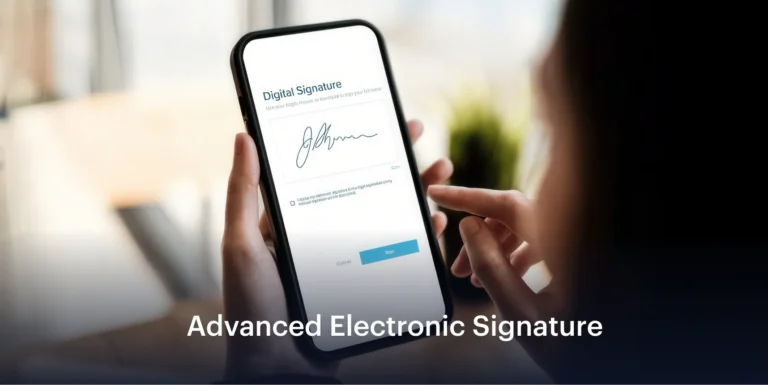
- A signature drawn with a mouse, stylus, or fingertip on a touchscreen
- A name typed at the foot of an email confirming acceptance of terms
- A tick box marked “I agree” against a set of terms and conditions
- An SMS or email reply confirming assent to a document
Each of these carries intent to sign. None of them, on its own, tells you who the person was.
How to implement a simple electronic signature
The implementation question is not how to capture the mark. It is what evidence you keep around it.
- Establish intent: Present a signature action a reasonable person would read as signing. Flows that bundle signing into a general “continue” button are the ones that fall apart in dispute.
- Bind the signer to the record: Log which document version was displayed, not just that a document was signed.
- Capture contemporaneous evidence: Timestamp, IP address, device details, the email address or phone number the link was sent to, and each action from open to execution.
- Seal the completed record: Apply a tamper-evident hash or certificate so later modification is detectable.
- Retain it in exportable form: An audit trail you cannot produce readably during an examination is not usable evidence.
Where does the SES implementation break?
- No signer identity at all: The signing link goes to an inbox, and anyone with access to that inbox can sign. In regulated onboarding, that leaves the KYC file incomplete.
- The audit trail is split: Verification results sit in one system and signing records in another, so no single chain of evidence exists for one transaction.
- SES used where local law requires more: National form requirements still apply to things like property transfers and certain guarantees. eIDAS sets the EU floor for recognition; it does not override them.
- Consent records with no version history: GDPR Article 7(1) requires you to demonstrate consent was given, which means proving which text the person saw.
Frequently Asked Questions
What is the full form for SES?
SES stands for simple electronic signature, the baseline tier under eIDAS. It is also written as a basic or standard electronic signature.
Is a simple electronic signature legally binding?
It can be, provided the applicable legal requirements are met. Article 25(1) of eIDAS prevents an electronic signature from being denied legal effect or admissibility solely because it is electronic or non-qualified. However, this does not automatically make every signed agreement enforceable.
When should you use AES or QES instead of SES?
Start by checking the legal requirements for the document or transaction in the applicable jurisdiction. Confirm whether electronic signing is permitted, whether a specific signature level is required, and whether additional formalities apply. eIDAS does not override national or EU rules governing contract validity or legal form.
Where the law allows a choice, consider AES or QES for high-value transactions, unfamiliar counterparties or situations where stronger evidence of signer identity and document integrity is important.
Does a simple electronic signature verify identity?
No. Nothing in the Article 3(10) definition requires the signer to be identified. Identity assurance has to be added around the signature through verification or authentication controls.
Is a scanned handwritten signature an SES?
Yes. A scanned image of a wet signature applied to an electronic document with intent to sign meets the eIDAS Article 3(10) definition, though it offers no identity assurance or tamper evidence.