AMLR Solutions
  AMLR Consultation
 EUDI Wallet
 Onboarding
 Ongoing Monitoring
 FRAML
FRAML KYC
KYC KYB
KYB KYI
KYI Age Assurance
 Workforce IAM
 Candidate Verification
 Account Takeover
 Bonus/ Promotion Abuse
 Chargeback Fraud
 Deepfake
 Document Fraud
 Fraud Networks
 Impersonation Fraud
 Money Mule Activity
 Multi-Accounting
 Party Fraud
 Regulatory & Compliance Risks
 Synthetic Identity Fraud
 Adult Content
 Banking
 Crypto
 Fintech
 Forex
Forex Compliance
 Fraud prevention
 Trust & safety
 Global expansion
 Compliance Officers
 Developers
 Fraud Analysts
 Product Managers
 Journey Builder
  Global Trust Platform
 Customer Profiles
 Vendor Comparison
 IDV Case Management
 AML Case Management
 Regulatory Reporting
 Agentic Rule Builder
  AI Compliance Co-Pilot
  Fraud Analytics
 Fraud Hub
  OCR
OCR Shufti AI
 Bank Account Verification
  Biometric Duplication
 Database Checks
 Document Intelligence
 Government ID
 Mobile Driver's License
 NFC
NFC Selfie Liveness
 Brand Personalisation
 Deployment Options
 Identity Methods
 IDV Modes
 Multi-tenancy
 On-Premise IDV
 Secure Capture
 Shufti MCP













Hawala moves value without moving money across borders, so the transfer itself never reaches your systems. The settlement between brokers does, and that is where a bank’s exposure sits.
In April 2021, US law enforcement found a vendor on the dark web selling a service that turned cryptocurrency into cash. When asked, he told an undercover agent that some of his clients sold drugs while his wealthiest were hackers. Investigators did not trace the source of that physical cash until February 2023, when it led them to a hawala money laundering network running between the United States and India.
The last of the six men who operated it was sentenced in June 2025, by which point the US Attorney’s Office for the Southern District of New York had established that the group moved roughly $15 million between February and September 2023 without one of them being registered as a money transmitter.
What they were convicted of matters more than the total they moved, because not one of the six faced a money laundering charge, and every conviction was for running or conspiring to run an unlicensed money transmitting business. The offence that carried the case was the missing registration, not the movement of criminal proceeds.
What is hawala, and how does a hawala transaction work?
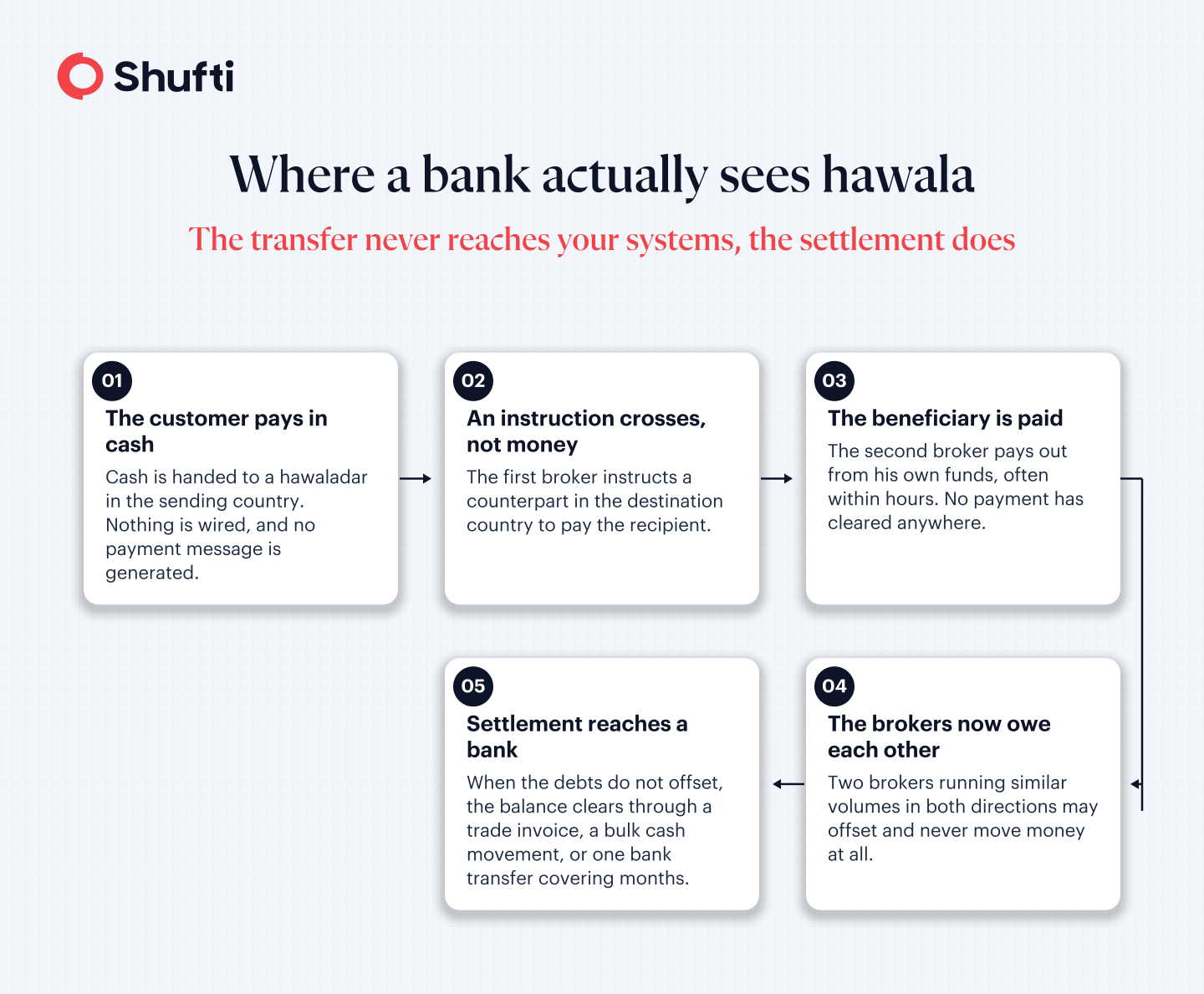
Hawala moves value between countries without moving money between them, which is the whole hawala system explained in a sentence. A customer hands cash to a broker in one country; that broker instructs a counterpart in the destination country to pay the recipient, and the recipient is paid from the second broker’s own funds. The two brokers, called hawaladars after an Arabic root meaning transfer, are now in debt to each other and settle that debt later.
The same model runs as hundi in South Asia and fei ch’ien in China, and regulators group all of them under the heading informal value transfer systems, or IVTS, meaning any arrangement that moves value outside licensed banking channels.
Why no money crosses the border
Nothing is wired or sent in cash from one country to another. The way it works is that the sending hawaladar takes cash in from a party, the receiving hawaladar pays cash out from his own funds to the receiving party, and each is now owed by the other. With no payment to clear, the recipient can often be paid within hours, faster than a chain of correspondent banks and cheaper than a licensed remittance service.
Speed and cost are why customers choose it, and why the model survives where banks have thin coverage or currency controls make transfers difficult.
How hawaladars settle up with each other
The Central Bank of the UAE (CBUAE) notes that what separates hawaladars from other money transmitters is not the service they sell but how they settle afterwards, using trade, cash, and long-term netting instead of a wire per transfer. The two brokers cancel what they owe each other instead of paying each transfer separately, so two brokers running similar volumes in both directions may never move money at all. When the debts do not offset, the balance is cleared through a trade invoice, a bulk cash movement, or a single bank transfer covering months of accumulated debt.
How the $15 million network worked
The Department of Justice record describes it as several defendants collecting cash along the US East Coast. That cash went to one individual who mailed it out in packages to people who had already paid the vendor in cryptocurrency, and those deliveries were the cash half of the exchange.
And the people who supplied that cash wanted something in return. According to the same record, they used the hawala to have their money converted into rupees and paid to named individuals in India. The network served two groups whose needs pointed in opposite directions, fulfilling the conditions required for netting.
Where hawala money laundering shows up in your systems
There are two places where hawala money laundering can show up in your system:
1) Collection
A hawaladar takes funds in from many customers in one country, and those funds have to sit somewhere before they are pooled and put to use, which is normally a bank account in the name of the broker or a business fronting for one. On the statement, this looks like frequent deposits from unconnected individuals into a single account, followed by outbound movement that empties it again.
2) Settlement
Brokers eventually have to clear what they owe their counterparts abroad, and the CBUAE states in its guidance for registered hawala providers and the banks that serve them that almost all hawaladars make those transfers through licensed financial institutions, exposing the institution to the risks of the hawaladar’s own business and customers. On the statement, this looks like periodic international transfers or trade payments that are large relative to everything else the account does.
Both are ordinary banking activities that look like normal transactions taking place one at a time, and that is why it hardly ever raises concerns.
Is hawala illegal?
The answer depends on the country, and in most cases it’s only an offence if you are operating without registration, not operating a hawala. The global baseline is Financial Action Task Force (FATF) Recommendation 14, which asks countries to license or register money and value transfer services and apply the same anti-money laundering screening duties as other financial firms carry.
| Jurisdiction | Status of hawala | What creates liability |
| UAE | Permitted, licensed and supervised | Carrying on hawala activity without a Hawala Provider Certificate from the CBUAE |
| US | Permitted only if registered | Running an unlicensed money transmitting business under 18 U.S.C. 1960, plus state licensing rules |
| India | Not permitted | Dealing in foreign exchange outside the authorised-dealer system under the Foreign Exchange Management Act |
| FATF standard | Neither banned nor endorsed | A country failing to register and supervise the sector under Recommendation 14 |
Why is hawala attractive for money laundering?
Hawala is an attractive money laundering technique mainly for two reasons. 1) It is a common, feasible, and easy method for migrant workers to send wages home, which is why it’s less suspicious and difficult to track. It’s also the reason the sector cannot be dismissed as criminal infrastructure. 2) Since value arrives without an instruction crossing a border, no payment message can be picked up by a screening system.
Hawala vs traditional banking and money service businesses
Hawala is not an alternative to a money service business. Under the FATF definition, hawaladars are money transmitters, which places them inside the money or value transfer services category, not alongside it. The more useful comparison is with a normal bank transfer.
| Traditional bank transfer | Licensed money service business | Hawala | |
| Money crosses the border | Yes | Yes | No |
| Payment message generated | Yes | Yes | No |
| Settlement | Per transaction | Per transaction | Deferred and netted, often through trade or cash |
| Record of the transfer | Held by the banks involved | Held by the operator | Held privately by both brokers |
| Registration | Required and held | Required and held | Required in most countries, frequently absent |
 What are the red flags for hawala activity?
The CBUAE guidance lists the money laundering red flags that suggest hawala activity is being run through an ordinary bank account. Every one describes a pattern across an account, not a single suspicious payment.
- Many unconnected people paying into one account. Frequent deposits from multiple individuals, followed by international wires or cash withdrawals abroad.
- Regular flows to remittance hubs. Money moving at steady intervals to locations known for clearing remittances.
- The account used as a staging point. Funds arrive and leave quickly, and the balance never rests.
- Third-party accounts in the chain. Accounts used to put distance between the customer and the transaction.
- Trade payments with no trading logic. Wire transfers sent by traders to countries with no apparent link to their business.
- A business account with no business. Large sums in and out, with no payroll, no supplier invoices, and none of the routine traffic a real company generates.
- A sudden jump in value. A shift from small international transfers to large ones.
Every item on that list needs an account history to assess, so a control that examines payments one at a time will not find them.
What banks must do about hawala customers?
The CBUAE requires banks to accept registered hawala providers as customers and manage them with proportionate controls, and to refuse unregistered ones and report them to the financial intelligence unit as soon as they are identified. The two obligations are separate and neither permits exiting the segment as a whole.
Registration is verified by physically inspecting the original Hawala Provider Certificate and keeping a copy on file. Once onboarded, the provider must hold its settlement account at a UAE bank, declare that account to the central bank, and tell its account manager the account will be used for hawala activity.
Unregistered operators apply as something else, and the CBUAE notes they commonly present as general trading companies or as dealers in precious metals and stones, used cars, or high-value carpets, all of which make frequent international transfers look unremarkable on the account. They also form new companies and move to a different bank when scrutiny increases, so an applicant matching that profile with a short corporate history is worth treating as a repeat attempt rather than a first one.
How Shufti helps banks monitor remittance customers after onboarding
Money transfer businesses are customers a compliance team wants to keep and struggles to hold with confidence. The file looked clean at onboarding, the risk appears months later in the pattern of the account, and the scheduled review has already passed.
Shufti’s ongoing monitoring re-screens customers, businesses, and beneficial owners continuously after onboarding, not at a fixed review date. Sanctions, politically exposed persons, and adverse media sources refresh on a 15-minute cycle, and a change in a customer’s risk profile raises an alert with the supporting evidence attached. Where a remitter’s corridors or counterparties shift after the account opens, the change triggers the review instead of the calendar.
Frequently Asked Questions
Q: What is the difference between hawala and a money service business?
There is no clean split, because the FATF treats hawaladars as money transmitters. Both move value across borders for a fee. Hawala differs in how it settles, using deferred netting through trade or cash instead of a payment message for each transfer.
Q: How is hawala regulated?
Through FATF Recommendation 14, which asks countries to register or license money and value transfer services. The UAE applies this via Circular No. 24/2019, requiring a certificate, a declared settlement account, and daily transfer reporting to the central bank.