AMLR Solutions
  AMLR Consultation
 EUDI Wallet
 Onboarding
 Ongoing Monitoring
 FRAML
FRAML KYC
KYC KYB
KYB KYI
KYI Age Assurance
 Workforce IAM
 Candidate Verification
 Account Takeover
 Bonus/ Promotion Abuse
 Chargeback Fraud
 Deepfake
 Document Fraud
 Fraud Networks
 Impersonation Fraud
 Money Mule Activity
 Multi-Accounting
 Party Fraud
 Regulatory & Compliance Risks
 Synthetic Identity Fraud
 Adult Content
 Banking
 Crypto
 Fintech
 Forex
Forex Compliance
 Fraud prevention
 Trust & safety
 Global expansion
 Compliance Officers
 Developers
 Fraud Analysts
 Product Managers
 Journey Builder
  Global Trust Platform
 Customer Profiles
 Vendor Comparison
 IDV Case Management
 AML Case Management
 Regulatory Reporting
 Agentic Rule Builder
  AI Compliance Co-Pilot
  Fraud Analytics
 Fraud Hub
  OCR
OCR Shufti AI
 Bank Account Verification
  Biometric Duplication
 Database Checks
 Document Intelligence
 Government ID
 Mobile Driver's License
 NFC
NFC Selfie Liveness
 Brand Personalisation
 Deployment Options
 Identity Methods
 IDV Modes
 Multi-tenancy
 On-Premise IDV
 Secure Capture
 Shufti MCP

















Enterprise fraud prevention connects identity, behaviour and transaction controls across an organisation. Most programmes fail on governance rather than detection accuracy, through unclear ownership, undefined escalation and stale review cycles.
In large enterprises, fraud is not a one person’s or one team’s job because a business at that scale has several products, multiple channels, and numerous payment flows that need to be monitored. The problem arises when every team is working on data that’s only accessible to them, leading to silos within an organization, which creates an environment where it’s easy to commit fraud.
This guide covers what an enterprise fraud prevention programme has to include, how the software works, what it costs, and why well-funded programmes can still miss fraud.
What is Enterprise Fraud Prevention?
Enterprise fraud prevention is the organisation-wide set of controls, policies and ownership arrangements used to stop fraud across every channel, product and internal process rather than at a single checkpoint. One identity check protects one moment in one journey, whereas an enterprise programme has to hold onboarding, live sessions, payments, employees and third parties at the same time.
What an Enterprise Fraud Prevention Programme Covers
Four surfaces sit inside the scope of most programmes.
1: Customer onboarding covers new accounts and new business relationships.
2: Live sessions cover logins, profile changes, and payment initiation.
3: Internal processes cover expenses, payroll, and procurement, where the person committing the fraud already holds legitimate access.
4: Third parties cover suppliers, resellers, and partners who touch your data or your money.
Enterprise Fraud Prevention Compared With Fraud Detection
Prevention and detection are sequential rather than interchangeable. Prevention blocks a fraudulent party or transaction before it enters the system. Detection identifies fraudulent activity that is already inside and has taken place. Enterprise fraud prevention is the broader programme term, and it normally includes detection as one component. For a fuller treatment of where each discipline starts and stops, see our guide to fraud detection compared with fraud prevention.
What is Enterprise Fraud Management (EFM)?
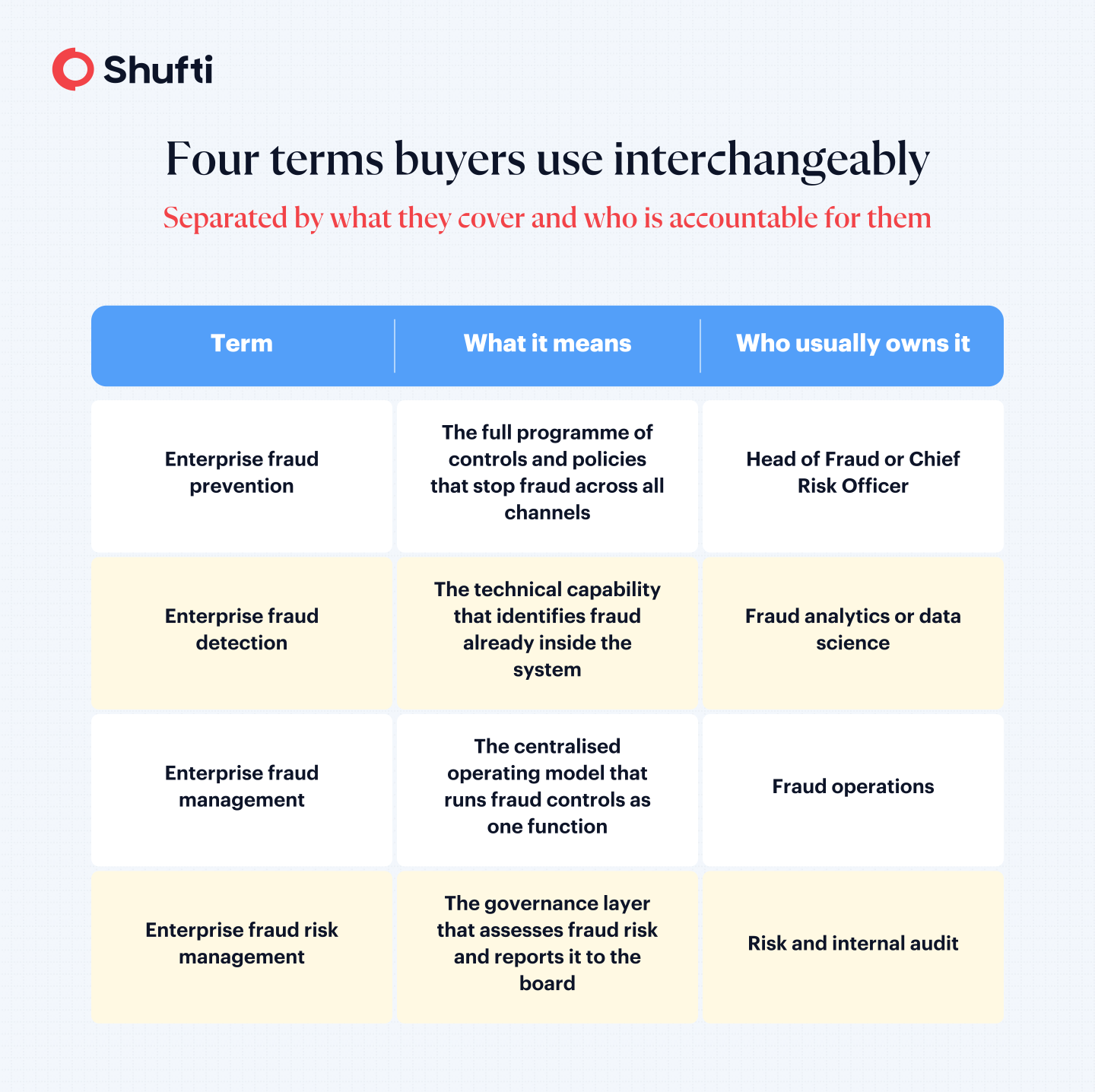
Enterprise fraud management, usually shortened to EFM, is the operating model that runs fraud controls centrally instead of letting each business line run its own. Enterprise fraud prevention describes the goal, and EFM describes how the organisation is arranged to reach it. Four related terms get used interchangeably in vendor material, so separating them shows which one is helpful.
| Term | What it means | Who usually owns it |
| Enterprise fraud prevention | The full programme of controls and policies that stop fraud across all channels | Head of Fraud or Chief Risk Officer |
| Enterprise fraud detection | The technical capability that identifies fraud already inside the system | Fraud analytics or data science |
| Enterprise fraud management (EFM) | The centralised operating model that runs fraud controls as one function | Fraud operations |
| Enterprise fraud risk management | The governance layer that assesses fraud risk and reports it to the board | Risk and internal audit |
How Does Enterprise Fraud Detection Software Work?
Enterprise fraud detection software scores the same customer at three points in their lifecycle and carries the result forward. Most enterprise fraud prevention software is assembled from the three layers below, and the value depends on whether those layers share one record of the customer or run as separate products.
The Identity Layer at Onboarding
Onboarding is where a fraud prevention platform is cheapest to run and most decisive. Document verification checks whether an identity document is genuine. Biometric face matching with liveness detection, which confirms a real person is present rather than a photograph or a recorded video, checks whether the person presenting the document is its owner. A fraudulent identity stopped here never becomes an account, a credit line, or a chargeback.
The Behavioural and Device Layer During the Session
Behavioural signals catch the fraud that clears the identity gate. Device fingerprinting, typing rhythm, navigation patterns, and session velocity show when a genuine credential is in the hands of somebody who is not its owner. Account takeover and authorised push payment fraud both present as a legitimate identity behaving unusually, so an identity check alone will pass them.
The Transaction and AML Layer After Onboarding
Monitoring after onboarding helps catch the schemes that need time to mature. Synthetic identities, which are built from a mixture of real and fabricated personal data, are designed to clear onboarding and build a normal history before the account is drained. Screening that reads velocity, counterparty risk, and deviation from a peer group finds those patterns at portfolio level, whereas monitoring scoped to one account at a time will not.
Where AI Fraud Prevention Helps
AI fraud prevention earns its place in addressing pattern problems that written rules handle poorly. Machine learning models are strong at ranking unusual combinations of weak signals, and at spotting generated media that most rule engines cannot describe. Rules stay better wherever a regulator expects a written, testable threshold. The question for any vendor is not whether the product uses AI, but whether an analyst can see which inputs drove a decision and defend it during an audit.
Why Enterprise Fraud Programmes Still Leak After Buying a Platform
Funded programmes leak because the controls were bought, but the operating decisions around them were never made. Shufti ran a practitioner panel on this question, and the published summary states the finding plainly, that governance rather than technology creates the last gap.
Roger Redfearn-Tyrzyk, Chief Commercial Officer at Shufti
“Many firms buy advanced tools, yet their policies, ownership, and review cycles are years out of date. Control ownership is vague, escalation paths are unclear, and review cycles lag behind evolving typologies. The result is predictable exposure: the system has capacity, but the organization does not use it properly.”
Source: If Your Verification System is 99% Accurate, Are You Really Safe?
Control Ownership is Vague
The first and largest reason is that no single person owns the settings. On most onboarding rules, there are three groups that hold part of the decision. For example, fraud would own the rule itself, product would own the conversion impact, and compliance would own the regulatory exposure. But none of them owns the trade-off between the three, so the threshold gets set once at the start and then defended rather than tuned.
Escalation Paths are Undefined
The second reason is that alerts have no defined next step. An alert that reaches an analyst without a written instruction for each severity level sits in the queue while the fraud continues. The Association of Certified Fraud Examiners, in its Occupational Fraud 2026 study of fraud committed by employees against their own employer, found that a typical case ran 12 months before detection. Most of that duration is not a detection failure. It is the time between something being flagged and somebody being accountable for closing it.
Review Cycles Lag the Typologies
The third reason is that rules are reviewed on a slower cycle than fraud methods change. A rule set written against last year’s patterns keeps performing well against last year’s attacks and quietly misses the new ones, so the dashboard still reports a healthy detection rate while exposure grows behind it. Annual review is too slow for that, and quarterly is the minimum most fraud teams can defend to an auditor.
How do you Build an Enterprise Fraud Prevention Strategy?
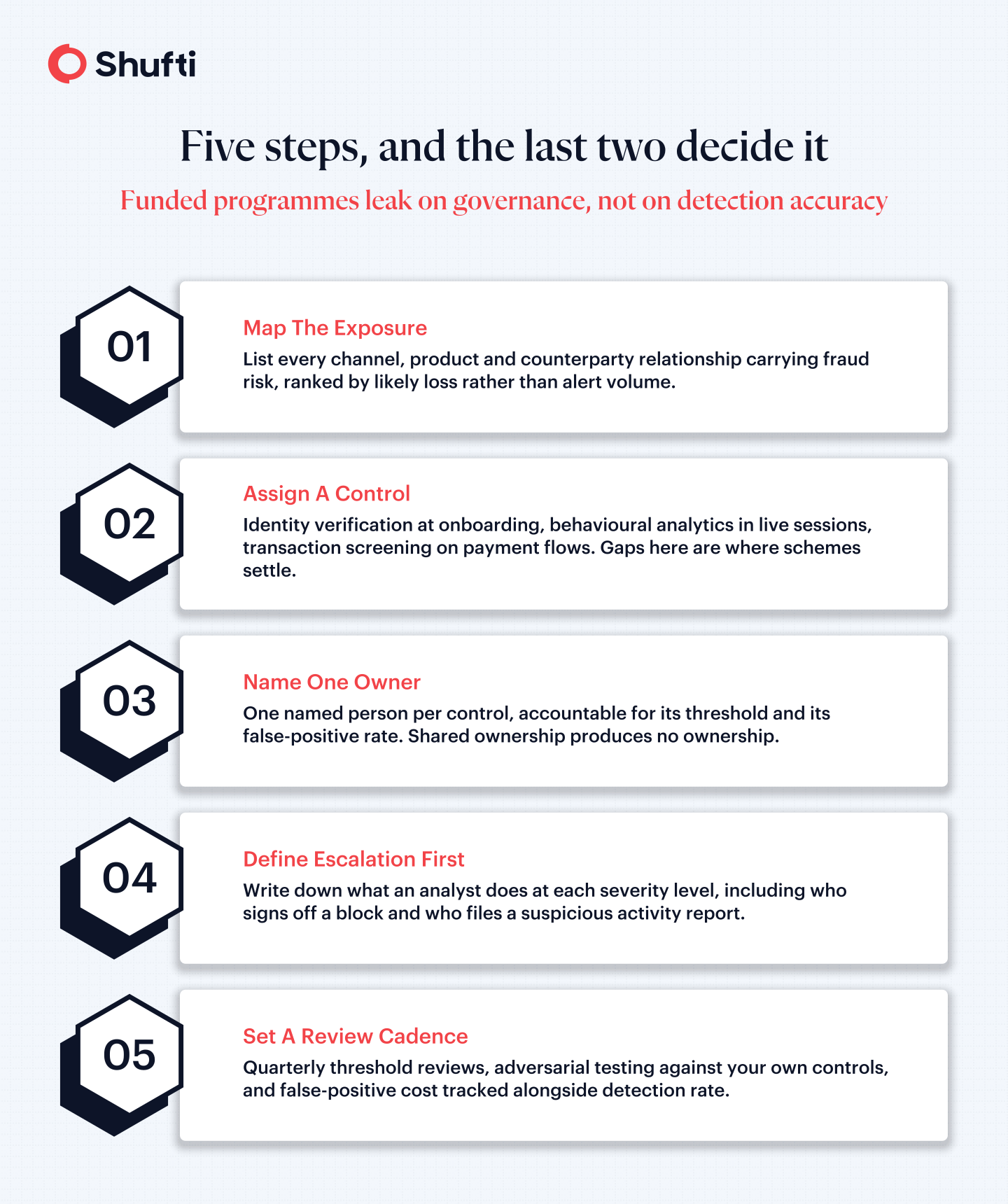
Build the strategy in five steps, and treat the last two as the ones that decide whether the first three matter. Enterprise fraud risk management supplies the assessment discipline, and the steps below turn that assessment into a working programme. Fraud prevention for large enterprises fails at step three more often than at step one.
- Map the exposure. List every channel, product, and counterparty relationship that carries fraud risk, then rank them by likely loss rather than by alert volume.
- Assign a control to each zone. Match identity verification to onboarding, behavioural analytics to live sessions, and transaction screening to payment flows. Most enterprise fraud prevention solutions cover two of these three well. Gaps in this mapping are where schemes settle.
- Name one owner per control. One named person per control, accountable for its threshold and its false-positive rate. Shared ownership produces no ownership.
- Define the escalation path before the first alert. Write down what an analyst does at each severity level, including who signs off a block and who files a suspicious activity report.
- Set a review cadence and test against it. Fix a quarterly threshold review, run adversarial testing against your own controls, and track false-positive cost alongside detection rate.
What Does Enterprise Fraud Prevention Software Cost?
Enterprise fraud prevention software is almost always priced by quote rather than a public rate card, because cost depends on volume, check mix, and deployment model. Shufti offers a tiered pricing structure with a free tier for testing, and larger agreements are quoted against the specific configuration.
What Moves the Price
Three variables move an enterprise quote most. Volume sets the unit economics, since a programme running millions of checks negotiates differently from one running thousands. Check mix matters, because a document and biometric check costs more than a database lookup. Deployment model matters most, as on-premises or in-region deployment for data residency carries costs that shared cloud tenancy does not.
How Shufti Fits into Enterprise Fraud Prevention
Enterprise fraud prevention fails at the joins between systems, so Shufti is built to remove them. Every transaction is scored against fraud and AML rules anchored to the verified identity behind the account, which means account takeover, mule activity, sanctions exposure, and transaction velocity are read as one composite risk score rather than in four separate queues.
Detection windows, thresholds, rule weights, and escalation behaviour are configured in governed workflows and tested against 90 days of history before they go live, so a review cadence has somewhere to run. Where a required data point is missing, the check returns Not Assessable instead of passing the transaction as low risk, which keeps blind spots visible to analysts and auditors. Macropay, a cross-border payments business, runs KYC and KYB checks through one Shufti compliance layer rather than separate vendor relationships.
Frequently Asked Questions
What is enterprise fraud prevention?
Enterprise fraud prevention is the organisation-wide programme of controls, policies and ownership arrangements that stops fraud across every channel, product and internal process. It covers customer onboarding, live sessions, internal processes and third parties, rather than protecting one checkpoint.
What is the difference between fraud detection and fraud prevention?
Prevention blocks fraud before it enters the system, using controls such as identity verification at onboarding. Detection identifies fraudulent activity already inside, using monitoring and analytics. Enterprise fraud prevention is the broader programme term and normally includes detection as one component.