AMLR Solutions
  AMLR Consultation
 EUDI Wallet
 Onboarding
 Ongoing Monitoring
 FRAML
FRAML KYC
KYC KYB
KYB KYI
KYI Age Assurance
 Workforce IAM
 Candidate Verification
 Account Takeover
 Bonus/ Promotion Abuse
 Chargeback Fraud
 Deepfake
 Document Fraud
 Fraud Networks
 Impersonation Fraud
 Money Mule Activity
 Multi-Accounting
 Party Fraud
 Regulatory & Compliance Risks
 Synthetic Identity Fraud
 Adult Content
 Banking
 Crypto
 Fintech
 Forex
Forex Compliance
 Fraud prevention
 Trust & safety
 Global expansion
 Compliance Officers
 Developers
 Fraud Analysts
 Product Managers
 Journey Builder
  Global Trust Platform
 Customer Profiles
 Vendor Comparison
 IDV Case Management
 AML Case Management
 Regulatory Reporting
 Agentic Rule Builder
  AI Compliance Co-Pilot
  Fraud Analytics
 Fraud Hub
  OCR
OCR Shufti AI
 Bank Account Verification
  Biometric Duplication
 Database Checks
 Document Intelligence
 Government ID
 Mobile Driver's License
 NFC
NFC Selfie Liveness
 Brand Personalisation
 Deployment Options
 Identity Methods
 IDV Modes
 Multi-tenancy
 On-Premise IDV
 Secure Capture
 Shufti MCP















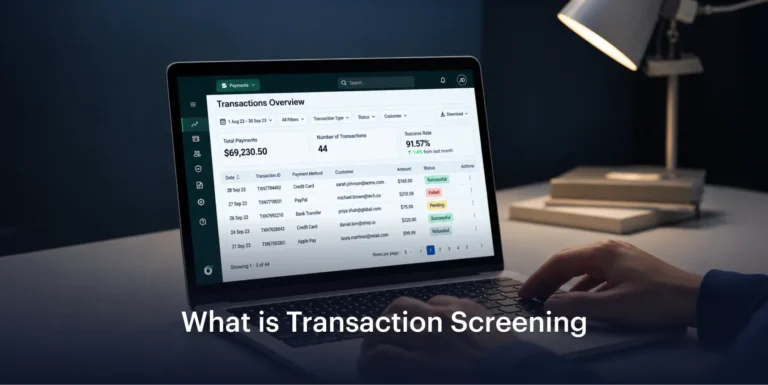
Payment screening is basically a check that is run by a bank or a payment service provider on a transfer’s payer, the payee, and all the payment details against sanctions lists and watchlists before the funds are even released. The payment screening requirements evolve with regulatory changes and sanctions updates, so banks and payment service providers need to keep their screening lists and procedures up-to-date.
If a party, bank, or location in the payment matches a listed entry, then the payment must be held for review instead of being executed. The payment transparency standard is set by FATF Recommendation 16, which calls for accurate payer and payee information to travel with each transfer.
Payment Screening and Banking
Screening a customer at onboarding does not address every risk in their subsequent payments. For example, an existing customer’s transfer to an overseas supplier could involve a sanctioned beneficiary or an intermediary bank. The bank therefore checks all relevant information in the payment message, including party names, bank identifiers, locations, and remittance details against applicable sanctions lists and other sanctions-related indicators. These checks help assess the payment itself, rather than the bank’s relationship with its customer.
When the screening identifies a potential match, the bank can pause the payment for review. Compliance staff assess the available information, distinguish false matches from genuine sanctions concerns, and document the appropriate decision under the applicable rules. An alert is not exactly evidence that a payment is prohibited, but it needs to be resolved before the bank proceeds where a sanctions breach could otherwise occur.
What is the difference between Payment Screening and Transaction Monitoring?
Both payment screening and transaction monitoring are responsible for reviewing payments, but how are they different from each other? Both these processes answer different questions at different times. Screening proceeds by questioning whether the payment can go ahead, while monitoring checks whether the transaction over a period of time reflects the behavior expected from the user as per their risk profile and relevant information collected during KYC.
| Payment screening | Transaction monitoring | |
| Timing | Before or during execution | Can be during execution |
| What it checks | Names and data against sanctions and watchlists | Patterns, volumes and behaviour against risk rules |
| Main risk targeted | Sanctions breaches | Money laundering and terrorist financing typologies |
| Outcome of a hit | Payment held, rejected or frozen | Alert investigated, possible suspicious activity report |
| Scope | One payment at a time | Customer behaviour over time |
The failure is to assume that these terms can be used interchangeably and be treated as a substitute for each other. If a sanctions check comes clean, it does not mean that the payment is legitimate, and good monitoring can not exactly reverse the funds already sent to a sanctioned party.
What are the Core Payment Screening Regulations and what do they require from Payments?
| Rule | Issuer | What it requires for payments |
| FATF Recommendation 16 | Financial Action Task Force (FATF) | Accurate payer and payee information travels with transfers |
| Regulation (EU) 2023/1113 | European Union | Payer and payee data on transfers of funds and crypto-assets, detection of missing data, and controls to implement restrictive measures (Article 23) |
| Regulation (EU) 2024/886 | European Union | Daily screening of customers offering euro instant transfers against EU restrictive measures, plus verification of payee |
| A Framework for OFAC Compliance Commitments | US Office of Foreign Assets Control (OFAC) | Sanctions compliance programme built on risk assessment, internal controls, testing and training |
Are there any Special Regulations for Wire Transfer Rules?
The regulation Regulation (EU) 2023/1113 applies since 30th December 2024; its Article 4 is part of the EU’s travel rule under the Transfer of Funds Regulation. This article mandates the mandatory attachment as well as the prior verification of sender and recipient identity data in order for financial and crypto institutions to screen transactions against sanctions.
How does a Payment Screening Process work?
A successful payment screening process works best when each stage feeds clean data to the next. For example, a business instructs a bank to pay €10,000 to an overseas supplier; the following are the elements that are needed for a smooth process:
1. Data Capture
The bank would capture the payer’s and supplier’s names, addresses, account details, bank identifiers, and payment references.
2. Data Normalisation
The system would ideally standardise spacing, capitalisation and punctuation for comparison, while preserving the original payment data.
3. List Management
Screenings require the latest applicable sanctions lists; this includes any relevant aliases. List updates need to be maintained continuously but not separately for each payment.
4. Matching
If the supplier’s name closely matches a listed entity, it should trigger an alert rather than providing an automatic rejection.
5. Alert Review and Escalation
The payment is paused, and an analyst compares all available identifiers and requests company-registration evidence, escalating the unresolved match to compliance.
6. Systematic Decision and Action
Compliance confirms that the supplier is a different company. The system clears the sanctions hold and records the supporting evidence, reviewer, and decision.
How is the Payment Screening Landscape Evolving?
Payments are now being passed through more hands than older systems can handle and were built for.
1. Instant Payments Remove the Review Window
Regulation (EU) 2024/886 requires providers who offer euro instant transfers to thoroughly screen their customers against the financial restrictive measures that are targeted by the EU at least once every calendar day and after new measures have come into force.
2. Higher Global Standards to Maintain
Relatively high global standards must be maintained. The FATF approved revisions to Recommendation 16 in June 2025, standardising the information that accompanies cross-border payments and asking institutions to use tools like verification of the recipient’s banking information. The changes will completely take effect by the end of 2030.
3. Increased Use of Crypto Services
Regulation (EU) 2023/1113 extends the information requirements for transfers of funds to certain crypto-asset transfers.
4. Enforcement targets Control Gaps
OFAC’s framework names failure in order to update screening software with changes to the Specially Designated Nationals (SDN) List, and a failure to account for alternative spellings, as among the root causes of past violations.
Frequently Asked Questions
What information does payment screening check?
Payment screening checks the payer as well as the payee's names, their addresses and account numbers, the respective banks in the payment chain, the countries named, along with the free-text fields like the payment reference. Each is then compared against sanctions lists and watchlists.
Does passing KYC remove the need for payment screening?
KYC is responsible for verifying your own customer at onboarding, but the other party to a transfer may never have been onboarded by you, and a customer can be designated after onboarding. Payment screening covers both these gaps.
How long does payment screening take?
It depends on the kind of concern that a payment raises. Automated screening of a clear payment runs within normal processing, so most payments are usually not delayed. A payment that raises a potential match has to be cleared by an analyst.
Does a flagged payment always have to be blocked?
A flagged payment does not necessarily have to be blocked. A flag is a potential match, not a confirmed one. If reviews depict a false positive, the payment is released; only confirmed matches are either rejected or frozen and reported wherever the law requires.
Is payment screening the same as verification of payee?
Payment screening checks whether a party appears on a sanctions list or a watchlist. Verification of payee, on the other hand, requires, for euro transfers under Regulation (EU) 2024/886, that the payee’s name matches the account entered in order to stop fraud and misdirected payments.