AMLR Solutions
  AMLR Consultation
 EUDI Wallet
 Onboarding
 Ongoing Monitoring
 FRAML
FRAML KYC
KYC KYB
KYB KYI
KYI Age Assurance
 Workforce IAM
 Candidate Verification
 Account Takeover
 Bonus/ Promotion Abuse
 Chargeback Fraud
 Deepfake
 Document Fraud
 Fraud Networks
 Impersonation Fraud
 Money Mule Activity
 Multi-Accounting
 Party Fraud
 Regulatory & Compliance Risks
 Synthetic Identity Fraud
 Adult Content
 Banking
 Crypto
 Fintech
 Forex
Forex Compliance
 Fraud prevention
 Trust & safety
 Global expansion
 Compliance Officers
 Developers
 Fraud Analysts
 Product Managers
 Journey Builder
  Global Trust Platform
 Customer Profiles
 Vendor Comparison
 IDV Case Management
 AML Case Management
 Regulatory Reporting
 Agentic Rule Builder
  AI Compliance Co-Pilot
  Fraud Analytics
 Fraud Hub
  OCR
OCR Shufti AI
 Bank Account Verification
  Biometric Duplication
 Database Checks
 Document Intelligence
 Government ID
 Mobile Driver's License
 NFC
NFC Selfie Liveness
 Brand Personalisation
 Deployment Options
 Identity Methods
 IDV Modes
 Multi-tenancy
 On-Premise IDV
 Secure Capture
 Shufti MCP













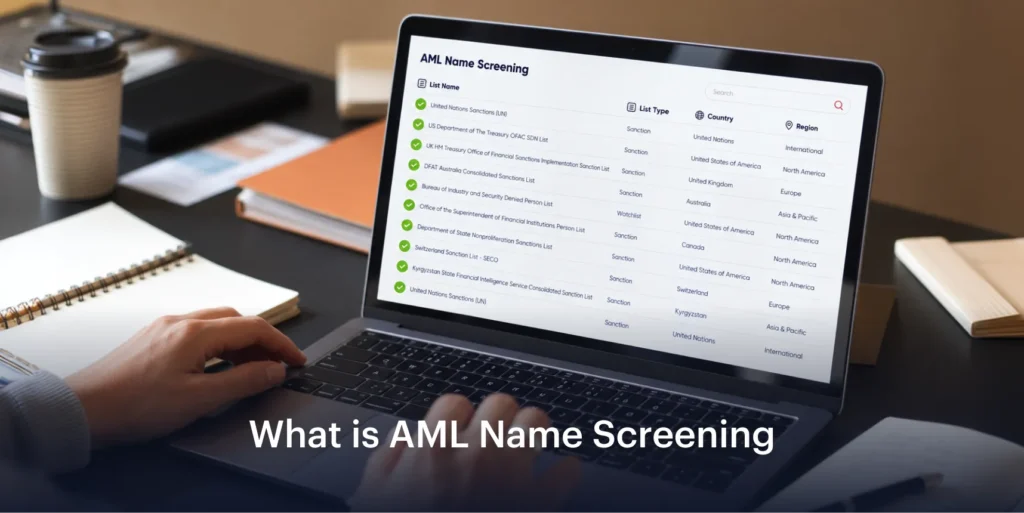

A customer’s name can look ordinary but it may still trigger an important compliance check. AML Name screening is the process of comparing a person’s or organisation’s name against relevant risk databases to identify potential connections to financial crime or regulatory risks.
A match does not automatically mean that the customer is a risk. Two people can share the same name while the spelling of one person’s name may appear differently across databases and countries. AML Name screening therefore needs to look beyond an exact name match and consider other available information before an alert is treated as a genuine match.
What Is AML Name Screening?
AML Name screening helps businesses check whether a customer, company or other relevant party may appear in records associated with financial or regulatory risk.
Depending on the screening requirements, these checks can include:
- Sanctions lists
- Politically Exposed Persons (PEPs)
- Regulatory watchlists
- Adverse media
AML Name screening is commonly used during customer onboarding and can also be repeated when relevant risk information changes.
How Does AML Name Screening Work?
The process starts with information collected about a customer or business, usually their name and where available, additional identifiers such as date of birth, nationality, address or identification number.
The screening system compares this information against relevant records and looks for potential matches. It may account for:
- Different spellings
- Aliases and former names
- Name order
- Transliteration between writing systems
- Minor character differences
Additional identifiers can then help determine whether the customer is actually the person or entity listed in the record. The FCA recommends considering information such as name, date of birth, address and other customer data when assessing potential sanctions matches.
What Does AML Name Screening Check?
AML Name screening can cover several types of risk information.
Sanctions Screening
Sanctions screening software checks whether a person or organisation appears on applicable sanctions lists. These lists can include individuals, companies, organisations and other designated parties.
The US Office of Foreign Assets Control (OFAC) maintains sanctions-related information and explains how businesses can use its lists when screening customers and other parties.
PEP Screening
PEP screening identifies people who hold or have held prominent public functions.
Being a PEP does not mean that someone has committed a crime. It indicates that the person may require additional measures because their position can create higher exposure to corruption or bribery risks. FATF recommends applying appropriate additional measures to relationships involving foreign and in certain circumstances, domestic PEPs and their family members and close associates.
Adverse Media and Watchlists
Businesses may also screen names against adverse media and other watchlists to identify information that could be relevant to a customer’s financial crime risk.
Why Do AML Name Screening Systems Produce False Positives?
Names are not unique identifiers. An aml screening system may therefore flag a legitimate customer simply because their name resembles that of someone appearing on a sanctions list or other risk database.
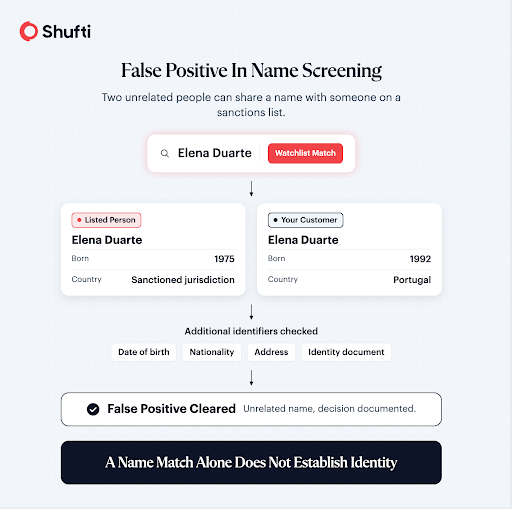
The FCA has highlighted the importance of appropriately calibrated screening systems, noting that poorly configured systems can generate excessive false positives while insufficiently sensitive systems can miss relevant matches.
How Do Name Variations Affect Screening?
Names can appear differently depending on language, country or how information was entered into a database.
Common variations include:
- Different spellings
- Reversed name order
- Accents and diacritics
- Abbreviations
- Aliases
- Transliteration
For example, an Arabic, Russian, Chinese or cyrillic based name can have several valid spellings when written in Latin characters. An exact-match system could miss a relevant record simply because the characters are different.
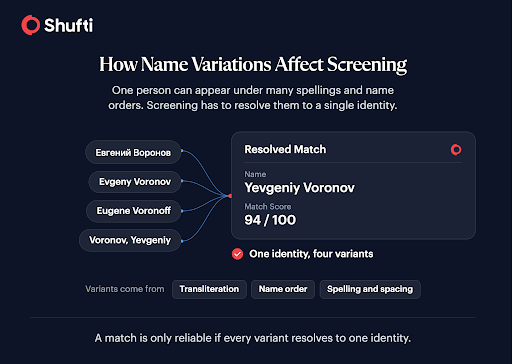
Fuzzy matching and phonetic matching can help identify potential matches even when names are not identical. The FCA recognises fuzzy matching as one approach for identifying variations in names and other customer information.
Name Screening in AML Compliance
AML Name screening is an important part of customer and entity screening, particularly when a business needs to identify potential sanctions or PEP exposure.
It should not, however, be treated as a one-time exercise. Sanctions lists and other risk information can change, meaning businesses may need to screen customers again when relevant updates occur. The FCA highlighted the importance of keeping screening systems and data up to date.
Shufti’s AML Screening software uses names and additional customer information to screen against sanctions, PEP, watchlist and adverse media data. Its matching process accounts for variations such as aliases, transliteration and phonetic similarities to help identify and assess potential matches.
Frequently Asked Questions
What is fuzzy matching in aml name screening?
Fuzzy matching looks for potential matches when names are similar but not identical. It can account for differences in spelling, name order, characters, and other variations.
Does AML name screening only check sanctions lists?
No. Depending on the screening requirements, name screening can also be used to check PEPs, watchlists, adverse media, and other relevant risk information.
When should businesses perform AML name screening?
Businesses commonly perform aml name screening during customer onboarding and may repeat checks when sanctions lists or other relevant risk information are updated.
Should beneficial owners be included in AML name screening?
Where required by applicable rules and the firm's risk-based policy, relevant beneficial owners and controlling persons should be identified and screened. The exact ownership threshold and treatment depend on the jurisdiction and use case.