AMLR Solutions
  AMLR Consultation
 EUDI Wallet
 Onboarding
 Ongoing Monitoring
 FRAML
FRAML KYC
KYC KYB
KYB KYI
KYI Age Assurance
 Workforce IAM
 Candidate Verification
 Account Takeover
 Bonus/ Promotion Abuse
 Chargeback Fraud
 Deepfake
 Document Fraud
 Fraud Networks
 Impersonation Fraud
 Money Mule Activity
 Multi-Accounting
 Party Fraud
 Regulatory & Compliance Risks
 Synthetic Identity Fraud
 Adult Content
 Banking
 Crypto
 Fintech
 Forex
Forex Compliance
 Fraud prevention
 Trust & safety
 Global expansion
 Compliance Officers
 Developers
 Fraud Analysts
 Product Managers
 Journey Builder
  Global Trust Platform
 Customer Profiles
 Vendor Comparison
 IDV Case Management
 AML Case Management
 Regulatory Reporting
 Agentic Rule Builder
  AI Compliance Co-Pilot
  Fraud Analytics
 Fraud Hub
  OCR
OCR Shufti AI
 Bank Account Verification
  Biometric Duplication
 Database Checks
 Document Intelligence
 Government ID
 Mobile Driver's License
 NFC
NFC Selfie Liveness
 Brand Personalisation
 Deployment Options
 Identity Methods
 IDV Modes
 Multi-tenancy
 On-Premise IDV
 Secure Capture
 Shufti MCP














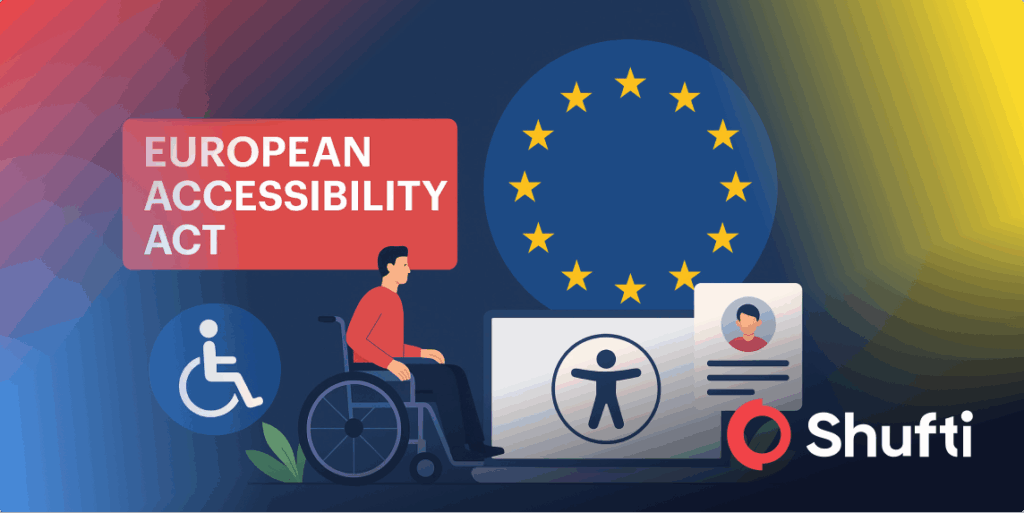
From 28 June 2025, accessibility is not optional in the EU. The European Accessibility Act (EAA) requires certain products and consumer-facing services to meet defined accessibility requirements. The goal of EAA is to remove barriers so people with disabilities can use essential digital services on equal terms—while harmonising rules across the Single Market.
What Is the European Accessibility Act?
The EAA is an EU directive aimed at ensuring equal access to essential products and services for people with disabilities.
The EAA applies to a specific list of products (e.g., ATMs, e‑readers) and to key consumer services delivered through websites and mobile apps—such as electronic communications, audiovisual access services, consumer banking services, passenger transport elements, e‑commerce services, and e‑books. The Directive sets functional accessibility requirements in Annex I (e.g., information must be perceivable, operable, understandable, and robust) and expects service providers to document how they meet them. It also establishes enforcement, penalties, and transitional arrangements.
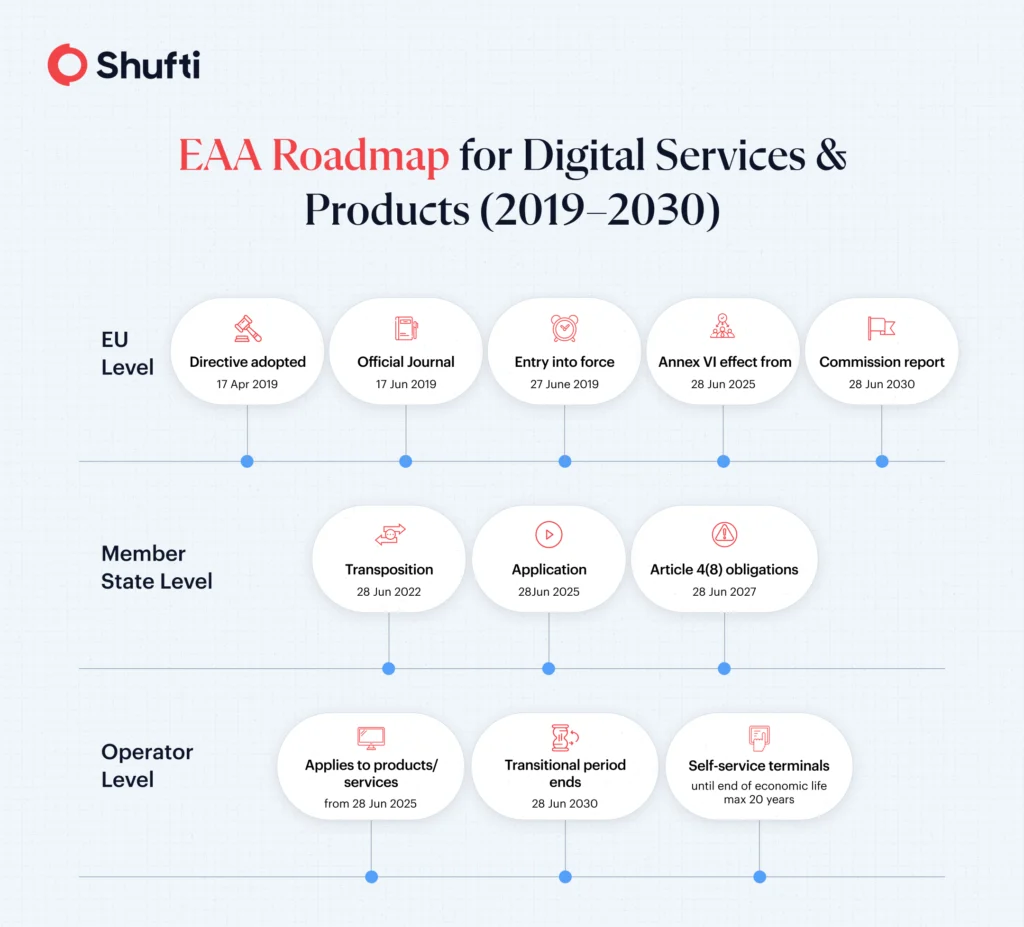
The framework includes transitional allowances, for example, limited continued use of pre‑existing terminals and an exemption for microenterprises that provide services. Conformity is demonstrated against Annex I’s functional requirements and, where applicable, through harmonised standards referenced in the Official Journal, which provide a presumption of conformity.
How the EAA Impacts IDV in Banking and E-commerce?
The EAA does not regulate identification methods in isolation; it addresses broader service categories in which identity verification is one step in the journey. Two categories are particularly relevant to IDV as mentioned in functional requirements in section IV (Annex I).
In consumer banking services, verification is integral to opening accounts, authorising payments, and securing sessions, and the law requires that identification methods, electronic signatures, security, and payments be accessible.
In e‑commerce services, online shopping and marketplace flows often require identity or age checks for higher‑risk use cases; where such functionality is delivered as part of the service, it must be accessible to people with disabilities.
How will the EAA change IDV journeys?
The EAA shifts accessibility from voluntary practice to enforceable outcome. Verification flows embedded in onboarding or checkout should meet Annex I’s functional requirements and interoperate with assistive technologies across web and mobile surfaces.
In practice this will means that:
- guidance and status updates need to be perceivable in text and announced correctly by assistive technologies
- controls must be operable without a mouse, with predictable focus order and adequate target size
- content and error handling should remain understandable, using plain language and forgiving recovery
- and implementations should be robust across mainstream browsers, operating systems, and assistive technologies
EAA requires organisations to publish clear information about accessibility features and maintain internal assessments where a claim of disproportionate burden is made.
For time‑critical steps such as facial biometrics, can benefit from adjustable time limits, non‑motion alternatives where appropriate, and multi‑modal prompts.
What Are Common Accessibility Barriers in IDV and How to Fix Them?
People who are blind or have low vision commonly encounter missing labels and roles, instructions delivered only visually, and contrast or reflow issues that make copy unreadable. Deaf and hard‑of‑hearing people are affected when prompts rely exclusively on audio tones or spoken instructions, and when help materials lack captions or transcripts. Cognitive and neurodivergent users are often challenged by complex wording, unpredictable focus changes, or motion patterns that distract or trigger discomfort.
Some of the identity verification functions such as Active liveness in face verification is likely to be challenging for certain users, because it often depends on head‑turns or following a moving dot within short time windows. People with limited neck mobility or tremors may find head rotations physically difficult, and those with attention differences may struggle with multi‑step, time‑sensitive challenges.
Where policy allows, verification can adopt a passive‑first approach with active liveness reserved as a step‑up, and a non‑biometric fallback is provided for users who cannot complete a biometric step.
Sector-wise IDV scenarios, Challenges and Fixes
| Sector | IDV moment | Likely barrier (disability) | EAA‑aligned fixes |
| Consumer banking | Account opening; step‑up for higher‑risk payments | Visual head‑turn prompts; insufficient screen‑reader cues (low vision/blind) | Passive‑first with prompts and captions; adjustable time windows |
| E‑commerce & marketplaces | Age checks; high‑value orders; seller onboarding | Small targets; cognitive overload in multi‑step flows | Larger targets; passive‑first with clear error recovery |
| Telecommunications | SIM registration; device financing; account recovery | Kiosk flows without keyboard paths; audio‑only beeps | Full keyboard navigation; visible textual cues; |
| Public sector & eGovernment | Benefits, permits, e‑signatures, notified eID | Dense language; multi‑step challenges; attention constraints (cognitive) | Plain language; clear step indicators; consistent prompts; |
| Transport, travel & hospitality | Loyalty/ticketing account creation; entitlement verification | Motion‑heavy guidance; photosensitive discomfort; low‑vision contrast issues | Static or minimal‑motion instructions; adjustable timing; high contrast |
| Gaming & gambling | Age/identity at registration or limit changes | Rapid animations; audio‑only cues; small targets | Passive‑first liveness; captioned visual prompts; larger targets |
| Crypto & digital assets | Onboarding; withdrawals; step‑up on risk events | Low bandwidth; strict timeouts | Offline capture with progressive upload; clear lighting guidance |
How to Turn EAA Principles into Accessible IDV Flows?
An effective plan begins with baselining: abandonment points such as permission prompts, glare loops, and liveness timeouts are identified and then exercised with keyboard navigation, popular screen readers, and low‑vision settings. The next step is to refactor essential components so that labels, roles, and focus order are reliable, and non‑text content has meaningful text alternatives. Time‑critical stages, particularly liveness and capture, are then tuned with adjustable limits and non‑motion guidance where appropriate.
Content and support channels should be hardened by publishing instructions and help materials in accessible formats and ensuring that customer support can respond in accessible modes where offered. Finally, documentation and monitoring close the loop: accessibility statements are maintained for the relevant service surfaces, methods of meeting requirements are recorded, and reviews are scheduled for significant releases or policy changes.
How Does Shufti Make IDV Accessible for All?
Shufti provides identity verification capabilities designed to support higher levels of assurance in identity verification, with customized user verification flows to ensure convenience.
Shufti’s identity document verification solution is built from scratch with capabilities to offer bespoke solutions as per an organization’s requirements. The platform supports both active and passive liveness and is capable of providing non‑biometric fallbacks such as assisted verification and document‑plus‑human review. This mix allows verification journeys to favour passive checks for accessibility and speed while reserving active challenges for step‑up scenarios.
Integration options include SDKs and APIs that assist teams in implementing clear labels, predictable focus, multi‑modal prompts, and accessible help content across web and mobile surfaces. Implementation guidance and documentation are available to support procurement and internal compliance reviews, ensuring that accessibility remains a first‑class consideration throughout deployment and operations.