AMLR Solutions
  AMLR Consultation
 EUDI Wallet
 Onboarding
 Ongoing Monitoring
 FRAML
FRAML KYC
KYC KYB
KYB KYI
KYI Age Assurance
 Workforce IAM
 Candidate Verification
 Account Takeover
 Bonus/ Promotion Abuse
 Chargeback Fraud
 Deepfake
 Document Fraud
 Fraud Networks
 Impersonation Fraud
 Money Mule Activity
 Multi-Accounting
 Party Fraud
 Regulatory & Compliance Risks
 Synthetic Identity Fraud
 Adult Content
 Banking
 Crypto
 Fintech
 Forex
Forex Compliance
 Fraud prevention
 Trust & safety
 Global expansion
 Compliance Officers
 Developers
 Fraud Analysts
 Product Managers
 Journey Builder
  Global Trust Platform
 Customer Profiles
 Vendor Comparison
 IDV Case Management
 AML Case Management
 Regulatory Reporting
 Agentic Rule Builder
  AI Compliance Co-Pilot
  Fraud Analytics
 Fraud Hub
  OCR
OCR Shufti AI
 Bank Account Verification
  Biometric Duplication
 Database Checks
 Document Intelligence
 Government ID
 Mobile Driver's License
 NFC
NFC Selfie Liveness
 Brand Personalisation
 Deployment Options
 Identity Methods
 IDV Modes
 Multi-tenancy
 On-Premise IDV
 Secure Capture
 Shufti MCP














A customer passed your onboarding checks six months ago. Today, someone logs into that same account from a new device, in a new country, and wires all the money to a beneficiary to whom the customer has never even paid before. The question is: Is it still them?
That question is the core reason behind the need for identity reassurance. One-off verification at signup just tells you who opened the account. It does not necessarily tell you who is using the account right now. For banks, fintechs, and crypto platforms, the present gap between these answers is where most fraud not only lives but has learned to thrive, too.
The problem in question: identity is not a one-time event
Most compliance teams still treat identity like a door lock. They check the ID initially, let the person in, and assume they are going to be the same person forever, underestimating the lengths to which fraudsters go to work. They have spent a decade exploiting this very assumption.
Account takeover, synthetic identity misuse, and social-engineering scams happen until after the verification process is completely done. As per Javelin Strategy & Research’s 2024 Identity Fraud Study, identity fraud and scams have cost US consumers an amount of $43 billion in one single year, with account takeover alone amounting for $15.6 billion. The fraud did not happen at KYC. It happened many months later, against the very accounts that had already cleared it.
Identity reassurance, however, answers an even more difficult question: how confident are we that the person acting on this account, right now, is still the same person we had initially verified?
How does reassurance differ from verification and assurance?
Following are the three terms that get used in exchange for one or another, but they remain very different in their core definition.
Identity verification: is basically collecting a document, running a database check as well as matching a selfie. It happens at a moment in time, usually during the onboarding process.
Identity assurance: is the level of confidence that is produced by that verification. NIST SP 800-63-3 has defined different Identity Assurance Levels (IAL1–IAL3) primarily based on how rigorously the identity was proofed. The UK’s Good Practice Guide 45 scores assurance as Low, Medium, High, or Very High across five different components.
Identity reassurance: is assurance carried forward over a passage of time. The running score of how trustworthy an identity remains as the customer transacts, logs in from new devices, or behaves outside the baseline. If simply put together, verification plays the role of proving the identity once, assurance further grades that proof and reassurance keeps the grade honest, throughout.
Proof that the Single-Verification Model is Breaking
The FATF’s Digital Identity Guidance instructs regulated entities that identity assurance should be risk-proportionate and it should be subject to reassessment across the customer lifecycle, not just specifically fixed at onboarding. Synthetic identity fraud routinely passes first-time KYC because every separate individual data point checks out. It only fails when someone looks at the pattern of behaviour afterward.
Onboarding with the assistance of deepfake adds more to the pressure. Even biometrically strong verification can be defeated without liveness checks against already known presentation attacks. The US Department of Homeland Security’s Remote Identity Validation Technology Demonstration has shown that many systems which clear paper certifications still fail in the end.
A customer’s “verified” status at onboarding tells you almost nothing about their risk, one year in.
Where do most already existing solutions fall short in identifying fraud?
Three patterns come up repeatedly in fraud post-mortems:
- Static KYC scoring. Scored once, flagged green, never updated unless a human has made an effort to reset it. Shared devices, compromised credentials as well as behavioural drift don’t show up.
- Compliance tools and Siloed fraud. The KYC system says the customer is legitimate; the fraud engine says the session looks wrong. Nothing stitches the two views together.
- No feedback loop from ongoing AML. A PEP status changes, a sanction is added, a new adverse media hit appears and the data sits in a batch report nobody reads until quarterly review.
Reassurance closes such gaps by treating identity confidence as a live variable, not a line item in the KYC file.
What signals build an identity confidence score?
An identity confidence score condenses signals into a number or band (Low / Medium / High / Very High, following GPG 45, or a 0–100 score) that downstream systems are able to act on.
Five signal groups feed it:
- Document and biometric evidence from the original verification type, issuer, tamper checks, selfie-to-document match.
- Database and eID corroboration. eIDV checks against government registries, credit bureaus, and national eID schemes return a confirmation in seconds.
- Behavioural and device signals login geography, device fingerprint, session velocity. A sudden shift from a Frankfurt iPhone to a Lagos Android at 3 am is a reassurance event, not just a fraud alert.
- Ongoing screening results sanctions, PEP, and adverse media updates from continuous AML screening.
- Re-verification triggers step-up biometric checks at high-risk moments (new beneficiary, large transfer, credential reset).
No single signal is decisive. Reassurance is the weighting that reflects real risk without punishing legitimate customers for a new phone.
Which industries need this most?
Digital banks and fintechs onboard remotely and face the full weight of payments fraud. Crypto exchanges deal with irreversible transactions under MiCA and the FATF Travel Rule. Gambling operators face age-assurance obligations that can shift mid-session. Insurers and lenders have long relationships where identity attributes drift.
The EU’s eIDAS 2.0 regulation and its incoming Digital Identity Wallet already treat identity as a reusable, continually attested credential. Reassurance is where regulation is moving.
How Shufti builds reassurance into a single platform
Shufti’s identity verification platform was designed for the lifecycle, not just the front door. Businesses can start with onboarding and extend into reassurance without replatforming.
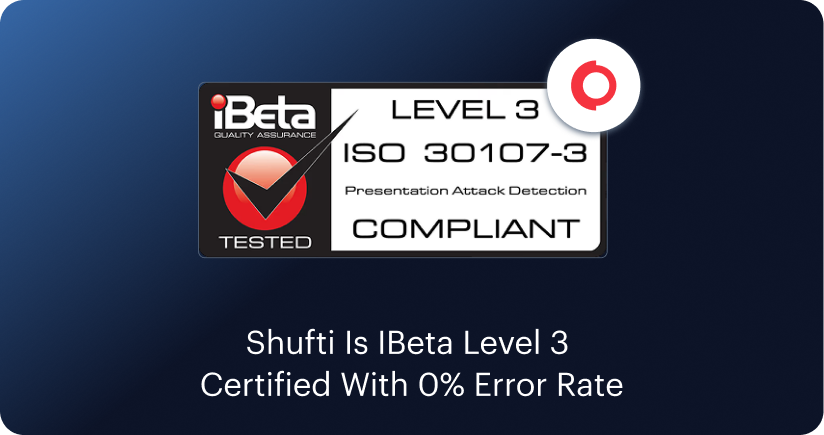
- Initial proofing. Document verification, biometric selfie match, and face verification with liveness detection establish an IAL2 or IAL3-equivalent starting assurance. Shufti’s biometric engine is iBeta Level 1 and Level 2 certified and was a DHS RIVR 2025 Top Performer.
- Database and eID corroboration. eIDV Pro covers 85+ countries passively and 30+ national eID schemes actively, returning a sub-3-second confirmation.
- Ongoing AML Continuous screening against 3,500+ watchlists, 2.6 million PEP profiles, and 50,000+ adverse media sources keeps the confidence score current.
- Step-up verification. FastID handles reusable identity for returning users, and risk-triggered re-verification fires a biometric or document check when an event warrants it — not on every login.
- Risk scoring. User Risk Assessment rolls the signals into one score that plugs into downstream fraud, transaction monitoring, and KYC workflows.
Compliance and fraud teams stop arguing over which system “owns” the customer. They share one score, updated in near real time, with a full audit trail of which signals moved it.
Measuring reassurance, and where to start
You don’t need to rebuild your identity stack. Three questions tell most teams where the gaps are:
- If a customer’s PEP or sanction status changed tomorrow, how long until your systems reflect it?
- When a user logs in from a new country and initiates a large transfer, does any system combine their KYC status with the session risk?
- If a regulator asked why you still trust a two-year-old verification, what evidence would you hand over?
If the honest answers are “weeks,” “no,” and “not much,” reassurance is the next investment, not another point solution.
Shufti’s platform answers all three with a single integration. To see what a live confidence score looks like against your own onboarding flow, request a demo or discuss a tailored assessment for your banking or fraud prevention use case.
Frequently Asked Questions
What is identity reassurance in KYC?
It is the ongoing confidence a regulated business holds in a customer's identity after the initial KYC check. Where KYC verifies identity at onboarding, reassurance keeps that verification current through continuous AML screening, behavioural signals, and step-up biometrics.
How is identity reassurance different from identity verification?
Verification is a single event. Reassurance is a running state. Verification asks "is this person who they claim to be right now?" Reassurance asks "are we still confident in that answer a month or a transaction later?"
How is identity reassurance different from identity assurance?
Assurance is the confidence level produced by a verification, usually graded against NIST IAL or UK GPG 45. Reassurance is that assurance level maintained and updated over time. Assurance is a snapshot; reassurance is a video.
What are the different levels of identity assurance?
NIST SP 800-63-3 defines three levels: IAL1 (self-asserted), IAL2 (remote proofing with evidence), and IAL3 (supervised proofing with biometric binding). UK GPG 45 uses Low, Medium, High, and Very High. EU eIDAS recognises Low, Substantial, and High.
How do you measure identity reassurance?
Through a confidence score that combines original proofing strength, eIDV corroboration, ongoing AML results, device and behavioural signals, and step-up verification outcomes. Scores are usually expressed on a 0–100 scale or in GPG 45 bands.
Why is identity reassurance important for digital banking?
Digital banks onboard at volume and transact in real time. They face account takeover and synthetic identity fraud at rates legacy KYC can't catch. Reassurance separates a customer who was trustworthy six months ago from one who still is.
How does identity reassurance prevent fraud at onboarding?
At onboarding it shows up as layered verification: document checks, biometric liveness, eIDV corroboration, and sanctions screening combined into a single confidence band rather than a pass/fail. That layering blocks synthetic identities and deepfake-assisted applications.
What signals are used to build identity reassurance?
Document and biometric evidence, eIDV database checks, behavioural and device telemetry, ongoing AML hits, and step-up verification outcomes combined in Shufti's user risk assessment.
Which industries need the highest level of identity reassurance?
Banking, crypto, payments, lending, regulated gambling, and insurance any sector with irreversible transactions or heavy AML exposure operates near the IAL3 / GPG 45 Very High end.