AMLR Solutions
 AMLR Consultation
 Onboarding
 Ongoing Monitoring
 FRAML
FRAML KYC
KYC KYB
KYB KYI
KYI Age Assurance
 Workforce IAM
 Candidate Verification
 Account Takeover
 Bonus/ Promotion Abuse
 Chargeback Fraud
 Deepfake
 Document Fraud
 Fraud Networks
 Impersonation Fraud
 Money Mule Activity
 Multi-Accounting
 Party Fraud
 Regulatory & Compliance Risks
 Synthetic Identity Fraud
 Adult Content
 Banking
 Crypto
 Fintech
 Forex
Forex Compliance
 Fraud prevention
 Trust & safety
 Global expansion
 Compliance Officers
 Developers
 Fraud Analysts
 Product Managers
 Advanced Journey Builder (AJB)
 Global Trust Platform
 Customer Profiles
 Vendor Comparison
 IDV Case Management
 AML Case Management
 Regulatory Reporting
 Travel Rule Protocols
 Agentic Rule Builder
 AI Compliance Co-Pilot
 Fraud Analytics
 Fraud Hub
 OCR
OCR Shufti AI
 Bank Account Verification
 Biometric Duplication
 Database Checks
 Document Intelligence
 Government ID
 Mobile Driver's License
 NFC
NFC Selfie Liveness
 Brand Personalisation
 Deployment Options
 Identity Methods
 IDV Modes
 Multi-tenancy
 On-Premise IDV
 Secure Capture















Tl:DR
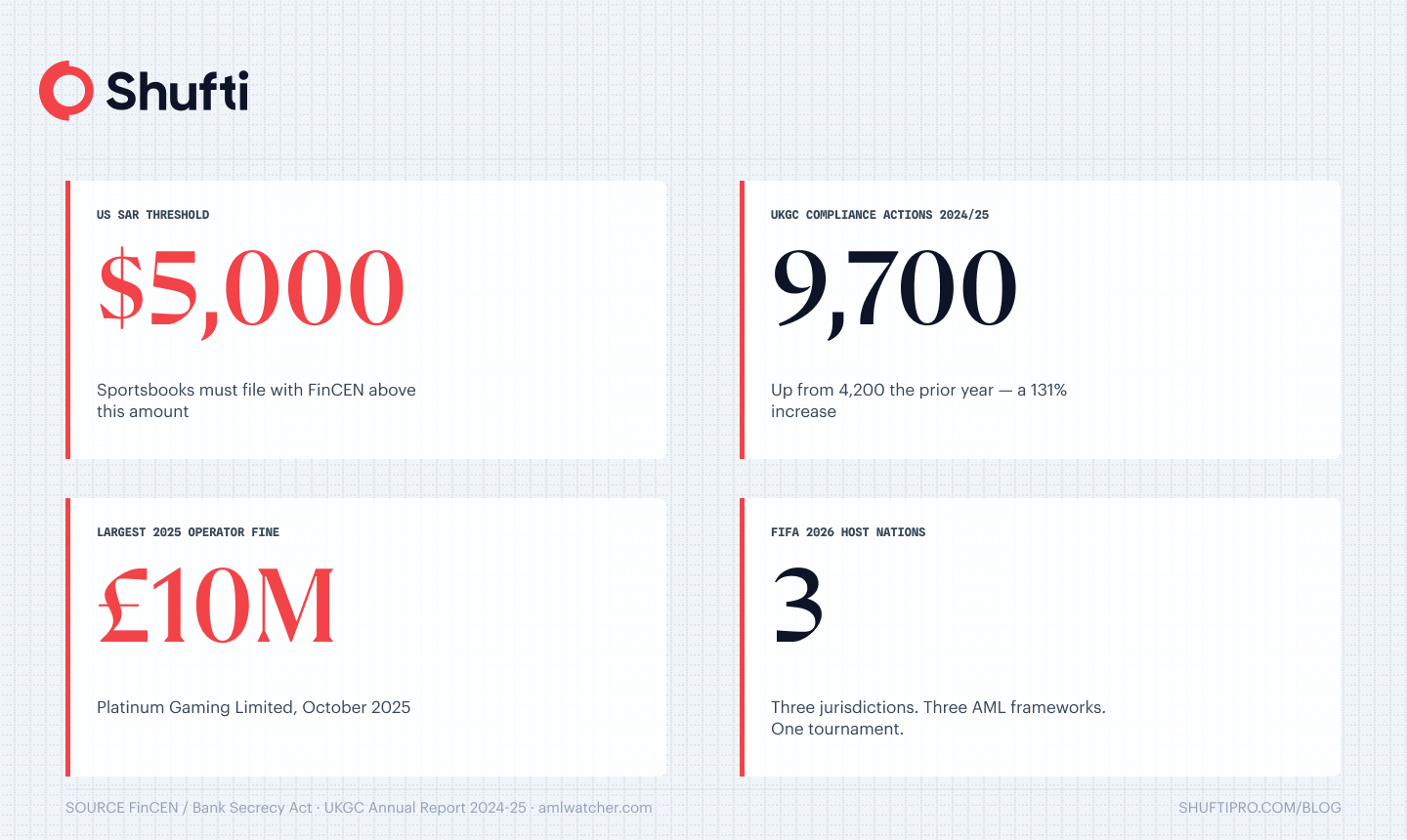
- FIFA 2026 spans three jurisdictions, each with distinct AML frameworks for sportsbook operators.
- FinCEN requires US sportsbooks to file SARs on suspicious activity at $5,000 and above.
- The UKGC carried out 9,700 compliance actions in 2024/25 and fined one operator £10 million in 2025.
- High-volume tournament windows compress the time available for fraudsters to layer illicit funds through betting accounts.
- Operators without real-time transaction monitoring and PEP screening enter the tournament already exposed.
In October 2025, the UK Gambling Commission fined Platinum Gaming Limited £10 million for significant gaps in its AML and safer gambling controls. The fine was not a consequence of missing technology. Monitoring systems existed. Policies were documented. The failure was in the space between knowing who deposited and understanding whether the funds were clean. FIFA 2026 opens that same gap at scale. Across 104 matches spanning 16 US cities, three Canadian venues, and three Mexican host sites, sportsbooks will absorb transaction volumes that stress-test every control they run. Operators who treat the tournament as a marketing event without treating it as a compliance event will face the same enforcement environment that produced that £10 million figure.
This article covers the money laundering methods fraudsters use during major tournaments, what the regulatory frameworks across all three host nations actually require, and how AML screening and transaction monitoring work in practice when traffic spikes.
Why major tournaments are the highest-risk AML window in iGaming
FIFA tournaments create the highest-risk AML window in iGaming because they combine volume, velocity, and cross-border complexity inside a window that lasts weeks, not months. Each of those three factors independently degrades AML controls. Together, they create conditions that sophisticated money laundering operations actively plan around.
Volume compresses due diligence timelines
New account registrations, deposits, and live-bet transactions that arrive in the 48 hours around a high-profile fixture can exceed what a sportsbook processes in a typical week. Customer due diligence (CDD) checks that take four hours to clear under normal conditions need to clear in minutes during a live match window. When verification queues build, two things happen. Operators accept customers before checks complete, and legitimate players abandon onboarding. Both outcomes create compliance exposure, one with regulators and one with revenue targets.
Cross-border fan traffic creates anonymity gaps
FIFA 2026 is the first World Cup co-hosted across three countries with structurally different regulatory systems. Fans traveling from Brazil to New York, or from Morocco to Guadalajara, arrive with unfamiliar identity documents, IP addresses that do not match their billing country, and payment instruments drawn on foreign banks. Each combination is a potential red flag under transaction monitoring rules. A monitoring system not calibrated for this level of cross-border variation will either miss genuine risk or misfire on legitimate customers at exactly the moment conversion matters most.
What money laundering through online gambling looks like during a tournament
The money laundering techniques most commonly used through online sports betting accounts during major events follow three recognizable patterns. Identifying them in advance is what separates a reactive compliance team from a proactive one.
Structuring through deposit fragmentation
Structuring breaking a large sum into multiple smaller deposits to stay below reporting thresholds is the most common placement technique in the gambling sector. During a tournament window, structuring becomes harder to detect because high volumes of small deposits from new accounts are superficially indistinguishable from legitimate fan onboarding. The Financial Action Task Force (FATF) identifies structuring as the primary layering method in its guidance on the vulnerabilities of casinos and the gaming sector.
Rapid deposit-withdrawal with minimal gameplay
A deposit placed, a minimal wager made, and a withdrawal requested gives the player a transaction record from a licensed, regulated sportsbook. The apparent legitimacy of that withdrawal partially obscures the origin of the funds. The UK Gambling Commission’s April 2025 emerging-risk bulletin specifically named this pattern as a top monitoring priority: customers buying in through multiple payment methods and requesting withdrawals with little or no gambling activity.
Multi-account syndicate rings exploiting bonus structures
Syndicates open multiple accounts under different identities, often using synthetic or stolen documents, to claim welcome bonuses, place coordinated bets across accounts, and withdraw at net profit. The coordination is invisible without behavioral analysis that links session activity across accounts. A player profile that looks clean in isolation can belong to a ring of 20 accounts operating simultaneously on the same platform.
What AML regulations actually require across all three host nations
AML requirements for sportsbooks differ meaningfully across the US, Canada, and Mexico. What counts as a reportable transaction, which body owns enforcement, and what triggers enhanced due diligence each depend on local law.
|
Jurisdiction |
Primary AML Framework |
Oversight Body |
SAR/STR Threshold |
CDD Trigger |
|
United States |
Bank Secrecy Act (BSA) |
FinCEN + state gaming regulators |
$5,000 for suspicious activity; CTR for cash above $10,000 in 24 hours |
At account opening; ongoing monitoring required |
|
Canada |
Proceeds of Crime (Money Laundering) and Terrorist Financing Act (PCMLTFA) |
FINTRAC |
CAD 10,000 for large cash transactions |
At account opening; CAD 10,000 single transaction |
|
Mexico |
Ley Federal para la Prevención e Identificación de Operaciones con Recursos de Procedencia Ilícita (LFPIORPI) |
SAT / CNBV |
MXN 645,000 (approx. USD 32,000) in cash |
Activity-based; legislative modernization underway |
A note on Mexico: as of September 2025, Mexican gambling regulators began a formal review of the LFPIORPI framework ahead of FIFA 2026, specifically targeting gaps that allow foreign operators to serve Mexican players without adequate oversight. That review is ongoing and may produce updated thresholds before the tournament opens in June.
The practical implication for operators across all three markets is direct: a single compliance policy will not satisfy three distinct regulators. Jurisdiction-specific monitoring procedures, separate reporting workflows, and staff trained on each framework are the floor, not the ceiling.
How does transaction monitoring work in iGaming AML?
Transaction monitoring is the control layer that detects suspicious activity after a player clears initial customer due diligence. It runs continuously, not just at onboarding, and it is where most real-time money laundering detection in iGaming actually happens.
Rule-based triggers vs. behavioral anomaly detection
Most sportsbook monitoring systems run two layers. Rule-based triggers flag activity that crosses a defined threshold a single deposit above a set amount, or a withdrawal request within a short window of a first deposit. Behavioral anomaly detection builds a baseline profile of each player’s typical activity and flags deviation from it. A player who increases their average bet size by 400% in a single session, or who suddenly deposits from a new device registered in a different country, triggers a review even if no individual transaction crosses a filing threshold.
PEP and sanctions screening during high-volume spikes
Politically Exposed Persons (PEPs) and individuals on OFAC, EU consolidated, or UN sanctions lists represent a distinct risk category requiring screening at onboarding and at defined intervals afterward. During a World Cup window, the volume of new account openings means screening results need to return before deposits are processed, not after. A screening queue that backlogs during peak traffic creates a gap where a sanctioned individual completes onboarding and deposits funds before any alert is raised.
Enhanced due diligence for VIP and high-stakes bettors
Enhanced due diligence (EDD) applies to players whose activity or profile places them in a higher-risk category: VIP accounts with elevated deposit limits, players who disclose politically sensitive employment, or accounts that show rapid bet escalation early in their lifecycle. EDD requires collecting source-of-funds evidence, bank statements, payslips, or employer records and reviewing it against the transaction record. FATF’s risk-based approach guidance for casinos specifies that EDD should be proportionate to assessed risk, not applied uniformly across all high-deposit accounts.
How Shufti keeps sportsbooks audit-ready during tournament spikes
The compliance failure behind October 2025’s £10 million UKGC fine was not a technology gap. It was an accountability gap onboarding identity data, transaction behavior, and ongoing monitoring operated as separate layers with no unified view connecting them.
Shufti’s AML screening covers risk from onboarding through continuous transaction monitoring and watchlist screening in one decisioning layer, not three vendor handoffs. PEP and sanctions coverage spans 1,200+ databases including OFAC, EU consolidated, UK HMT, and UN lists, with results returning in real time before a deposit is processed. During the traffic spikes that define a tournament window, match scoring is risk-tunable: your compliance team sets alert thresholds calibrated to your customer base, rather than accepting a vendor default that floods the review queue the moment volumes peak. Every screening decision is explainable because the models are Shufti’s own — the audit pack regulators ask for exists because the decisioning layer is built and owned end-to-end.
See how Shufti’s AML screening keeps your sportsbook audit-ready before June 11 book a demo.
Frequently Asked Questions
What AML regulations apply to sports betting during FIFA 2026?
In the US, sportsbooks follow the Bank Secrecy Act under FinCEN oversight, filing SARs for suspicious activity at $5,000 and above and Currency Transaction Reports for cash transactions exceeding $10,000 in a 24-hour period. Canada's PCMLTFA requires reporting to FINTRAC for large cash transactions above CAD 10,000. Mexico's LFPIORPI framework is under active regulatory review ahead of the tournament. All three markets require customer due diligence at onboarding and continuous transaction monitoring.
How do bookmakers detect money laundering during major sporting events?
Detection relies on two layers: rule-based triggers that flag activity crossing defined thresholds, and behavioral monitoring that builds individual player profiles and alerts on deviations from baseline. PEP and sanctions screening runs at onboarding and on an ongoing basis. Enhanced due diligence applies to higher-risk accounts, including VIPs with elevated deposit limits and players with politically sensitive backgrounds.
What is enhanced due diligence in sports betting AML?
Enhanced due diligence is an elevated review applied to players assessed as higher risk. It requires collecting source-of-funds evidence bank statements, payslips, or employment records and cross-referencing that evidence against the player's transaction history. FATF guidance specifies EDD should be proportionate to the assessed risk level, not applied as a blanket requirement to all high-deposit accounts.
What are the AML compliance differences between the US, Canada, and Mexico for sports betting?
The US requires SARs for suspicious activity at $5,000 and above, administered by FinCEN alongside state-level gaming regulators. Canada's FINTRAC framework applies PCMLTFA to sportsbooks, with large cash transaction reporting triggered at CAD 10,000. Mexico's LFPIORPI sets activity thresholds in pesos and is currently under legislative modernization review. A single compliance policy will not satisfy all three regulators; each jurisdiction requires its own monitoring procedures and reporting workflows.