









Cryptocurrency exchanges operate in one of the most scrutinized corners of global finance. As digital assets have moved from niche speculation into mainstream financial infrastructure, regulators worldwide have responded with increasingly detailed expectations around identity verification, transaction monitoring, and anti-money laundering controls. Know Your Customer compliance is now central to how exchanges earn -and keep – their operating licenses.
The sections below map the global regulatory framework for KYC crypto exchanges, the documents and data your exchange must collect, and the automation tools compliance teams are using to move past manual review.
What Do Global Crypto KYC Regulations Require in 2026?
Global crypto KYC regulations 2026 have converged around three frameworks that determine whether most exchanges can legally operate. Those are the EU’s MiCA, the US Bank Secrecy Act as supervised by the Financial Crimes Enforcement Network (FinCEN), and the UK Financial Conduct Authority (FCA) registration regime.
The Financial Action Task Force (FATF) standards run beneath all three, setting the global floor for AML and counter-terrorist financing obligations.
MiCA and the EU Travel Rule
Any crypto-asset service provider (CASP) operating in the European Union must hold MiCA authorization by July 1, 2026, or cease operations. There is no extension mechanism. MiCA Regulation 2023/1114 mandates that CASPs implement full KYC and AML/CFT processes, including customer identification, document verification, and ongoing transaction monitoring.
Alongside MiCA, the EU Transfer of Funds Regulation, which took effect December 30, 2024, applies the Travel Rule to all crypto transfers between CASPs regardless of transaction amount, requiring originator and beneficiary data to accompany every transfer. Exchanges can review a MiCA compliance strategy guide for a step-by-step breakdown of the CASP authorization process.
FinCEN, the BSA, and the GENIUS Act
US exchanges classify as Money Services Businesses (MSBs) under FinCEN’s Bank Secrecy Act (BSA) framework, which requires a Customer Identification Programme (CIP), sanctions screening, and suspicious activity reporting.A 2024 FinCEN update extended the Travel Rule to crypto transfers over $3,000, mandating that institutions transmit identifying information for both sender and recipient.
July 2025 brought additional obligations. The GENIUS Act placed payment stablecoins under the BSA, adding Office of Foreign Assets Control (OFAC) screening requirements for stablecoin issuers. Exchanges that route dollar-pegged stablecoins now carry those obligations directly.
UK FCA registration requirements
The UK FCA requires all crypto businesses serving UK customers to register under the 2017 Money Laundering Regulations before offering services. As of 2026, operating without FCA registration constitutes a criminal offense. Registration demands documented AML/KYC procedures, evidence of transaction monitoring systems, and proof of senior management competence.
The FCA cryptoasset registration page documents the full application requirements, including what evidence of transaction monitoring systems looks like and how senior management competence must be demonstrated, which signals how precisely FCA-compliant crypto KYC providers and exchanges must document their compliance programmes.
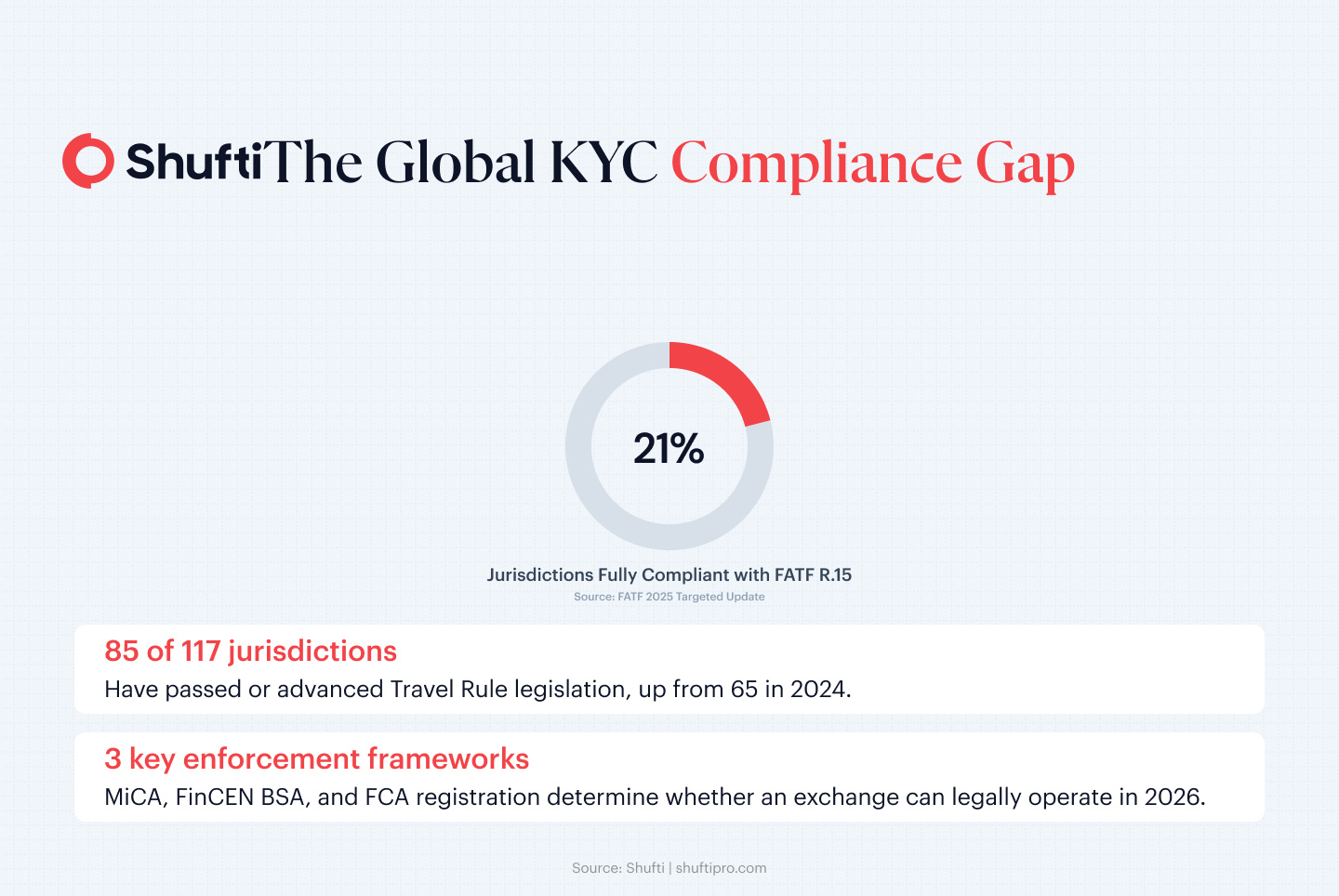
Across all three jurisdictions, the compliance gap remains significant. FATF’s 2025 targeted update on virtual assets found that only 21% of 138 assessed jurisdictions are fully compliant with FATF Recommendation 15, despite 85 of 117 jurisdictions having passed or advanced Travel Rule legislation. The legislation has arrived, the supervisory muscle is still developing, and exchanges that close their internal gaps first face fewer interruptions.
What Does KYC Onboarding Require for Crypto Exchanges?
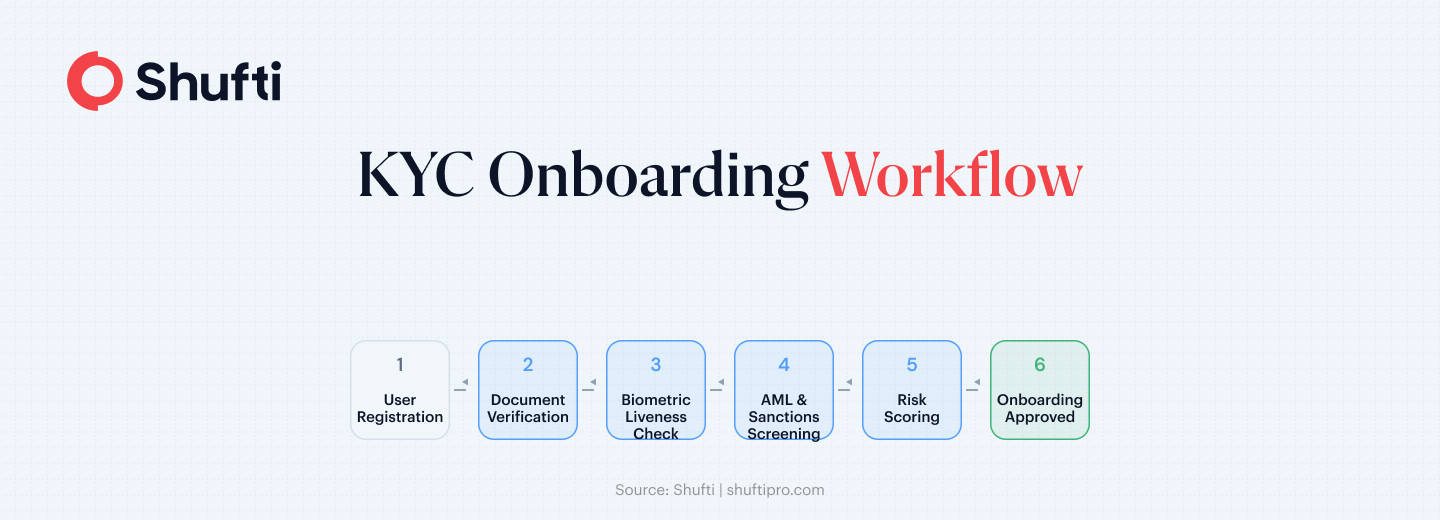
Exchanges working through the KYC checklist for crypto exchanges face the same core requirements across MiCA, FinCEN, and FCA frameworks. Verified identity, authenticated documents, biometric liveness checks, and sanctions screening must all be in place before any trading account goes live. The digital identity verification crypto firms must implement goes beyond a single document scan, combining biometric matching and AML screening into one sequential flow every new customer must clear before an account activates. The three main components differ in what they capture and why regulators require each one.
Identity document verification
Exchanges must collect government-issued photo identification from every user before account activation. Accepted document types include national ID cards, passports, driver’s licences, and residence permits, each verified against known document templates to catch forgeries and expired documents. In higher-risk onboarding scenarios, enhanced due diligence (EDD) adds source-of-funds documentation, proof of address, and corporate structure records for business accounts.
Document coverage across global document types is the first baseline regulators review when auditing KYC requirements for crypto exchanges, and gaps in document support frequently surface compliance failures in multi-market exchanges.
Biometric and liveness checks
A government ID alone is insufficient for anti-spoofing compliance. Exchanges now require a biometric match between the submitted document and a live selfie, with a liveness detection check that confirms the selfie was captured in real time and not sourced from a photograph or video replay.
FATF’s June 2025 update to Recommendation 16 strengthened the requirement for originator identity assurance in virtual asset transfers, making biometric verification a practical necessity rather than a compliance option. Exchanges that skip liveness detection are leaving a measurable gap in their anti-fraud posture.
AML and sanctions screening
AML and KYC compliance for crypto run in parallel rather than sequentially. At onboarding, every user and associated wallet address is screened against sanctions lists, Politically Exposed Persons (PEP) registers, and adverse media databases. This initial screening establishes a compliance baseline that follows the user throughout their lifecycle on the platform.
As the regulatory environment tightens, exchanges are expected to maintain these checks as an ongoing process rather than a one-time gate at registration.
How Can Crypto Exchanges Scale KYC Onboarding?
Manual review queues are where onboarding pipelines break. Exchanges handling thousands of new user registrations daily cannot scale compliance through human analysts alone, which is why KYC automation tools for exchanges have moved from optional to operational. Three approaches have proven most effective for compliance teams trying to reduce onboarding friction without relaxing verification standards.
Build around a single KYC API integration for crypto platforms
API architecture matters more than any single check. Exchanges that patch together separate APIs for document verification, biometric matching, and AML screening create integration overhead, inconsistent audit trails, and fragmented risk signals.
A unified KYC API integration crypto platform routes all checks through one endpoint, returns a single risk decision, and logs the full verification chain in one record. That record is what regulators inspect during audits, and a fragmented stack makes it substantially harder to demonstrate compliance end-to-end.
Automate document capture and biometric verification
The biggest friction points in crypto onboarding solutions are document capture and biometric matching. Automated document capture reduces user drop-off by guiding the session in real time, prompting for better lighting, correct document orientation, or a clearer image before the check runs.
Paired with AI-based biometric verification, exchanges can process identity checks in under 15 seconds without routing individual sessions to a human reviewer. KYC automation tools for exchanges deliver the clearest time-to-value here. The analyst queue shrinks to edge cases and exceptions, not every submission.
Choose KYC onboarding software with built-in AML coverage
Best KYC software for crypto exchanges bundles AML screening into the same workflow as identity verification, rather than treating them as sequential steps managed through separate dashboards. KYC onboarding software for crypto startups benefits particularly from platforms that include sanctions, PEP, and adverse media checks in the same API call as the identity check, because the operational overhead of managing separate vendors compounds quickly as user volume grows.
When evaluating crypto compliance services, ask how often watchlist data is refreshed, how many sanctions regimes are covered, and what risk categories the adverse media engine classifies. For a detailed breakdown of what regulators expect to see in a compliant stack, the latest regulatory updates on KYC verification for crypto exchanges covers the current supervisory priorities across MiCA, FCA, and FinCEN.
How Shufti helps crypto exchanges meet 2026 KYC requirements
Exchanges building toward MiCA CASP authorization or FCA registration need a verification stack that covers document capture, biometric liveness, AML screening, and risk scoring in one auditable workflow. Fragmented compliance stacks create the audit gaps regulators find first.
Shufti’s crypto KYC and AML platform runs document verification and AML screening through a single API, with coverage across 230+ countries, 10,000+ document types, and 100,000+ AML data sources that include 3,500 global watchlists, 2.6 million PEP profiles, and 215+ sanction regimes.
Watchlist data updates every 15 minutes, which matters when sanctions lists shift faster than batch-refresh cycles can catch. Full identity checks complete in under 15 seconds, keeping onboarding conversion rates intact while meeting the verification depth MiCA and FinCEN require.
Compliance teams running manual review as a first-pass process find that moving to automated identity verification routes only flagged sessions to human review rather than every submission. AML risk signals surface in the same record as the identity check, producing the unified audit trail that regulators expect to see, and that compliance teams need when responding to supervisory inquiries on tight timelines.
Crypto exchanges running fragmented verification stacks face both the operational cost of manual review and the regulatory risk of incomplete audit trails at exactly the moment enforcement is sharpening.
Shufti’s crypto compliance platform runs KYC verification and AML screening through one API, giving compliance teams the unified workflow and global coverage that MiCA, FinCEN, and FCA audits expect to see. Request a demo to see the full onboarding flow on your exchange’s document and wallet data.
Frequently Asked Questions
What are the KYC requirements for crypto exchanges in 2026?
At minimum, exchanges must verify user identity through government-issued documents, run biometric liveness checks, screen users against sanctions lists and PEP registers, and implement ongoing transaction monitoring. Requirements vary by jurisdiction. MiCA demands full CASP authorization by July 1, 2026. FinCEN requires a CIP and Travel Rule compliance above its reporting threshold. FCA registration demands documented AML procedures and evidence of senior management competence.
How do global regulations impact crypto KYC?
Each jurisdiction applies its own KYC standards on top of FATF's baseline. As of June 2025, FATF's targeted update on virtual assets found only 21% of 138 jurisdictions fully compliant with Recommendation 15. Exchanges operating across multiple markets must adapt onboarding workflows to local registration, reporting, and screening requirements, not just the FATF floor.
What is the role of AML in crypto compliance?
AML and KYC compliance in crypto are operationally linked. KYC verifies who the user is, and AML screens them against risk databases before and after onboarding. Ongoing AML monitoring catches risk changes that occur after initial verification, which is why regulators treat AML as a continuous obligation rather than a one-time check. Gaps in either layer create audit findings.
How can exchanges speed up KYC onboarding?
The most effective approach combines a single API handling identity verification and AML screening in one call with automated document capture that guides users through the session in real time. This removes the main friction points without reducing verification depth.
What should compliance teams look for in crypto KYC software?
Compliance teams should prioritise global document coverage, real-time AML watchlist data, biometric liveness detection that meets iBeta or equivalent standards, a unified audit trail, and an API that integrates with existing account management systems. The ability to configure risk rules by user type and jurisdiction reduces false positives without creating blind spots in the verification flow.