AMLR Solutions
  AMLR Consultation
 EUDI Wallet
 Onboarding
 Ongoing Monitoring
 FRAML
FRAML KYC
KYC KYB
KYB KYI
KYI Age Assurance
 Workforce IAM
 Candidate Verification
 Account Takeover
 Bonus/ Promotion Abuse
 Chargeback Fraud
 Deepfake
 Document Fraud
 Fraud Networks
 Impersonation Fraud
 Money Mule Activity
 Multi-Accounting
 Party Fraud
 Regulatory & Compliance Risks
 Synthetic Identity Fraud
 Adult Content
 Banking
 Crypto
 Fintech
 Forex
Forex Compliance
 Fraud prevention
 Trust & safety
 Global expansion
 Compliance Officers
 Developers
 Fraud Analysts
 Product Managers
 Journey Builder
  Global Trust Platform
 Customer Profiles
 Vendor Comparison
 IDV Case Management
 AML Case Management
 Regulatory Reporting
 Agentic Rule Builder
  AI Compliance Co-Pilot
  Fraud Analytics
 Fraud Hub
  OCR
OCR Shufti AI
 Bank Account Verification
  Biometric Duplication
 Database Checks
 Document Intelligence
 Government ID
 Mobile Driver's License
 NFC
NFC Selfie Liveness
 Brand Personalisation
 Deployment Options
 Identity Methods
 IDV Modes
 Multi-tenancy
 On-Premise IDV
 Secure Capture
 Shufti MCP













Integration problems, lack of adequate attributes, and how Know Your Customers (KYC) are handled, are some critical issues that the financial services industry is currently facing. To address these predicaments, new solutions are emerging in the Regtech. These solutions are designed to assist banks in financial institutes in client onboarding, conducting due diligence and screening against sanction lists.
In financial institutes, it is important to know how financial transactions carry chunks of information with them which are often difficult to track. These financial messages include clearances, invoices, and even regulatory documents. Such messages need to be tracked properly with their respective record which is used in later stages for auditing either for investigation or AML purposes.
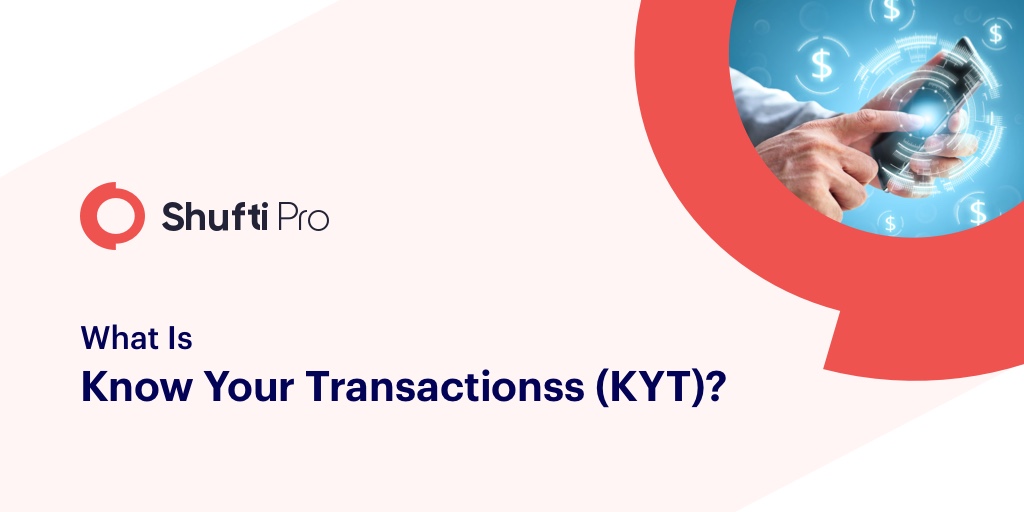
The compliance processes are often tedious, challenging and cumbersome. Due to rising complications in data retrieval and weak measures around due diligence and insufficient processes for monitoring of transactions, financial institutions face intense circumstances. Taking into account these problems, experts introduced the concept of Know your transaction (KYT) that is purely about financial institutions dealing with more precise, complete and granular data-set particular to transactions.
A deep dive into KYT
Know your transaction is performed to verify and monitor the transactions done by the customers. Some major financial transactions associated with customer accounts include cash and card transactions, cross border transactions, inward and outward remittances, and cross border and trade finance transactions.
Any bank or financial institute would want to know all particular details of these transactions especially in the cases where third parties are involved. These details provide insights into the purpose and nature of the transaction to detect suspicious behavior and perform further analysis. To achieve this goal seamlessly, many institutions are creating several data models based on different parameters such as customer name, transaction patterns, country of origin, transaction type, originating bank, etc.
Know your transaction (KYT) solution is one such model that facilitates banks in monitoring and drilling down the transactions to find suspicious activities or fraudulent transactions as a part of the transaction analysis process. This analysis is performed on the bank data internally to find fraudulent transactions. The results from the process serve as solid evidence, hence helping the institutions to protect themselves from fraud and regulatory penalties.
Why KYC is not enough
Financial institutions are faced with stringent KYC requirements and are obliged to adhere to the set of guidelines that are agreed upon by the global regulators. Though these guidelines show uniformity in what should be known about the customer, the requirements can’t be taken as internationally accepted standards. Some countries have defined proper rules and processes to fulfill these requirements while others have left it up to businesses to follow whatever strategy.
Today, most of the institutes are still relying on manual processes that are static in nature. It means once the KYC and due diligence is performed on the customer, most of the time there is no follow-up or ongoing process to ensure that the customer doesn’t possess any risk in the long run. In fact, when the client is onboarded, the file or record on that person/company is kept in paper form until the time the law requires otherwise. This raises a challenge for the banks and other financial institutions that how can they effectively conduct ongoing due diligence on their customers without compromising the customer experience.
With the intervention of technology in financial institutions, financial crime compliance has become a sensitive area that requires greater focus. Taking into the market trends and how the participants are becoming transparent; regulators are going to be more strict and detail-oriented in upcoming years. Lawmakers are coming with new regulations to keep the investors safe and assist institutions in combating money laundering and countering the financing of terrorism.
Just ‘knowing the customer’ isn’t going to be enough for businesses to deter financial fraud. Knowing each transaction will become a mandatory component of future regulation. And businesses need to be prepared for it.
Finding a Needle in the Haystack
Entering into the fourth industrial revolution, every person whether a banker, a business owner or an asset manager, is facing digital revolution. One study shows that only 5% of the global payments were done through the paper. This highlights the major change in the payment mix, witnessing the substantial growth in the cash-less transactions. Business analysts explain this growth in relevance to the advent of online and mobile banking that offers frictionless customer experience.
Through omnichannel accessibility, now clients can easily connect to their financial services at any time from anywhere. However, within these legitimate transactions, there are some fraudulent transactions as well. A study reveals that 99.85% of the credit card transactions that are processed every day seem lawful hence fraud detection is like finding a needle in a haystack.
Hence, KYT is the need of the hour for constant monitoring of the transactions for fraud detection. The KYT solutions are affecting leveraging AI technology that uses machine learning algorithms to detect anomalies.