


 Face Verification
 Address Verification
 Document Verification
 Age Verification
 VideoIdent
 Fast ID
 Docless Verification
 Consent Verification
 NFC Verification
 Business Verification
 Due Diligence
 Investor Verification
 E-Signature

 QES
QES
 AML Screening
 Transaction Monitoring
 Adverse Media
 Business AML Screening
 PEP & RCA
 Sanctions
 Watchlist
 Behavioural Biometrics
 Device Fingerprinting
 Biometric Face Authentication
 MFA
MFA
 Fraud Hub
 Onboarding
 Ongoing Monitoring
 KYC
KYC
 KYB
KYB
 KYI
KYI
 Age Assurance
 Identity Verification
 Workforce IAM
 Candidate Verification
 Compliance
 Fraud prevention
 Trust & safety
 Global expansion
 Product Managers
 Compliance Officers
 Fraud Analysts
 Developers
 Deepfake Detection
 Bonus Abuse / Promotion Abuse
 Account Takeover
 Synthetic Identity Fraud
 Document Fraud
 Impersonation Fraud
 Multi-Accounting
 Fraud Networks
 Chargeback Fraud
 Money Mule Activity
 Party Fraud
 Regulatory & Compliance Risks
 Fintech
 Crypto
 iGaming
 Forex
Forex
 Social Network
 Marketplace
 Banking
 Gig Economy
 Payments
 Ride Hailing
 Adult Content
 Blind Spot Audit
 Deepfake Detector
 Liveness Spoofs
 Document Originality
 Document Deepfake
 Global Trust Platform
 Journey Builder
 Case Management
 Shufti AI
 Fraud Analytics
 Vendor Comparison
 Brand Personalisation
 AI Compliance Co-Pilot
 OCR
OCR
 Secure Capture
 Deployment Options
 Identity Methods
 API Documentation
 Mobile SDKs
 Service Status
 Help Center
 Contact Us
 Technical Support
 Supported Documents
 Supported Countries
 Content library
 Blogs
Blogs
 News
News
 Reports
 Insights
 Knowledgebase
 ROI calculator
 About
About
 Career
 Press Release
 Certifications
 Partnership
 Awards
 Events & Webinar
 Interactive Demo
 Podcast Studio
 Spotlight Studio
Florida SB1161 and Deepfake Platform Accountability: What the Law Requires (Updated October 2025)
-
Add us as a Preferred Source on Google
- 01 What Florida SB1161 requires of covered platforms
- 02 What counts as non-consensual synthetic intimate content under SB1161
- 03 What are the civil and criminal remedies under Florida SB1161
- 04 How SB1161 relates to the federal TAKE IT DOWN Act
- 05 How Shufti helps platforms detect synthetic intimate content
Florida Governor Ron DeSantis signed SB1161 (Brooke’s Law) into law in June 2025, creating concrete Florida SB1161 deepfake platform accountability obligations where discretionary content moderation policies once sat. Named for Brooke Curry, whose AI-altered intimate images were distributed without her knowledge, the law targets the gap between a victim’s right to have content removed and a platform’s legal duty to act. Platforms that have relied on voluntary policies rather than structured removal processes now operate under binding obligations they cannot opt out of. This article covers what SB1161 requires, what penalties apply, and how it interacts with the parallel federal TAKE IT DOWN Act signed the same year.
What Florida SB1161 requires of covered platforms
SB1161’s obligations are structural and non-discretionary. A covered platform under the statute is any publicly available website, application, or online service that allows users to post content, which means most social networks, adult content platforms, and content-sharing services fall inside it. The Florida AI intimate image platform duties the law creates cluster around three requirements. Platforms must build a reporting mechanism, process removal requests within a set window, and extend that removal to identical copies of the reported content.
Building a removal reporting process
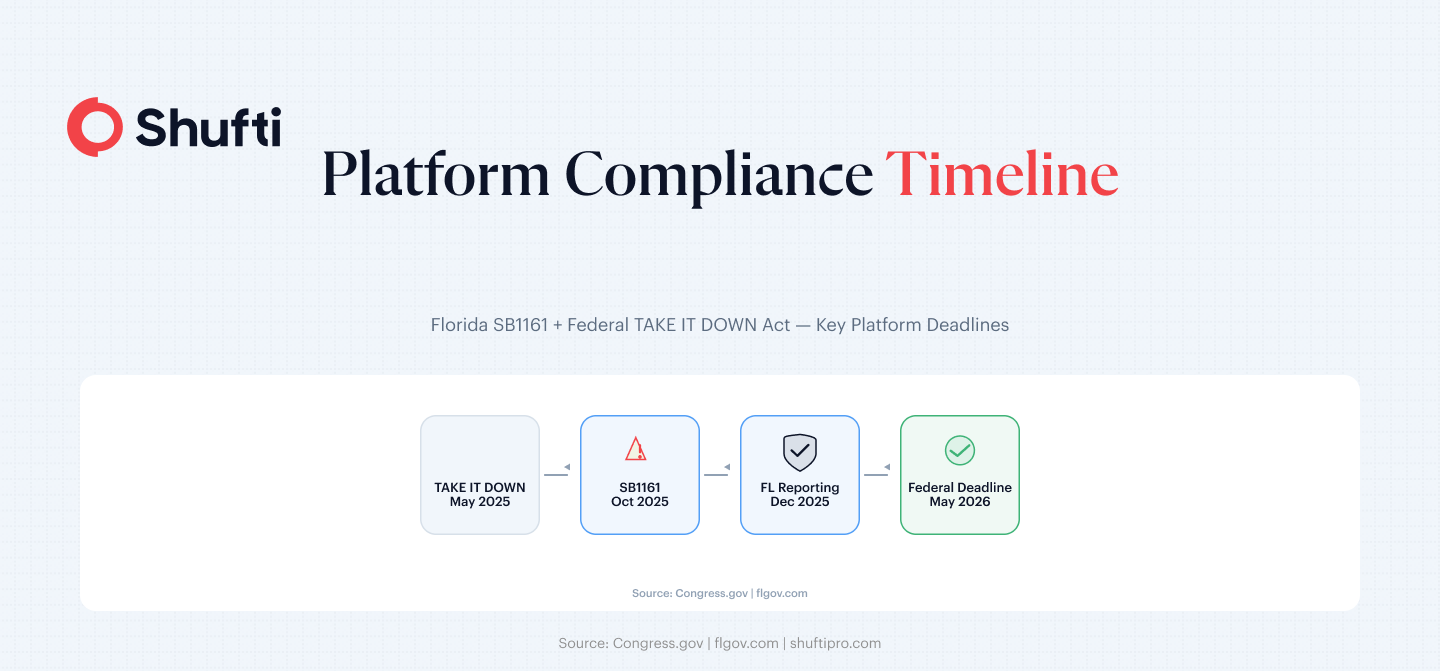
Covered platforms had until December 31, 2025 to establish a process by which an identifiable person could notify the platform of an altered sexual depiction published without their consent and submit a formal removal request. The law’s reporting-mechanism requirement applies regardless of where the platform is incorporated, if it serves Florida users, it is covered. Platform legal and trust-and-safety teams that had not built a structured intake process for non-consensual intimate imagery (NCII) removal claims by that date are already out of compliance with this requirement.
The 48-hour takedown window
Once a platform receives a valid removal request, SB1161 sets a 48-hour window for the Florida deepfake social media takedown. Within that window, the platform must remove the altered depiction and make reasonable efforts to identify and remove all identical copies hosted on the platform. The law does not require proactive scanning for NCII. Platforms that build a reporting inbox but rely on slow manual review to process it are structurally non-compliant. The 48-hour clock starts on receipt of the request, not on internal triage completion.
What counts as non-consensual synthetic intimate content under SB1161
The term the statute uses is “altered sexual depiction,” and its scope is broader than most platforms initially assume. SB1161 does not limit coverage to photographs edited after capture, it extends to AI-generated imagery and any digitally created content that depicts an identifiable person in a sexual or intimate context without their consent.
An altered sexual depiction under Florida § 836.13 covers images and videos produced or modified using AI or other digital tools to depict a real person in intimate or sexual contexts. SB1161 Florida synthetic intimate content obligations apply to the platform hosting the content once a valid claim is made, regardless of where the content originated. Generative tools that produce realistic intimate imagery from a text prompt fall inside the definition provided the person depicted is identifiable. Research published by the Institute for Strategic Dialogue in 2024 found that 96-98% of all deepfake content online is non-consensual intimate imagery, with 99% of depicted individuals being women. Platforms that treat NCII as a tail risk in their moderation queue are working from an outdated exposure model.
For compliance and trust-and-safety teams, the practical question is how to distinguish altered sexual depictions from other flagged content quickly enough to meet the removal deadline. A primer on what are deepfakes and how detection works sets the technical baseline for teams building or evaluating NCII detection systems.
What are the civil and criminal remedies under Florida SB1161
SB1161 creates consequences at two levels. Criminal exposure falls on individuals who create and distribute NCII. Civil and regulatory Florida NCII platform liability falls on covered platforms that miss their removal obligations. Both tracks operate independently of each other.
Criminal penalties for creators and distributors
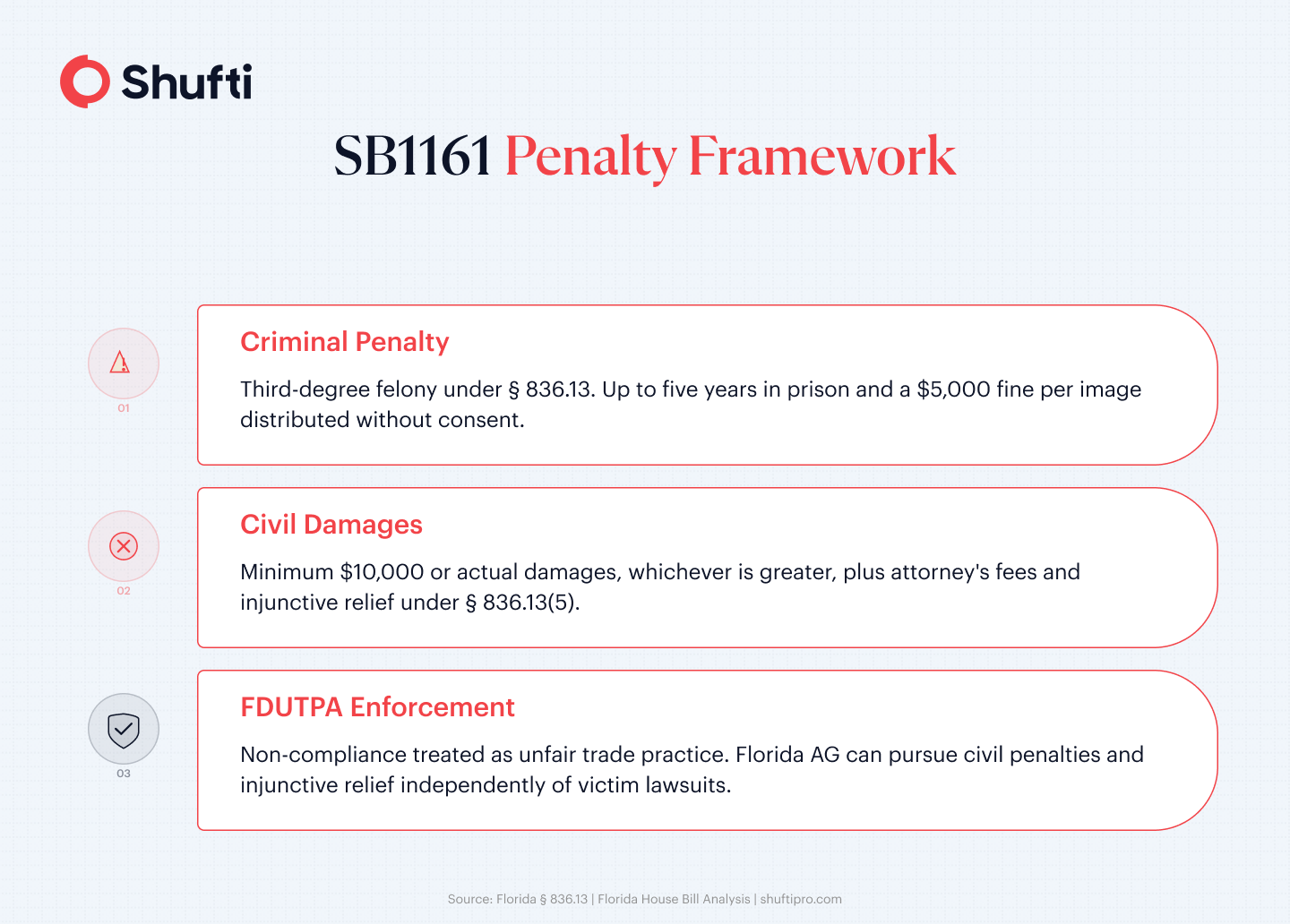
Under Florida law as of October 1, 2025, creating, possessing, or distributing an altered sexual depiction of an identifiable person without consent is a third-degree felony. A conviction under § 836.13 carries up to five years in prison, five years of probation, and a fine of up to $5,000 per image. The per-image structure means distributing a collection of NCII compounds and the criminal exposure across each distinct depiction, not just the act of distribution.
Civil damages and regulatory enforcement for platforms
Under § 836.13(5), victims can pursue damages of $10,000 minimum, or actual damages whichever is greater, plus attorney’s fees and costs. For platforms, failure to process a valid removal request within 48 hours constitutes an unfair or deceptive act under the Florida Deceptive and Unfair Trade Practices Act (FDUTPA). FDUTPA enforcement runs through the Florida Attorney General, who can seek civil penalties and injunctive relief on a track separate from any individual victim’s lawsuit.
How SB1161 relates to the federal TAKE IT DOWN Act
Florida SB1161 does not operate in isolation. On May 19, 2025, President Trump signed the TAKE IT DOWN Act into federal law, creating a parallel deepfake platform responsibility layer that Florida-based and nationally operating platforms must both satisfy. The two regimes share a 48-hour removal window but differ on enforcement bodies and implementation timelines.
The federal law’s full name is the Tools to Address Known Exploitation by Immobilizing Technological Deepfakes On Websites and Networks Act. The TAKE IT DOWN Act required covered platforms to build their notice-and-removal system by May 19, 2026, a later deadline than Florida’s December 31, 2025 requirement for the reporting mechanism. The Federal Trade Commission (FTC) is the enforcement body at the federal level, with unfair or deceptive trade practice exposure for non-compliant platforms. Social media deepfake Florida law obligations and federal obligations are cumulative. A platform that satisfies the federal process requirements generally meets SB1161’s reporting-mechanism standard, but the Florida criminal penalties and FDUTPA track operate on their own rails. For a deeper look at how deepfake platform responsibility Florida compliance intersects with content review architecture, the deepfake challenge in remote identity verification is a useful operational reference.
How Shufti helps platforms detect synthetic intimate content
A 48-hour removal window at scale requires detection that runs faster than a human review queue. Platforms receiving high volumes of NCII reports cannot depend on analysts triaging each request manually. The window is too short, and the “reasonable efforts to identify and remove copies” language in SB1161 requires more than removing the specific URL named in the complaint.
Shufti’s deepfake detection covers 56+ anti-spoofing attack vectors, including frequency-domain analysis designed to catch synthetic intimate images that evade pixel-level inspection. The system identifies AI-generated content at the biometric and forensic level, going beyond metadata checks or keyword heuristics that NCII producers have learned to circumvent. When integrated into a content review pipeline, deepfake detection reduces the time between a valid removal request and confirmed content identification to a fraction of the 48-hour window. Each detection event generates an audit log that documents the compliance action, relevant for both FDUTPA enforcement proceedings and FTC inquiries under the federal Act.
For platforms building or upgrading NCII removal systems under SB1161, automated forensic detection is what makes the 48-hour obligation operationally sustainable rather than a manual race against a legal deadline.
Non-consensual intimate content creates a narrow compliance window for any platform hosting user-generated media, and the Florida SB1161 framework makes every missed takedown a legal and regulatory exposure. Shufti’s deepfake detection flags synthetic intimate imagery at the forensic layer, giving compliance and trust-and-safety teams audit-ready removal evidence before the 48-hour window closes.
Frequently Asked Questions
What is Florida SB1161 (Brooke's Law)?
Florida SB1161, known as Brooke's Law, is a state statute effective October 1, 2025, requiring covered platforms to remove non-consensual altered sexual depictions within 48 hours of a valid removal request. Non-compliance is treated as a violation under FDUTPA.
What platform obligations does Florida SB1161 create?
SB1161 requires covered platforms to establish a reporting mechanism for NCII removal requests by December 31, 2025, process those requests within 48 hours, and make reasonable efforts to identify and remove identical copies of the reported content.
Can platforms be held liable for deepfake intimate content under Florida SB1161?
Yes. Platforms that fail to process valid removal requests within 48 hours face enforcement under FDUTPA, which allows the Florida Attorney General to pursue civil penalties and injunctive relief independently of any individual victim's civil lawsuit.
What are the penalties for creating deepfake intimate images in Florida?
Creating or distributing altered sexual depictions without consent is a third-degree felony under § 836.13, carrying up to five years in prison and a $5,000 fine per image. Victims can also sue for a minimum of $10,000 in civil damages plus attorney's fees.
How does SB1161 relate to the federal TAKE IT DOWN Act?
Both laws impose a 48-hour removal requirement on covered platforms. The TAKE IT DOWN Act adds FTC enforcement at the federal level with a platform system deadline of May 19, 2026. Florida platforms must comply with both regimes. Whichever deadline falls earlier controls for Florida-hosted content.