


 Face Verification
 Address Verification
 Document Verification
 Age Verification
 VideoIdent
 Fast ID
 Docless Verification
 Consent Verification
 NFC Verification
 Business Verification
 Due Diligence
 Investor Verification
 E-Signature

 QES
QES
 AML Screening
 Transaction Monitoring
 Adverse Media
 Business AML Screening
 PEP & RCA
 Sanctions
 Watchlist
 Behavioural Biometrics
 Device Fingerprinting
 Biometric Face Authentication
 MFA
MFA
 Fraud Hub
 Onboarding
 Ongoing Monitoring
 KYC
KYC
 KYB
KYB
 KYI
KYI
 Age Assurance
 Identity Verification
 Workforce IAM
 Candidate Verification
 Compliance
 Fraud prevention
 Trust & safety
 Global expansion
 Product Managers
 Compliance Officers
 Fraud Analysts
 Developers
 Deepfake Detection
 Bonus Abuse / Promotion Abuse
 Account Takeover
 Synthetic Identity Fraud
 Document Fraud
 Impersonation Fraud
 Multi-Accounting
 Fraud Networks
 Chargeback Fraud
 Money Mule Activity
 Party Fraud
 Regulatory & Compliance Risks
 Fintech
 Crypto
 iGaming
 Forex
Forex
 Social Network
 Marketplace
 Banking
 Gig Economy
 Payments
 Ride Hailing
 Adult Content
 Blind Spot Audit
 Deepfake Detector
 Liveness Spoofs
 Document Originality
 Document Deepfake
 Global Trust Platform
 Journey Builder
 Case Management
 Shufti AI
 Fraud Analytics
 Vendor Comparison
 Brand Personalisation
 AI Compliance Co-Pilot
 OCR
OCR
 Secure Capture
 Deployment Options
 Identity Methods
 API Documentation
 Mobile SDKs
 Service Status
 Help Center
 Contact Us
 Technical Support
 Supported Documents
 Supported Countries
 Content library
 Blogs
Blogs
 News
News
 Reports
 Insights
 Knowledgebase
 ROI calculator
 About
About
 Career
 Press Release
 Certifications
 Partnership
 Awards
 Events & Webinar
 Interactive Demo
 Podcast Studio
 Spotlight Studio
Video Identification in Switzerland: FINMA Compliance Guide for Banks, Insurance and Asset Managers
- 01 What FINMA Video Identification Means Under Swiss Law
- 02 FINMA Circular 2016/7: The Rules That Govern Swiss Video KYC
- 03 Who Must Comply: Banks, Insurance and Asset Managers
- 04 How FINMA Video Identification Differs From Germany's BaFin VideoIdent
- 05 Common Compliance Pitfalls Swiss Firms Face With VideoIdent
- 06 How Shufti helps Swiss firms run FINMA-compliant video identification
TL;DR
- FINMA Circular 2016/7 defines how Swiss financial institutions must conduct compliant VideoIdent under AMLA.
- Swiss VideoIdent requires a live operator, document verification, biometric face matching, TAN verification, and secure session recording.
- Banks, insurers, asset managers, and other AMLA-regulated financial intermediaries must follow these requirements for remote onboarding.
- Shufti helps firms achieve FINMA-compliant VideoIdent with trained operators, multilingual support, and secure audit-ready evidence.
Swiss Financial Market Supervisory Authority (FINMA) Circular 2016/7 defines the rules Swiss banks, insurers, and asset managers must follow when identifying customers over video. The circular has been the operative framework since 2016 and remains the reference text for any remote-channel onboarding under AMLA in 2026.
When a private banking client in Zurich, an insurance prospect in Geneva, or an asset management onboarding in Lugano happens entirely online, the firm has to confirm the customer is real and document that process well enough to satisfy FINMA. Video identification has become the dominant answer.
Compliance teams know the rules exist. What is harder to find is a practical guide to how the requirements work, where firms most often slip, and how Switzerland’s framework compares with Germany’s. In this guide we’ll discuss FINMA video identification in Switzerland for banks, insurers and asset managers operating under Swiss financial market law in 2026.
What FINMA Video Identification Means Under Swiss Law
Video identification, often shortened to VideoIdent, is a real-time process where a trained operator confirms a customer’s identity through a live video call. The session combines visual verification of an identity document, a face-match against the document photo, and a one-time code or transaction number that the customer reads aloud.
For Swiss firms, the legal foundation sits in three documents. The Anti-Money Laundering Act (AMLA), known locally as GwG) sets the duty to identify customers entering a permanent business relationship. The Anti-Money Laundering Ordinance issued by FINMA (AMLO-FINMA, or GwV-FINMA) details how identification must be performed. FINMA Circular 2016/7 “Video and online identification” defines the technical and procedural standards for remote identification, including the use of video.
The Swiss video KYC AMLA framework treats VideoIdent as functionally equivalent to in-person identification, provided the operational baseline holds. That equivalence is conditional. Firms that miss any of the operational requirements in the circular cannot rely on VideoIdent to satisfy their AMLA duty, and the relationship may be deemed inadequately identified.
FINMA Circular 2016/7: The Rules That Govern Swiss Video KYC
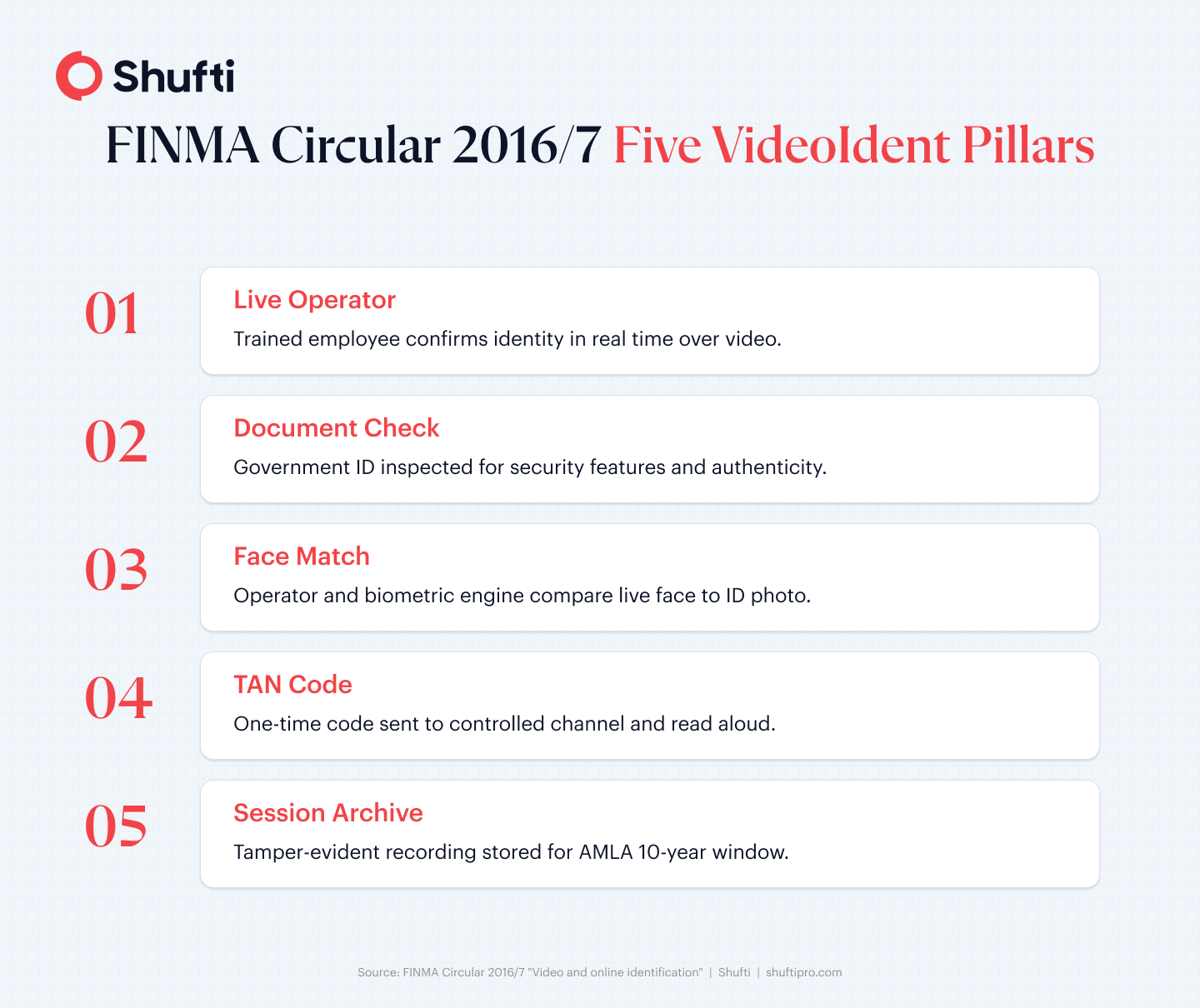
FINMA Circular 2016/7 video identification requirements set out the operational baseline. Swiss firms relying on video for customer due diligence must build their workflow around five categories of requirement. Each category was written to map the equivalence test between in-person and remote identification, and missing any of them collapses the whole identification act under AMLA. The five requirements work as a single chain, not a checklist of optional features that compliance teams can mix and match.
Live operator and real-time interaction
The session must be conducted by a trained employee of the financial intermediary or a delegated service provider. Pre-recorded videos, fully automated flows without operator review, and asynchronous identification do not qualify as VideoIdent under the circular. The operator confirms identity in real time.
Identity document verification
The customer must present a government-issued, machine-readable identity document with a photograph. The operator examines security features, including holograms, microprint, and where possible the third dimension of the document by tilting it on camera. Documents that fail any security check, show signs of tampering, or do not appear in FINMA’s accepted lists trigger session abandonment.
Biometric face match
The operator visually compares the customer’s face on screen with the photograph on the identity document. Most compliant workflows pair this with automated biometric matching to reduce operator subjectivity and create an audit-evidenced score.
One-time TAN or transaction code
To confirm the customer controls the channel they claim to control, an SMS or email containing a transaction authentication number (TAN) is sent to the customer during the session. The customer reads the code aloud. This binds the identification act to a specific contact channel that the firm holds.
Session recording and storage
The full audio-visual session must be recorded and stored in line with the firm’s record-keeping obligations. The retention period follows the AMLA’s general 10-year rule. Storage must be secure, tamper-evident, and retrievable for audit.
These five elements operate together. A session that records correctly but skips the TAN step, or one that confirms the TAN but uses a low-resolution video stream that prevents document security feature inspection, fails the circular.
Who Must Comply: Banks, Insurance and Asset Managers
The duty to identify customers under AMLA falls on every entity supervised as a financial intermediary in Switzerland. Whether that duty triggers VideoIdent specifically depends on how the firm conducts its onboarding. Branch-based identification with a face-to-face interaction does not require VideoIdent. Remote-channel onboarding without an in-person meeting almost always does, and the choice of compliant remote method is what brings VideoIdent into scope for any given product line.
Banks under FINMA supervision
Cantonal banks, private banks, retail banks, and foreign-bank branches all sit under direct FINMA supervision and the AMLA. Where a bank onboards retail or private clients without a face-to-face meeting in a branch, video identification is the most widely used compliant alternative.
Insurance companies offering qualifying products
Life insurance products with savings or investment components, including unit-linked policies, fall under AMLA. Insurers offering these products must identify policyholders. Where distribution moves to digital channels, the same VideoIdent requirements apply.
Asset managers and trustees under FinIA
Following the Federal Act on Financial Institutions (FinIA), independent asset managers and trustees became subject to prudential supervision. They are supervised by FINMA-authorised supervisory organisations and remain subject to AMLA. Asset managers running remote onboarding must apply VideoIdent or another compliant remote identification path.
SRO-affiliated financial intermediaries
Smaller financial intermediaries supervised by self-regulatory organisations (SROs) operate under SRO regulations that mirror FINMA’s. The same VideoIdent technical requirements apply through the SRO rulebook.
Smaller firms sometimes ask whether VideoIdent is mandatory for remote onboarding. The FINMA framework permits it without requiring it. Firms can also use online identification methods involving qualified electronic signatures or other compliant procedures defined in the circular. Within the Switzerland remote identification regime, VideoIdent is the most operationally familiar path, which is why it dominates Swiss remote onboarding today.
How FINMA Video Identification Differs From Germany’s BaFin VideoIdent
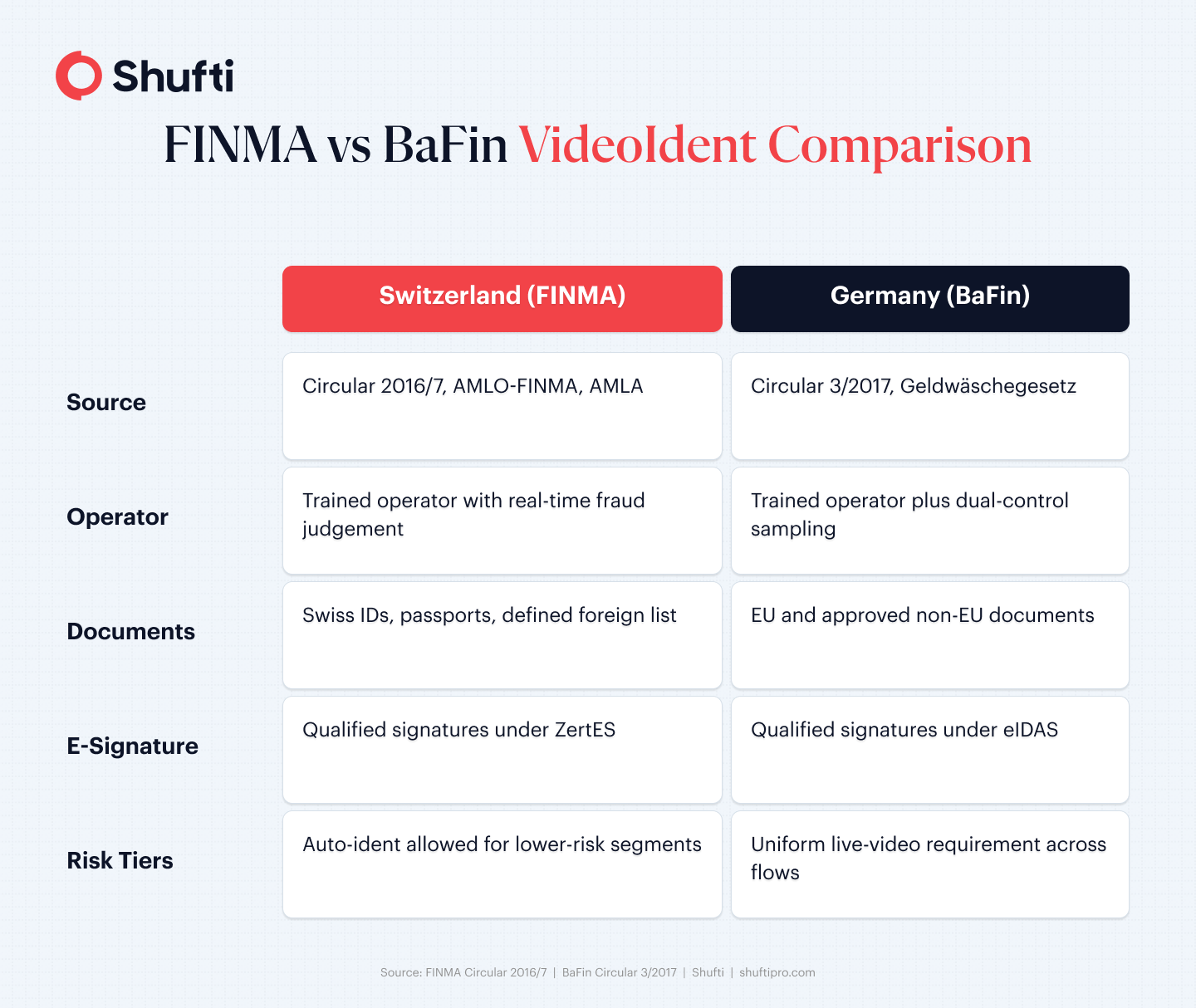
DACH (Germany-Austria-Switzerland) compliance teams often run shared infrastructure across Switzerland and Germany, on the assumption that one VideoIdent stack will satisfy both regulators. The two regimes look similar from a distance and diverge in operational detail. Most production differences live in the small print, including document acceptance lists, operator-training expectations, and the e-signature regime that follows the identification step.
Legal source and supervisor
Switzerland’s framework lives in FINMA Circular 2016/7, the AMLO-FINMA, and the AMLA. Germany’s framework lives in the German Federal Financial Supervisory Authority (BaFin) Circular 3/2017 and the Geldwäschegesetz (GwG). FINMA and BaFin are separate supervisors with separate inspection cycles and separate enforcement priorities.
Operator training and oversight
Both regimes require trained operators. FINMA’s expectations focus on the operator’s ability to detect document fraud and suspicious behaviour in real time. BaFin places similar weight on operator training and additionally requires more prescriptive controls around dual-control sampling of completed sessions.
Accepted identity documents
FINMA’s accepted document lists differ from BaFin’s. Swiss workflows must accept Swiss ID cards, Swiss passports, and a defined set of foreign documents. Germany has its own list of acceptable EU and non-EU documents. Firms operating cross-border need configurable document acceptance rules per jurisdiction.
Electronic signature integration
Switzerland uses qualified electronic signatures under the Federal Act on Electronic Signatures (ZertES). Germany uses qualified electronic signatures under eIDAS (Electronic Identification, Authentication and Trust Services Regulation). Where VideoIdent feeds into a contract-signing flow, the underlying signature regime is different.
Risk-tier flexibility
FINMA’s amended circular allows certain auto-ident methods for lower-risk customer relationships, subject to defined criteria. BaFin maintains a more uniform requirement for live video across remote-identification flows. Swiss firms with an appetite for selective automation have a narrow but useful path that German firms do not.
Common Compliance Pitfalls Swiss Firms Face With VideoIdent
The patterns repeat across compliance audits and operations reviews. Failed VideoIdent sessions and audit findings cluster around five recurring weaknesses, none of which are about the technology choice itself. They are about how the workflow is staffed, how sessions are captured and stored, and how the operator is supported when something on the customer side breaks. Each pitfall below carries a fix that compliance and operations teams have field-tested across Swiss banking, insurance, and wealth-management onboarding flows.
Operator capacity at peak hours
Wealth-management firms see onboarding spikes around bonus seasons and tax-year boundaries. Insurance firms see seasonal life-event clusters. When the operator pool runs short, queue times balloon and customers drop out before completing the session. Firms underestimate the staffing model when they internalise the operator function without a 24/7 surge capability.
Session quality failures
Low-light environments, weak mobile connections, and outdated browsers degrade the operator’s ability to inspect document security features. A session that the operator could not properly verify still consumed staff time and customer patience without producing a compliant onboarding. The fix is upfront device and connection checks before the session begins.
Storage and retrieval gaps
Recording the session is the easier part. Storing it in a tamper-evident format with reliable retrieval over a 10-year window is harder. Recordings start failing to play or going missing three or four years into the retention window, and many firms only discover the gap during regulatory inspection.
Document fraud detection gaps
Synthetic identity documents and high-quality forgeries have improved. Operator-only checks without supporting biometric match scoring and document authenticity scoring leave gaps that fraud teams later trace to onboarding.
Cross-border language coverage
Swiss customers communicate in German, French, Italian, and English. Operator pools that cover only one or two languages force customers into a non-native session, raising drop-off rates and risking miscommunication during identity confirmation.
How Shufti helps Swiss firms run FINMA-compliant video identification
Shufti operates video KYC infrastructure built for the requirements of regimes like FINMA’s. The platform pairs a trained 24/7 operator network with automated document verification, and the live operator handles the face-match step against the document photo so each session produces both human judgement and machine-evidenced scoring against a defensible audit trail.
For Swiss banks, insurers, and asset managers, the operational fit covers three dimensions. Operators are trained to recognise the document security features and behavioural patterns relevant to AMLO-FINMA expectations. The session capture, recording, and storage architecture is designed for the 10-year AMLA retention window with tamper-evident archival. Multilingual operator coverage spans German, French, Italian, and English, removing the cross-border drop-off seen in single-language operator pools.
The same identification workflow feeds into continuous downstream monitoring, so the verification act becomes the start of an ongoing compliance posture rather than a one-time event. Swiss firms running both retail and private-client books can configure tiered flows so higher-risk relationships receive deeper operator review and lower-risk segments use lighter-touch paths within the bounds of the FINMA framework.
Compliant Swiss VideoIdent demands trained operators, multilingual coverage, and tamper-evident recording across a 10-year retention window, and most firms find that mix difficult to staff in-house. Shufti’s video KYC pairs a 24/7 trained operator network with automated document verification configured for AMLO-FINMA expectations. Book a Shufti consultation to map your workflow against FINMA Circular 2016/7 and stress-test your retention architecture.
Frequently Asked Questions
What technical requirements must Swiss firms meet for FINMA-compliant VideoIdent?
Sessions need a stable real-time video feed, trained operators, document security feature inspection, biometric face matching, a TAN delivered to a controlled channel, and tamper-evident recording stored for the AMLA retention window. Encryption and access control on stored recordings are baseline expectations.
Can Swiss asset managers use the same VideoIdent solution as banks?
Yes. The technical requirements in FINMA Circular 2016/7 apply uniformly to all financial intermediaries under AMLA. Asset managers supervised under FinIA can deploy the same operator-led video workflow used by banks, provided the configuration matches their own risk classification and customer mix.
What alternative identification does FINMA allow if a customer refuses VideoIdent?
Customers can be identified in person at a branch or via a delegated identification provider. Where qualified electronic signatures are involved, online identification under ZertES rules can substitute. Firms can also accept identification performed by a regulated third party meeting AMLA standards.
Does FINMA require VideoIdent sessions to be conducted in a specific language?
As of 2026, FINMA does not mandate a session language. Firms must ensure the operator and customer can communicate clearly enough for identity confirmation and TAN exchange. In practice this means offering German, French, Italian, and English to cover Swiss residents and international customers.