



 Face Verification
 Address Verification
 Document Verification
 Age Verification
 VideoIdent
 Fast ID
 Docless Verification
 Consent Verification
 NFC Verification
 Business Verification
 Due Diligence
 Investor Verification
 E-Signature

 QES
QES
 AML Screening
 Transaction Monitoring
 Adverse Media
 Business AML Screening
 PEP & RCA
 Sanctions
 Watchlist
 Behavioural Biometrics
 Device Fingerprinting
 Biometric Face Authentication
 MFA
MFA
 Fraud Hub
 Onboarding
 Ongoing Monitoring
 KYC
KYC
 KYB
KYB
 KYI
KYI
 Age Assurance
 Identity Verification
 Workforce IAM
 Candidate Verification
 Compliance
 Fraud prevention
 Trust & safety
 Global expansion
 Product Managers
 Compliance Officers
 Fraud Analysts
 Developers
 Deepfake Detection
 Bonus Abuse / Promotion Abuse
 Account Takeover
 Synthetic Identity Fraud
 Document Fraud
 Impersonation Fraud
 Multi-Accounting
 Fraud Networks
 Chargeback Fraud
 Money Mule Activity
 Party Fraud
 Regulatory & Compliance Risks
 Fintech
 Crypto
 iGaming
 Forex
Forex
 Social Network
 Marketplace
 Banking
 Gig Economy
 Payments
 Ride Hailing
 Adult Content
 Blind Spot Audit
 Deepfake Detector
 Liveness Spoofs
 Document Originality
 Document Deepfake
 Global Trust Platform
 Journey Builder
 Case Management
 Shufti AI
 Fraud Analytics
 Vendor Comparison
 Brand Personalisation
 AI Compliance Co-Pilot
 OCR
OCR
 Secure Capture
 Deployment Options
 Identity Methods
 API Documentation
 Mobile SDKs
 Service Status
 Help Center
 Contact Us
 Technical Support
 Supported Documents
 Supported Countries
 Content library
 Blogs
Blogs
 News
News
 Reports
 Insights
 Knowledgebase
 ROI calculator
 About
About
 Career
 Press Release
 Certifications
 Partnership
 Awards
 Events & Webinar
 Interactive Demo
 Podcast Studio
 Spotlight Studio
KYB Compliance in Philiippines Guidelines
-
Add us as a Preferred Source
- 01 What is KYB Compliance in the Philippines?
- 02 Who Regulates KYB in the Philippines?
- 03 What Documents Are Required for KYB Verification in the Philippines?
- 04 CDD and Enhanced Due Diligence Under Philippine KYB Rules
- 05 KYC, KYB, and Fintech in the Philippines
- 06 How Shufti helps compliance teams meet Philippines KYB requirements
TL;DR
- The Philippines’ removal from the FATF grey list in 2025 has increased the importance of strong KYB compliance for financial institutions, fintechs, and regulated businesses.
- KYB requires organizations to verify a business’s legal status, ownership structure, beneficial owners, and risk profile before establishing a business relationship.
- Compliance is overseen by three key regulators: the Anti-Money Laundering Council (AMLC), the Bangko Sentral ng Pilipinas (BSP), and the Securities and Exchange Commission (SEC).
- Businesses must collect and verify registration documents, confirm authorized representatives, and identify ultimate beneficial owners holding at least 25% ownership or control.
- Standard Customer Due Diligence (CDD) is required for all business customers, while Enhanced Due Diligence (EDD) applies to higher-risk entities such as politically exposed persons and companies with complex ownership structures.
- For fintechs and virtual asset service providers, KYB is an ongoing obligation that includes continuous monitoring, AML screening, and reporting requirements throughout the customer relationship.
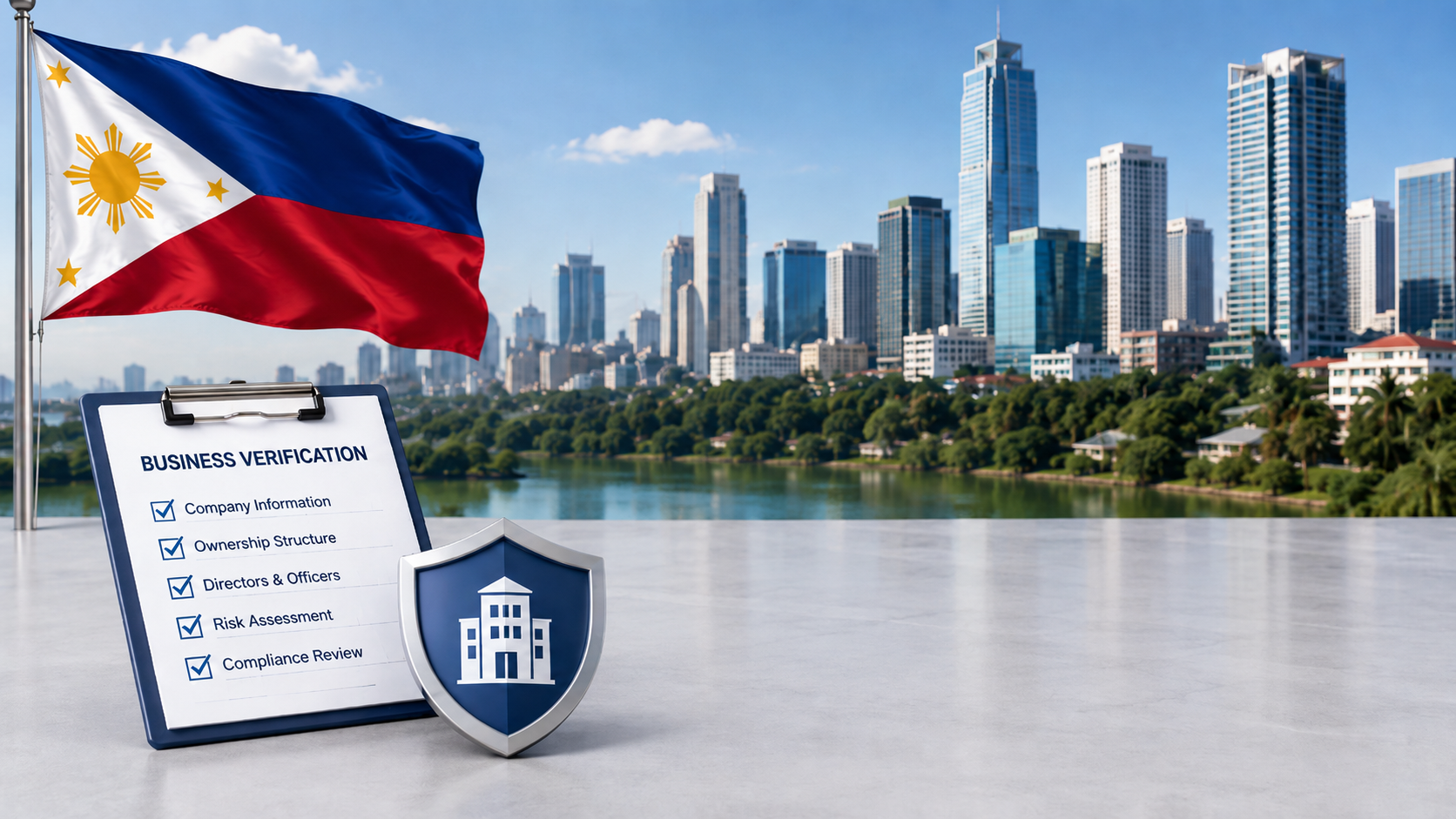
When the Financial Action Task Force (FATF) officially removed the Philippines from its grey list on February 21, 2025, it closed a four-year reform cycle and raised the compliance bar for every financial institution, fintech, and designated business operating in the country. Staying off the list requires maintaining the improvements that earned the exit. For businesses and their compliance teams, that starts with understanding what Know Your Business Philippines standards require, who enforces them, and where corporate verification processes tend to fall short. This guide covers the core Philippines business verification requirements, the regulatory bodies behind them, and how Philippines corporate due diligence works in practice.
What is KYB Compliance in the Philippines?
Know Your Business (KYB) is the process by which covered persons (banks, fintechs, virtual asset service providers, and designated non-financial businesses) verify the identity, ownership structure, and risk profile of business customers before establishing a financial relationship. In the Philippines, KYB operates within the anti-money laundering framework established by Republic Act No. 9160, the Anti-Money Laundering Act (AMLA), as amended multiple times and most recently by Republic Act No. 11521 in January 2021.
Anti-Money Laundering Act Philippines KYB obligations are not discretionary. AMLA requires covered persons to establish and record the true identity of every client, including legal entities, using reliable, independent documents, data, or information before a transaction or business relationship commences. Philippines corporate due diligence is the operational expression of that legal requirement: a structured process for knowing exactly who you are doing business with before any exposure is created.
Who Regulates KYB in the Philippines?
Three regulatory bodies share oversight of KYB and AML compliance in the Philippines, each with a distinct mandate and a different scope of authority. Knowing which regulator governs your organisation determines which specific rules you are subject to, which reporting obligations apply, and how enforcement is structured when deficiencies are found.
Anti-Money Laundering Council
The Anti-Money Laundering Council (AMLC) is the Philippines’ financial intelligence unit and primary enforcer of AMLA. AMLC KYB Philippines obligations require all covered persons to register via the AMLC Online Registration System (AORS), with renewal required every three years. Covered persons must report cash and cash-equivalent transactions exceeding PHP 500,000 (approximately USD 9,000) within one banking day, and file Suspicious Transaction Reports whenever a transaction is inconsistent with a customer’s known profile. In December 2024, AMLC issued Regulatory Issuance No. 2, the Guidelines on Transaction Reporting and Compliance Submissions (GoTRACS), standardising electronic filing across all covered persons and raising the bar for submission quality.
Bangko Sentral ng Pilipinas and the Securities and Exchange Commission
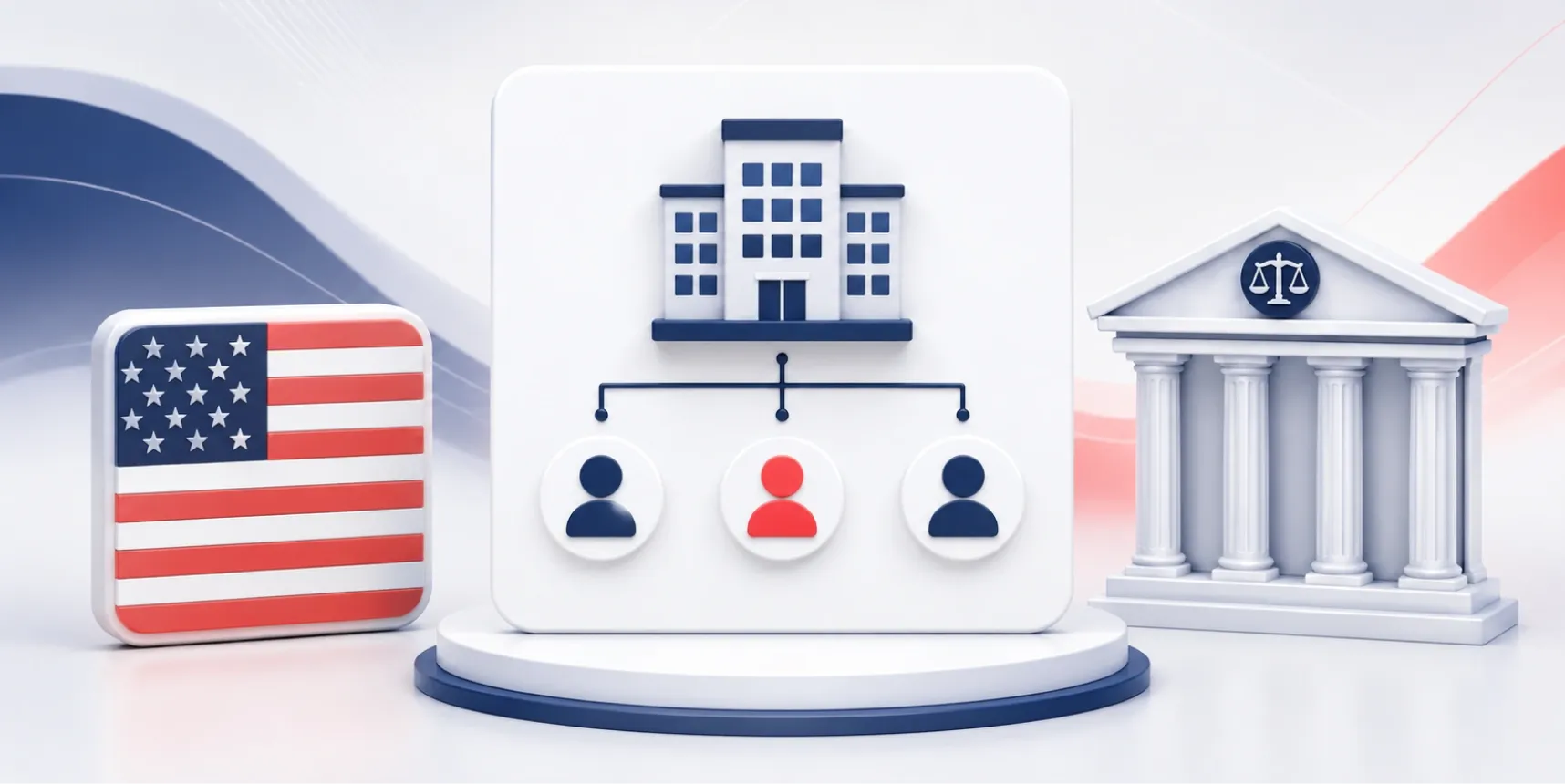
The Bangko Sentral ng Pilipinas (BSP) supervises banks, digital banks, e-money issuers, and virtual asset service providers (VASPs). Part IX of the BSP Manual of Regulations for Banks (MORB) sets the AML and customer due diligence standards for all BSP-licensed entities. The Securities and Exchange Commission (SEC) maintains the Philippines business registry and administers beneficial ownership disclosure requirements under SEC Memorandum Circular 15 (s. 2019) and MC 30 (s. 2020), which require all SEC-registered corporations to report beneficial owners as part of their Annual General Information Sheet.
Philippine AML regulations for businesses are jointly enforced: AMLC investigates and prosecutes financial crimes, BSP supervises licensed financial entities, and the SEC governs corporate transparency and registration-based disclosure.
What Documents Are Required for KYB Verification in the Philippines?
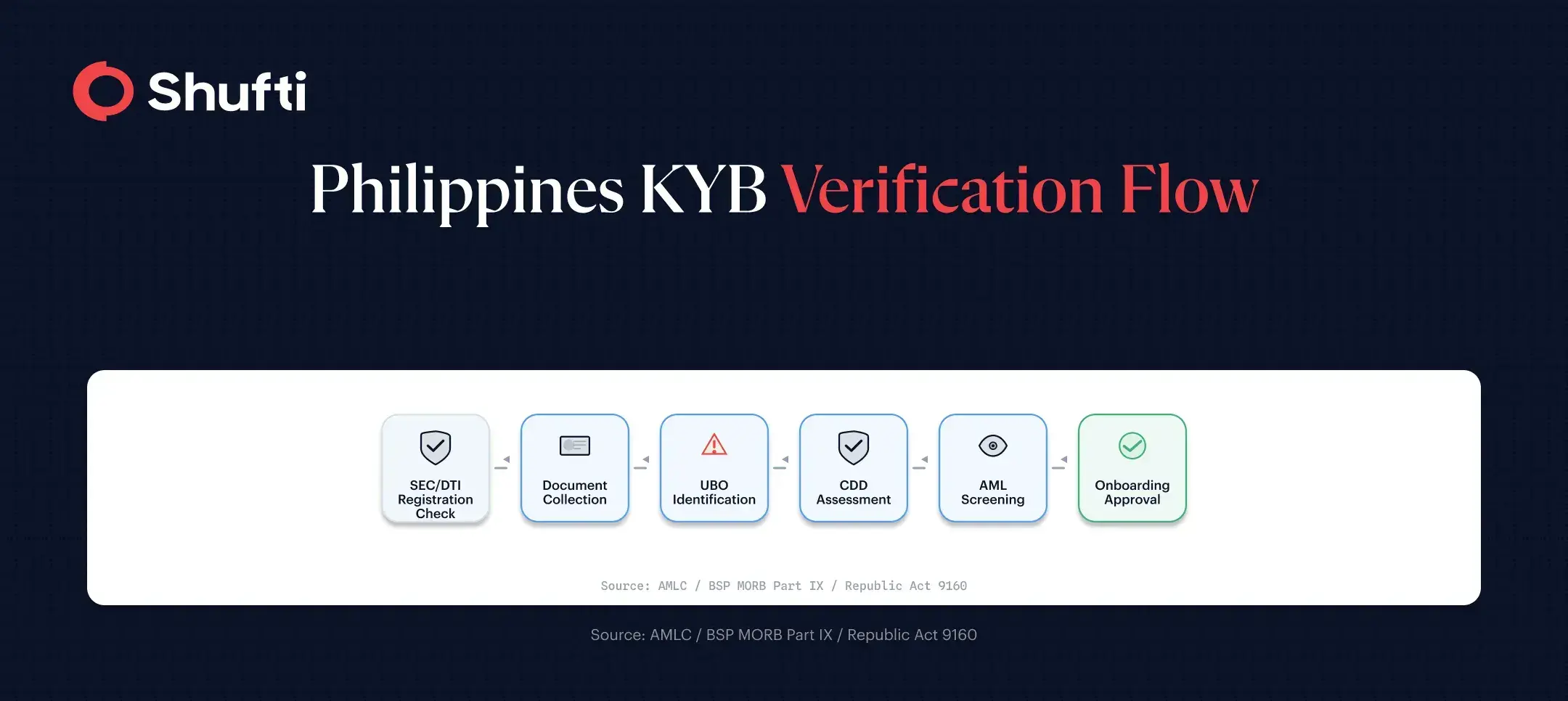
Philippines business verification requires covered persons to collect a specific document set before a business relationship is established. The documents fall into two categories: proof of legal existence and beneficial ownership identification. Both layers must be satisfied before onboarding proceeds, and regulated entities that skip either layer face AMLC enforcement exposure.
Business Registration Verification
Business registration verification Philippines centres on the SEC Registration Certificate, Articles of Incorporation, and the General Information Sheet (GIS) for domestic stock and non-stock corporations. Sole proprietors must present their Department of Trade and Industry (DTI) Registration Certificate. Partnerships submit their Articles of Partnership. Foreign corporations registered in the Philippines must additionally comply with the beneficial ownership disclosure requirements of SEC Memorandum Circular 30. Beyond registration credentials, covered persons verify the entity’s registered business address, the authority and identity of all individuals acting on the entity’s behalf, and any applicable operating licences or regulatory approvals relevant to the entity’s business type.
Philippines UBO Verification Requirements
Philippines UBO verification requirements are defined in AMLC Regulatory Issuance A, B and C, No. 3, Series of 2018. A beneficial owner is any natural person who ultimately owns or controls the customer, or on whose behalf a transaction is being conducted. The ownership identification threshold is 25% of voting rights, shares, or capital for companies registered with the SEC. For covered persons identifying their own beneficial owners, the threshold drops to 20%.
The UNODC reported that beneficial ownership compliance among active, registered Philippine companies improved from 26% in 2021 to 69% in 2024. The gain reflects sustained SEC enforcement of MC 15 and the growing use of beneficial ownership data by Philippine law enforcement agencies in financial crime investigations.
CDD and Enhanced Due Diligence Under Philippine KYB Rules
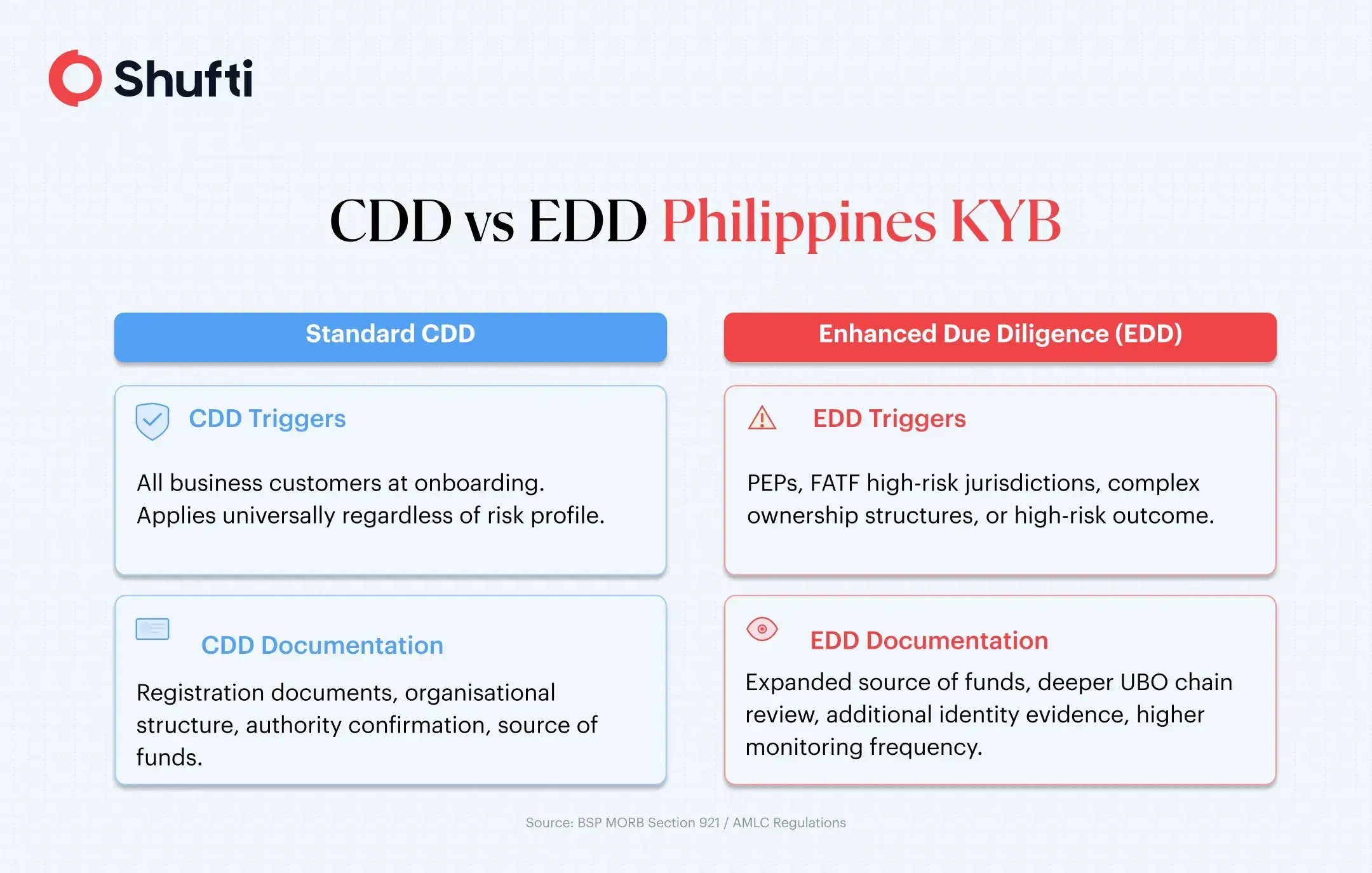
KYB CDD EDD Philippines requirements define two tiers of business customer scrutiny. Standard Customer Due Diligence (CDD) applies to every covered business relationship. Enhanced Due Diligence (EDD) triggers when specific risk indicators are present. The distinction matters because EDD demands a materially deeper investigation and additional documentation from the business customer and failure to apply it when required is a direct AMLA compliance breach.
Standard CDD for Business Customers
Standard CDD for business customers under BSP MORB Section 921 requires covered persons to verify the legal existence and organisational structure of the entity, confirm the authority and identification of all persons acting on its behalf, assess the purpose and intended nature of the business relationship, and determine the source of funds. Documentation must originate from reliable, independent sources. Covered persons must also maintain an accurate customer risk profile and update it whenever material changes to the customer’s circumstances occur.
When Does EDD Apply?
Enhanced due diligence is mandatory under Philippine regulations for four categories of business customers. The first is Politically Exposed Persons (PEPs) and entities they own or control. The second is customers from jurisdictions that the FATF identifies as high-risk or non-cooperative. The third is corporate customers with complex, opaque, or non-transparent ownership structures where the ultimate beneficial owner cannot be identified through standard documentation alone. The fourth is any customer assessed as high risk through the covered person’s own risk-based framework. EDD requires expanded source-of-funds documentation, a more thorough review of the beneficial ownership chain, validation procedures at higher scrutiny, and ongoing monitoring at greater frequency than standard CDD.
KYC, KYB, and Fintech in the Philippines
KYC KYB fintech Philippines obligations have grown substantially as the BSP expanded its regulatory perimeter to cover digital operators on the same terms as traditional licensed banks. BSP Circular No. 1170, issued in March 2023, amended the CDD provisions of the MORB and MORNBFI to formalise electronic KYC, including remote onboarding via biometric technology and recognition of the Philippine Identification System (PhilSys) as sufficient proof of identity for individual customers. For fintech companies and VASPs onboarding business customers, the same AML compliance obligations that apply to traditional banks now apply in full.
VASPs licensed under BSP Circular 1108 must implement full CDD, EDD, and AML screening requirements. The travel rule applies to virtual asset transfers above PHP 50,000, requiring originator and beneficiary information to accompany each transaction. GoTRACS (AMLC RI No. 2, December 2024) requires all covered persons to submit compliance filings electronically and to maintain continuous watchlist screening. Merchant payment service providers must also satisfy KYB obligations under BSP Circular No. 1198 before onboarding merchant clients, including comprehensive merchant identification, verification, and ongoing monitoring.
Business verification in the Philippines is no longer a one-time onboarding gate. Under the post-FATF exit framework, it is an ongoing monitoring programme covering the full lifecycle of the corporate relationship — with changes in ownership structure, licensing status, or watchlist exposure expected to surface and be acted on in near real time.
How Shufti helps compliance teams meet Philippines KYB requirements
The practical pain in Philippine KYB is rarely knowing which documents to collect. The breakdown happens in the fragmentation that follows: registry data in one system, UBO records in a manual spreadsheet, AML screening running through a separate vendor, and ongoing monitoring that triggers only at scheduled renewal rather than when something actually changes. Compliance teams describe EDD queues backing up because the ownership chain investigation is entirely manual, and onboarding timelines stretching when the process sits across three tools that do not share a data model.
Shufti’s KYB solution queries company registries and ownership records across 250+ jurisdictions, runs UBO traversal and director verification, and connects business AML screening against sanctions lists, PEP databases, and adverse media within a single workflow. Changes in ownership structure or watchlist status after onboarding surface in real time rather than at the next scheduled review. If your team is currently splitting these tasks across separate tools and manual registry lookups, consolidating into one auditable flow closes the most common gaps in Philippine KYB compliance.
Book a live demo to see how Shufti handles Philippines KYB across business registration checks, UBO identification, and AML screening in a single workflow.
Frequently Asked Questions
What are the KYB requirements in the Philippines?
KYB requirements in the Philippines are set by AMLA (RA 9160) and AMLC regulations. Covered persons must collect business registration documents, identify all beneficial owners above a 25% threshold, conduct Customer Due Diligence before onboarding, and maintain ongoing monitoring. Covered transactions above PHP 500,000 must be reported to AMLC within one banking day.
Who regulates KYB in the Philippines?
KYB in the Philippines is jointly regulated by the Anti-Money Laundering Council (AMLC), which enforces AMLA and manages reporting requirements; the Bangko Sentral ng Pilipinas (BSP), which supervises banks, digital banks, and virtual asset service providers; and the SEC, which administers corporate registration and beneficial ownership disclosure for all registered entities.
How is UBO defined under Philippine regulations?
Under AMLC Regulatory Issuance No. 3, Series of 2018, a beneficial owner is any natural person who ultimately owns or controls the customer. The threshold is 25% of voting rights or capital for SEC-registered companies, and 20% for entities that are themselves AML-covered persons under AMLA. All beneficial owners above threshold must be identified and verified.
What is CDD vs EDD in Philippine compliance?
CDD applies to all business customers and covers identity verification, organisational structure, and source of funds. EDD is mandatory for higher-risk categories, including Politically Exposed Persons, customers from FATF-flagged jurisdictions, and entities with opaque ownership structures. EDD requires deeper documentation, expanded beneficial ownership review, and more frequent ongoing monitoring.
Is KYB mandatory for fintech companies in the Philippines?
Yes. BSP Circular 1170 (2023) and the AMLA framework apply to all BSP-supervised entities, including digital banks, e-money issuers, and VASPs. Fintech companies onboarding business clients must conduct full KYB, including CDD, UBO identification, and ongoing monitoring, on equal terms with licensed banks.