


 Face Verification
 Address Verification
 Document Verification
 Age Verification
 VideoIdent
 Fast ID
 Docless Verification
 Consent Verification
 NFC Verification
 Business Verification
 Due Diligence
 Investor Verification
 E-Signature

 QES
QES
 AML Screening
 Transaction Monitoring
 Adverse Media
 Business AML Screening
 PEP & RCA
 Sanctions
 Watchlist
 Behavioural Biometrics
 Device Fingerprinting
 Biometric Face Authentication
 MFA
MFA
 Fraud Hub
 Onboarding
 Ongoing Monitoring
 KYC
KYC
 KYB
KYB
 KYI
KYI
 Age Assurance
 Identity Verification
 Workforce IAM
 Candidate Verification
 Compliance
 Fraud prevention
 Trust & safety
 Global expansion
 Product Managers
 Compliance Officers
 Fraud Analysts
 Developers
 Deepfake Detection
 Bonus Abuse / Promotion Abuse
 Account Takeover
 Synthetic Identity Fraud
 Document Fraud
 Impersonation Fraud
 Multi-Accounting
 Fraud Networks
 Chargeback Fraud
 Money Mule Activity
 Party Fraud
 Regulatory & Compliance Risks
 Fintech
 Crypto
 iGaming
 Forex
Forex
 Social Network
 Marketplace
 Banking
 Gig Economy
 Payments
 Ride Hailing
 Adult Content
 Blind Spot Audit
 Deepfake Detector
 Liveness Spoofs
 Document Originality
 Document Deepfake
 Global Trust Platform
 Journey Builder
 Case Management
 Shufti AI
 Fraud Analytics
 Vendor Comparison
 Brand Personalisation
 AI Compliance Co-Pilot
 OCR
OCR
 Secure Capture
 Deployment Options
 Identity Methods
 API Documentation
 Mobile SDKs
 Service Status
 Help Center
 Contact Us
 Technical Support
 Supported Documents
 Supported Countries
 Content library
 Blogs
Blogs
 News
News
 Reports
 Insights
 Knowledgebase
 ROI calculator
 About
About
 Career
 Press Release
 Certifications
 Partnership
 Awards
 Events & Webinar
 Interactive Demo
 Podcast Studio
 Spotlight Studio
Corporate Transparency Act & FinCEN’s BOI Rule: What AML Compliance Requires in 2026

- 01 What the Corporate Transparency Act Actually Does
- 02 Why Beneficial Ownership Sits at the Heart of AML
- 03 Which Businesses Must File a BOI Report Under FinCEN's New Rule
- 04 How the Corporate Transparency Act Strengthens AML Compliance in the US
- 05 AML Penalties for Non-Compliance with the Corporate Transparency Act
- 06 What CTA Compliance Looks Like in Practice
- 07 Where Shufti Fits Into a CTA-Aligned AML Programme
TL;DR
- The Corporate Transparency Act (CTA) went live January 1, 2024, requiring U.S. entities to report beneficial owners to FinCEN.
- A March 2025 Interim Final Rule narrowed this: only foreign entities registered to do business in a U.S. state or tribal jurisdiction must file BOI reports.
- U.S.-formed companies and U.S. persons are now fully exempt from BOI filing.
- Foreign entities registered before March 26, 2025, had until April 25, 2025, to file; those registering after get 30 days from the registration notice.
- Wilful non-filing carries civil penalties up to $606/day, criminal fines up to $10,000, and up to 2 years imprisonment.
- FATF upgraded the U.S. from “Non-Compliant” to “Largely Compliant” on beneficial-ownership transparency (Recommendation 24) in April 2024, partly due to the CTA.
- For U.S. financial institutions, this is now a screening and monitoring problem, not a filing problem: BOI data feeds KYB, sanctions, and PEP screening for any foreign entity counterparty.
Compliance teams keep telling us the same thing. Beneficial-owner verification used to mean a partner running a search at a law firm, a stack of PDFs, and a tab inside the AML platform that never quite synced with the rest. Then the Corporate Transparency Act (CTA) lit up a federal beneficial ownership registry, and the March 2025 Interim Final Rule narrowed who has to file.
The result is a smaller reporting population than the original law imagined but a heavier operational lift for any US-active business that touches foreign entities. This guide walks through Corporate Transparency Act AML compliance as it stands in April 2026, who still has to file under the new rule, and how Beneficial Ownership Information (BOI) data threads into a working anti-money-laundering (AML) programme.
What the Corporate Transparency Act Actually Does
The Corporate Transparency Act took effect on January 1, 2024, and required millions of U.S. legal entities to disclose their beneficial owners to the Financial Crimes Enforcement Network (FinCEN). The goal was to close the anonymous-shell-company gap that the Financial Action Task Force (FATF) had flagged in successive U.S. mutual evaluations.
That original scope did not last. On March 21, 2025, the U.S. Treasury issued an Interim Final Rule that revised the definition of “reporting company” to cover only entities formed under the law of a foreign country and registered to do business in a U.S. state or tribal jurisdiction. Domestic U.S. companies and U.S. persons are now exempt from the BOI filing obligation. The federal registry still exists. The corporate base feeding it just got far smaller.
Why Beneficial Ownership Sits at the Heart of AML
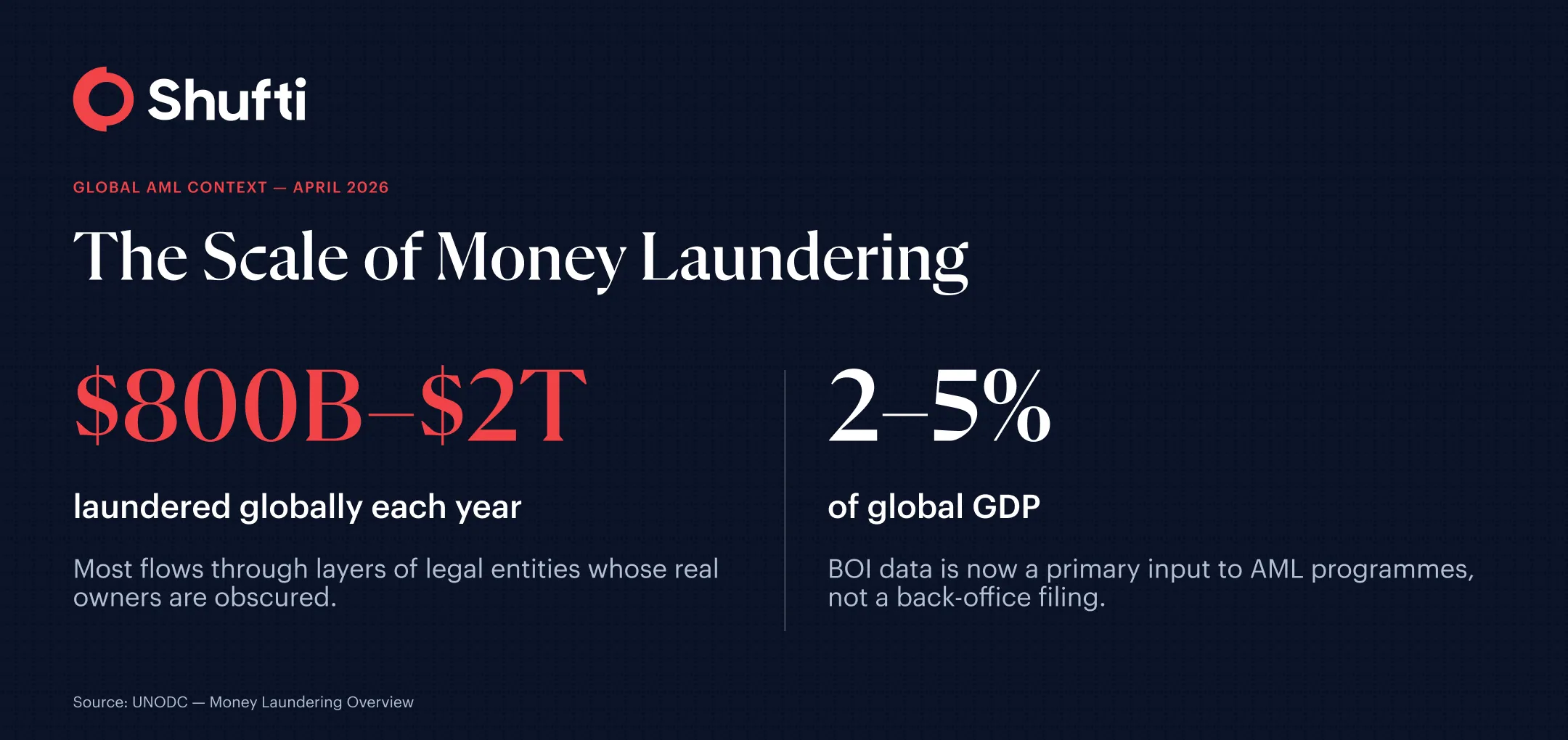
Anonymous corporate ownership is the connective tissue of laundering schemes. The United Nations Office on Drugs and Crime (UNODC) estimates that 2–5% of global GDP, between US$800 billion and US$2 trillion, is laundered each year. Most of that flow moves through layers of legal entities whose real owners are obscured.
FATF Recommendation 24 was written precisely for this problem. The United States spent years rated “non-compliant” on it. After the CTA went live, FATF re-rated the country as “largely compliant” with Recommendation 24 in April 2024. That rating shift is not abstract. It signals to correspondent banks and cross-border counterparties that beneficial-ownership data is now expected to feed onboarding, ongoing screening, and adverse-media reviews.
For firms running an AML programme inside the United States, beneficial-ownership AML work in the U.S. has stopped being a back-office filing exercise and has become a primary input to the risk model.
Which Businesses Must File a BOI Report Under FinCEN’s New Rule
After the March 2025 revision, FinCEN’s BOI rule requirements now apply to a single bucket. Foreign reporting companies are entities formed under the law of a foreign country and registered to do business in any U.S. state or tribal jurisdiction by filing a document with a secretary of state or similar office. U.S.-formed corporations, LLCs, and partnerships sit outside that scope. U.S. persons are not reportable as beneficial owners, even of foreign reporting companies.
Deadlines split by registration date. Foreign entities registered to do business in the U.S. before March 26, 2025, had until April 25, 2025, to file an initial BOI report. Foreign entities that register on or after March 26, 2025, have 30 calendar days from the registration notice. Updates and corrections to previously filed BOIs follow the same 30-day cadence.
CTA compliance for businesses outside that scope is therefore a screening problem, not a filing problem. The duty to identify the ultimate human owners of a counterparty has not gone away. It has migrated from the filer to the institution doing due diligence.
How the Corporate Transparency Act Strengthens AML Compliance in the US
The shift from filing to screening is the whole story. Foreign reporting companies populate the federal registry, and U.S. financial institutions, fintechs, and crypto exchanges then consume that data through their Know Your Business (KYB) and AML workflows when those foreign entities turn up as customers, counterparties, or institutional investors.
That changes three things inside an AML programme. First, the source of truth for who really owns a business shifts from a self-attested form to a federal record where wilful misstatement is a federal offence. Second, ongoing monitoring gets cleaner. Foreign-entity ownership changes flow into FinCEN within 30 days, giving compliance teams a tighter feedback loop on PEP exposure, sanctions hits, and adverse-media risk against the actual humans behind the entity. Third, the FATF re-rating gives correspondent banking partners a clearer expectation that U.S. counterparties will not be the weak link in a cross-border flow. FinCEN’s BOI reporting regime in 2026 is not a one-off filing window. It is settling into a steady-state reference dataset that sits alongside sanctions lists and PEP feeds inside any serious AML stack.
AML Penalties for Non-Compliance with the Corporate Transparency Act
Penalties stayed in the statute even after the IFR narrowed the rule. According to the FinCEN BOI FAQs, wilful failure to report or update BOI can trigger civil penalties up to $606 per day (adjusted for inflation, frozen at this level through January 2027), criminal fines up to $10,000, and up to two years’ imprisonment. Senior officers of foreign reporting companies that fail to file face personal liability.
The enforcement posture is targeted. Treasury has publicly committed not to pursue penalties against U.S. citizens or domestic companies, consistent with the IFR. Foreign reporting companies and their senior officers remain fully exposed. The bigger commercial worry, though, is the downstream AML risk. A U.S. bank that onboards a foreign entity that has not met its BOI obligation inherits a control gap that an examiner will flag, and the penalty in that case lands on the financial institution under the Bank Secrecy Act, not under the CTA. The institutional cost of a counterparty’s filing failure is often larger than the filer’s own.
What CTA Compliance Looks Like in Practice
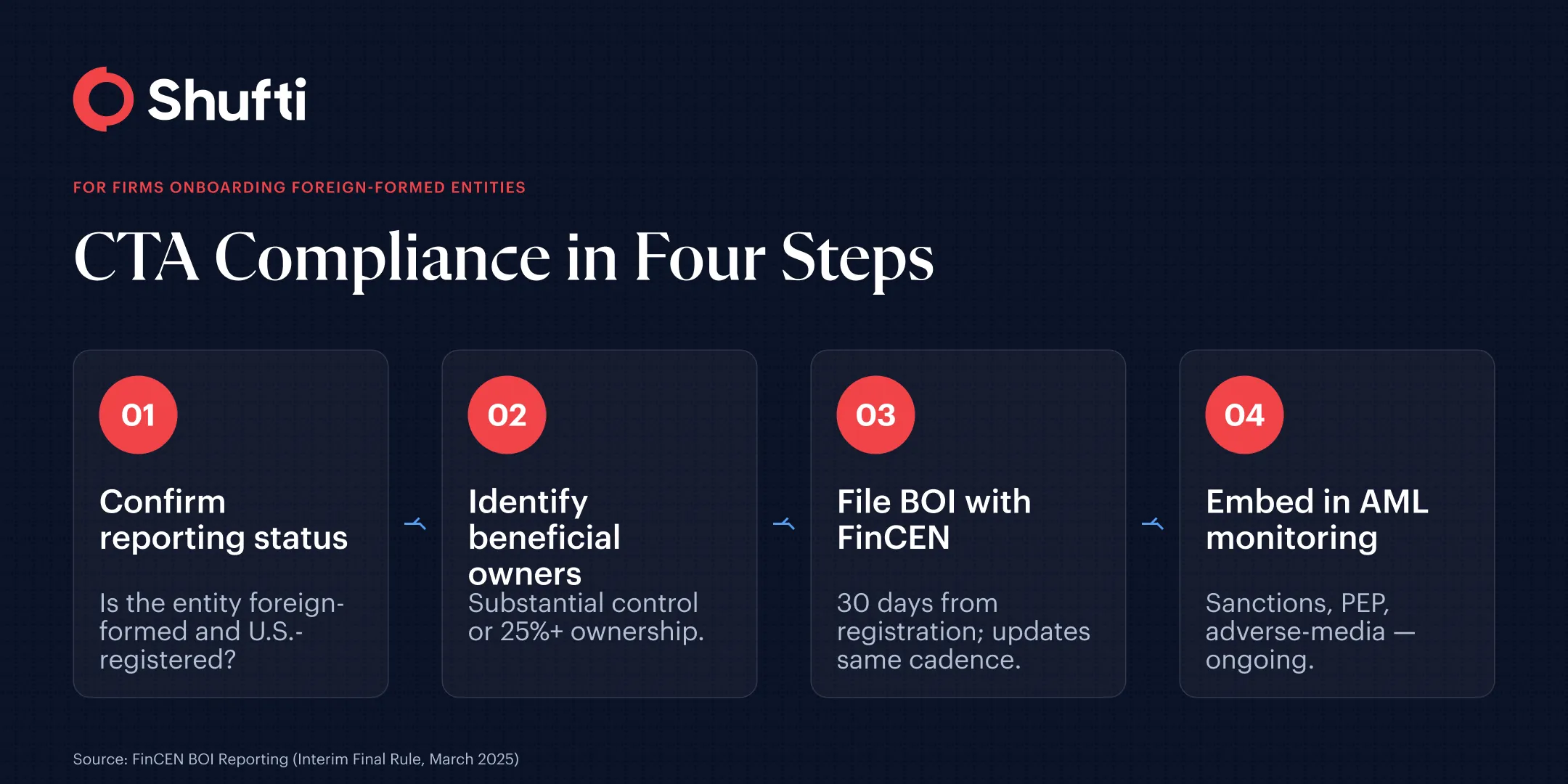
For a firm onboarding foreign-formed corporate clients, the operational pattern is becoming consistent.
- Confirm reporting status during KYB intake.
- Identify the beneficial owners (each individual exercising substantial control or owning at least 25% of the entity).
- Cross-check the customer’s BOI filing against your own due diligence record.
- Embed the result into the AML programme so any change in ownership, sanction status, or PEP designation refreshes the customer risk score automatically.
The teams getting this right are the ones who stopped treating beneficial ownership as a one-time intake question. They feed BOI data into the same monitoring engine that handles sanctions, PEP, and adverse-media screening, so a single change in a foreign entity’s ownership tree updates everything downstream.
The teams still struggling are usually the ones described in our pipeline as running a fragmented stack. KYB pulled together by a lawyer, AML by a separate vendor, and identity by a third tool, and no clean handoff between them.
Where Shufti Fits Into a CTA-Aligned AML Programme
Shufti runs Know Your Business and AML Screening on the same platform, which is the configuration most relevant to firms working through the BOI shift. KYB intake captures corporate structure, identifies the natural persons behind a foreign reporting company, and routes them through identity verification.
Ongoing monitoring keeps that lookup live, so a sanctions match or ownership change after onboarding surfaces in the same audit trail as the original check. For compliance teams worried about a fragmented stack, that single-platform approach is what closes the gap between a CTA filing record and a working AML programme.
Compliance teams onboarding foreign-registered corporate clients in 2026 need a workflow that pulls beneficial ownership, runs sanctions and PEP screening, and keeps monitoring after the customer is live. Shufti’s Know Your Business platform and AML screening are built around exactly that loop. Book a demo to see how the BOI-to-AML workflow runs end to end.
Frequently Asked Questions
How does FinCEN's BOI rule relate to AML compliance?
BOI gives FinCEN a federal record of who really owns foreign reporting companies. U.S. financial institutions then pull that data into KYB and AML workflows, using it to drive sanctions, PEP, and adverse-media screening on the actual humans behind the entity rather than on the corporate name alone.
Who qualifies as a beneficial owner under the Corporate Transparency Act?
Any individual who either exercises substantial control over a reporting company or owns or controls at least 25% of its ownership interests. Senior officers, directors with major decision rights, and large shareholders typically qualify, regardless of whether they sit inside or outside the United States.
What are the penalties for failing to comply with CTA BOI requirements?
Wilful failure to file or update BOI can trigger civil penalties up to $591 per day, criminal fines up to $10,000, and up to two years' imprisonment. Treasury has paused penalties against U.S. domestic companies, but foreign reporting companies and their senior officers remain fully exposed.