AMLR Solutions
  AMLR Consultation
 EUDI Wallet
 Onboarding
 Ongoing Monitoring
 FRAML
FRAML KYC
KYC KYB
KYB KYI
KYI Age Assurance
 Workforce IAM
 Candidate Verification
 Account Takeover
 Bonus/ Promotion Abuse
 Chargeback Fraud
 Deepfake
 Document Fraud
 Fraud Networks
 Impersonation Fraud
 Money Mule Activity
 Multi-Accounting
 Party Fraud
 Regulatory & Compliance Risks
 Synthetic Identity Fraud
 Adult Content
 Banking
 Crypto
 Fintech
 Forex
Forex Compliance
 Fraud prevention
 Trust & safety
 Global expansion
 Compliance Officers
 Developers
 Fraud Analysts
 Product Managers
 Journey Builder
  Global Trust Platform
 Customer Profiles
 Vendor Comparison
 IDV Case Management
 AML Case Management
 Regulatory Reporting
 Agentic Rule Builder
  AI Compliance Co-Pilot
  Fraud Analytics
 Fraud Hub
  OCR
OCR Shufti AI
 Bank Account Verification
  Biometric Duplication
 Database Checks
 Document Intelligence
 Government ID
 Mobile Driver's License
 NFC
NFC Selfie Liveness
 Brand Personalisation
 Deployment Options
 Identity Methods
 IDV Modes
 Multi-tenancy
 On-Premise IDV
 Secure Capture
 Shufti MCP









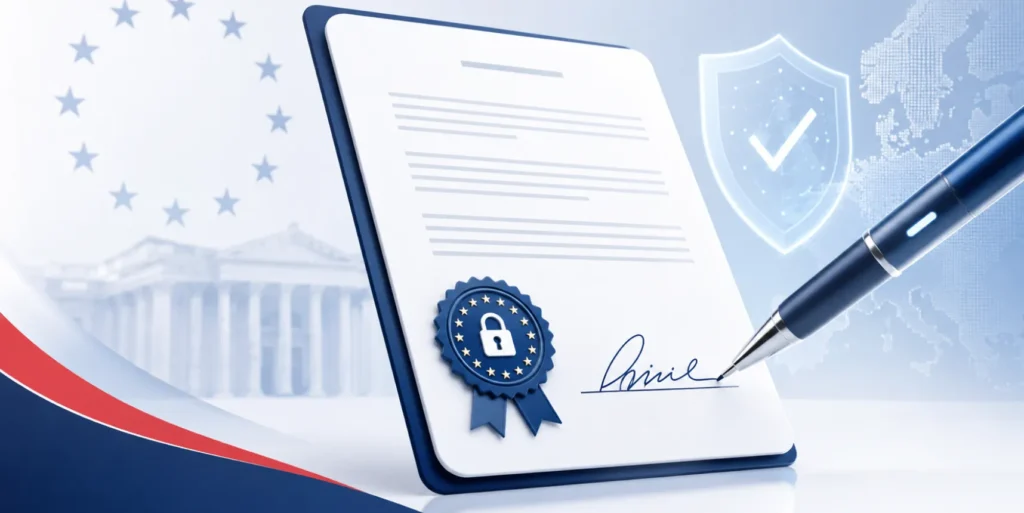

A signature typed at the bottom of a PDF and one backed by a qualified certificate can look identical on screen, yet only one carries the same legal weight as ink under EU law. That difference is the qualified electronic signature (QES), the top tier of e-signature under eIDAS. This guide breaks down what makes a signature “qualified,” how QES differs from a digital signature and a simple e-signature, and when a business actually needs one.
TL;DR
- A QES is the only e-signature with the same legal effect as a handwritten one across the EU.
- It needs three things: a qualified certificate, a QSCD, and a verified signer identity.
- Its legal weight rests on identity proofing done before the certificate is issued.
- A digital signature is the cryptography; a QES is the full legal package around it.
- QES sits above simple and advanced e-signatures under the EU’s eIDAS regulation.
Sign a document online and most people assume every electronic signature carries the same legal weight. Under the EU’s eIDAS regulation, the framework for electronic identification and trust services set out in Regulation (EU) No 910/2014, that assumption is wrong.
eIDAS defines three tiers of electronic signature, and only the top tier, the qualified electronic signature, carries the same legal effect as a handwritten one across all 27 member states. Knowing which tier you are using, and which one a given document actually requires, is the difference between a signature that holds up in court and one you have to defend after the fact.
What is a Qualified Electronic Signature?
A qualified electronic signature (QES) is an advanced electronic signature backed by a qualified certificate and created with a qualified signature creation device. In plain terms, the QES meaning comes down to one outcome. It is the only class of electronic signature that eIDAS treats as the legal equal of a handwritten, wet-ink signature in every EU member state.
eIDAS, set out in Regulation (EU) No 910/2014, defines three tiers of electronic signature. Each tier adds requirements on top of the one below it, so a qualified signature meets the most conditions and a simple one the fewest.
| Signature tier | Identity of signer | Legal effect | Typical use |
| Simple electronic signature (SES) | Not verified | Admissible, but weight judged case by case | Low-risk internal approvals, NDAs |
| Advanced electronic signature (AES) | Linked to signer, tamper-evident | Stronger evidence, no automatic wet-ink equivalence | Commercial contracts, HR documents |
| Qualified electronic signature (QES) | Verified by a QTSP before issuance | Equivalent to a handwritten signature EU-wide | Mortgages, consumer credit, notarial acts |
What Makes a Signature “Qualified”? The Three Building Blocks
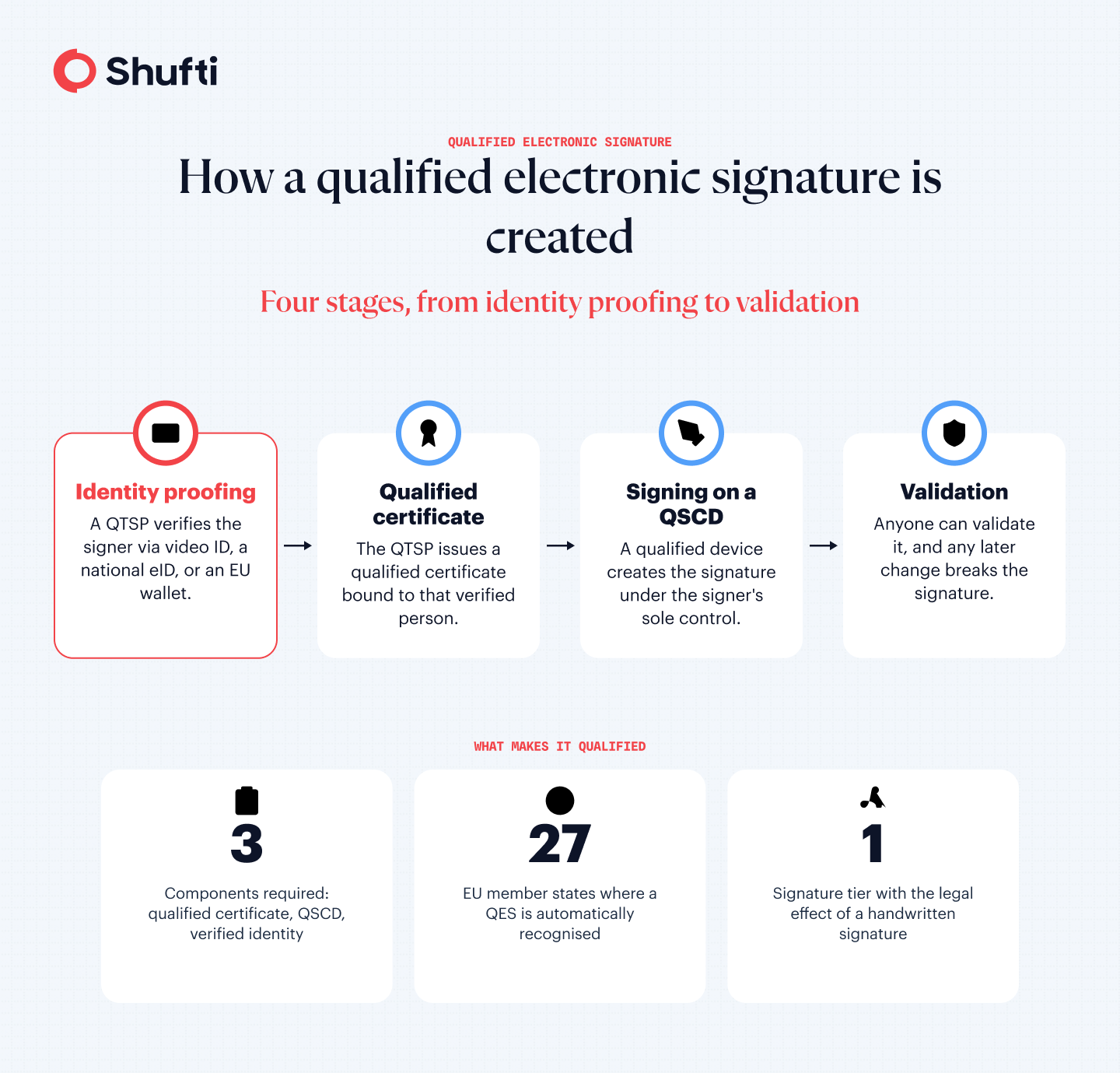
Three components separate a qualified electronic signature from a lesser one, and a valid qes signature only exists when all three are present. Remove any one and the signature drops a tier, losing its automatic legal equivalence.
A Qualified Certificate from a QTSP
The certificate binds the signature to a named, verified person. It can only be issued by a qualified trust service provider (QTSP), an organisation that a national authority has audited and added to an official EU Trusted List under Article 22 of eIDAS. If a provider is not on a member state’s trusted list, the certificates it issues are not qualified, and neither are the signatures built on them.
A Qualified Signature Creation Device (QSCD)
The qualified signature creation device (QSCD) is the secured hardware or certified software that actually generates the signature. Its job is to keep the signing key under the sole control of the signer, so no one, not even the provider, can sign on their behalf. A QSCD can be a physical smart card or a remote, cloud-based module that meets the same certified security standard.
A Verified Signer Identity
Before any certificate is issued, the signer’s identity has to be proven, and this is the step most explainers gloss over. The QTSP must confirm the person is who they claim to be, usually through a video identification session, a national electronic ID, or, increasingly, an EU Digital Identity Wallet. This proofing step is the foundation the whole signature rests on. A GES signature with a weak identity check is a legally binding mark attached to the wrong person.
Is a Qualified Electronic Signature the same as a Digital Signature?
No, and the two terms describe different things. A digital signature is a cryptographic technique, the mathematics that scrambles a document’s fingerprint and seals it so any later change is detectable. A qualified electronic signature is a legal status defined by eIDAS.
The European Commission draws the line clearly. An electronic signature is a legal concept, while a digital signature is the mathematical method often used to deliver it, per the Commission’s eSignature FAQ. Every QES uses digital-signature cryptography under the hood, but a digital signature on its own, without a qualified certificate, a QSCD, and a verified identity, is not a QES. The cryptography proves the document was not altered. The QES framework proves who signed it and gives that proof legal weight.
How does QES differ from a Simple Electronic Signature?
The difference is identity assurance and legal weight. A simple electronic signature (SES) can be as basic as a typed name, a scanned signature image, or a checkbox, with no verification of who applied it. A qualified electronic signature verifies the signer through a QTSP and carries wet-ink legal equivalence automatically.
eIDAS does not make a simple signature worthless. Under Article 25, no electronic signature can be denied legal effect in court purely for being electronic. But an SES puts the burden on you to prove, after a dispute, that the right person signed and the document was never changed. A QES front-loads that proof, so a court starts from the presumption that the signature is valid. For a low-risk internal approval, an SES is fine. For a mortgage or a consumer credit agreement, that presumption is worth paying for.
When do you Actually Need a QES?
You need a QES whenever national law demands a signature with the same standing as ink, or whenever the cost of a disputed signature is high. eIDAS sets the EU-wide framework, but each member state decides which specific documents carry a qualified-signature requirement.
Categories that commonly require a qualified signature across various member states include:
- High-value financial agreements such as mortgages, consumer credit contracts, and certain investment mandates.
- Notarial and real-estate documents, including property transfers and powers of attorney.
- Specific employment contracts and regulated filings where a member state mandates a qualified signature.
- Public-sector procurement submissions and official filings with government bodies.
Because these requirements are set nationally, the exact list varies, so confirm the rule in the jurisdiction where the document takes effect. One thing does not vary. Under Article 25(3) of eIDAS, a QES issued in one EU member state is recognised as a QES in all the others, which is what makes it the default for cross-border business.
The framework is also expanding. eIDAS 2.0, Regulation (EU) 2024/1183, entered into force in May 2024 and is rolling out the EU Digital Identity Wallet that every member state must offer its citizens. Once wallets are widespread, proving identity for a QES becomes a tap rather than a full video call, and remote qualified signing gets faster for everyone.
See how Shufti enhances Qualified Electronic Signature verification
How Shufti fits into Qualified Electronic Signatures
A qualified electronic signature is only as trustworthy as the identity check that happens before the certificate is issued. That is where most QES workflows strain. Verifying a signer in Berlin is straightforward, but any QES solution has to verify one in Jakarta, Riyadh, or São Paulo with the same speed and pass rate, and that is where many identity checks break., and a failed check means a lost signing session.
Shufti closes that gap with identity verification trained natively on 240+ countries and territories, so the proofing step that underpins a QES holds up in the markets where documents are hardest to read. Shufti supports Qualified Electronic Signatures under eIDAS 2.0, feeding a verified, audit-ready identity into certificate issuance rather than bolting verification afterwards.
One platform. Fully owned technology. Global coverage with real local depth.
See how verified identity data can strengthen your qualified electronic signature workflow under eIDAS 2.0, and explore Shufti’s eIDV and QES software capabilities.
Frequently Asked Questions
Is a qualified electronic signature the same as a digital signature?
No. A digital signature is the cryptographic method that seals a document, while a qualified electronic signature is the full legal package eIDAS defines around it, a qualified certificate, a QSCD, and a verified signer identity. Every QES uses digital-signature technology, but not every digital signature is a QES.
How does QES differ from a simple electronic signature?
A simple electronic signature can be a typed name or a scanned image with no identity check. A qualified electronic signature verifies the signer through a QTSP and carries the same legal effect as a handwritten signature EU-wide. The gap is identity assurance and legal weight.
Is a QES legally valid outside the EU?
A QES has automatic wet-ink legal equivalence only inside the EU and EEA under eIDAS. Outside that zone, its validity depends on local law and any mutual-recognition agreements. Many non-EU courts still accept it as strong evidence, but automatic equivalence is not guaranteed.