





 Face Verification
 Address Verification
 Document Verification
 Age Verification
 VideoIdent
 Fast ID
 Docless Verification
 Consent Verification
 NFC Verification
 Business Verification
 Due Diligence
 Investor Verification
 E-Signature

 QES
QES
 AML Screening
 Transaction Monitoring
 Adverse Media
 Business AML Screening
 PEP & RCA
 Sanctions
 Watchlist
 Behavioural Biometrics
 Device Fingerprinting
 Biometric Face Authentication
 MFA
MFA
 Fraud Hub
 Onboarding
 Ongoing Monitoring
 KYC
KYC
 KYB
KYB
 KYI
KYI
 Age Assurance
 Identity Verification
 Workforce IAM
 Candidate Verification
 Compliance
 Fraud prevention
 Trust & safety
 Global expansion
 Product Managers
 Compliance Officers
 Fraud Analysts
 Developers
 Deepfake Detection
 Bonus Abuse / Promotion Abuse
 Account Takeover
 Synthetic Identity Fraud
 Document Fraud
 Impersonation Fraud
 Multi-Accounting
 Fraud Networks
 Chargeback Fraud
 Money Mule Activity
 Party Fraud
 Regulatory & Compliance Risks
 Fintech
 Crypto
 iGaming
 Forex
Forex
 Social Network
 Marketplace
 Banking
 Gig Economy
 Payments
 Ride Hailing
 Adult Content
 Blind Spot Audit
 Deepfake Detector
 Liveness Spoofs
 Document Originality
 Document Deepfake
 Global Trust Platform
 Journey Builder
 Case Management
 Shufti AI
 Fraud Analytics
 Vendor Comparison
 Brand Personalisation
 AI Compliance Co-Pilot
 OCR
OCR
 Secure Capture
 Deployment Options
 Identity Methods
 API Documentation
 Mobile SDKs
 Service Status
 Help Center
 Contact Us
 Technical Support
 Supported Documents
 Supported Countries
 Content library
 Blogs
Blogs
 News
News
 Reports
 Insights
 Knowledgebase
 ROI calculator
 About
About
 Career
 Press Release
 Certifications
 Partnership
 Awards
 Events & Webinar
 Interactive Demo
 Podcast Studio
 Spotlight Studio
Malta iGaming Compliance: One Onboarding Record or Two Parallel Trails?

-
Add us as a Preferred Source
- 01 Malta's Two-Regulator Structure
- 02 The Self-Diagnostic: One Record or Two Parallel Trails?
- 03 Where MGA and FIAU Inspection Scopes Stop Overlapping?
- 04 A Worked Example: The Same Check, Two Different Outcomes
- 05 How Does Shufti Close the Diagnostic Loop?
- 06 Three Actions Before Your Next Supervisory Visit
TL;DR
- The MGA checks player protection while the FIAU checks CDD methodology under the PMLFTR.
- Both regulators inspect the same player file and ask different questions of it.
- The most common FIAU gap is a record showing the outcome but not the method.
- CDD triggers at the first transaction or €150, and EDD at €2,000 or the first withdrawal.
- The FIAU ran 187 supervisory interventions in 2024 across subject persons.
- One record logging method and outcome satisfy both the MGA and the FIAU.
An operator passes MGA’s quarterly review in Q1. In Q3, the FIAU issues a finding on the same player cohort. The onboarding system ran a liveness check on every player. The CDD records show the results: all passed. But the FIAU inspector asks a different question. Which liveness method ran? Was it active 3D liveness, passive liveness, or a static image comparison? The CDD record does not say. The inspection outcome is there. The evidential basis, the method behind that outcome, is absent.
This is not an edge case. The FIAU conducted 187 supervisory interventions in 2024, with remote gaming operators among the leading sectors for suspicious transaction report (STR) submissions, according to the FIAU 2024 Annual Report. The record deficiency above, correct conclusion, missing methodology, is the most common gap the FIAU finds in iGaming CDD files.
This guide gives Malta-licensed compliance officers and MLROs a three-question diagnostic to run on their current setup before the next supervisory visit, and explains exactly where MGA and FIAU inspection scopes diverge so one onboarding record can satisfy both.
Malta’s Two-Regulator Structure
The Malta Gaming Authority (MGA) governs gaming conduct, licence obligations, and player protection under the Gaming Act and the Player Protection Directive. The Financial Intelligence Analysis Unit (FIAU) governs AML/CFT obligations under the Prevention of Money Laundering and Funding of Terrorism Regulations (PMLFTR).
Same player. Same onboarding event. Different inspection scope, different evidentiary standards. When MGA and FIAU inspect the same operator, they each pull records for the same players and ask different questions of the same file. The file must answer both.
The Self-Diagnostic: One Record or Two Parallel Trails?
Before the next supervisory visit, pull a sample of ten player CDD records and run these three checks.
| Check | What to Look for in the Record | A “No” Means |
| 1. Outcome or method? | Verify that the file records the liveness category, document type, and AML data source, not merely a “passed” status. | The record shows the outcome but not the evidence or process that produced it. |
| 2. Risk-reasoning chain present? | Confirm that enhanced due diligence (EDD) decisions include documented reasoning, not just an EDD designation. | An EDD flag appears in the file without any explanation of why it was applied. |
| 3. Dual-query ready? | Check whether a single data source can satisfy both an MGA and an FIAU information request. | Staff would need to reconstruct separate files from multiple systems to respond to regulators. |
Where MGA and FIAU Inspection Scopes Stop Overlapping?
Both regulators require identity verification at onboarding. That is where the overlap begins and, for many operators, where their mental model of the overlap ends.
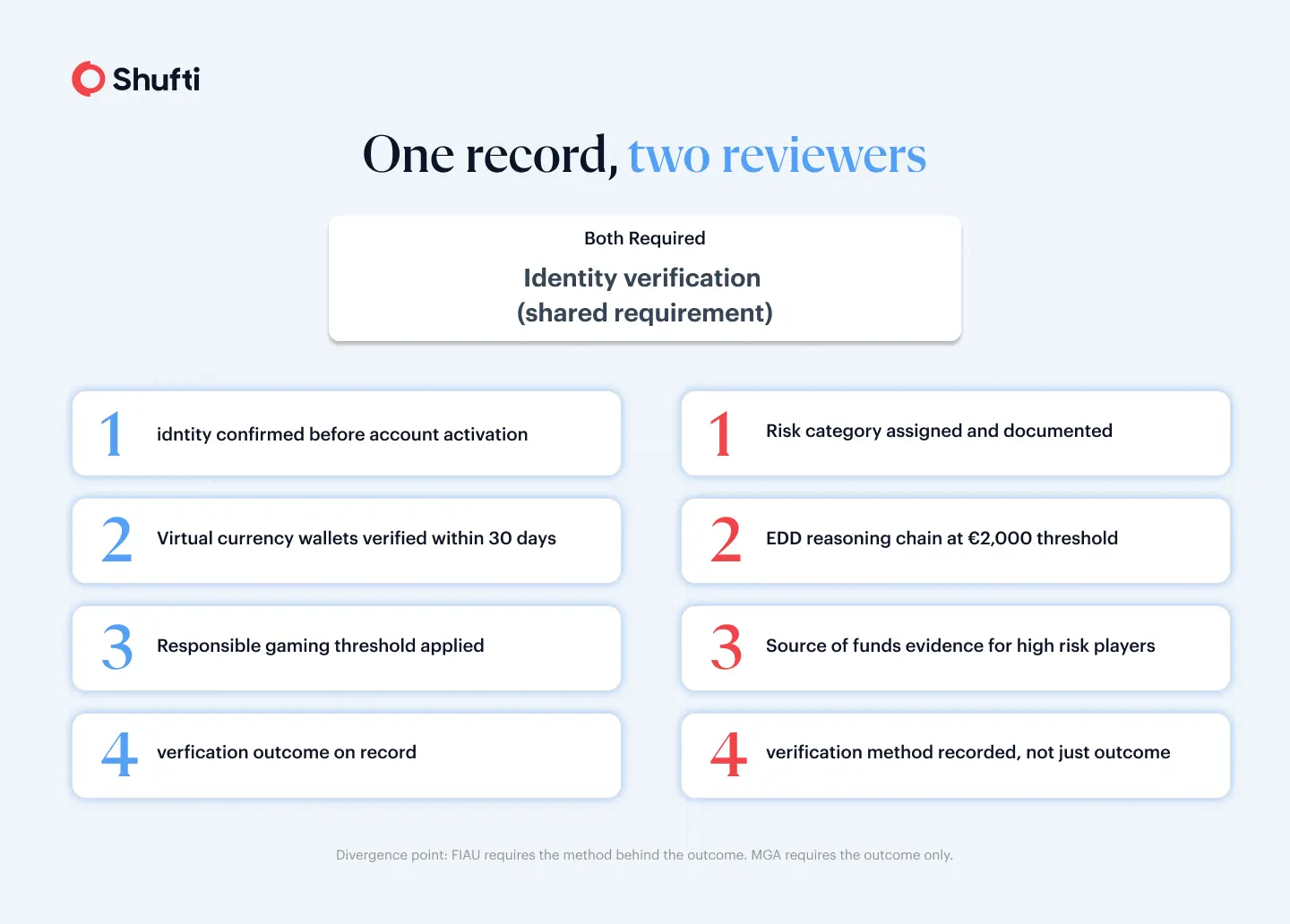
The MGA’s Player Protection Directive focuses on player protection outcomes: was the player’s identity confirmed before the account was activated? Were virtual currency wallet holders verified within 30 days of account opening? Were responsible gaming intervention thresholds applied correctly?
The FIAU’s PMLFTR inspection reaches further into the risk file. Customer due diligence (CDD) triggers at the first transaction or at €150 for remote gaming operators. The FIAU wants to see not only that CDD ran, but also: what risk category was assigned, why, what source-of-funds evidence was collected, and what justified the EDD decision when the €2,000 threshold or first-withdrawal trigger applied.
The divergence point is methodology. The MGA needs evidence that a player protection step happened. The FIAU needs evidence that the underlying risk decision was reasoned and documented. A verification outcome satisfies the first question. Only the documented method and risk logic satisfy the second.
A Worked Example: The Same Check, Two Different Outcomes
A Malta-licensed operator onboards a player in Q4 2023. Document verification runs, a liveness check runs, and AML screening runs. All pass. The onboarding system logs: “KYC, passed. Liveness, passed. AML screening, clear.”
MGA inspection, Q1 2025. The inspector examines the player protection file. Identity verified, yes. Liveness completed, yes. The file passes.
FIAU supervisory visit, Q3 2025. The FIAU visits the same operator following a spike in STR volumes from the remote gaming sector. The FIAU received 9,430 STRs in 2024 across all subject persons, with remote gaming operators among the top contributing sectors (FIAU 2024 Annual Report). The inspector pulls the same player cohort. The question is not “did liveness pass?” but “what liveness method was used, and is it adequate for the risk category this player was assigned?”
The record says: liveness, passed. It does not say: active 3D liveness, iBeta-certified, method logged at [timestamp], risk basis: low-risk self-declaration plus document match.
FIAU finding: CDD record incomplete. The outcome is present. The evidentiary basis for the risk classification is not.
Same operator. Same player. Same underlying check. Two inspections, one pass, one finding. The gap is not in what the system did. It is what the system recorded.
One record, both regulators
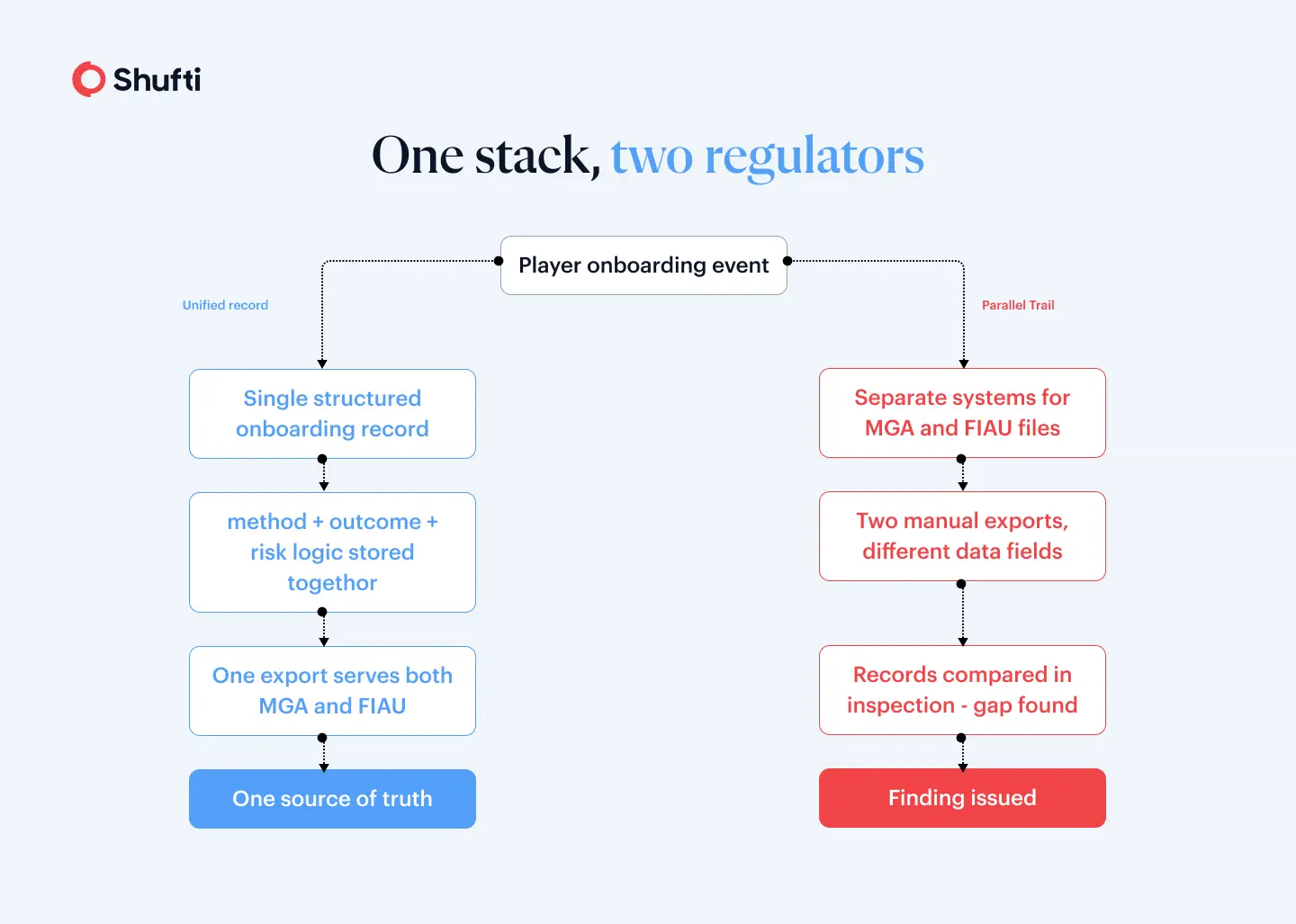
Shufti logs the method and the outcome of every check in one structured record that the MGA and the FIAU can both read.
How Does Shufti Close the Diagnostic Loop?
Shufti’s KYC and AML Screening capture both the result and the method in a single, structured record. Every verification event is logged with the method used, document classification, liveness type, AML data sources queried, alongside the outcome, timestamp, and risk signals detected.
That means Check 1 is answered: method and outcome are both in the file. Check 2 is answered: EDD decisions log the risk-reasoning chain, not just the flag. Check 3 is answered: the same record that satisfies an MGA player protection query can produce the CDD file a FIAU inspector needs, from one API call, without manual reconstruction, without a second parallel trail. Ready to enhance your compliance workflow with Shufti? Explore more insights tailored to Malta’s regulatory framework on our dedicated page.
One onboarding record. One source of truth. Both regulators served.
Three Actions Before Your Next Supervisory Visit
First, audit your CDD record template. Does every field the FIAU may ask about, verification method, risk-category basis, EDD trigger, source-of-funds evidence, exist as a structured data field, not a free-text note that gets lost on export?
Second, run a dual-export test. Pull one player’s record in the format you would hand to the MGA and then again in the format you would hand to the FIAU. If the content differs, you have two trails. If it is the same file, you have one source of truth.
Third, review your EDD documentation for the €2,000 threshold cohort specifically. EDD flags present without a documented reasoning chain represent the highest-risk gap going into any FIAU visit. This is the cohort the FIAU focuses on when STR volumes in remote gaming are elevated.
Looking to streamline your compliance processes and ensure complete audit readiness? Request a demo to see how Shufti can support you.
See how Shufti’s KYC and AML Screening give Malta iGaming operators one audit-ready record that satisfies both the MGA and the FIAU, without parallel trails or manual reconstruction.
Frequently Asked Questions
What is the difference between MGA and FIAU inspection scope in Malta iGaming?
The MGA inspects player protection compliance, whether identity steps were completed, and thresholds applied. The FIAU inspects CDD and AML/CFT obligations under PMLFTR, including risk methodology, EDD reasoning, and STR reporting. Both regulators review the same players. Neither asks exactly the same questions of the file.
What records does the FIAU require for CDD under PMLFTR?
PMLFTR requires remote gaming operators to document the customer's identity, assigned risk category, basis for any EDD decision, source-of-funds evidence for higher-risk players, and AML screening results. CDD triggers at the first transaction or €150. EDD triggers at a €2,000 deposit or first withdrawal.
How often does the FIAU conduct supervisory interventions on Malta's iGaming operators?
The FIAU 2024 Annual Report recorded 187 supervisory interventions across all subject persons and issued more than 70 enforcement and administrative actions. Remote gaming has consistently been among the leading sectors for both STR submissions and supervisory activity.
What triggers enhanced due diligence for Malta remote gaming operators?
Under PMLFTR, EDD is mandatory when a customer's deposit reaches €2,000 or at the point of their first withdrawal, whichever comes first. EDD is also required for any customer assigned a high-risk profile, politically exposed persons (PEPs), and customers from higher-risk jurisdictions identified in the FIAU's risk assessments.