





 Face Verification
 Address Verification
 Document Verification
 Age Verification
 VideoIdent
 Fast ID
 Docless Verification
 Consent Verification
 NFC Verification
 Business Verification
 Due Diligence
 Investor Verification
 E-Signature

 QES
QES
 AML Screening
 Transaction Monitoring
 Adverse Media
 Business AML Screening
 PEP & RCA
 Sanctions
 Watchlist
 Behavioural Biometrics
 Device Fingerprinting
 Biometric Face Authentication
 MFA
MFA
 Fraud Hub
 Onboarding
 Ongoing Monitoring
 KYC
KYC
 KYB
KYB
 KYI
KYI
 Age Assurance
 Identity Verification
 Workforce IAM
 Candidate Verification
 Compliance
 Fraud prevention
 Trust & safety
 Global expansion
 Product Managers
 Compliance Officers
 Fraud Analysts
 Developers
 Deepfake Detection
 Bonus Abuse / Promotion Abuse
 Account Takeover
 Synthetic Identity Fraud
 Document Fraud
 Impersonation Fraud
 Multi-Accounting
 Fraud Networks
 Chargeback Fraud
 Money Mule Activity
 Party Fraud
 Regulatory & Compliance Risks
 Fintech
 Crypto
 iGaming
 Forex
Forex
 Social Network
 Marketplace
 Banking
 Gig Economy
 Payments
 Ride Hailing
 Adult Content
 Blind Spot Audit
 Deepfake Detector
 Liveness Spoofs
 Document Originality
 Document Deepfake
 Global Trust Platform
 Journey Builder
 Case Management
 Shufti AI
 Fraud Analytics
 Vendor Comparison
 Brand Personalisation
 AI Compliance Co-Pilot
 OCR
OCR
 Secure Capture
 Deployment Options
 Identity Methods
 API Documentation
 Mobile SDKs
 Service Status
 Help Center
 Contact Us
 Technical Support
 Supported Documents
 Supported Countries
 Content library
 Blogs
Blogs
 News
News
 Reports
 Insights
 Knowledgebase
 ROI calculator
 About
About
 Career
 Press Release
 Certifications
 Partnership
 Awards
 Events & Webinar
 Interactive Demo
 Podcast Studio
 Spotlight Studio
Building Audit-Ready CDD for Malta’s Estate Agents, Notaries, and Law Firms
TL;DR
- Real estate STRs in Malta rose 80% year-on-year in 2024.
- Estate agents, notaries, and property lawyers are all subject persons under the PMLFTR.
- Both buyer and seller count as customers for CDD under the AMLR.
- CDD records must be retained for at least five years.
- From 10 July 2027, the occasional-transaction CDD threshold drops to €10,000.
- One workflow covering ID, UBO, and source of funds keeps files audit-ready.
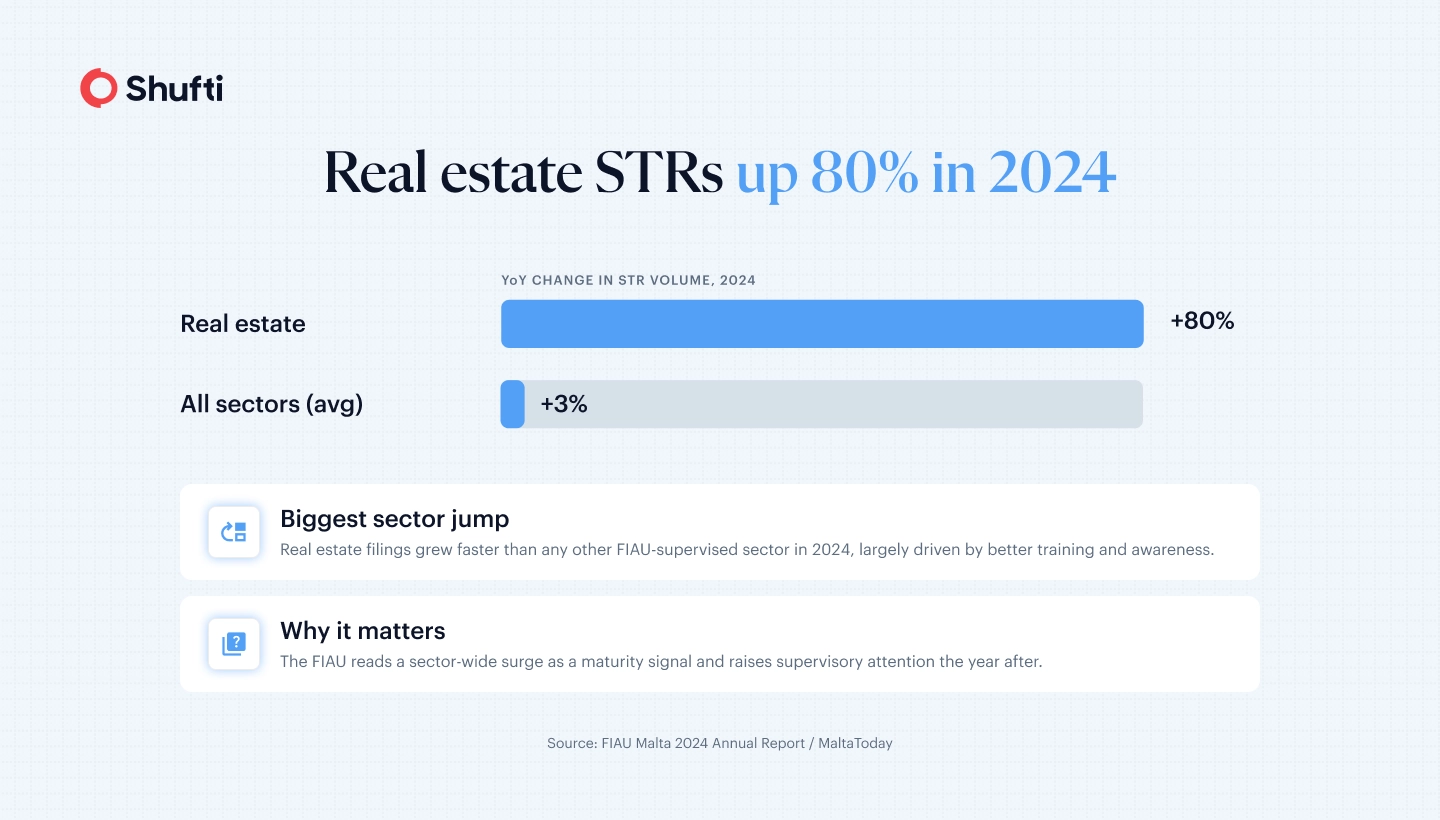
In June 2025, Malta’s Financial Intelligence Analysis Unit (FIAU) reported an 80% year-on-year rise in suspicious transaction reports (STRs) from the real estate sector, the largest jump of any sector it supervises last year. For a market where most agencies run with fewer than ten staff and no dedicated compliance officer, that kind of attention lands heavily.
Estate agents, notaries, and property lawyers handling Maltese conveyancing are all “subject persons” under the Prevention of Money Laundering and Funding of Terrorism Regulations (PMLFTR). Customer due diligence (CDD) is not optional, and the FIAU can inspect your paper trail.
The rest of this article walks through what an audit-ready CDD for Malta looks like in property transactions, where small firms most often slip, and the workflow you can run without a dedicated compliance team.
A subject person under Maltese law is a business or professional that must apply anti-money laundering obligations directly. For property transactions, that list includes real estate agents, notaries, and legal practitioners acting on conveyancing mandates. The PMLFTR gives each of them the same four core duties. Identify the customer, assess the risk, monitor the transaction, and report suspicions to the FIAU.
Why has the real estate sector moved to the top of the FIAU’s list?
Real estate agents are filing more STRs in Malta because two things changed at once. The FIAU put the sector through targeted outreach, thematic reviews, and sectoral training for the first time in years, and agents are acting on what they were shown. The 2024 FIAU Annual Report captures both the volume increase and the quality improvement, landing alongside 187 supervisory interventions and more than 70 enforcement actions across all supervised sectors.
The headline numbers frame the scale. Malta’s FIAU received 9,430 STRs in 2024, a 3% rise year-on-year. Remote gaming still files the most reports, but the 80% jump in real estate filings is the sharpest sector-level increase on the FIAU’s list. Most of that jump reflects better awareness, better training, and more confident filing by agents who had previously under-reported, not a sudden rise in underlying typologies.
Malta spent twelve months on the Financial Action Task Force (FATF) grey list and came off it in June 2022 after a concentrated AML reform programme. Post-greylisting, the compliance culture has not softened. From 10 July 2027, the EU Anti-Money Laundering Regulation (AMLR) drops the occasional-transaction CDD threshold from €15,000 to €10,000, which means more Maltese property deals will trigger full CDD, not fewer. The direction of travel is one way.
What an audit-ready property CDD file actually looks like?
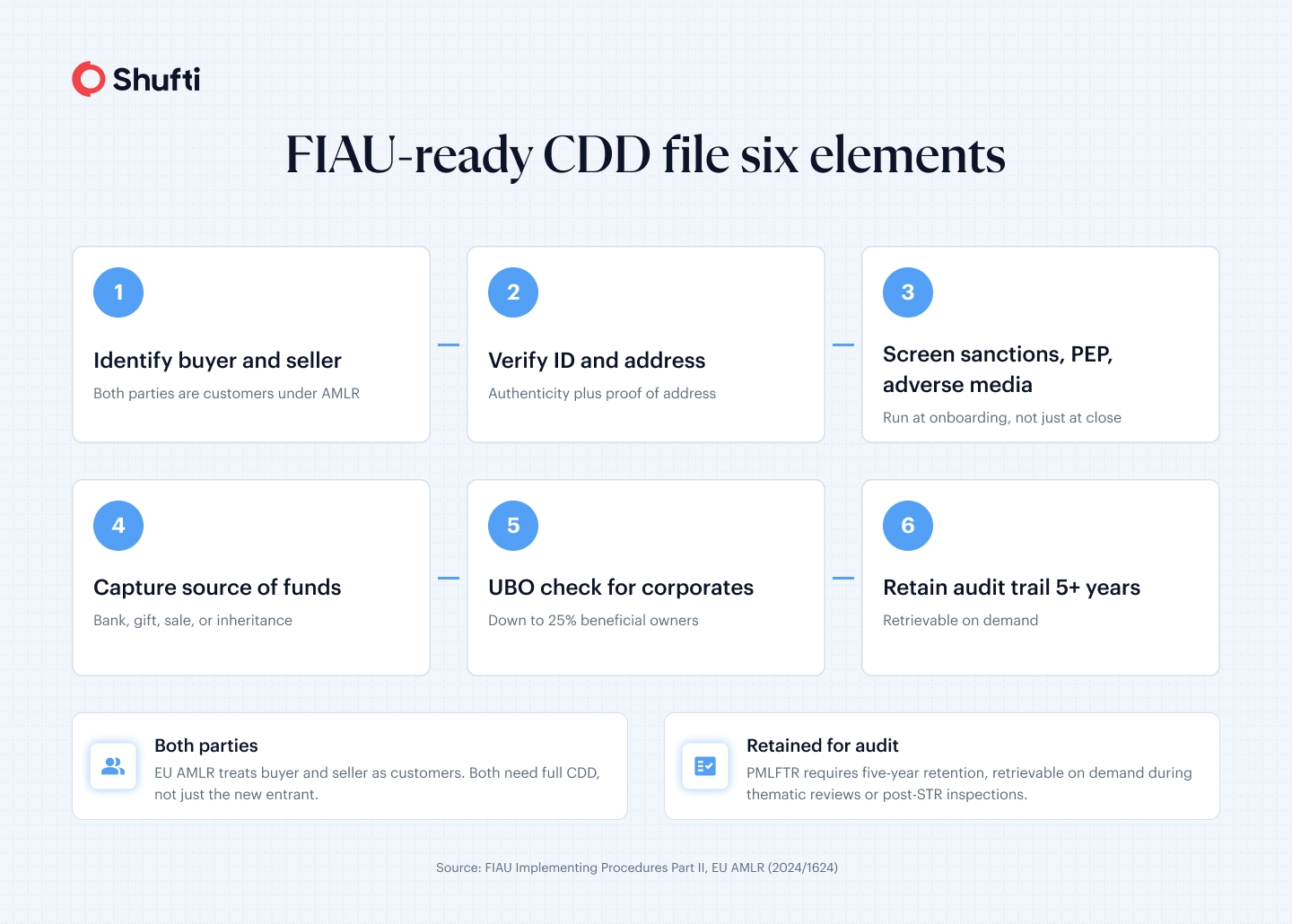
A CDD file that survives an FIAU inspection is not a folder of copied ID cards. It is a documented chain of decisions with evidence at each step. The FIAU Implementing Procedures Part II for the real estate sector is specific about what the chain must contain, and missing any link means the whole file fails. Six elements do the heavy lifting, and each one needs evidence that can be pulled months after the deal closes.
Identify and verify both parties
Both buyer and seller count as customers for CDD purposes under the AMLR. For residential deals with foreign buyers, that is the step where most files break down. Identity verification needs a government-issued ID checked for authenticity, a proof of address that matches the ID record, and a liveness check where the customer is not present in person. For remote onboarding, the file needs evidence of the check, not just the pass or fail result.
Cover beneficial owners when the buyer is a company
Foreign corporate buyers routing purchases through holding structures are a known laundering typology in Malta. The 2023 National Risk Assessment flagged corporate service providers as a sector of concern for exactly this reason. For any corporate buyer, the file needs a ultimate beneficial ownership (UBO) check that walks every layer of the structure down to the natural persons holding 25% or more. A register extract is a starting point, not an ending point.
Screen, capture the source of funds, and retain the trail
Sanctions, politically exposed persons (PEP), and adverse media screening need to run against every party at onboarding, not only at closing.
Source of funds evidence matters most when the buyer is paying outside a bank mortgage, which is a frequent pattern in Malta’s cash-heavy property market and in Special Designated Areas where high-net-worth foreign buyers are common.
Bank statements covering the full deposit period, sale documentation from the previous property, gift letters with the donor’s own identity checked, and inheritance paperwork with a grant of probate for each land with a different weight in the file.
The evidence does not have to be perfect. It does have to be consistent with the price, the buyer profile, and the timing. The full audit trail, timestamped and retained for at least five years under PMLFTR, is what the FIAU asks for during a thematic review.
Where small firms most often get tripped up?
The failure modes in Maltese property CDD are not exotic. They cluster around four patterns that the FIAU repeatedly cites in enforcement notices, and each one is avoidable with a standard workflow. Administrative fines dropped to around €750,000 in 2024 from €3.2 million the year before (FIAU 2024 Annual Report), even as supervisory interventions and enforcement actions rose. Enforcement has broadened, not narrowed.
Four failure patterns account for most of those notices, and each one is avoidable. Here is what the FIAU sees:
| Common Pitfall | What Typically Happens | Why the FIAU Flags It |
| Foreign ID treated as a photocopy | A notary’s assistant eyeballs an EU passport, UK licence, or non-Latin-script ID instead of running an authenticity check. | Non-Maltese documents require structured verification. Visual inspection alone is insufficient. |
| The deal outruns the CDD | A busy agency allows the buyer to sign the promise of sale before customer due diligence (CDD) is completed. | The FIAU audits timestamps. A CDD check dated after the promise of sale, or after funds have moved, is a finding in itself. |
| A one-off sanctions check | Screening is performed once during onboarding and is never repeated throughout a transaction that may take months to close. | Under the Implementing Procedures Part II (revised 2024), monitoring must be ongoing. A sanctions list can change before conveyance. |
| Seller “known to the firm” | Agents and notaries bypass CDD requirements for a seller they already know. | Under the EU AMLR, both buyer and seller are customers. The notary executing the deed has the same AML obligations as the agent initiating the transaction. |
Run a CDD file that the FIAU can pull on demand
Shufti captures ID, UBO, and AML screening in one workflow with a retention trail mapped to the PMLFTR.
How does Shufti help Malta’s property professionals build audit-ready CDD?
A small agency or two-partner notary practice does not need to build a compliance function from scratch. What it needs is one workflow that captures the full chain, from buyer ID to source-of-funds retention, in a way the FIAU can pull on demand.
Shufti’s customer due diligence for Malta runs on a single API and covers the moving parts that a small firm does not have the capacity to stitch together. Document verification works on more than 10,000 document types across 220+ countries, which handles the foreign-buyer problem at source.
AML screening runs against 3,500+ global watchlists and 2.6 million PEP profiles, with the data refreshed on a 15-minute cycle so a sanctions list change during conveyancing is caught, not missed. Every check sits inside an audit trail that maps to the PMLFTR record-keeping duty, and the same file is ready for FIAU review months after the deed is closed.
FIAU inspectors check for evidence, not intent, and a CDD file either shows the full chain or it does not. Shufti runs identity, UBO, and AML screening for Maltese property professionals inside one workflow, with a retention trail that matches the Implementing Procedures Part II checklist. Start a workspace on the Shufti Self-Service Portal to run your first check without a procurement cycle, or request a demo and start verifying in minutes.
Frequently Asked Questions
Are estate agents in Malta subject persons under AML law?
Yes. Real estate agents, notaries, and legal professionals acting on conveyancing are all subject persons under the PMLFTR. That means full AML obligations, including risk assessment, customer due diligence, ongoing monitoring, STR filing, and five-year record retention, all supervised by the FIAU.
Does a notary have to verify the buyer and the seller?
Yes. Under the EU AMLR, both buyer and seller count as customers for CDD purposes in a real estate transaction. Notaries who previously treated the seller as known must now run CDD on both parties, including identity, beneficial ownership, and source of funds where relevant.
When is an STR required on a Maltese property deal?
An STR is required as soon as the subject person has knowledge or suspicion of money laundering or terrorism financing, regardless of whether the deal closes. Common triggers include an inconsistent source of funds, unusual cash involvement, reluctance to provide documents, or screening hits that cannot be cleared.
What changes under the EU AMLR for Maltese property transactions?
The EU Anti-Money Laundering Regulation applies from 10 July 2027. Its main shifts for property work include the occasional-transaction CDD threshold dropping from €15,000 to €10,000, both buyer and seller defined as customers, and national carve-outs for "simplified" due diligence tightening. Maltese procedures will align upward, not downward.
How long must Maltese property CDD records be retained?
At least five years from the end of the customer relationship or the date of the occasional transaction, under the PMLFTR. The FIAU can request the file during a thematic review, targeted inspection, or after an STR, so retained records must be retrievable on demand.