


 Face Verification
 Address Verification
 Document Verification
 Age Verification
 VideoIdent
 Fast ID
 Docless Verification
 Consent Verification
 NFC Verification
 Business Verification
 Due Diligence
 Investor Verification
 E-Signature

 QES
QES
 AML Screening
 Transaction Monitoring
 Adverse Media
 Business AML Screening
 PEP & RCA
 Sanctions
 Watchlist
 Behavioural Biometrics
 Device Fingerprinting
 Biometric Face Authentication
 MFA
MFA
 Fraud Hub
 Onboarding
 Ongoing Monitoring
 KYC
KYC
 KYB
KYB
 KYI
KYI
 Age Assurance
 Identity Verification
 Workforce IAM
 Candidate Verification
 Compliance
 Fraud prevention
 Trust & safety
 Global expansion
 Product Managers
 Compliance Officers
 Fraud Analysts
 Developers
 Deepfake Detection
 Bonus Abuse / Promotion Abuse
 Account Takeover
 Synthetic Identity Fraud
 Document Fraud
 Impersonation Fraud
 Multi-Accounting
 Fraud Networks
 Chargeback Fraud
 Money Mule Activity
 Party Fraud
 Regulatory & Compliance Risks
 Fintech
 Crypto
 iGaming
 Forex
Forex
 Social Network
 Marketplace
 Banking
 Gig Economy
 Payments
 Ride Hailing
 Adult Content
 Blind Spot Audit
 Deepfake Detector
 Liveness Spoofs
 Document Originality
 Document Deepfake
 Global Trust Platform
 Journey Builder
 Case Management
 Shufti AI
 Fraud Analytics
 Vendor Comparison
 Brand Personalisation
 AI Compliance Co-Pilot
 OCR
OCR
 Secure Capture
 Deployment Options
 Identity Methods
 API Documentation
 Mobile SDKs
 Service Status
 Help Center
 Contact Us
 Technical Support
 Supported Documents
 Supported Countries
 Content library
 Blogs
Blogs
 News
News
 Reports
 Insights
 Knowledgebase
 ROI calculator
 About
About
 Career
 Press Release
 Certifications
 Partnership
 Awards
 Events & Webinar
 Interactive Demo
 Podcast Studio
 Spotlight Studio
Alabama HB172: What the Political Synthetic Media and Election Integrity Act Actually Requires
- 01 What Alabama's HB172 actually prohibit?
- 02 What disclosures does HB172 require for AI-generated political ads?
- 03 What are the penalties for election deepfakes under Alabama HB172?
- 04 How Alabama HB172 fit into the broader state deepfake law landscape?
- 05 How Shufti help platforms verify synthetic media compliance?
- AI-generated or digitally manipulated audio/video/audiovisual content that falsely depicts a real, identifiable person saying or doing something they didn’t, distributed within 90 days of an election (primary, general, or runoff).
- Only applies when both conditions are met: the distributor knows the content is false AND intends to influence an election outcome or damage a candidate. Good-faith errors or non-electoral content are exempt.
- A clear, conspicuous disclaimer (stating the content is manipulated, visible throughout the entire video, not just at the start/end) exempts content from the ban. Clearly labeled parody is also exempt.
- First offense, Class A misdemeanor; second offense within 5 years = Class C felony. Civil injunctions can be sought independently by the AG, the depicted person, or an affected candidate, running in parallel with criminal charges.
- Unlike many state laws that only target paid political ads, HB172’s distributor liability extends to unpaid reposts/shares too, widening compliance exposure for campaigns and platforms alike.
In January 2024, voters in New Hampshire received robocalls that sounded exactly like President Biden, falsely telling Democrats to skip the upcoming primary. The Federal Communications Commission moved to ban AI-generated voices in robocalls shortly after, but state election codes had largely not been updated to address synthetic political media. Alabama moved earlier than most.
Governor Kay Ivey signed HB172 into law on May 15, 2024, and the Act took effect October 1, 2024. This article breaks down what the Alabama political synthetic media law actually prohibits, what disclosures it demands, and where the liability edges fall for campaigns and platforms.
What Alabama’s HB172 actually prohibit?
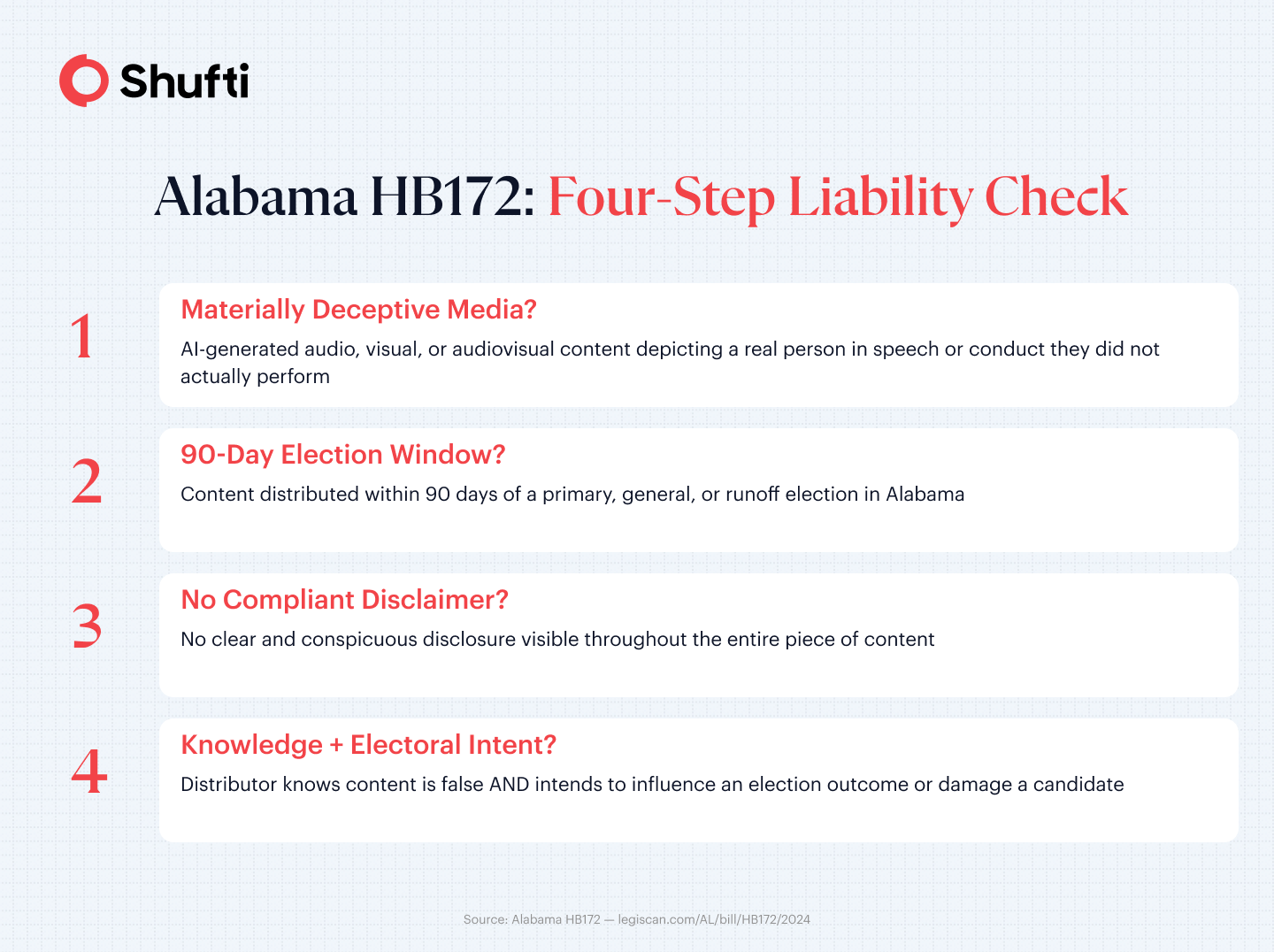
Alabama’s Political Synthetic Media and Election Integrity Act targets a narrowly defined category of content, and the statutory definitions shape the liability surface more precisely than the broad phrase “political deepfake ban Alabama” implies. Campaign teams, media producers, and platform trust leads distributing election-period content in Alabama need the exact statutory definition before they can assess their exposure.
The Act defines materially deceptive media as audio, visual, or audiovisual content that depicts a real, identifiable person engaging in speech or conduct they did not actually perform, and that was produced using generative artificial intelligence or similar digital manipulation techniques. The definition spans video, audio, and combined formats. Partial manipulation that changes the meaning of real footage qualifies, not only entirely fabricated content.
HB172’s prohibition is not a blanket ban on synthetic media. The Act triggers liability only when two conditions are simultaneously present. The distributor must know the content is false, meaning it depicts speech or conduct the person did not actually engage in.
The distributor must also intend to influence an election outcome or damage a candidate’s electoral prospects. Both conditions must be met before the prohibition applies. Good-faith errors and content distributed without electoral intent fall outside the Act’s reach.
The 90-day window is the defining timing trigger. The Act activates on any distribution of materially deceptive media within that window, provided both knowledge and electoral intent are present, regardless of whether the election is a primary, a general, or a runoff.
What disclosures does HB172 require for AI-generated political ads?
HB172 does not ban all synthetic media in political contexts. Content that carries a clear and conspicuous disclaimer is exempt from the prohibition. Alabama’s 2024 synthetic media election law creates a compliance path for campaigns willing to disclose AI use, but the statutory requirements are specific enough that a poorly placed or briefly flashed disclaimer will not satisfy them.
The disclaimer must meet three criteria. It must state clearly that the content has been technologically manipulated. It must remain visible throughout the entire video, not only at the start or at the end of the clip. And it must be comprehensible to the average viewer, not buried in fine print or obscured by competing visual elements.
Platform teams managing political video libraries face a practical question here. A disclaimer visible for two seconds before a two-minute video, or appearing only in description text outside the video itself, does not meet the standard. The disclaimer must accompany the content throughout each viewing, in every distribution format where the video appears.
The Act also exempts clearly labeled parody. In October 2024, the Alabama Attorney General confirmed that HB172 does not apply to content that is plainly satirical, provided a reasonable viewer would understand it as parody rather than a factual depiction. That carve-out does not extend to content that is deceptive in presentation but described as satire only in accompanying text.
What are the penalties for election deepfakes under Alabama HB172?
HB172 establishes both criminal liability and civil enforcement routes, and Alabama election deepfake penalties escalate on repeat offenses. The criminal track carries mandatory classification thresholds, while the civil path is available to multiple parties, not only the state. A single distribution event can draw concurrent criminal charges and civil injunctions.
Criminal penalties
A first violation under HB172 is a Class A misdemeanor under Alabama law. A second or subsequent violation within five years of the first becomes a Class C felony. The step from misdemeanor to felony on the second offense within five years creates meaningful exposure for campaigns that operate across multiple election cycles or distribute political content at volume.
Civil enforcement
The Alabama Attorney General (AG) may seek permanent injunctive relief against any person who distributes materially deceptive media in violation of the Act. The depicted individual and any candidate likely to be injured by the distribution may independently file for injunctive relief, regardless of whether the AG acts. Both tracks can run in parallel, meaning a single distribution event may produce concurrent state and private civil actions.
The escalating penalty structure also means that timing and volume of distribution affect the legal risk profile directly. A campaign that re-distributes a flagged piece of media after receiving notice of a first violation transitions from misdemeanor to felony territory on the second occurrence within the five-year window.
How Alabama HB172 fit into the broader state deepfake law landscape?
Alabama’s Act is part of a broader legislative wave that accelerated after synthetic media became commercially accessible at scale. For campaigns and platforms managing content distribution across multiple states, each state has its own requirements for deepfake election integrity, and the variation in scope, timing windows, and penalty structures creates a genuinely complex compliance environment.
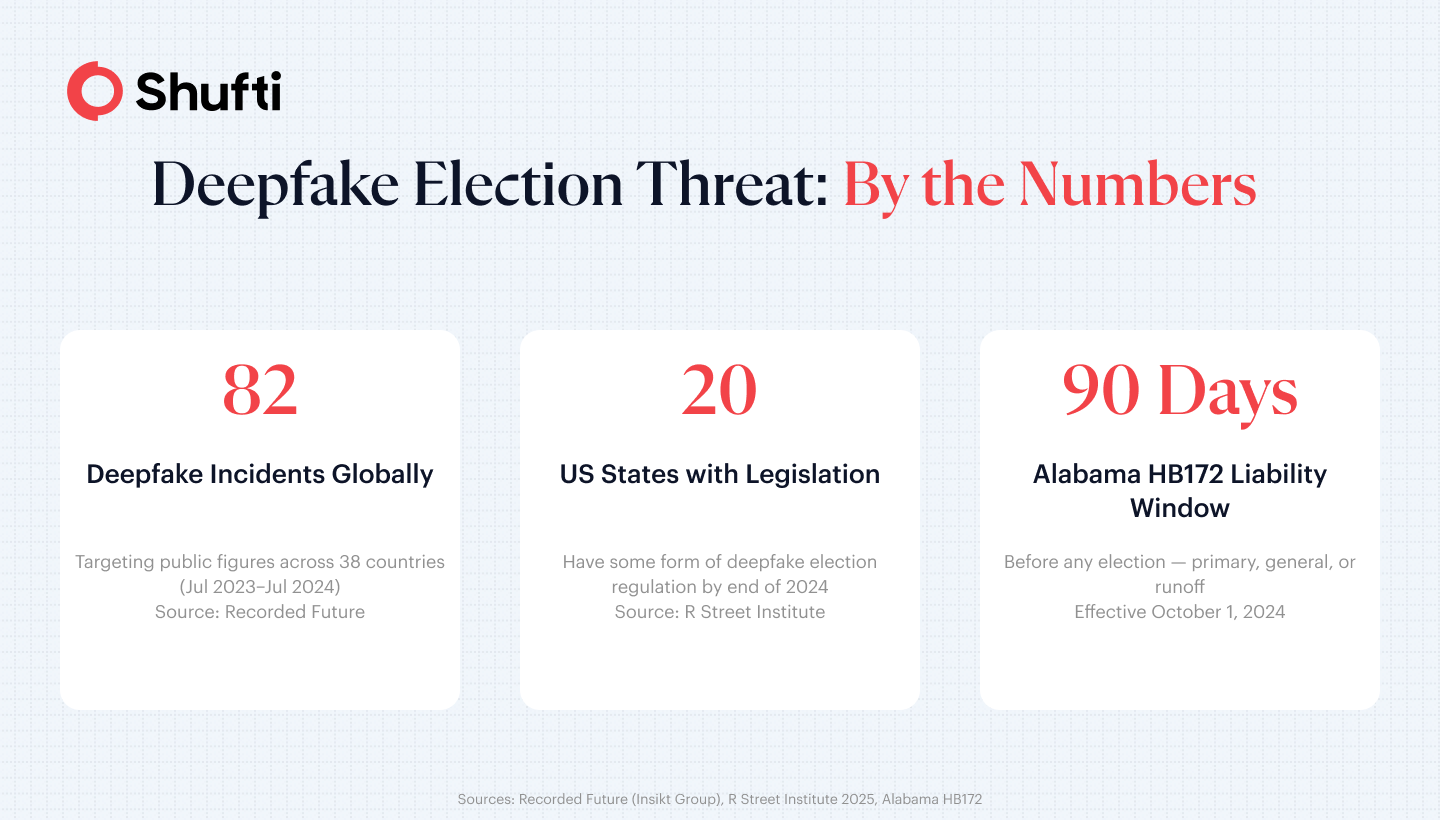
The Insikt Group at Recorded Future identified 82 deepfake incidents targeting public figures across 38 countries between July 2023 and July 2024, with 30 nations holding elections during the period or scheduled to do so in 2024. That data point drove state legislative activity in the United States sharply upward in the same period.
By the end of 2024, 16 states had enacted new AI disclosure or prohibition laws covering political media, bringing the total with some form of deepfake election regulation to 20 states, per the R Street Institute’s 2025 state legislation update. Alabama HB172’s 90-day window sits at the median. Some states use shorter windows covering only paid political advertising, while California adopted a 120-day window and additional platform notification requirements.
Alabama’s approach to deepfake election integrity, specifically the distributor liability clause in HB172, puts the Act in a different category from disclosure-only frameworks. A campaign operative who reposts materially deceptive media on a personal social account, without payment or official campaign authority, can still trigger the Act if the other elements are present.
Most state frameworks targeting paid political advertising do not reach that far. Teams building synthetic media detection processes should treat Alabama’s unpaid-distribution reach as a material scope difference when calibrating content review workflows.
How Shufti help platforms verify synthetic media compliance?
HB172’s distributor liability clause is the provision that changes the compliance calculus for platforms. The Act does not limit liability to the original creator of synthetic media. It reaches whoever distributes the content with knowledge of its deceptive nature and intent to influence an election.
Platforms hosting or sharing election-period video in Alabama face real exposure if that content crosses the statutory line, and they had no prior process to detect whether it does.
Shufti’s deepfake detection runs output video through a detection stack covering 56+ spoofing and manipulation attack vectors, including face-swap, voice modification, and video injection techniques. Compliance teams and platform trust & safety leads can push candidate-adjacent content through the API before publication to determine whether synthetic manipulation is present.
The check runs against the output file that the viewer actually sees, rather than on production metadata that is typically unavailable to distributors who receive content from third parties.
The detection layer is validated against government-grade standards. Shufti’s synthetic-media and biometric detection earned top-performer recognition at the Department of Homeland Security (DHS) Biometric Rally 2025 evaluation, meeting 100% of DHS goals across diverse demographic groups.
For campaign legal teams that need a defensible record of due-diligence checks before content release, that validation level is the difference between a documented review process and an undocumented one.
Political teams and platforms that distribute AI-generated media in Alabama face simultaneous criminal and civil exposure under HB172 when verified disclosures are absent.
Shufti’s deepfake detection runs synthetic media checks against 56+ attack vectors before content reaches an audience, so trust and safety teams know exactly what they are distributing before it goes live. Request a demo to walk through a detection check on actual political video content.
Frequently Asked Questions
What does Alabama HB172 say about synthetic media in elections?
HB172 prohibits distributing AI-generated media that falsely depicts a real person in speech or conduct they did not engage in, when the distributor knows the content is false and intends to influence an election. The prohibition applies within 90 days of an election.
What disclosures are required for political deepfakes in Alabama?
Alabama HB172 requires a clear and conspicuous disclaimer stating the content has been technologically manipulated. The disclaimer must remain visible throughout the entire video, not only at the start, and must be comprehensible to the average viewer. Content meeting these criteria is exempt from the prohibition.
What are the penalties for election deepfakes under Alabama HB172?
A first violation is a Class A misdemeanor. A second or subsequent violation within five years of the first is a Class C felony. The Attorney General and affected candidates may also seek permanent injunctive relief through civil court independently of any criminal proceedings.
Is it illegal to use deepfakes in Alabama elections?
Alabama HB172 makes it illegal to distribute materially deceptive AI-generated political media when the distributor knows the content is false and intends to influence an election. The law applies within 90 days of an election. Clearly labeled parody and content with persistent visible disclaimers are exempt.