AMLR Solutions
 AMLR Consultation
 Onboarding
 Ongoing Monitoring
 FRAML
FRAML KYC
KYC KYB
KYB KYI
KYI Age Assurance
 Workforce IAM
 Candidate Verification
 Account Takeover
 Bonus/ Promotion Abuse
 Chargeback Fraud
 Deepfake
 Document Fraud
 Fraud Networks
 Impersonation Fraud
 Money Mule Activity
 Multi-Accounting
 Party Fraud
 Regulatory & Compliance Risks
 Synthetic Identity Fraud
 Adult Content
 Banking
 Crypto
 Fintech
 Forex
Forex Compliance
 Fraud prevention
 Trust & safety
 Global expansion
 Compliance Officers
 Developers
 Fraud Analysts
 Product Managers
 Advanced Journey Builder (AJB)
 Global Trust Platform
 Customer Profiles
 Vendor Comparison
 IDV Case Management
 AML Case Management
 Regulatory Reporting
 Travel Rule Protocols
 Agentic Rule Builder
 AI Compliance Co-Pilot
 Fraud Analytics
 Fraud Hub
 OCR
OCR Shufti AI
 Bank Account Verification
 Biometric Duplication
 Database Checks
 Document Intelligence
 Government ID
 Mobile Driver's License
 NFC
NFC Selfie Liveness
 Brand Personalisation
 Deployment Options
 Identity Methods
 IDV Modes
 Multi-tenancy
 On-Premise IDV
 Secure Capture











What Is Address Verification?
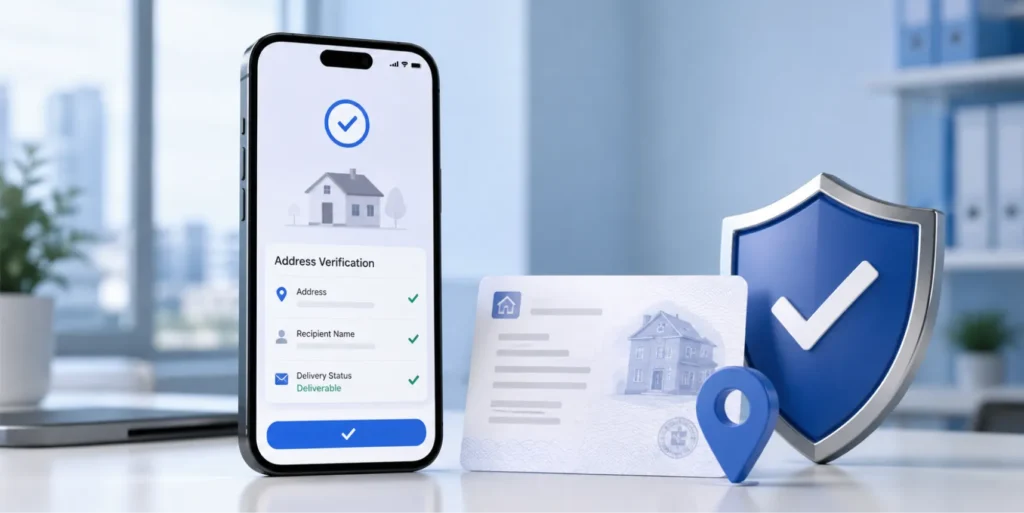
Address verification is the process of confirming that a stated address is real, correctly formatted, and, in identity and compliance contexts, connected to the person or business claiming it. It works by cross checking the submitted address against reference data, such as postal databases, government records, or financial account records, and returning a result ranging from a full match to no match at all.
That covers the mechanics. What it doesn’t cover is that address verification is used to mean three different things depending on who is asking, and conflating them is where most confusion, and a fair amount of compliance risk, comes from.
Key Takeaways
- Address verification is the process of confirming that a customer’s address is real, accurate, and genuinely linked to the individual or business.
- Address verification includes three distinct functions: AVS for payments, address validation for deliverability, and identity verification for KYC/AML compliance.
- Compliance grade verification goes beyond checking whether an address exists by validating ownership using trusted data sources and proof of address documents.
- Modern fraud, including synthetic identities and AI-generated documents, requires layered verification and risk based checks.
- Continuous address verification and emerging technologies like AI and digital identity wallets are shaping the future of secure customer onboarding and compliance.
Most explanations of address verification pick one lens and stop there. A payments article describes AVS matching a billing address to a card issuer’s file. A logistics article describes postal databases correcting typos so a parcel doesn’t bounce back. A compliance article mentions verifying the customer’s address as one line in a longer KYC checklist, without explaining what that actually involves.
This guide treats address verification as what it has become for most regulated and high growth businesses: a compliance grade discipline that sits alongside identity verification, document verification, and sanctions screening. It covers how address verification works mechanically, what regulators expect, how fraud typologies such as synthetic identity and AI generated documents have changed the risk picture, and what a well built address verification programme looks like in practice.
The Three Meanings of Address Verification
A payments team asking about address verification usually means AVS: does the billing address on a transaction match what the card issuer has on file. AVS was built to catch stolen card use in card not present transactions. A partial or no match is a signal, not a verdict, since customers who have moved recently or use a corporate card can legitimately produce a mismatch. AVS is also largely a US and Canada centric system; many countries don’t participate in it at all.
A logistics or marketing team asking about address verification usually means address validation: does this address exist, is it formatted correctly, and will a package or letter actually arrive there. This checks a submitted address against a postal authority’s database, standardizes formatting, and corrects likely typos. It confirms the address is a real, deliverable location. It says nothing about who lives or operates there.
This distinction gets lost in casual usage more than any other. A business can pass every address validation check available and still be onboarding an applicant whose stated address has nothing to do with them personally, because validation was never designed to answer that question in the first place.
A compliance officer asking about address verification means something closer to identity verification. confirming that a stated address is genuinely connected to the individual or business being onboarded, typically as part of Know Your Customer (KYC) or Know Your Business (KYB). This is the meaning regulators care about, and it usually relies on cross referencing government or credit bureau records, a proof of address document such as a utility bill or bank statement, or both.
A business that runs only a postal database check and calls its customer’s address verified is not meeting the bar that compliance focused verification requires, even though the term sounds identical.
For business entities specifically, this same problem is handled through Know Your Business (KYB) checks, which verify a registered business address against official commercial registries rather than a personal document. A company’s address carries a different evidence trail than an individual’s residence, which is why KYB and consumer KYC address checks, though related, aren’t interchangeable processes.
Address Verification vs Address Validation vs AVS vs Proof of Address vs Identity Verification
These five terms are frequently used interchangeably, but each describes a different check, with a different standard of proof.
| Term | What It Confirms | Typical Data Source | Proves Identity Ownership? |
| Address Validation | Address exists and is deliverable | Postal databases | No |
| AVS | Billing address matches card issuer’s file | Card issuer records | No |
| Proof of Address | A document evidences a person/business at an address | Utility bills, bank statements, official letters | Partially |
| Identity Verification (address component) | Address is genuinely linked to the verified party | Government records, credit bureau data, proof of address, cross referencing | Yes, combined with broader identity checks |
Why Address Verification Matters
Address verification sits at the intersection of two costly problems: fraud and undeliverable mail. On the fraud side, the FTC’s Consumer Sentinel Network Data Book 2024 recorded 1,135,270 identity theft reports that year, a 9.5 percent increase over 2023, with credit card fraud the single most reported category at 449,076 reports. Javelin Strategy & Research’s 2026 Identity Fraud Study put total identity fraud losses at 27.3 billion dollars affecting 18 million victims in 2025.
On the delivery side, the US Postal Service’s Office of Inspector General has reported that undeliverable as addressed mail typically runs at around 4.3 percent of total mail volume, costing the Postal Service close to 1.5 billion dollars annually to process, with total costs across the mailing industry estimated at roughly 20 billion dollars a year. USPS OIG analysis attributes about 40 percent of this to individuals not updating their address, around 35 percent to business mailer errors, and the remainder to postal processing issues.
The broader market is scaling accordingly. Juniper Research’s May 2026 Digital Identity Verification Market report forecasts global spend on digital identity verification will grow 55 percent between 2026 and 2030, from just under 19 billion dollars in 2026, with growth increasingly driven by e-commerce, gig economy, and digital native platforms rather than financial services alone.
For a business evaluating whether to invest further in address verification, these two categories of cost, fraud losses and undeliverable mail or failed onboarding, are usually the clearest business case. A regulated business also carries a third cost that’s harder to quantify but just as real: the cost of a supervisory finding that its customer due diligence process, including address verification, wasn’t proportionate to the risk it was meant to manage.
A Brief History: From Manual Checks to AI-Driven Verification
Address verification began as a manual, paper based process: clerks cross referencing customer submitted addresses against physical postal records or utility company files. The arrival of digitized postal databases in the late twentieth century allowed businesses to automate the first layer of this, standardizing and validating addresses in bulk rather than one at a time.
APIs then made real time verification possible during checkout or onboarding, rather than as a batch process run afterward. The most recent shift has been the application of AI and OCR to proof of address documents, allowing businesses to extract, cross check, and score address related documents automatically, while also introducing new fraud risks as the same technology can be used to generate convincing fake documents.
Each stage in this evolution solved the previous stage’s speed problem while introducing a new integrity problem. Manual review was slow but hard to fake at scale. Automated database matching was fast but blind to document-level fraud. AI-driven extraction is fast and document-aware, but now has to contend with equally capable AI on the fraud side, which is why the most recent developments in this space are as much about detecting AI-generated content as they are about processing genuine documents faster.
How Address Verification Works
Address verification generally happens at one of two points: upfront, as a customer types their address into a form, or referentially, after submission, when the address is checked and, if necessary, corrected against reference data.
Upfront Verification
Upfront verification uses address autocomplete to suggest valid addresses as a user types, reducing typos and abandoned forms. Some providers strengthen this with device or geolocation signals to make suggestions more relevant. Autocomplete alone does not guarantee accuracy, since some providers populate suggestion lists with best guesses rather than confirmed addresses, so a service cross referencing an authoritative source is preferable for anything beyond convenience.
Referential Verification
Referential verification happens after submission and generally takes one of three forms. Standardization reformats an address into the correct order with proper abbreviations. Cleansing corrects typos or outdated information. Supplementing fills in missing elements, such as a unit number or postal code. For compliance purposes, referential verification typically goes further, cross referencing the address against government or credit bureau data, or requiring a supporting document, to establish the identity level connection a postal database alone cannot provide.
Address Verification for KYC and AML Compliance
Address verification is one component of customer due diligence under most KYC and AML frameworks, sitting alongside identity document checks, AML screening against sanctions and PEP lists, and, for higher risk customers, enhanced due diligence. Regulatory expectations are typically principles based rather than prescriptive about method, which is part of why so much variation exists in how businesses implement this step.
| Framework / Body | Relevant Focus | Practical Implication |
| FATF | Sets international standards for customer due diligence, including identity and address verification expectations | Businesses should be able to evidence a risk based approach to how addresses are verified |
| FinCEN (US) | Administers Bank Secrecy Act requirements including Customer Identification Programme rules | US regulated entities need a documented, risk based address verification method |
| FCA (UK) | Sets AML and financial crime expectations for UK regulated firms | Address verification should be proportionate to customer risk, not a single fixed check |
| Companies House (UK) | Maintains UK business registration records, relevant to registered office verification | Useful reference point for KYB registered address checks in the UK |
| European Commission / AMLA | Oversees EU AML policy, including the newly established AML Authority | EU regulated firms should track AMLA guidance as it becomes operational |
None of these bodies mandate a single specific method for verifying an address. What they consistently expect is that a business can demonstrate its approach is proportionate to customer risk and properly documented, which is why a risk based, tiered approach (covered later in this guide) tends to hold up better under regulatory review than a one size fits all check.
For readers wanting the primary source language directly, the relevant guidance sits with FATF, FinCEN, the FCA, Companies House, and the European Commission’s eIDAS 2.0 policy pages, each of which publishes current requirements directly rather than through secondary summaries.
Proof of Address: What It Is and What Documents Are Accepted
Proof of address is a document used to evidence that a person or business is genuinely located at a stated address, typically requested when a postal database match alone isn’t sufficient for compliance purposes. Shufti’s own address verification and proof of address checks work this way: cross referencing a submitted document against declared details rather than accepting it at face value. Accepted documents vary by jurisdiction and by how strict a business’s risk policy is, but a few categories recur across most markets.
| Document Type | Common Acceptance | Notes |
| Utility bill (electricity, gas, water) | Widely accepted | Usually required to be recent, often within 3 months |
| Bank or credit card statement | Widely accepted | Digital statements are increasingly accepted alongside paper |
| Government issued letter | Widely accepted | Tax authority or municipal correspondence, varies by country |
| Tenancy or mortgage agreement | Commonly accepted | Useful where utility bills aren’t in the applicant’s name |
| Driver’s licence | Sometimes accepted | Often treated as supporting identity evidence rather than standalone proof of address |
A recurring practical problem is applicants who don’t have a utility bill in their own name, often because they live with family or in shared housing. A well designed policy accounts for this with alternative acceptable documents rather than defaulting to rejection, which reduces false negatives without weakening the underlying standard.
Address Fraud: What Businesses Are Actually Up Against
Address fraud covers the range of ways bad actors manipulate address information to open accounts, pass onboarding checks, or move stolen funds, and it has evolved considerably as identity fraud in general has grown. This is also the area where current published guides are thinnest, despite it being one of the more consequential risks businesses face.
Synthetic Identity Fraud
Synthetic identity fraud combines real, often stolen personal identifiers, such as a Social Security number, with fabricated details, including a fabricated address, to create an identity that can pass standard verification checks. Because the underlying identifier is real but the full profile is fabricated, these cases are harder to catch with a single point check and typically require cross referencing multiple identity signals together.
Money Mule Networks
Money mule operations often rely on multiple accounts sharing the same address, or addresses that cluster in patterns inconsistent with genuine customer distribution, such as several unrelated applicants listing the same residential unit. Address data, viewed across a customer base rather than one application at a time, can surface these clustering patterns even when each individual application looks unremarkable on its own.
This is precisely why address verification tends to deliver more value as part of a connected fraud detection layer than as an isolated check. A single flagged address rarely proves anything by itself, but the same address appearing across a dozen otherwise unconnected applications, opened within a short window, is a materially different signal, and it’s one that only becomes visible when address data is analyzed at the portfolio level rather than the individual application level.
Deepfake and AI-Generated Proof of Address Documents
The same generative AI tools capable of producing convincing images and audio can also produce convincing fake utility bills and bank statements. Regula’s 2025 survey found that roughly half of companies had already experienced fraud involving audio or video deepfakes, a trend that extends into document fraud more broadly. This is a newer and faster moving risk than most existing address verification guidance accounts for, and it’s part of why document level verification is increasingly paired with independent data source cross referencing rather than relied on alone.
Verifying Addresses Across Borders
International address verification confirms an address against the correct standard for its country of origin, since address formats, postal authorities, and available reference data vary significantly by region. The Universal Postal Union coordinates international postal standards, but individual countries maintain their own address databases and formatting conventions, and coverage quality varies considerably between markets with mature postal infrastructure and those without formal street level addressing in some areas.
Businesses operating across many markets, particularly across 240 or more countries in some cases, need address verification that adapts to these differences rather than applying a single country’s rules universally. A US style address format check will misclassify or incorrectly flag addresses in markets that don’t follow the same conventions, which is a common source of false negatives for global businesses.
This becomes especially important for businesses onboarding customers in regions where formal street level addressing is still developing. In these cases, a rigid postal-match requirement can unintentionally exclude legitimate customers, and a well designed verification programme needs an alternative path, such as government ID cross referencing or a documented exception process, rather than a blanket rejection.
Risk-Based and Continuous Address Verification
Risk based address verification applies a different depth of check depending on customer risk level, reserving the most rigorous document and cross referencing checks for higher risk customers rather than applying maximum friction to every applicant. Lower risk customers might only need a postal database match, while higher risk customers, larger transactions, or business accounts might require full proof of address plus cross referencing.
Continuous, or perpetual, address monitoring extends this beyond onboarding, checking periodically or triggered by specific events (such as a change in transaction pattern) whether an address on file is still current and still consistent with other account activity, rather than treating verification as a single event at signup. This reflects a broader shift in the market: Juniper Research’s 2026 forecast notes that growth in identity verification spend is increasingly driven by businesses scaling toward lifecycle based monitoring rather than one time checks.
A practical example: a customer who passes onboarding with a low risk profile might later increase transaction volume significantly or update their address shortly before a large transfer. Neither event is proof of wrongdoing on its own, but a continuous monitoring approach flags the combination for review, whereas a one time onboarding check would have no mechanism to notice it at all.
How Address Verification APIs Work
An address verification API typically follows a pipeline: the submitted address (or a photographed document) is captured, relevant data is extracted using OCR where a document is involved, that data is matched against reference sources such as postal databases or government records, a confidence score is generated reflecting how strong the match is, and a decision or risk flag is returned to the calling system.
- Input: raw address text or an uploaded proof of address document
- Extraction: OCR pulls structured fields from a document image where applicable
- Matching: extracted or submitted data is checked against postal, government, or credit bureau records
- Scoring: a confidence score reflects match strength rather than a binary pass or fail
- Decision: the calling system applies its own risk thresholds to the returned score
This pipeline level view matters because a vendor’s API is rarely a single check; it’s an orchestration of several underlying data sources and models, and the quality of each stage affects the reliability of the final result. Where address verification fits alongside document verification, face verification, and case management in a broader compliance stack often determines how well these signals combine into a single risk decision rather than several disconnected ones.
For product and engineering teams evaluating a vendor, it’s worth asking specifically how each stage is handled rather than accepting a single aggregate accuracy figure. A provider with strong OCR but thin data source coverage in a given region will produce different failure patterns than one with the reverse strengths, and that distinction usually only becomes visible once a business is live in that specific market.
Where Address Verification Fits in a Compliance Stack
Address verification rarely operates as a standalone check inside a mature compliance programme. It typically sits alongside document verification, face verification, and sanctions or PEP screening as one input into a broader onboarding decision, with results feeding into a case management system that a compliance analyst can review when a check doesn’t clear automatically.
Businesses building this stack from scratch generally benefit from orchestrating these checks through a single platform rather than stitching together separate point solutions, since a unified confidence score across identity, document, and address signals tends to produce fewer false positives than reviewing each signal in isolation. This is also where a journey builder style workflow, which lets a business configure different verification paths for different customer risk tiers, becomes useful rather than optional.
Industry Use Cases
Address verification requirements differ meaningfully by industry, both in how strict the check needs to be and in what regulatory framework applies.
| Industry | Typical Requirement | Key Consideration |
| Banking | Full KYC address verification with documented evidence | Highest regulatory scrutiny, often requires ongoing monitoring |
| Fintech / Payments | Risk based verification, often AVS plus KYC address checks | High transaction volume requires low friction, automated checks |
| Crypto / VASPs | Full KYC address verification, often enhanced due diligence | Evolving regulatory expectations, higher inherent fraud risk |
| Insurance | Address verification tied to underwriting and claims | Address accuracy affects risk pricing, not just fraud prevention |
| Marketplaces / Gig Economy | Address verification for sellers or workers, often lighter touch | Balancing onboarding speed with fraud and tax reporting obligations |
| E-commerce | Delivery focused address validation, plus AVS for payments | Primarily concerned with deliverability and chargeback prevention |
Two patterns cut across nearly every industry in this table. First, transaction volume and regulatory scrutiny tend to move together, so the industries facing the strictest address verification requirements are also the ones least able to absorb manual review at scale. Second, the businesses seeing the fastest growth in identity verification spend, per Juniper Research’s 2026 figures, are the ones outside traditional financial services: e-commerce, gig economy, and other digital native platforms that historically treated address checks as a delivery problem rather than a compliance one.
What to Look for in an Address Verification Solution
Vendor evaluations in this space tend to focus heavily on accuracy claims and coverage maps, which matter but tell an incomplete story. The list below reflects the questions that typically surface only after a solution is already in production, when they’re more expensive to address.
- Coverage across the specific countries and regions the business actually operates in
- Support for both postal database matching and identity level cross referencing, not just one
- Confidence scoring rather than a simple pass or fail result
- Ability to handle document based proof of address, including OCR extraction
- Support for risk based tiering, so verification depth can scale with customer risk
- Clear documentation suitable for demonstrating compliance to a regulator or auditor
Common Mistakes in Address Verification
Most address verification failures trace back to a small handful of avoidable design choices, several of which stem directly from conflating the three meanings of address verification covered earlier in this guide.
- Treating a postal database match as equivalent to identity level proof of address
- Applying the same verification depth to every customer regardless of risk
- Rejecting applicants outright when they lack a utility bill in their own name, instead of offering alternative documents
- Relying on document checks alone without cross referencing against independent data sources
- Treating verification as a one time onboarding event with no ongoing monitoring
- Applying US centric address formatting logic to international addresses
Best Practices and Expert Tips
A practical self audit for an existing address verification process should check the following:
- Is verification depth actually tied to documented customer risk levels, or applied uniformly?
- Are proof of address documents cross referenced against an independent data source, not just visually reviewed?
- Is there a defined process for re verifying addresses on an ongoing basis, not only at onboarding?
- Does the process account for international address formats correctly, or default to a single country’s rules?
- Is the reasoning behind each verification decision documented well enough to withstand an audit?
The Future of Address Verification
The most significant near term shift is the move toward digital identity wallets. The EU Digital Identity Wallet (EUDI), introduced under eIDAS 2.0, is expected to be available across all EU Member States by the end of 2026, allowing individuals to hold and selectively share verified identity attributes, potentially including a verified address, directly from a digital wallet rather than submitting a fresh document each time.
This points toward a broader move away from repeated document based proof of address checks and toward reusable, portable identity credentials that a business can verify once and rely on across multiple relationships, provided privacy by design principles are properly built into how that data is requested, stored, and reused.
Ready to Strengthen Your Address Verification Process?
Frequently Asked Questions
What is address verification?
Address verification is the process of confirming that a stated address is real, correctly formatted, and, in identity contexts, connected to the person or business claiming it, by checking it against reference data sources.
What is the difference between address verification and address validation?
Address validation confirms an address exists and is deliverable using postal database matching. Address verification, in identity and compliance contexts, goes further by confirming the address is genuinely connected to the applicant.
What is an AVS (Address Verification System)?
AVS is a fraud prevention check used in card not present payments, comparing a transaction's billing address to the address a card issuer has on file. It is primarily used in the US and Canada.
Is address verification required for KYC?
Most KYC frameworks expect some form of address verification as part of customer due diligence, though regulators generally require a risk based, documented approach rather than mandating one specific method.
What documents count as proof of address?
Commonly accepted documents include recent utility bills, bank or credit card statements, and government issued letters, though acceptance varies by jurisdiction and by a business's own risk policy.
Can proof of address documents be faked?
Yes. AI generated and digitally edited fake utility bills and bank statements are an increasing risk, which is why document checks are increasingly paired with independent data source cross referencing rather than relied on alone.
How does address verification work internationally?
It requires adapting to each country's own address format, postal authority, and available reference data, since formats and data quality vary significantly by region rather than following a single global standard.
What is continuous address verification?
Continuous, or perpetual, address verification checks an address periodically or in response to specific triggers after onboarding, rather than treating verification as a single check performed only at signup.
How accurate are address verification APIs?
Accuracy depends on the underlying data sources and matching logic used, which is why confidence scoring, rather than a simple pass or fail result, gives a more useful picture of match strength.
What should I look for in an address verification vendor?
Look for country coverage matching your actual footprint, support for both postal matching and identity level cross referencing, confidence scoring, and documentation suitable for demonstrating compliance to a regulator.
Why do banks verify your address?
Banks verify addresses as part of customer due diligence obligations under AML regulation, to confirm a customer's identity, support fraud prevention, and maintain accurate records for correspondence and regulatory reporting.
Is a virtual office address acceptable for business verification?
It depends on the business's risk policy and jurisdiction. Virtual offices and registered agent addresses can complicate KYB verification since they don't confirm where a business actually operates, and many compliance teams treat them as a higher risk signal requiring additional checks.