AMLR Solutions
  AMLR Consultation
 EUDI Wallet
 Onboarding
 Ongoing Monitoring
 FRAML
FRAML KYC
KYC KYB
KYB KYI
KYI Age Assurance
 Workforce IAM
 Candidate Verification
 Account Takeover
 Bonus/ Promotion Abuse
 Chargeback Fraud
 Deepfake
 Document Fraud
 Fraud Networks
 Impersonation Fraud
 Money Mule Activity
 Multi-Accounting
 Party Fraud
 Regulatory & Compliance Risks
 Synthetic Identity Fraud
 Adult Content
 Banking
 Crypto
 Fintech
 Forex
Forex Compliance
 Fraud prevention
 Trust & safety
 Global expansion
 Compliance Officers
 Developers
 Fraud Analysts
 Product Managers
 Journey Builder
  Global Trust Platform
 Customer Profiles
 Vendor Comparison
 IDV Case Management
 AML Case Management
 Regulatory Reporting
 Agentic Rule Builder
  AI Compliance Co-Pilot
  Fraud Analytics
 Fraud Hub
  OCR
OCR Shufti AI
 Bank Account Verification
  Biometric Duplication
 Database Checks
 Document Intelligence
 Government ID
 Mobile Driver's License
 NFC
NFC Selfie Liveness
 Brand Personalisation
 Deployment Options
 Identity Methods
 IDV Modes
 Multi-tenancy
 On-Premise IDV
 Secure Capture
 Shufti MCP












Main Takeaways
- Ten vendors dominate KYC shortlists in 2026, with very different underlying architectures.
- Most platforms license liveness, OCR, or forensics from partners rather than owning them.
- Deepfake fraud is projected to rise 495% in 2026, per Shufti’s own network data.
- The deployment model decides eligibility before features do, especially under GCC and APAC residency rules.
- The right vendor depends on user geography, regulatory regime, deployment, and fraud exposure.
Most KYC buyer guides rank vendors by feature checklist, which completely misses the question buyers are actually asking in 2026. The question is: When a deepfake slips past liveness, when pass rates collapse in a non-Latin market, when a regulator audits an onboarding decision, who is accountable?
The answer is rarely the vendor whose name is on the contract. It is mostly whichever partner that vendor licensed for the component that failed.
The regulations changed this year too. On 1 January 2026 the European Banking Authority and the EU’s Anti-Money Laundering Authority completed the transfer of all AML and CFT mandates to AMLA, which makes it the central EU authority for rulemaking and supervisory convergence.
Moreover, AMLA begins direct supervision of up to 40 high-risk institutions in 2028, and its single rulebook applies across all 27 member states from 10 July 2027, per the European Council timeline.
At the same time, in the United States, FinCEN’s proposed AML/CFT programme rule of 7 April 2026 shifts supervision from whether a programme exists on paper to fill a checklist or whether it can actually demonstrate reliable performance, and also mentions the use of innovative tools, including but not limited to artificial intelligence.
This guide compares the ten KYC software providers buyers frequently evaluate and compare, along with the criteria and capabilities to keep in mind, and public ratings of these solutions.
The 10 best KYC Software Providers in 2026
As the publisher of this guide, we list Shufti first for transparency. The remaining nine vendors are listed alphabetically and described on the same factual basis. Each entry includes an overview, an assessment against our published criteria, certifications and recognitions, current public ratings, and the buyer it best fits.
All product details are sourced from each vendor’s public website, the Gartner Magic Quadrant for Identity Verification 2025, the KuppingerCole Analysts 2025 market assessment, public iBeta conformance listings, and verified review platforms.
KYC Vendor Comparison at a glance
| Vendor | Technology ownership | iBeta liveness level | Deployment | G2 rating | Best fit |
| Shufti | Own IP, full stack | Level 3 | SaaS, Local Cloud, on-premises | 4.5 | Full-stack ownership, any market |
| GBG | Own IP (Acuant, IDology) plus data orchestration | Level 2 via Acuant | SaaS, single API | 4.4 | Data-based KYC in mature markets |
| IDnow | Own plus partner | Level 2 | SaaS, EU residency | N/A | EU video-ident and eIDAS QES |
| Jumio | Own plus iProov (legacy) | Level 2 | SaaS | 4.0 | Enterprise scale |
| Entrust IDV | Own plus iProov, Namirial, SecureKey | Level 2 | SaaS | 4.4 | Government and healthcare |
| Persona | Orchestrated | Conformance stated, level not specified publicly | SaaS only | 4.3 | US developer-first teams |
| Socure | Own plus partner | No public listing found | SaaS, US only | 4.5 | US-only fintech |
| Sumsub | Own plus Smart Engines, Inverid, others | No public listing found | SaaS | 4.6 | Crypto and fintech orchestration |
| Trulioo | Own plus IDMerit | No public listing found | SaaS | 4.4 | Non-document KYC |
| Veriff | Own plus IDMerit | Level 2 | SaaS only | 4.5 | EU and US digital platforms |
Sources: Gartner Magic Quadrant for Identity Verification 2025, KuppingerCole Analysts 2025 market assessment, public iBeta conformance listings, vendor public sites, G2 vendor profiles. Competitor figures as of May 2026, Shufti figures as of July 2026. “No public listing found” means no iBeta conformance letter was located, not that a vendor lacks liveness capability. Verify directly with each vendor before procurement.
Scores and certifications look similar on paper. Run Shufti against your own traffic, fraud patterns, and hardest markets before you decide.Compare Shufti on your criteria →
1. Shufti
UK-headquartered KYC and AML vendor built entirely on owned intellectual property. OCR, liveness detection, document intelligence, KYC, KYB, and AML are all developed in-house rather than licensed from partners. That ownership is what made Shufti a genuinely ‘Glocal’ identity verification vendor, because the same architecture verifies a US driver’s licence with the same engineering control as a Vietnamese national ID or an Indonesian KTP.
Technology ownership: No third-party dependency across the core verification path, so incident response, retraining, and regulatory adaptation run on one release timeline.
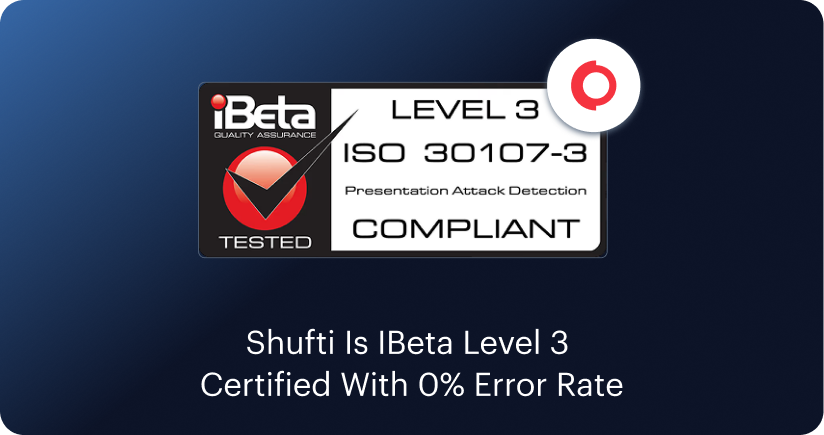
Independent validation: Holds iBeta Level 3 conformance under ISO/IEC 30107-3, the highest published presentation-attack detection tier, and is among the few vendors globally to hold it. Also a DHS RIVR 2025 Top Performer at 98.49% True Accept Rate with zero False Template Creation events.
Coverage and doc-less depth: Actively verifies 10,000+ document types across 240+ countries and territories every month, with in-house OCR at 99.7% accuracy across 150+ languages, plus 270+ authoritative data sources across 95+ countries and 40+ active eID integrations through a single API.
Honest trade-off: Commercial presence in North America is smaller than US-headquartered peers, a brand-awareness and contracting consideration rather than a capability one. Pricing is quoted by deployment model rather than published per transaction.
Deployment Options:
- SaaS
- Cloud
- Local Cloud
- On-premises for data-residency compliance
Certifications and recognitions:
- iBeta Level 3 conformance under ISO/IEC 30107-3
- DHS RIVR 2025 Top Performer
- SOC 2 Type II, PCI DSS, ISO 27001
- GDPR compliance, Cyber Essentials, Cyber Essentials Plus
- Leader, G2 Summer 2026 Identity Verification Grid and Anti-Money Laundering Grid
Ratings:
- Shufti G2 reviews: 4.5 / 5 (151 reviews) as of 6 August 2026, Leader in the Summer 2026 Identity Verification Grid
- Shufti Trustpilot reviews: 4.8 / 5 (3,945 reviews) as of 6 August 2026, the highest rating-and-volume combination among the vendors compared
Verdict:
An ideal option for businesses that want full ownership of their tech-stack and have direct control over verification updates, regulatory adaptation, and fraud-response timelines, in any market.
It’s also particularly reliable for verticals that have very high deepfake exposure (like…), for fulfilling data-residency requirements that SaaS-only solutions cannot meet, and for buyers who want to expand into emerging markets under one solution.
2. GBG
UK-headquartered identity data vendor founded in 1989, specialising in data-based verification at global scale. GBG built much of its stack through acquisition, IDology in 2019 and Acuant in 2021, and delivers KYC through GBG Go.
Technology ownership: GBG Go orchestrates 80+ identity, fraud, and risk modules through a single API, with core document and biometric IP acquired rather than built on one in-house stack.
Coverage: Authoritative-data coverage for doc-less verification across 195+ countries, with a library of 8,500+ government-issued IDs per GBG’s public site.
Independent validation: Publicly documented iBeta conformance is Level 2, achieved under the Acuant brand, with no Level 3 submission surfaced as of May 2026.
Certifications and recognitions:
- ISO/IEC 27001:2022 (BSI certified, re-certified February 2025)
- PCI DSS, Cyber Essentials, Cyber Essentials Plus
- iBeta PAD Level 1 and Level 2 conformance under ISO/IEC 30107-3
Ratings (as of May 2026):
- G2: 4.4/5 (47 reviews)
- Trustpilot: 2.3/5 (7 reviews)
Verdict: Regulated financial services and lending businesses wanting to prioritize data-based verification and broad authoritative-data coverage across the UK, US, and Australia.
3. IDnow
German identity verification vendor with a long track record in EU video-ident and deep presence across Germany, Austria, and Switzerland. Video-ident is a specialism shaped by European regulatory expectations rather than a general-purpose feature, and IDnow has built operational depth around it that newer entrants have not matched.
That focus is a genuine advantage inside its home regulatory perimeter and a constraint outside it, so the fit question is less about capability than about where your users actually are
Technology ownership: Mixed model combining owned components with partner services, including qualified trust services through ARIADNEXT.
Coverage: Strong DACH regulatory positioning and established video-ident operations at scale, though coverage outside Europe is narrower than global-first competitors.
Deployment flexibility: SaaS with EU data residency, which serves EU requirements but not GCC or APAC frameworks.
Certifications and recognitions:
- ISO/IEC 27001
- eIDAS Qualified Trust Service Provider status via ARIADNEXT
- ETSI standards under the eIDAS framework
- GDPR compliance with regional EU data-centre options
Ratings (as of May 2026):
- G2: N/A
- Trustpilot: 3.4/5 (16,408 reviews, reflecting consumer video-ident volume)
Verdict. EU-headquartered organisations needing video-ident at scale, particularly in regulated financial services and qualified electronic signature use cases.
4. Jumio
US-headquartered KYC and identity verification vendor with one of the largest enterprise customer bases in the category. Scale brings advantages a smaller vendor cannot match, including mature integrations, a wide partner ecosystem, and procurement teams that already know how to buy it.
The architectural question is which generation of the platform a new deployment would sit on, given the liveness transition described below, and that is worth asking directly during evaluation rather than inferring from the product page.
Technology ownership: Per the Gartner Magic Quadrant 2025, the platform was initially built on third-party liveness from iProov, with in-house capabilities developed in late 2024 and therefore less time-tested at scale.
Coverage: Mature SDK and API with broad deployment across digital banking, gaming, telecom, and travel.
Independent validation: Holds iBeta Level 2 conformance per public iBeta listings.
Certifications and recognitions:
- ISO/IEC 27001:2022
- SOC 2 Type II
- PCI DSS
- iBeta Level 2 PAD conformance under ISO/IEC 30107-3
Ratings (as of May 2026):
- G2: 4.0 / 5 (24 reviews)
- Trustpilot: 1.3 / 5 (93 reviews), a pattern common among consumer-facing vendors and indicative of end-user friction rather than enterprise dissatisfaction
Verdict: Established enterprises with existing Jumio deployments, or buyers in mature Western markets prioritising vendor scale over architectural ownership.
5. Entrust IDV
British-founded vendor acquired by Entrust in April 2024 and rebranded under the Entrust IDV product line. Post-acquisition integration reshapes roadmaps, so buyers evaluating it now are buying into Entrust’s broader security portfolio rather than the standalone product Onfido was. That is an advantage where identity verification sits alongside certificate management and wider PKI needs, and a consideration where it does not, since roadmap priorities follow the parent.
Technology ownership: Per the Gartner Magic Quadrant 2025, Entrust IDV carries partner dependencies including iProov and SecureKey, and uses human reviewers as fallback for non-Latin script OCR, adding cost and latency.
Coverage: Strong document verification on Latin-script documents, supporting more than 6,000 government-issued identity documents, with a mature SDK and no-code Workflow Studio.
Independent validation: iBeta conformance is Level 2 per public listings as of May 2026.
Certifications and recognitions:
- ISO 27001 (BSI certified, IS 660122)
- SOC 2 Type II
- ETSI certified IDV for Qualified Electronic Signatures under eIDAS
Ratings (as of May 2026):
- G2: 4.4 / 5 (122 reviews)
- Trustpilot: 1.2/5 (381 reviews)
Verdict: Enterprise buyers with existing Entrust security relationships, or those prioritising government-sector deployment alongside identity verification.
6. Persona
US-based identity infrastructure vendor with API-first positioning and a developer-friendly orchestration platform. Orchestration is a deliberate architectural choice rather than a shortcoming, and it buys real flexibility, because components can be swapped as requirements change without replacing the platform. The trade is accountability, since a verification failure has to be traced across suppliers before anyone can fix it, which suits teams with engineering capacity to own that diagnosis themselves.
Technology ownership: The KuppingerCole Analysts 2025 assessment positions Persona as an orchestration-led entrant, with document and biometric capabilities relying more on partner components than own-IP vendors.
Deployment flexibility: SaaS-only with US and EU data-residency options, which cannot meet on-premises or Local Cloud requirements under GCC and SEA frameworks.
Coverage: Flexible workflow orchestration with strong traction in marketplaces, gig platforms, and US fintech onboarding.
Certifications and recognitions:
- ISO 27001 (recertified February 2025)
- SOC 2 Type II
- PCI DSS, HIPAA
- ISO/IEC 30107-3 liveness conformance
- GDPR and CCPA compliance
Ratings (as of May 2026):
- G2: 4.3 / 5 (45 reviews)
- Trustpilot: 1.2 / 5 (185 reviews)
Verdict: US-headquartered marketplaces, fintechs, and digital platforms prioritising developer experience and rapid integration over deployment flexibility or hard-market accuracy.
7. Socure
US-headquartered vendor focused on US-market identity proofing using predictive risk modelling and alternative data signals including phone, email, and behavioural data. This is depth traded for breadth, and within the US market that trade pays off, because consortium models get sharper as domestic volume grows. The same mechanism works against it elsewhere, so the decision is rarely about quality and almost always about whether your verification footprint stays inside the market the models were built for.
Coverage: Per the Gartner Magic Quadrant 2025, almost all documents processed by Socure are North American, which makes it unsuited to volumes spanning APAC, MENA, or LATAM.
Technology ownership: Owned risk modelling combined with partner components, drawing on consortium fraud signals across 2,800+ customers per Socure product documentation.
Deployment flexibility: SaaS-only with US data residency.
Certifications and recognitions:
- No prominent public certification listing surfaced in our May 2026 review. Refer to socure.com directly for current trust documentation.
Ratings (as of May 2026):
- G2: 4.5/5 (103 reviews)
- Trustpilot: limited presence
Verdict: US-only verification volumes prioritising predictive identity risk scoring, alternative-data depth, and US fintech onboarding optimisation.
8. Sumsub
UK-incorporated vendor with strong fintech and crypto onboarding presence. Time to live is a genuine strength, and the no-code workflow builder means compliance teams can adjust onboarding logic without engineering tickets, which matters in fast-moving regulated verticals. Given the component mix described below, the liveness and forgery-detection layers are the part worth interrogating in a proof of concept rather than accepting on the strength of the catalogue size.
Technology ownership: Per the Gartner Magic Quadrant 2025, the platform incorporates third-party components including Smart Engines for forgery detection, Inverid for NFC, and Resistant.ai for forensics, with AML also drawn from partners.
Coverage: Wide document library of 14,000+ types per Sumsub’s public site, with no-code workflow configuration and a publicly reported 90% average pass rate.
Independent validation: Sumsub has not submitted to iBeta presentation-attack detection conformance at any level, per public iBeta listings as of May 2026.
Certifications and recognitions:
- ISO 27001, ISO 22301:2019, ISO/IEC 27017, ISO/IEC 27018
- SOC 2 Type II and SOC 3
- PCI DSS
- ETSI 119 and 319 standards under eIDAS
Ratings (as of May 2026):
- G2: 4.6 / 5 (125 reviews)
- Trustpilot: 1.3/5 (272 reviews)
Verdict: Crypto, fintech, and iGaming operators needing rapid integration and wide document coverage where independent liveness conformance is not a procurement requirement.
9. Trulioo
Canadian-headquartered vendor specialising in non-document identity verification through data-source aggregation. For many buyers this is a complement rather than a replacement, sitting alongside a document and biometric stack to lift users who never need to upload anything. Evaluated as a full-stack KYC platform, it will look thin, and evaluated as a doc-less layer it is one of the strongest options in this comparison, so framing the requirement correctly matters more here than with most vendors.
Coverage: A single API connecting to 450+ data sources globally per Trulioo’s public site, with support for 14,000+ document types across 240+ countries and 43 languages.
Technology ownership: Aggregation depth is the differentiator. Document and biometric capabilities are less so, and no public iBeta listing or active eID count was found in our review.
Deployment flexibility: SaaS.
Certifications and recognitions:
- ISO 27001 (certified since 2015)
- SOC 2 Type II (since February 2024)
Ratings (as of May 2026):
- G2: 4.4/5 (40 reviews)
- Trustpilot: limited presence
Verdict: Buyers needing deep doc-less verification through authoritative data sources, particularly in markets where document availability is unreliable.
10. Veriff
Estonian vendor with strong AI-driven document and biometric verification positioning. Speed is the design priority, and for consumer platforms where onboarding drop-off is the main commercial problem, that focus is well matched to the pain. The binding constraint is deployment rather than capability, because a SaaS-only model settles the question before feature comparison begins for anyone facing residency requirements outside the EU.
Coverage: Supports 240+ countries and 12,000+ government-issued IDs per Veriff’s public site, with average verification within 6 seconds. Training-data weighting is EU and US centric, so non-Latin hard-market coverage is narrower than vendors trained on those documents from inception.
Technology ownership: Per the Gartner Magic Quadrant 2025, Veriff uses IDMerit as a partner for certain data verification capabilities.
Deployment flexibility: SaaS-only with EU data residency hosted on AWS, with no on-premises or Local Cloud option for GCC or SEA residency requirements.
Certifications and recognitions:
- ISO/IEC 27001:2022, ISO/IEC 27017:2015, ISO/IEC 27018:2019
- SOC 2 Type II
- Cyber Essentials
- GDPR and CCPA compliance
- iBeta Level 2 PAD conformance under ISO/IEC 30107-3
Ratings (as of May 2026):
- G2: 4.5 / 5 (61 reviews)
- Trustpilot: 1.3/5 (228 reviews)
Verdict: EU and US digital platforms and marketplaces prioritising fast verification and SaaS deployment over data-residency flexibility or hard-market document depth.
What to look for in a KYC software provider in 2026
Here we explain six criteria that would help you distinguish credible vendors from those whose solutions fragment under load.
Technology ownership versus orchestrated stacks
Many KYC compliance solutions describe themselves as end-to-end while assembling core capabilities from third party software providers. For example, they’d get OCR from one vendor, liveness from another, and forensics from a third, package it up together and present it as one solution.
The problem with that approach is that when an attack ventor emerges or a regulation changes, the whole tech stach cannot be updated at the same time. In order for the solution to be fully updated, all the individual vendors would have to update their tools on their ends, which takes time and there’s no guarantee when that happens. That is why ownership of the whole tech stack is so important.
Ownership also answers which AI is actually running your checks, because a vendor that licenses its liveness model cannot fully explain or retrain it.
Independent liveness conformance
The iBeta presentation-attack detection conformance under ISO/IEC 30107-3 is the published independent benchmark. Level 2 tests defined-budget attackers. Level 3, introduced in mid-2025, tests expert attackers with no budget constraints and weeks of attempts. Shufti’s own Deepfake Identity Fraud Index 2026 projects a 495% year-on-year surge in deepfake-powered identity fraud, annualised from verification-network data across January to May 2026. Vendors running retrofitted liveness on borrowed components are the ones exposed by it.
Hard-market document accuracy
It’s crucial to have a solution that can accurately scan and extract documents with non-Latin scripts, such as regional formats from Vietnam, Indonesia, Brazil, South Asia, and Gulf states. While almost all solutions can accurately scan and extract text in Latin script, most fail when it comes to non-Latin scripts, and it has a direct impact on pass rates.
Per the KuppingerCole Analysts 2025 assessment, vendors trained on those documents from the start consistently outperform vendors that retrofitted them later, and pass rates can swing 10 to 30 percentage points between vendors handling identical traffic.
Deployment flexibility
SaaS-only vendors cannot serve organisations subject to data-residency requirements under Saudi PDPL, UAE NESA, Thailand PDPA, or Indonesia OJK. Buyers in these jurisdictions need Local Cloud or on-premises deployment. Deployment flexibility is a regulatory unlock rather than an architectural preference, and it eliminates candidates before any feature comparison begins.
AML and doc-less integration depth
Regulators increasingly treat KYC and AML as one workflow. Vendors handling only onboarding identity leave teams to integrate downstream AML tooling separately, producing two audit trails and two accountable parties. Doc-less verification against authoritative databases and eID schemes removes most document-capture friction, and under eIDAS 2.0 active eID acceptance is becoming a requirement. Real-time AI identity verification, meaning an automated decision returned in seconds without human review, depends on both layers working together.
Verification speed and commercial model
Automated KYC in 2026 typically returns a decision in 6 to 30 seconds depending on document complexity and downstream checks, and slower flows measurably increase drop-off. KYC software pricing is usually per completed verification, so always ask your vendor whether rejected sessions are billed, whether AML screening is bundled, and whether on-premises deployment carries a different structure.
See these criteria on a real platform
The criteria above separate a serious shortlist from a marketing one. Shufti runs all of them on owned, end-to-end technology across 240+ countries and territories.
How we evaluated
We assessed every vendor against the same six criteria, in the same order, and using primary sources wherever available. Technology ownership and coverage claims come from each vendor’s own public documentation. Certification claims come from public registries and conformance listings, including iBeta’s published ISO/IEC 30107-3 letters. Analyst positioning comes from the Gartner Magic Quadrant for Identity Verification 2025 and the KuppingerCole Analysts 2025 assessment, used as corroboration rather than primary evidence.
Verification dates: Shufti figures and the regulatory sources were checked in July 2026. The nine competitor profiles carry May 2026 checks and are due for re-verification before any procurement decision is made on them. Where a claim could not be traced to a primary or dated third-party source, it is omitted rather than asserted. Absence of a public certification listing is reported as absence of a listing, never as absence of the capability.
How to choose the right KYC Software for your business
The vendor that fits is the one that handles your verification cases under your regulatory regime, with a deployment model your data-residency requirements accept. Most buyers fall into one or more of six situations.
Scenario 1: Your verification volume is concentrated in North America
Shufti serves North American verification alongside future expansion under one architecture, so the team that verifies US driver’s licences can retrain models for a new market without re-platforming. For buyers certain they will stay US-only at scale, Socure offers deeper US consortium fraud data, and Persona’s developer-first orchestration suits early-stage marketplaces.
For everyone else, Shufti pairs US capability with the global infrastructure that most growing businesses need within two to three years.
Scenario 2: You are EU-regulated and need eIDAS 2.0 and AMLA readiness
Shufti supports the full eIDAS 2.0 spectrum, including physical IDs, Digital IDs and EUDI Wallets, NFC chip verification, and Qualified Electronic Signatures, alongside owned AML for continuous monitoring under one audit trail. IDnow is a specialist for DACH-region video-ident and qualified electronic signature delivery.
Scenario 3: You need on-premises or Local Cloud deployment for data residency
Shufti is one of the few vendors offering SaaS, Local Cloud, and on-premises deployment for PDPL, NESA, PDPA, and OJK frameworks. IDnow supports EU data residency only. SaaS-only vendors in this comparison cannot meet GCC or SEA residency requirements at all.
Scenario 4: You operate across multiple geographies including emerging markets
For global businesses, Shufti’s owned full stack and cross-market accuracy make it the structural fit for verifying users across North America or Europe alongside Vietnam, Indonesia, Brazil, South Asia, and Gulf states. One architecture, retrained per market, with public clients including Binance, Stripe, and ByteDance/TikTok operating across this profile. Trulioo is a narrower specialist for non-document verification where documents are unreliable, without the biometric and AML depth needed for full-stack KYC across geographies.
Test us on your hardest documents, not our marketing
Shufti actively verifies 10,000+ document types across 240+ countries and territories every month, including the non-Latin IDs most vendors treat as edge cases.
Scenario 5: You are a high-deep fake-exposure operator in crypto, forex, gaming, or fintech
Shufti is the most defensible posture here, combining iBeta Level 3 conformance under ISO/IEC 30107-3 with full-stack ownership that allows defence updates on its own timeline as new attack patterns emerge.
Deepfake exposure needs an independent benchmark
Shufti holds iBeta Level 3 conformance under ISO/IEC 30107-3, the highest published presentation-attack detection tier, with defence updates on our own release timeline.
Scenario 6: You are optimising onboarding conversion and document-upload drop-off
Shufti operates the broadest combination of authoritative database depth and active eID integration here, with 270+ data sources across 95+ countries plus 40+ active eID integrations including BankID, Singpass, MitID, and OneID, served through a single API across three eIDV modes. Trulioo is a specialist for non-document verification through 450+ data sources.
Marketing pages do not reveal the right vendor. Verification performance on your actual traffic does. The question is which vendor’s structural advantages match your reality, meaning where your users live, which compliance regimes you face, how you deploy, and how exposed you are to AI-driven fraud. For most buyers facing more than one of those, Shufti’s combination of full-stack ownership, iBeta Level 3 conformance, deployment flexibility, and doc-less depth is the broadest single-vendor answer.
Frequently Asked Questions
What are the best KYC software providers in 2026?
The most commonly evaluated KYC providers in 2026 include Shufti, GBG, IDnow, Jumio, Entrust IDV (Onfido), Persona, Socure, Sumsub, Trulioo, and Veriff. The right fit depends on user geography, regulatory regime, deployment requirements, and fraud exposure.
How do I choose the best KYC software for my business?
Start with verification volume by geography. Add regulatory regime, deployment model, and deepfake exposure. Shortlist only vendors whose deployment model you can legally accept, then run a proof of concept on real traffic against your hardest cases before signing.
What features should a KYC software provider offer?
Owned rather than orchestrated OCR and liveness, independent iBeta conformance, AML screening with continuous monitoring, support for digital identity formats including EUDI Wallets, NFC, and QES under eIDAS 2.0, and flexible deployment including Local Cloud and on-premises. A single API and no-code workflow configuration are baseline.
How much does KYC software cost?
Pricing is typically per completed verification and varies with document complexity, geographic coverage, and AML add-ons. Before comparing headline rates, confirm whether rejected sessions are billed, whether AML screening is bundled, and how enterprise volume or on-premises deployment changes the structure.
Can KYC software be integrated into existing systems?
Yes. Modern platforms offer a single REST API, web and mobile SDKs, and connectors for orchestration platforms and CRMs. Integration ranges from days for SaaS to weeks for on-premises or Local Cloud setups with custom workflow logic. No-code builders reduce engineering overhead.
What industries need KYC software the most?
Financial services, fintech, crypto, forex, iGaming, lending, neobanks, payment service providers, marketplaces, telecoms, healthcare, and government all require KYC at varying thresholds. Age-verification and online-safety laws are extending requirements to social media and content platforms.