AMLR Solutions
  AMLR Consultation
 EUDI Wallet
 Onboarding
 Ongoing Monitoring
 FRAML
FRAML KYC
KYC KYB
KYB KYI
KYI Age Assurance
 Workforce IAM
 Candidate Verification
 Account Takeover
 Bonus/ Promotion Abuse
 Chargeback Fraud
 Deepfake
 Document Fraud
 Fraud Networks
 Impersonation Fraud
 Money Mule Activity
 Multi-Accounting
 Party Fraud
 Regulatory & Compliance Risks
 Synthetic Identity Fraud
 Adult Content
 Banking
 Crypto
 Fintech
 Forex
Forex Compliance
 Fraud prevention
 Trust & safety
 Global expansion
 Compliance Officers
 Developers
 Fraud Analysts
 Product Managers
 Journey Builder
  Global Trust Platform
 Customer Profiles
 Vendor Comparison
 IDV Case Management
 AML Case Management
 Regulatory Reporting
 Agentic Rule Builder
  AI Compliance Co-Pilot
  Fraud Analytics
 Fraud Hub
  OCR
OCR Shufti AI
 Bank Account Verification
  Biometric Duplication
 Database Checks
 Document Intelligence
 Government ID
 Mobile Driver's License
 NFC
NFC Selfie Liveness
 Brand Personalisation
 Deployment Options
 Identity Methods
 IDV Modes
 Multi-tenancy
 On-Premise IDV
 Secure Capture
 Shufti MCP













The Identity Verification Platform Users Keep Recommending: Shufti’s G2 Summer 2026 Results.
TL;DR
- G2 named Shufti a Leader in the Summer 2026 Identity Verification Grid, based on high customer Satisfaction and large Market Presence scores.
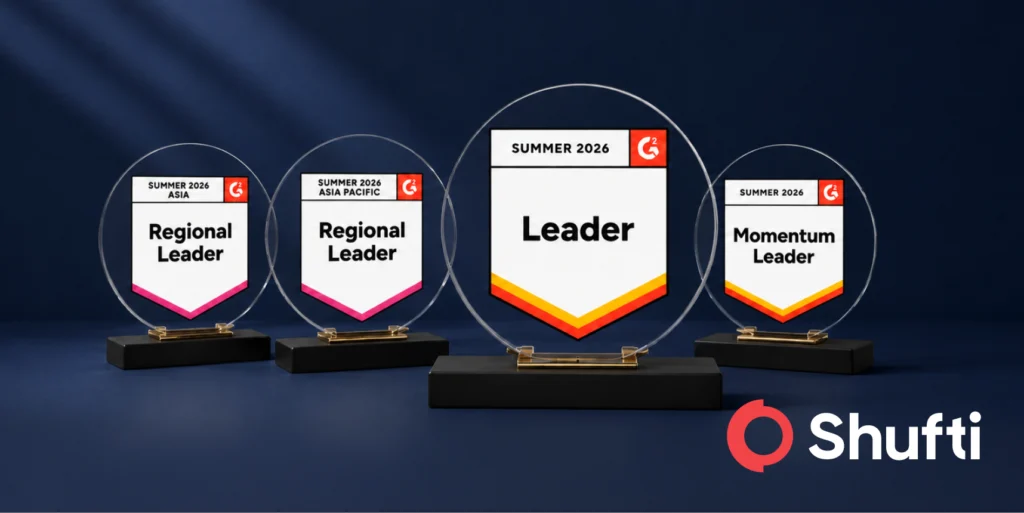
- Shufti also earned Asia Regional Leader and Asia-Pacific Regional Leader badges in the same report cycle.
- Shufti is named a Leader in the Momentum Grid Report for Identity Verification and the Grid Report for Anti-Money Laundering (AML) Summer 2026.
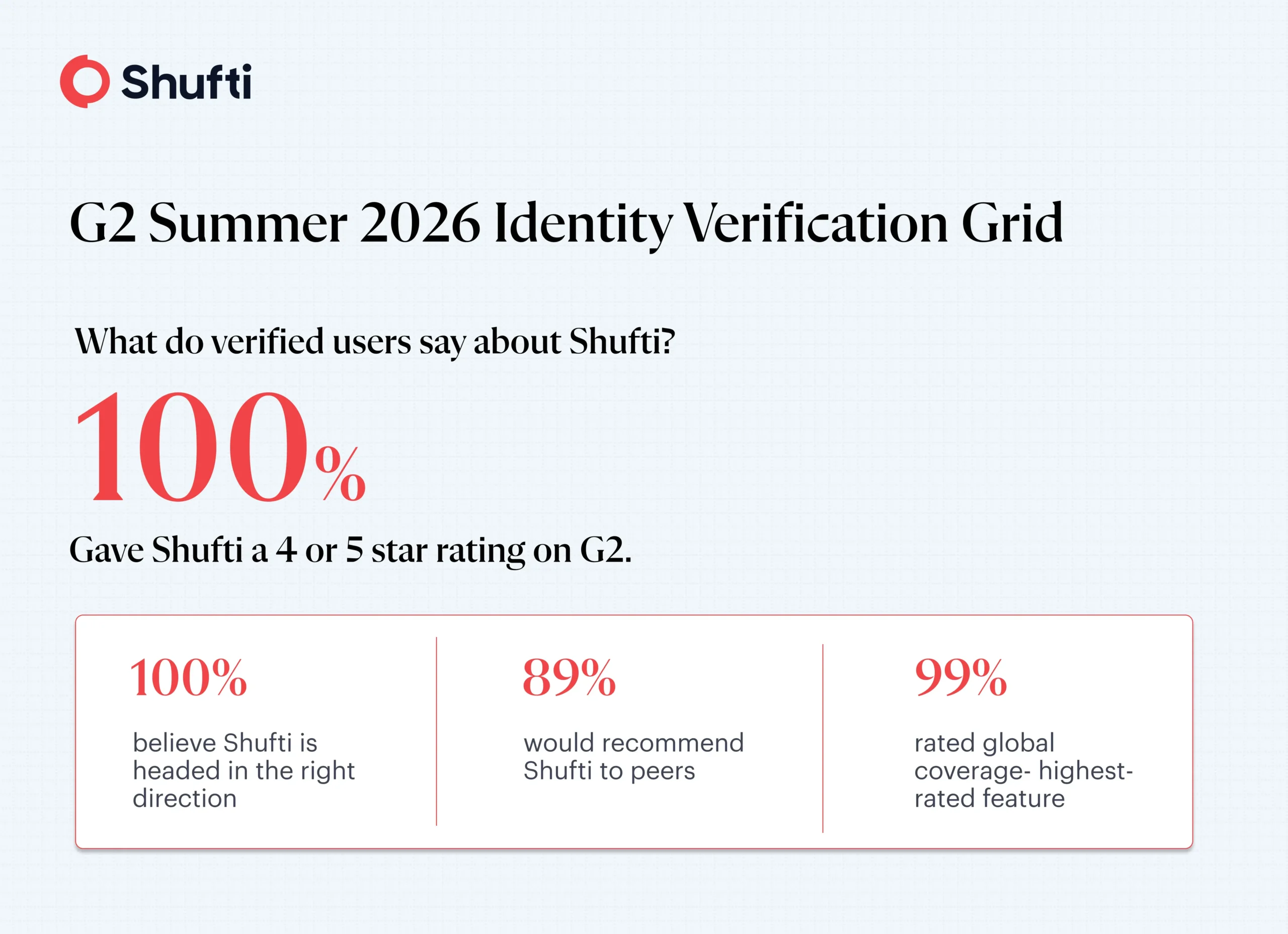
- 100% of G2 reviewers rated Shufti 4 or 5 stars, and 89% said they would recommend the platform.
- Reviewers rated Global Coverage at 99% and Workflow Orchestration at 95%, placing both among the top-rated capabilities across Shufti’s G2 profile.
- All distinctions reflect verified user sentiment collected through G2’s review platform, updated quarterly based on real deployments and feedback, not analyst opinions or vendor briefings.
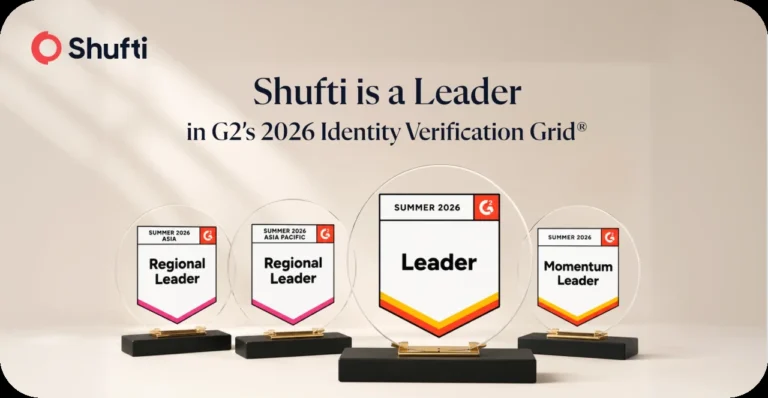
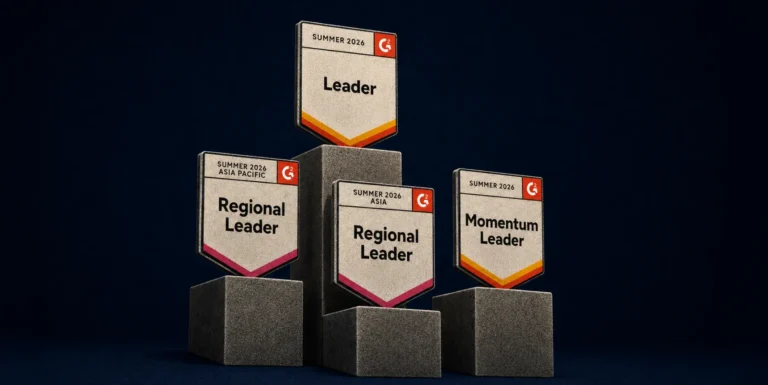
G2 has published its Summer 2026 Grid Reports. Shufti is recognized with four distinctions in the Identity Verification category: Leader in the Identity Verification Grid, Asia Regional Leader, Asia-Pacific Regional Leader, and Leader in the Momentum Grid Report. Shufti has also been named a Leader in G2’s Summer 2026 Anti-Money Laundering (AML) Report, further highlighting its strong performance in compliance and risk management solutions.
For compliance and product teams evaluating identity verification platforms, the combination is worth unpacking. A global Leader placement reflects broad market presence and consistent satisfaction across a diverse reviewer base. Regional Leader designations in Asia and Asia-Pacific reflect how users in those specific markets rated the platform. The Momentum Grid placement extends that signal further, reflecting the trajectory of Shufti’s review growth and market presence over the reporting period.
What does earning a Leader badge on G2 actually mean?
G2’s Leader Quadrant is not based on analyst opinions, sponsorships, or paid placements. It is a data-driven ranking built entirely from verified user reviews and publicly available market data. The rankings are updated every quarter to reflect the latest customer feedback and market performance.
How does G2 calculate the Leader quadrant?
G2 places products in the Leader quadrant based on two independently calculated scores. The Satisfaction score is built from verified user ratings across ease of use, quality of support, and likelihood to recommend. The Market presence score is built from review volume, web presence, and third-party data signals. A product reaches the Leader quadrant only when both scores are high simultaneously: strong satisfaction from a large, active user base.
Why is the identity verification category competitive to rank in?
Identity verification is a procurement-critical category. The buyers leaving reviews on G2 are compliance officers, product managers, and engineering leads who have run live deployments, seen the failure modes, and have a direct stake in the outcome. Reviews in this category reflect operational experience with document acceptance rates, liveness accuracy, support responsiveness during incidents, and how the vendor behaves when something breaks.
That reviewer profile makes a high Satisfaction score harder to achieve in identity verification than in many other software categories. The users writing these reviews know the difference between a vendor that was built for the problem from the start and one that assembled a solution over time.
What did Shufti’s G2 Summer 2026 reviewers say?
The headline figures from Shufti’s Summer 2026 G2 profile are straightforward.
| Metric | Score |
| Users who rated Shufti 4 or 5 stars | 100% |
| Users who believe Shufti is headed in the right direction | 100% |
| Users who would recommend Shufti | 89% |
A 100% distribution at 4 or 5 stars means every reviewer in the cohort gave a positive rating. In a product category where specific pain points, such as a failed liveness check, a rejected document, or a slow support response, often drive negative reviews, the highest rating distribution reflects consistent delivery across the full user base.
The 100% directional confidence figure reflects a different kind of signal. G2’s “headed in the right direction” question asks whether reviewers believe the product’s roadmap meets their evolving needs. In identity verification, where the threat landscape and regulatory requirements shift quarterly, that figure reflects sustained confidence in product development priorities, not just satisfaction with the current state.
The 89% likelihood-to-recommend score rounds out the picture. In B2B compliance software, recommendation intent is a meaningful indicator: buyers are willing to attach their professional credibility to the referral.
Across the six satisfaction dimensions measured by G2, Shufti achieved strong scores:
- Ease of Use: 91%
- Quality of Support: 90%
- Ease of Doing Business With: 86%
- Ease of Setup: 87%
Highest-rated features:
- Global Coverage: 99%
- Workflow Orchestration: 95%
Both feature ratings were above or in line with category averages.
What do the Asia and Asia-Pacific Regional Leader badges reflect?
G2’s Regional Leader badges apply the same Satisfaction and Market Presence methodology to a geographically scoped reviewer cohort. Earning Asia Regional Leader and Asia-Pacific Regional Leader means that users in those regions rated Shufti highly within the identity verification category, independently of the global grid.
The APAC identity verification market places distinct demands on a platform that the global average does not fully capture. Document sets in Vietnam, Indonesia, Thailand, the Philippines, and across South Asia span scripts, formats, and security features that differ significantly from the Western ID formats most platforms were originally trained on. Regulatory requirements add a second layer: Indonesia’s OJK, Thailand’s Personal Data Protection Act (PDPA), and similar frameworks impose data-residency and audit requirements that a standard cloud deployment cannot satisfy.
The Regional Leader designations reflect that users in these markets, operating under those specific conditions, rated Shufti highly within the category. That reviewer base is self-selected for the use cases where identity verification is technically the most demanding.
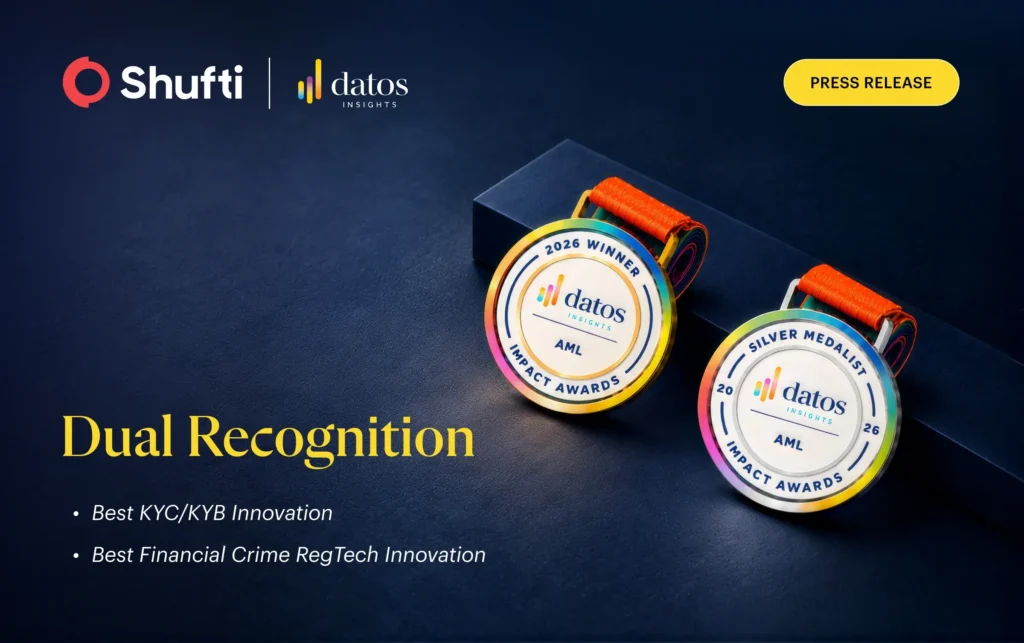
Shufti also earned Leader in the AML Grid Report for Summer 2026
In addition to the identity verification recognitions, Shufti was named a Leader in G2’s Summer 2026 Grid Report for Anti-Money Laundering (AML). The AML category on G2 covers sanctions screening, PEP and watchlist screening, adverse media, and transaction monitoring.
The Leader placement in this category reflects the same Satisfaction and Market Presence methodology applied to reviewers evaluating AML solutions, specifically a separate reviewer cohort from the identity verification grid, giving the recognition an independent signal value.
Shufti’s approach to identity verification
Compliance and product teams in APAC, MENA, and LATAM operate under regulatory frameworks that vary significantly by jurisdiction. Indonesia’s OJK, Saudi Arabia’s PDPL, the UAE’s NESA, and similar regimes each carry specific requirements around data residency, audit trails, and onboarding controls that a one-size-fits-all approach cannot satisfy.
Most vendors built their document models on Western IDs and adapted everything else later, which surfaces at exactly the wrong moment: a user in Jakarta abandoning a session because their national ID keeps failing capture, or a compliance team in Singapore unable to meet OJK data-residency requirements with a SaaS-only stack.
Shufti built its document intelligence on 10,000+ document types across 240+ countries from the start, with proprietary OCR trained natively on 150+ languages, no human fallback for low-confidence reads, and no retrofitted adaptation. Deployment options include Local Cloud and on-premises configurations that meet PDPA, OJK, PDPL, and similar data-residency requirements through the same single API.
Whether navigating non-Latin scripts in APAC or meeting data-residency and audit standards in MENA and LATAM, Shufti’s coverage is built for the markets where document complexity and regulatory requirements are highest. Shufti also holds iBeta Level 3 conformance under ISO/IEC 30107-3, the highest published independent standard for liveness attack detection, introduced in June 2025 in response to AI-driven fraud.
Why do compliance teams choose Shufti?
- Named a G2 Leader in the Identity Verification Grid®, Asia Regional Leader, Asia-Pacific Regional Leader, Leader in the Momentum Grid® for Identity Verification, and AML Grid®, all Summer 2026
- 100% of verified G2 reviewers rated Shufti 4 or 5 stars; 89% would recommend Shufti to peers
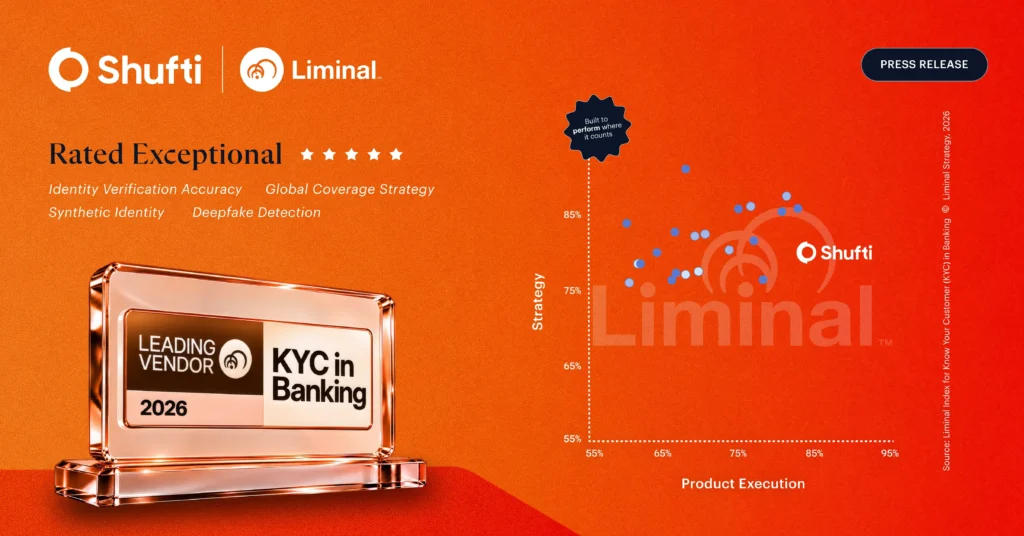
- Recognised as a Leader in Liminal’s 2026 Age Verification and Liminal’s 2026 Age Estimation Index
- Full-stack ownership: OCR, liveness, document intelligence, and AML built in-house, not assembled from third-party components
See how Shufti’s identity verification platform performs on your documents and your use case. Book a 20-minute demo.
Frequently Asked Questions
What criteria does G2 use to name a Leader in identity verification?
G2 places products in the Leader quadrant based on two scores: Satisfaction (derived from verified user reviews covering ease of use, support quality, and recommendation intent) and Market Presence (derived from review volume, web presence, and third-party signals). Both must score high simultaneously.
What badges did Shufti earn in the G2 Summer 2026 reports?
Shufti earned five badges: Leader in the Identity Verification Grid, Asia Regional Leader, Asia-Pacific Regional Leader, Leader in the Momentum Grid Report for Identity Verification, and Leader in the AML Grid Report. Regional badges use the same G2 methodology applied to geographically scoped reviewer cohorts.
How do G2's user review scores differ from analyst-assigned ratings?
G2 scores are built entirely from verified user reviews and publicly available market data: no analyst opinion, no vendor briefings, no sponsored placement. Satisfaction and Market Presence scores update quarterly based on new reviews. Analyst ratings, by contrast, are typically based on vendor interviews, reference calls, and a proprietary framework, updated annually or less frequently.