AMLR Solutions
  AMLR Consultation
 EUDI Wallet
 Onboarding
 Ongoing Monitoring
 FRAML
FRAML KYC
KYC KYB
KYB KYI
KYI Age Assurance
 Workforce IAM
 Candidate Verification
 Account Takeover
 Bonus/ Promotion Abuse
 Chargeback Fraud
 Deepfake
 Document Fraud
 Fraud Networks
 Impersonation Fraud
 Money Mule Activity
 Multi-Accounting
 Party Fraud
 Regulatory & Compliance Risks
 Synthetic Identity Fraud
 Adult Content
 Banking
 Crypto
 Fintech
 Forex
Forex Compliance
 Fraud prevention
 Trust & safety
 Global expansion
 Compliance Officers
 Developers
 Fraud Analysts
 Product Managers
 Journey Builder
  Global Trust Platform
 Customer Profiles
 Vendor Comparison
 IDV Case Management
 AML Case Management
 Regulatory Reporting
 Agentic Rule Builder
  AI Compliance Co-Pilot
  Fraud Analytics
 Fraud Hub
  OCR
OCR Shufti AI
 Bank Account Verification
  Biometric Duplication
 Database Checks
 Document Intelligence
 Government ID
 Mobile Driver's License
 NFC
NFC Selfie Liveness
 Brand Personalisation
 Deployment Options
 Identity Methods
 IDV Modes
 Multi-tenancy
 On-Premise IDV
 Secure Capture
 Shufti MCP














In December 2019, the US Department of Justice sentenced Evaldas Rimasauskas to five years in prison after a business email compromise scheme caused two US internet companies to send more than $120 million to accounts he controlled. He had registered a Latvian company with the same name as a real Asian hardware manufacturer. Fraudulent emails then redirected payments, while forged invoices, contracts, and letters helped support the transfers.
The case shows why teams need to verify suppliers independently and confirm payment instructions through trusted channels, reinforcing their role in preventing fraud and building trust in the process.
What is vendor KYC, and what does it verify?
Vendor KYC verifies that a supplier is legally registered, owned by the claimed individuals, and safe to engage, helping teams feel assured of thorough due diligence before signing contracts or releasing payments.
Because companies change owners, sanctions lists update, and criminals can replace payment details, maintaining continuous oversight helps teams stay confident in the vendor record’s accuracy and security.
The comparison below shows how vendor KYC differs from customer KYC (Know Your Customer) and general KYB (Know Your Business).
| Dimension | Customer KYC | General KYB | Vendor KYC |
|---|---|---|---|
| Who is checked | An individual customer | A business counterparty | A supplier or service provider |
| Main purpose | Confirm who is using a service | Confirm a business and its ownership | Confirm a supplier and protect the payment path |
| Core checks | Identity, risk-based screening,g and monitoring | Registry, ownership, and risk-based screening | Registry, ownership, sanctions risk, and bank-account evidence |
| Key triggers | Onboarding and later risk events | Business onboarding and material changes | Set up, payment-detail changes, ownership changes, risk alerts, and reactivation |
| Risk reduced | Fraudulent or misused accounts | Shell or opaque counterparties | Payment fraud, sanctions exposure, and supplier disruption |
The direction of risk matters. Customer KYC protects access to your services, while vendor KYC also protects the money and sensitive access you give to suppliers. As a result, bank account checks and change controls are central to a vendor program.
Why vendor KYC matters for procurement and compliance teams
Third-party risk reaches beyond invoice fraud. Verizon’s 2026 Data Breach Investigations Report found that third parties were involved in 48% of breaches in its dataset, a 60% increase over the previous year. Vendor KYC cannot test a supplier’s cyber controls, so it should sit within a broader third-party risk program. It does, however, help ensure that you assess the correct legal entity and owners before granting access.
Meanwhile, the Association for Financial Professionals reported in its 2026 Payments Fraud and Control Survey that 76% of organizations experienced attempted or actual payments fraud in 2025. The survey also highlights concerns about the impersonation of executives, vendors, and other trusted parties through voice and video. Therefore, a bank detail change should never be approved only because the request looks or sounds convincing.
Company data is also becoming more reliable in some markets. From 18 November 2025, Companies House introduced compulsory identity verification for new UK directors and people with significant control, while existing individuals are being phased in according to their due dates during a 12-month transition. A missed applicable deadline should trigger review, although it is not proof of fraud by itself.
How does the vendor KYC verification process work?
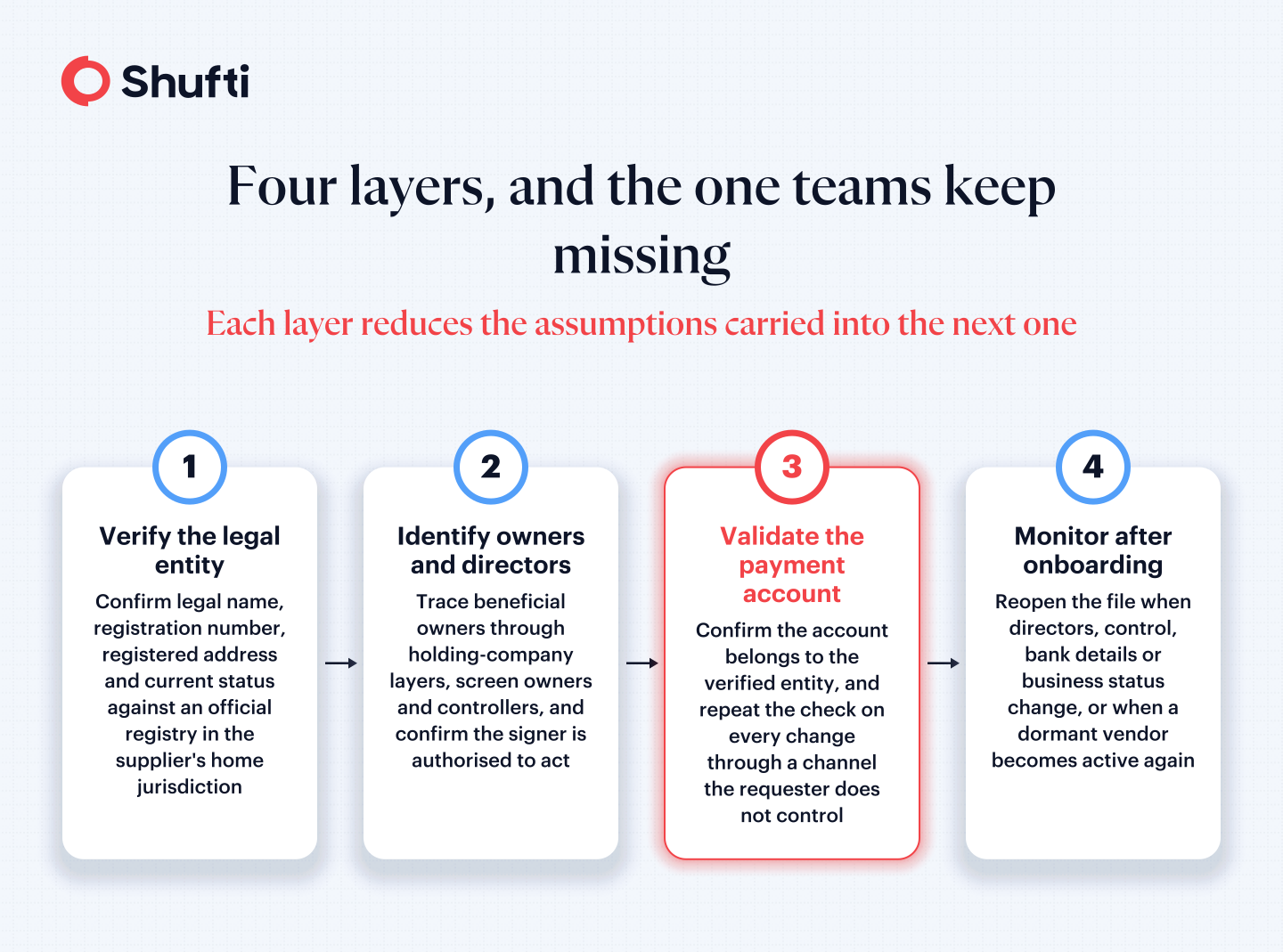
A practical vendor KYC process has four connected layers. This is an operating framework, not a universal legal standard. First, verify the entity, then identify the people behind it, confirm where payments will go, and keep the record up to date. Each layer reduces the assumptions carried into the next one.
1. Verify the legal entity
Start with an official company registry or authoritative source in the supplier’s home jurisdiction. Confirm the legal name, registration number, registered address, and current status. If discrepancies arise between these details and your records, pause onboarding, document the differences, and escalate for further verification before proceeding.
2. Identify the owners, directors, and authorized representatives
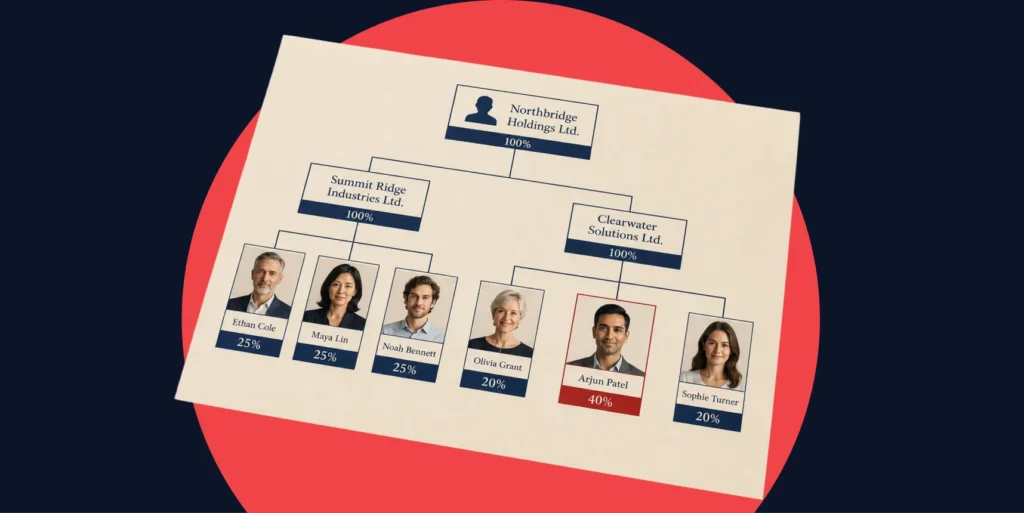
A registry match proves that the company exists, but it does not explain every ownership or control risk. Identify the ultimate beneficial owners through any holding-company layers and apply the threshold required by the relevant jurisdiction or your policy. In higher-risk cases, verify the individual as well as the company, and confirm that the person signing the contract is authorized to act on behalf of the company.
Screen relevant owners, directors, and controllers against sanctions, politically exposed persons (PEP), and adverse media screening sources according to your risk policy. However, a PEP match is not an automatic reason to reject a supplier. It is a risk indicator that may require more information, senior approval, or enhanced monitoring.
3. Validate the payment account and every change request
Confirm that the payment account belongs to the verified legal entity where account-name matching or reliable bank evidence is available. More importantly, repeat the check when bank details change. Validate the request through a channel the requester does not control, such as a known phone number from the original contract, and require a second approval before changing the vendor master record.
4. Regular reviews help maintain accurate records and reduce the risk of fraud or compliance breaches
Verification becomes less reliable as the supplier changes. Monitor relevant sanctions and ownership events, and reopen the file when directors, control, bank details, or business status change. Reviews can also be triggered when a dormant vendor becomes active again. The review frequency should reflect the supplier’s risk, applicable law, and your policy rather than a single calendar rule for every vendor.
Where vendor KYC programs commonly fail
The vendor is verified once and never reviewed again
A clean onboarding result is only accurate for that point in time. Without trigger-based reviews, ownership or sanctions changes can remain hidden until the next scheduled refresh. Therefore, define the events that automatically reopen a supplier file before the vendor is approved.
Documents are collected without checking the source
A certificate of incorporation can be genuine, altered, or simply unrelated to the company requesting payment. Where possible, compare submitted documents with an official registry and record which source supported the decision. This gives reviewers evidence, not just a folder of PDFs.
Bank details are treated as ordinary admin data
Changing a payment account can shift the risk from a verified supplier to a criminal in a single email. Separate bank detail changes from routine profile updates, use independent confirmation, and keep an approval log. This control protects the payment path even when the supplier itself is legitimate.
Every supplier receives the same checks
Heavy checks on low-value, low-risk suppliers create delays and manual work without improving the most important decisions. Meanwhile, a light check can miss the risk in a high-spend or cross-border relationship. Risk tiers help teams apply more evidence and monitoring where the potential loss is higher.
Procurement, compliance,e and finance use different records
A supplier can pass compliance while finance pays a different account if the teams do not share the same record. One vendor profile should show the verified entity, owners, risk decision, bank evidence, approvals, and review triggers. This gives every team the same facts before a contract or payment is released.
Vendor KYC checklist: documents and evidence to collect
The exact evidence depends on the supplier’s country, sector, ownership, and risk. Collect baseline information in a single request to reduce friction, then request additional evidence only when the risk or law requires it.
Business registration evidence: Use a recent official registry extract or certificate that shows the legal name, registration number, status, and registered address.
Tax identification: Collect the relevant VAT, GST, employer, or national tax number and compare it with the jurisdiction and invoice details.
Ownership and control information: Request a UBO declaration and an ownership chart for layered structures. Where required by risk or rules, verify the identities of the relevant owners and controllers.
Authority to act: Confirm that the person signing the contract or changing payment details can act on behalf of the supplier. This may require a board resolution, power of attorney, or another reliable record.
Bank-account evidence: Use a bank letter, account-name match, or equivalent evidence in the legal entity’s name, then validate it independently before the first payment and after any change.
Licenses and accreditations: Confirm any sector permissions the supplier needs, such as a transport, food, healthcare, or financial services license, directly with the issuing authority where possible.
Insurance and financial standing: For material contracts, collect appropriate insurance evidence and financial information that supports the supplier’s ability to deliver.
Screening and review record: Keep the sanctions, politically exposed persons, and adverse-media results used for the decision, together with the reviewer, date, outcome, and next trigger or review point.
Procurement usually opens the vendor file, while compliance and finance contribute risk and payment controls. The process works best when all three teams use a single record and a single trigger list. Otherwise, important evidence gets trapped in emails, and the supplier can change between departmental hand-offs.
Is vendor KYC mandatory for every business?
No single universal law requires every organization to run the same vendor KYC process. Duties vary by country, sector, and relationship. Sanctions rules, anti-bribery controls, regulated outsourcing requirements, public procurement rules, and contract terms may all require some form of supplier due diligence. However, customer due diligence rules do not automatically impose identical KYC requirements on every supplier.
Therefore, map the laws, regulatory guidance, and contract terms that apply to your organization, and obtain legal advice where the position is unclear. Then use a proportionate policy. Low-risk domestic suppliers may need basic entity and payment checks, while high-value, cross-border, regulated, or unusually structured suppliers may need full ownership verification, screening, and ongoing monitoring.
How Shufti supports vendor KYC and ongoing supplier checks
Manually checking thousands of suppliers across several jurisdictions can create slow onboarding and inconsistent evidence. Shufti’s business verification service helps teams confirm companies against official registries, identify directors and beneficial owners, map ownership chains, and apply jurisdiction-specific ownership thresholds. Registry data, documents, and UBO outcomes can then be consolidated into one audit-ready company report.
Shufti’s database covers more than 300 million companies, and it actively processes 240+ regions. Coverage and match quality still vary by registry and jurisdiction, so document-led fallbacks and human review remain important when authoritative data is limited. Teams can also connect business verification with AML screening and ongoing monitoring to keep higher-risk supplier records up to date.
Frequently Asked Questions
How is vendor KYC different from KYB?
Vendor KYC is a supplier-focused use case of KYB. Both can verify the company, ownership, and relevant risk indicators. However, vendor KYC also connects those checks to procurement and payment controls, including authority to act, bank account evidence, and change-request validation.
What does Know Your Vendor (KYV) mean?
Know Your Vendor, or KYV, is another name for supplier due diligence or vendor KYC. Some organizations use KYV for the wider relationship, including security, performance, and resilience reviews. Vendor KYC typically refers to identity, ownership, screening, and payment-related checks.
How often should vendor KYC be renewed?
There is no single renewal period for every supplier. Review vendors when material events occur, including changes in ownership or directorship, changes to bank details, sanctions alerts, status changes, and the reactivation of a dormant record. High-risk suppliers may also need scheduled reviews, often annually when policy or regulation requires it, while lower-risk suppliers may be reviewed less often.
Can vendor KYC verification be automated?
Much of it can. Registry searches, ownership mapping, sanctions screening, data comparison, and monitoring can be automated. However, people should review unresolved ownership chains, weak source data, potential matches, and unusual payment changes. Automation should speed up clear cases and direct attention to exceptions, not remove judgment from difficult decisions.