


 Face Verification
 Address Verification
 Document Verification
 Age Verification
 VideoIdent
 Fast ID
 Docless Verification
 Consent Verification
 NFC Verification
 Business Verification
 Due Diligence
 Investor Verification
 E-Signature

 QES
QES
 AML Screening
 Transaction Monitoring
 Adverse Media
 Business AML Screening
 PEP & RCA
 Sanctions
 Watchlist
 Behavioural Biometrics
 Device Fingerprinting
 Biometric Face Authentication
 MFA
MFA
 Fraud Hub
 Onboarding
 Ongoing Monitoring
 KYC
KYC
 KYB
KYB
 KYI
KYI
 Age Assurance
 Identity Verification
 Workforce IAM
 Candidate Verification
 Compliance
 Fraud prevention
 Trust & safety
 Global expansion
 Product Managers
 Compliance Officers
 Fraud Analysts
 Developers
 Deepfake Detection
 Bonus Abuse / Promotion Abuse
 Account Takeover
 Synthetic Identity Fraud
 Document Fraud
 Impersonation Fraud
 Multi-Accounting
 Fraud Networks
 Chargeback Fraud
 Money Mule Activity
 Party Fraud
 Regulatory & Compliance Risks
 Fintech
 Crypto
 iGaming
 Forex
Forex
 Social Network
 Marketplace
 Banking
 Gig Economy
 Payments
 Ride Hailing
 Adult Content
 Blind Spot Audit
 Deepfake Detector
 Liveness Spoofs
 Document Originality
 Document Deepfake
 Global Trust Platform
 Journey Builder
 Case Management
 Shufti AI
 Fraud Analytics
 Vendor Comparison
 Brand Personalisation
 AI Compliance Co-Pilot
 OCR
OCR
 Secure Capture
 Deployment Options
 Identity Methods
 API Documentation
 Mobile SDKs
 Service Status
 Help Center
 Contact Us
 Technical Support
 Supported Documents
 Supported Countries

 Content library
 Blogs
Blogs
 News
News
 Reports
 Insights
 Knowledgebase
 ROI calculator
 About
About
 Career
 Press Release
 Certifications
 Partnership
 Awards
 Events & Webinar
 Interactive Demo
 Podcast Studio
 Spotlight Studio
5 Identity Verification Challenges and How to Address Each One

TL;DR
|
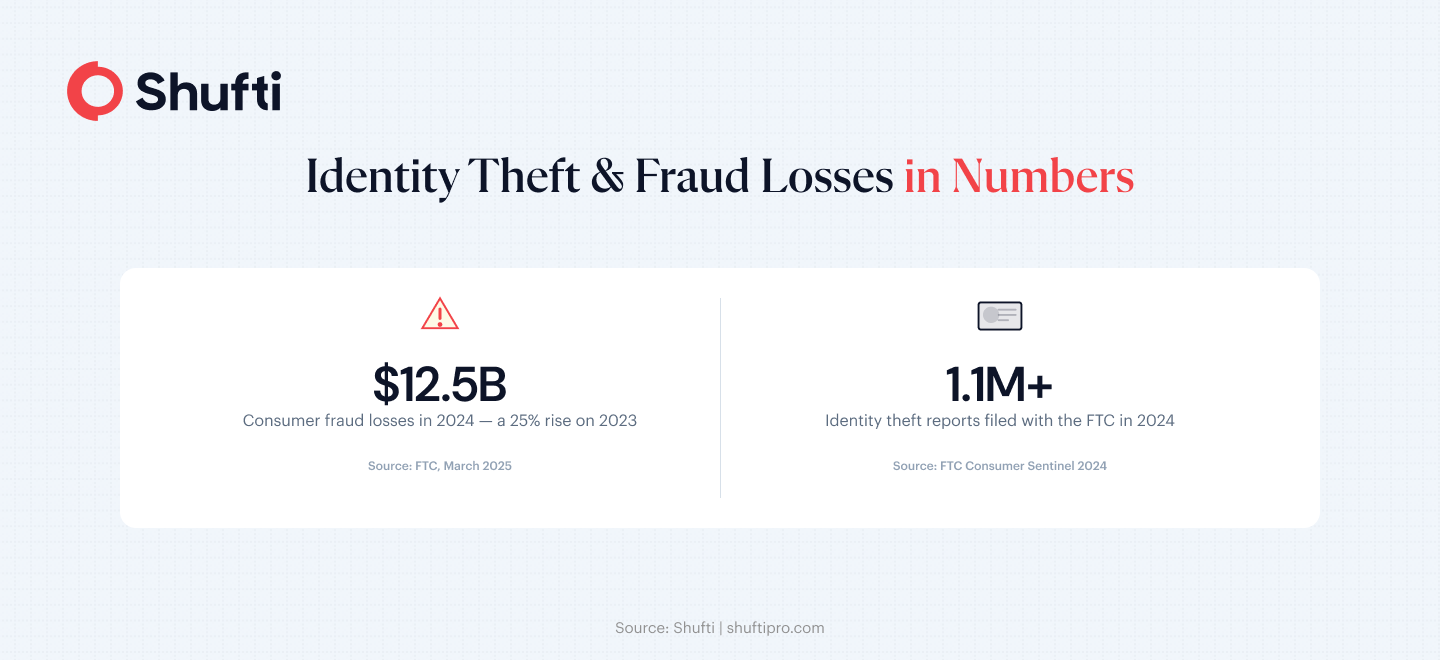
The FTC recorded more than 1.1 million identity theft reports in 2024, and total fraud losses for the year reached $12.5 billion, a 25% rise on 2023. Both numbers reflect the same underlying problem. Verification systems are either too weak to catch sophisticated fraud, or too rigid to let legitimate customers through without abandoning the process. These five challenges explain where identity verification breaks down most often, and what each failure costs in practice.
1. Document fraud that outpaces standard detection
Forged documents have always been a problem, but the barrier to producing convincing fakes has dropped sharply. Generative AI tools now allow bad actors to create plausible ID replicas without specialist equipment, and dedicated editing software can produce documents that clear low-quality OCR scans without ever touching a printer. National ID cards attract the most targeting because they vary so much in format across issuing countries, which means verification systems frequently encounter document types they were not trained on.
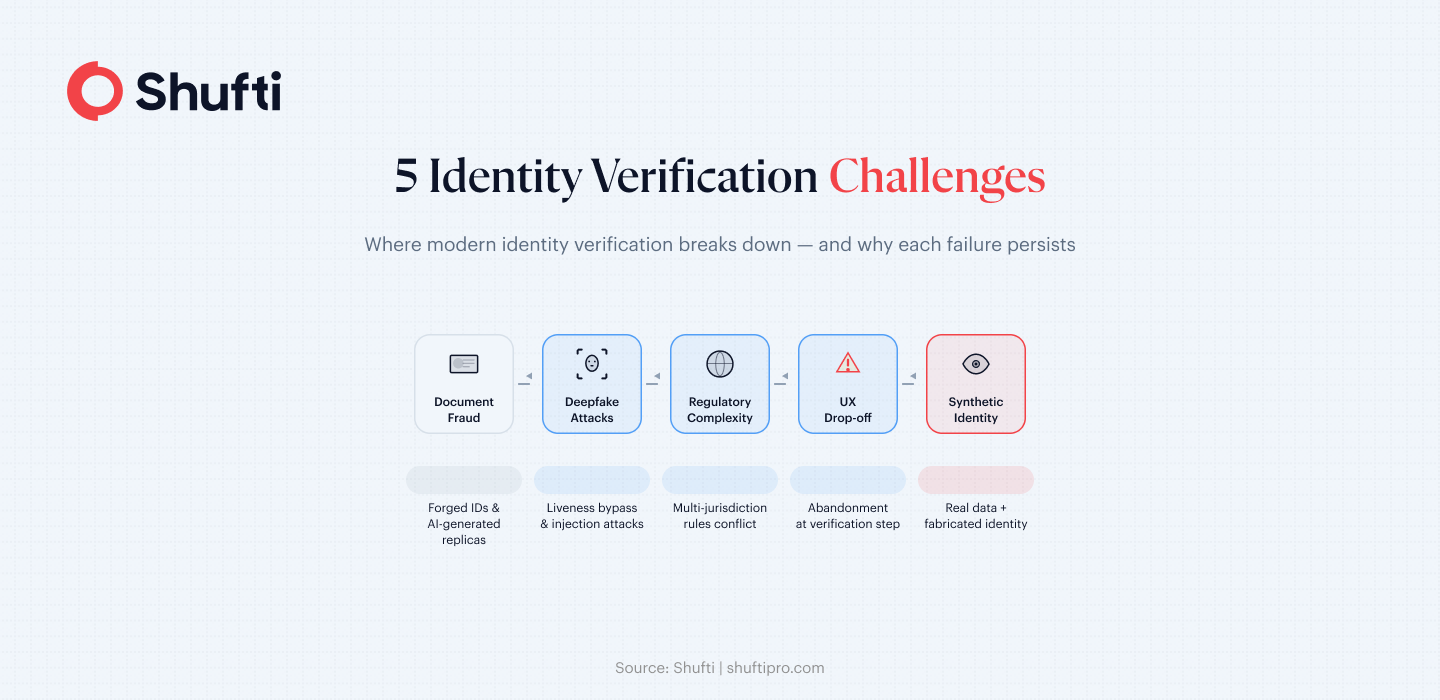
| Challenge | Why it breaks verification | What addresses it |
| Document fraud | AI-made fakes clear low-quality OCR; ID formats vary by country | Continuously updated document intelligence across formats |
| Deepfake / biometric spoofing | Deepfakes and injection attacks bypass older liveness checks | Continuous retraining on live attack data; injection monitoring |
| Regulatory fragmentation | Each market sets its own document, consent, retention rules | Real-time compliance monitoring; jurisdiction-specific flows |
| Onboarding friction | Extra steps and unclear errors cause customer drop-off | Auto-capture and clear user guidance |
| Synthetic identity fraud | Real ID number plus fake details returns partial matches | Ongoing behavioural monitoring across the lifecycle |
Businesses verifying customers across multiple markets face an additional layer of exposure. A passport from one country may carry embedded security features absent from a national ID issued the same year in a different jurisdiction. The KYC verification process that works for a domestic customer base frequently misses edge cases when applied globally, and covering thousands of document formats across hundreds of countries demands continuously updated document intelligence. Teams running static document models are operating on forensic data that fraudsters have already studied. For a closer look at where forgery techniques stand today, this guide on combating document forgery in 2025 maps the current attack surface in detail.
2. Deepfake and biometric spoofing attacks
Liveness detection was designed to block someone holding a printed photo in front of a camera. That threat still exists, but it has been surpassed by attacks that older systems were not built to handle. Deepfake video can now pass passive liveness checks that rely on motion cues or texture analysis, and injection attacks feed a synthetic video stream directly into the camera API, bypassing active liveness entirely. The FBI’s Internet Crime Complaint Center 2025 Annual Report recorded over 22,000 AI-assisted fraud complaints that year, with losses exceeding $893 million, and identity impersonation drove a large share of those cases.
The core problem for verification teams is model drift. A biometric layer deployed two years ago was calibrated to attack vectors of two years ago. Fraudsters update their tools faster than most vendors push patches, so a growing fraction of synthetic faces will clear detection models that have not been retrained against current spoofing techniques. Effective biometric verification needs continuous retraining against live attack data, not only against validation benchmarks, and the pipeline needs active monitoring for injection-style attacks that never physically engage a camera.
3. Regulatory fragmentation across markets
FATF’s guidance on digital identity recommends a risk-based approach to verification, but individual regulators interpret and apply that principle differently. A fintech operating across the EU, UK, Singapore, and UAE faces four distinct verification regimes, each with its own document requirements, biometric consent rules, and data retention limits. GDPR constrains how biometric data is stored and processed across EU member states. Singapore’s MAS guidelines define their own onboarding standards. The UAE’s CBUAE adds requirements specific to remote customer onboarding.
For businesses expanding internationally, the compliance overhead of adapting a verification workflow to each jurisdiction is real. A check sequence that satisfies one regulator may conflict with another’s rules, and manual tracking of these requirements creates audit risk because the rules change. Regulatory updates often give businesses 90 to 180 days to adapt, and those running rigid, internally-built verification stacks tend to be the last to respond. Compliance tools that monitor regulatory changes in real time, and verification platforms built to run jurisdiction-specific flows without code changes, are what separate businesses that adapt quickly from those that scramble through each transition.
4. Onboarding friction and customer drop-off
The verification step is where more new customers exit than at any other point in the onboarding flow. A process that requests more documents than necessary, times out on marginal image quality, or returns a generic rejection message without guidance leaves the user with no clear path forward. Most close the session and do not return.
Friction is not only about how many steps a process requires. It is also about what happens when something goes wrong. A user who photographs a slightly blurry ID and receives an unhelpful error may not realise they should retake it. Someone filling in a form with field labels that do not match the terminology on their documents may abandon before the document check even starts. Dedicated identity verification services reduce these failure points by bringing auto-capture technology and clear user guidance that most internally-built flows lack. A customer who exits at the verification step is one who completed interest and intent but never converted.
5. Synthetic identity fraud
Synthetic identity fraud sits at the hard end of the detection spectrum because the identity being verified contains real data. A synthetic identity combines a genuine national ID number or Social Security number with fabricated name, address, and date-of-birth details. Database cross-checks that would flag a wholly invented identity often return a partial match instead of a hard fail, and that ambiguity carries the synthetic identity through the onboarding check.
The problem compounds over time. Many synthetic identities are credit-built across months or years before any fraudulent transaction occurs. By the time they activate, they carry a history that looks legitimate. AI-powered KYC processes that monitor behavioural signals across the customer lifecycle, cross-reference document metadata against known synthetic patterns, and flag clusters of related identities provide a more durable detection layer than a single point-in-time onboarding check. Ongoing monitoring, not one-time verification, is what catches synthetic fraud before the losses accumulate.
| Document forgery evolves, deepfake tooling improves, synthetic identities pass point-in-time checks, and each new market adds compliance requirements your current stack may not handle. Shufti’s identity verification platform addresses all five failure points through a single API, with AI-powered document analysis across 10,000+ document types, proprietary liveness and deepfake detection, and real-time compliance mapping across 240+ countries. Request a demo to run your current onboarding scenario through the platform and see exactly where verification gaps are costing you customers. |
Frequently Asked Questions
What are the biggest identity verification challenges businesses face today?
Document forgery, deepfake spoofing, regulatory fragmentation, onboarding friction, and synthetic identity fraud are the five areas where verification processes break down most often, each requiring a distinct technical response.
What are the main reasons identity verification fails during customer onboarding?
The most common causes include poor image quality handling, document coverage gaps for cross-border customers, unclear error messaging that does not guide the user, and biometric systems that have not been updated against current spoofing methods.
Why is verifying customer identity online so difficult?
Online verification cannot rely on physical inspection, so it depends on document analysis, biometrics, and database cross-checks, all of which can be manipulated by fraud techniques the system was not trained to detect.
How does verification drop-off rate relate to identity verification challenges?
Every additional friction point, from unclear error messages to unsupported document formats, increases the likelihood that a legitimate customer abandons the process before completing onboarding, which directly reduces conversion rates.
What is the biggest challenge in remote identity verification?
Biometric spoofing and deepfake attacks are the hardest to defend against in a fully remote process, because there is no human reviewer to catch anomalies that automated liveness systems have not yet been trained to recognise.